Stairlifts for Small Business: ADA Compliance Guide
ADA Title III: What It Requires from Your Business
Title III applies to places of public accommodation — retail stores, restaurants, professional offices, banks, gyms, laundromats. Three obligation forms exist based on construction status:
The Elevator Exemption: When You Do Not Need One
Buildings with fewer than 3 stories OR fewer than 3,000 sq ft per story are exempt from the elevator requirement. This covers most two-story offices, retail shops with upstairs storage, and restaurants with second-floor dining.
Exceptions where elevators ARE required regardless of size: shopping centers/malls, healthcare provider offices, transportation terminals, and airport terminals.
Exemption from the elevator requirement does not eliminate the obligation to make services accessible. If essential services occupy the second floor, you must either relocate services or provide alternative vertical access.
Why a Stairlift Is NOT ADA-Compliant (and When It Still Works)
Residential-style stairlifts (seated chairlifts) are not permitted under ADA as an accessibility solution for places of public accommodation. ADA Standards require vertical access equipment that allows wheelchair users to ride in their wheelchair without transferring. Stairlifts require transfer to a separate seat. This prohibition applies universally.
When Stairlifts Still Make Sense
Scenario 1: Employee-only access. Second floor used exclusively by employees. A stairlift qualifies as "reasonable accommodation" under Title I (employment), which has different standards than Title III public access. Document the accommodation in writing.
Scenario 2: Supplement to compliant solution. You have already provided ADA-compliant access (ramp, platform lift, elevator). A stairlift serves additional convenience for ambulatory visitors with difficulty on stairs. Does not replace — only augments.
ADA-Compliant Alternatives: Platform Lifts and LULA Elevators
| Equipment | Cost Installed | Max Travel | ADA-Compliant | Best For |
|---|---|---|---|---|
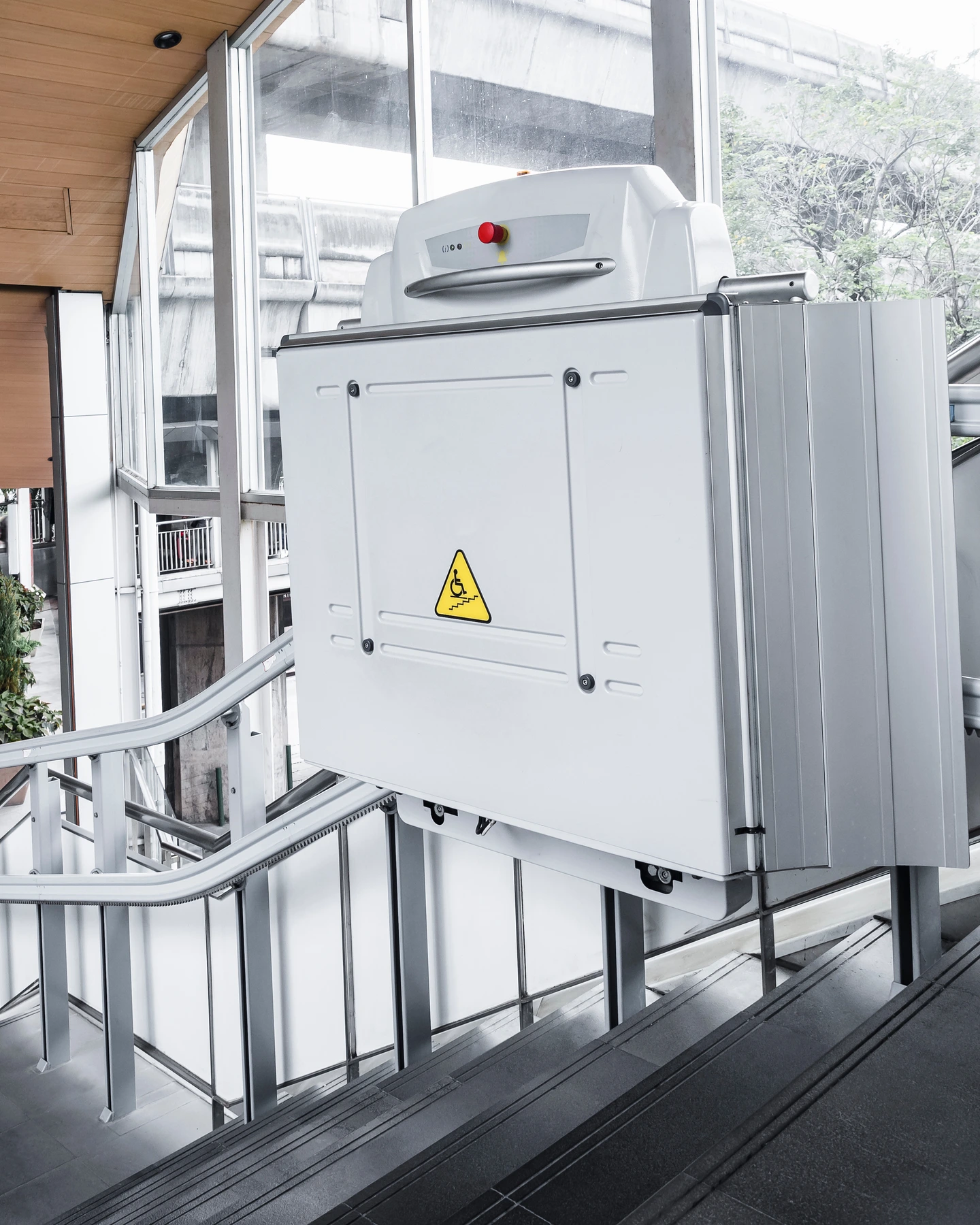
| Inclined platform lift | $8,000–$20,000 | Staircase length | Yes | Existing buildings, no shaft mod |
| Vertical platform lift (VPL) | $10,000–$25,000 | 14 ft | Yes | Single-floor transitions |
| LULA elevator | $25,000–$55,000 | 25 ft | Yes | Long-term, high-frequency use |
| Permanent ramp (1:12) | $100–$200/linear ft | 1–3 steps | Yes | Entrances, short transitions |
| Residential stairlift | $3,000–$5,000 | Staircase length | No | Employee accommodation only |
Commercial vs Residential Equipment
| Specification | Commercial-Grade | Residential |
|---|---|---|
| Duty cycle | 100+ trips/day | 8–20 trips/day |
| Controls | Key-call for unattended operation | Simple toggle/remote |
| Platform size | 30" x 48" minimum (ADA) | Seat-based, not platform |
| Weight capacity | 500–750 lb | 300–400 lb |
| Certification | ASME A18.1 required | Residential code only |
| Warranty | Parts + labor, 3–5 yr | Parts only, 1–5 yr |
Problems: duty-cycle burnout (residential motors fail under commercial use), building inspector rejection, and insurance liability denial on injury claims. Commercial equipment costs 2–3x more, but liability exposure from misuse dwarfs the cost difference.
Tax Credits and Deductions: Section 44 and Section 190
Section 44: Disabled Access Credit (IRS Form 8826)
- Businesses with $1M or less revenue OR 30 or fewer employees
- Covers 50% of eligible expenditures between $250–$10,250
- Maximum annual credit: $5,000 (non-refundable, carries forward)
Section 190: Architectural Barrier Removal Deduction
- Available to businesses of ANY size — no revenue or employee limits
- Up to $15,000/year above-the-line deduction
Using Both Together
$15,000 inclined platform lift installation:
- Claim Section 44 credit: $5,000
- Deduct remaining under Section 190: $10,000
- Effective out-of-pocket cost: $6,000–$8,000 (depending on tax bracket)
IRS requires reducing the Section 190 deduction by the Section 44 credit amount. Consult your accountant for precise calculations.
The 'Undue Burden' Defense
Readily Achievable Standard (Title III): Barrier removal required only when easily accomplishable without significant difficulty or expense. A $35,000 LULA elevator may not be readily achievable for a business netting $80,000 annually.
Alternative Access: If full barrier removal is not readily achievable, provide access through alternatives — relocate services to an accessible floor, offer curb service, provide delivery.
Documentation: Businesses determining modifications are not readily achievable should document the analysis. Documented good-faith analysis results in significantly lower penalties than providing no analysis at all.
Your Compliance Action Plan
- Step 1: Accessibility audit. Walk your building with the ADA Checklist for Existing Facilities (free resource from ADA.gov).
- Step 2: Determine applicable standard. New construction, alteration, existing building, or employee accommodation — each has different requirements.
- Step 3: Get equipment quotes. ADA-compliant options (platform lift, LULA) and employee-accommodation options (stairlift) where applicable.
- Step 4: Calculate tax benefits. Run Section 44 + Section 190 calculations with your accountant before purchasing.
- Step 5: Install and document. Keep purchase invoices, installer licenses, completion photos, ASME A18.1 certification, and building permits on file.
- Step 6: Maintain and inspect. ASME A18.1 requires annual platform lift inspection. Schedule through installer or third-party service.
Frequently Asked Questions
No. Residential-style seated stairlifts are not permitted under ADA for public access because they require wheelchair users to transfer from their chairs. ADA-compliant alternatives include inclined platform lifts, vertical platform lifts, LULA elevators, and ramps. Stairlifts may qualify as employee accommodations under Title I, but not for public access under Title III.
Up to $5,000 per year. Covers 50% of eligible access expenditures between $250 and $10,250. Available to small businesses with $1M or less revenue or 30 or fewer employees. Can be combined with Section 190 deduction on the same project, reducing effective cost by 40–60%.
Probably not. The ADA elevator exemption applies to buildings with fewer than 3 stories or fewer than 3,000 sq ft per story — unless you are a shopping center, healthcare provider, transportation terminal, or government facility. However, you must still make services accessible through alternative means.
Commercial equipment handles 100+ trips/day, carries ADA-dimensioned platforms (30x48" minimum), meets ASME A18.1 certification, and has higher weight capacities (500–750 lb). Residential stairlifts are seat-based, light-duty (8–20 trips/day), and not designed for public-access applications.
Yes. Section 190 allows businesses of any size to deduct up to $15,000/year for barrier removal. Small businesses can also claim the Section 44 credit for up to $5,000/year. Combined, they reduce effective cost by 40–60% depending on tax bracket.
Complaints evaluate whether barrier removal was readily achievable and whether alternatives were provided. Without assessment or documentation, legal position is weak — penalties include injunctive relief, compensatory damages, and attorney's fees. Documented good-faith analysis strengthens your position considerably.
Related Guides
Ready to Get Started?
Free in-home assessment within 24 hours. No pressure, no obligation.