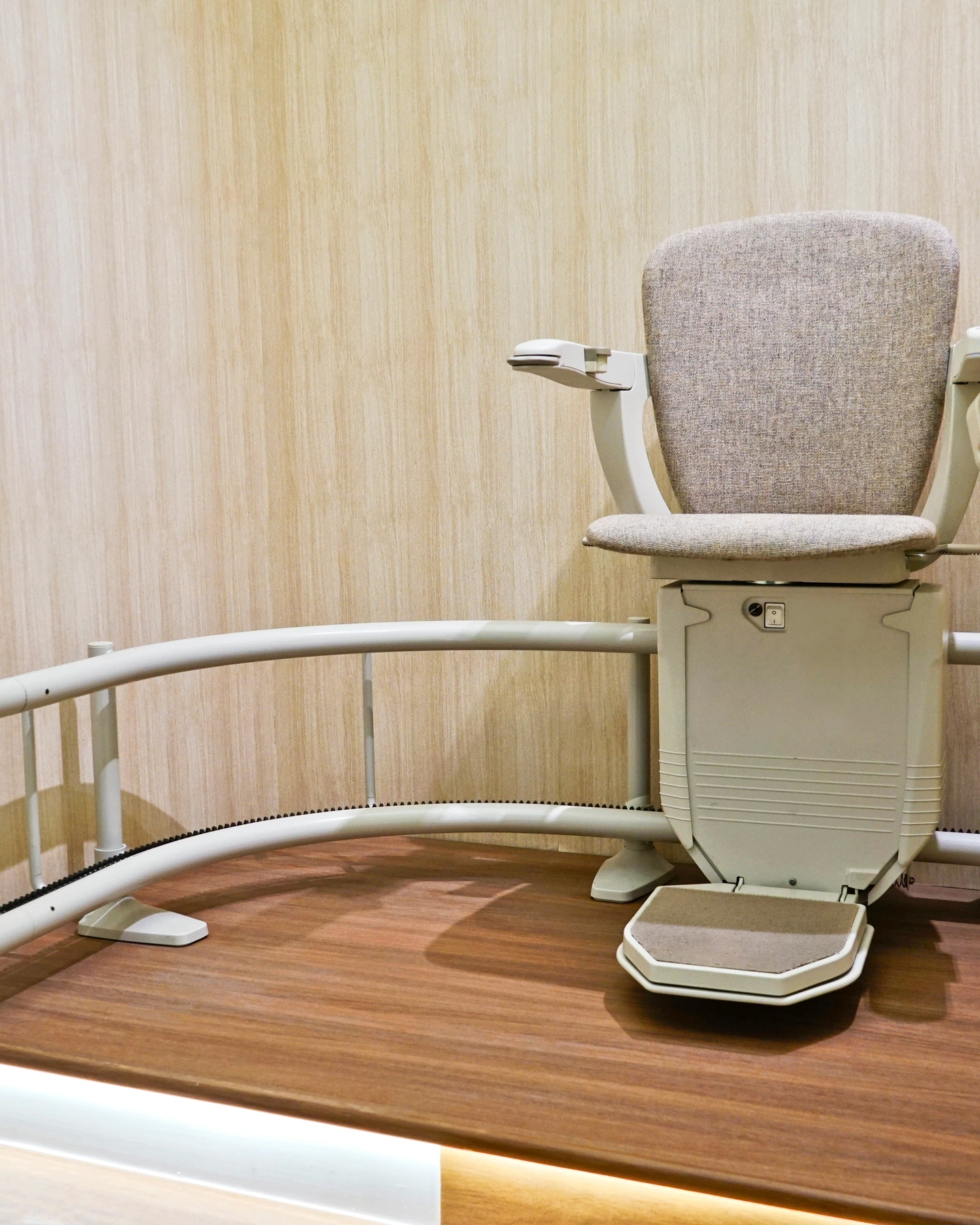
Curved Stairlifts: Custom Rails for Every Turn
If your staircase has a turn anywhere — a 90-degree bend at the top, an L-shape, a mid-flight landing, a spiral — you need a curved stairlift. Every curved rail is custom-fabricated from laser measurements of your specific staircase. There is no stock curved rail. That custom fabrication is what drives the cost, and it's also what makes a curved install ride like it was built into the house.
What makes a curved stairlift different from a straight one
A straight rail is stock steel cut to length on site. A curved rail is custom-manufactured in a factory from precise measurements of your staircase. The rail bends, twists, and angles to follow every turn. That fabrication accounts for about 60% of the total installed cost.
A curved stairlift uses the same basic components as a straight unit — DC battery motor, rack-and-pinion drive, swivel seat, safety sensors — but the rail is entirely different. Instead of a straight extrusion, the rail is a custom-bent steel or aluminum track that follows the exact geometry of your staircase: every turn radius, every angle change, every landing transition.
The rail is manufactured in a factory from a digital model of your staircase. We capture that model during the free in-home assessment using a combination of laser measurement and photogrammetry — a series of calibrated photographs that a software system stitches into a 3D model of your stair geometry. The factory uses that model to CNC-bend the rail sections, test-fit them on a jig, and ship them to us in labeled segments for on-site assembly.
This fabrication process is why curved stairlifts cost roughly triple what a straight unit costs. It's also why lead time is longer — typically 1 to 2 weeks from measurement to delivery, compared to same-day for a straight rail. And it's why you should never buy a curved stairlift from anyone who hasn't physically measured your staircase. Phone quotes and "send us a photo" estimates on curved rails are guesses, and guesses on custom fabrication lead to rails that don't fit.
The custom fabrication process: measurement to delivery
Step 1: In-home laser measurement (during your free assessment)
Our technician measures every tread, every riser height, every turn angle, the landing width, the ceiling clearance at the turn, and the distance from the wall to the opposite railing at every point along the flight. This takes 30–45 minutes for a single turn, up to 60 minutes for complex multi-turn staircases. We also photograph the staircase from multiple angles for the 3D modeling software.
Step 2: Digital modeling and rail design (1–3 days)
The measurements feed into the manufacturer's proprietary rail design software. Bruno uses their CRE Design System. Handicare uses the Freecurve configurator. Stannah uses their own platform. The software generates a 3D rail path and produces CNC bending instructions for the factory. We review the model with you — you'll see exactly where the rail runs, where the chair parks at top and bottom, and how much clearance remains for other people to walk the stairs.
Step 3: Factory fabrication (5–10 business days)
The rail sections are CNC-bent from steel tube or extruded aluminum, depending on the manufacturer and model. Each section is labeled with a position number. The factory test-fits the sections on a full-scale jig that replicates your stair geometry. If a section doesn't track cleanly, it's re-bent before shipping. The assembled rail ships in padded crates, typically via freight carrier.
Step 4: On-site installation (1 full day)
The labeled rail sections are assembled on your staircase in sequence, bolted to the treads with stainless lag bolts. The motor, carriage, and seat mount to the completed rail. The full safety test sequence runs. Rider training completes the day. Total on-site time: 6–8 hours for a single turn, 8–10 hours for complex multi-turn.
Schedule your free curved stairlift measurement — no cost, no obligation
Three configurations that cover 90% of curved installs
1. Single 90-degree turn at the top (most common)
The staircase runs straight up from the ground floor and makes a 90-degree turn at the top to meet a hallway or landing. The curved rail follows the turn, and the seat parks on the upper landing facing the hallway. This is the simplest and least expensive curved configuration — typically $9,000–$11,000 installed.
About 55% of our curved installs are this type. It's the standard layout in colonials, split-levels, and many townhomes built from the 1940s through the 1990s.
2. Mid-flight landing (L-shape or U-shape)
The staircase has a flat landing partway up, with the flight continuing at a 90-degree or 180-degree angle after the landing. The rail transitions from incline to flat across the landing, then back to incline. This requires more rail length and more complex bending — typically $12,000–$15,000 installed.
Common in Victorian homes, larger colonials, and some mid-century modern split-levels. The landing transition is the most mechanically demanding part of any curved install — the carriage has to smoothly decelerate, traverse the flat, and re-engage the incline without jerking. This is where cheap modular "curved" systems fail and where the name brands justify their premium.
3. Spiral staircase
A true spiral — a continuous helix with a center pole — is the most complex curved rail to fabricate. Every inch of rail has a compound curve (bending horizontally and twisting vertically simultaneously). Fabrication time is 2–3 weeks instead of 1–2. Installed price: $15,000+, sometimes north of $20,000 for a full spiral from basement to second floor.
Spiral installs are rare — about 5% of our curved work. Most spiral staircases are in older homes, lofts, or custom-built properties. If you have a spiral and need a stairlift, call us directly — this is specialist work, and we want to see the staircase before quoting.
Three models we install and recommend
Bruno Elite CRE-2110 — industry benchmark
The CRE-2110 is to curved stairlifts what the Elan is to straight — the standard against which everything else is measured. Bruno's curved rail system has the largest install base in North America, which means parts availability, technician familiarity, and service response times are the best in the curved category.
- Capacity: 400 lb
- Speed: 18 ft/min
- Drive: Rack-and-pinion, DC battery
- Rail: Twin-tube steel, CNC-bent to order, powder-coated
- Seat: 21-inch width, padded vinyl, powered swivel at top and bottom landings
- Warranty: 5-year parts, 2-year labor, lifetime rail
- Installed price: $9,500–$14,000 depending on configuration
Handicare Freecurve — tightest turn radius
The Freecurve system uses a single-tube rail with a smaller bend radius than any competitor. If your staircase has a very tight turn — common in older townhomes and Victorians where the stairwell is narrow — the Freecurve may be the only system that fits without structural modification.
- Capacity: 300 lb (standard) / 400 lb (heavy-duty option)
- Speed: 16 ft/min
- Drive: Worm gear, DC battery
- Rail: Single-tube steel, smallest footprint in class
- Seat: 20-inch width, powered swivel, 5 seat styles including a perch option
- Warranty: 5-year parts, 2-year labor, lifetime rail
- Installed price: $10,000–$15,000 depending on configuration
Stannah Siena 260 — premium, British-built
Stannah has been manufacturing stairlifts in the UK since 1975. The Siena 260 is their flagship curved model and arguably the quietest, smoothest curved stairlift on the market. It's a premium product at a premium price, and it shows in the ride quality and the fit-and-finish of the seat and armrests.
- Capacity: 300 lb
- Speed: 16 ft/min
- Drive: Worm gear, DC battery
- Rail: Twin-tube aluminum, CNC-bent, anodized finish
- Seat: 19.5-inch width, real leather option, powered everything (swivel, footrest, seat fold)
- Warranty: 5-year parts, 2-year labor, lifetime rail (10-year option available)
- Installed price: $12,000–$16,000 depending on configuration
The right curved model depends on your stair geometry, not your budget. A tight 1920s townhome stairwell may only fit the Handicare Freecurve. A wide colonial may be best served by the Bruno CRE-2110 for its service network. We recommend the model that fits — not the one with the highest margin. Schedule your free measurement.
Real pricing: $9,000–$15,000+ installed
Curved stairlift pricing is driven almost entirely by the rail. The seat, motor, and electronics are similar to straight models — the cost premium comes from custom fabrication. Here's how it breaks down by configuration:
Single 90-degree turn: $9,000–$11,000
The most common and least expensive curved install. One turn at the top or bottom of an otherwise-straight flight. Rail fabrication: 5–7 business days. On-site install: 6–8 hours.
Double turn / L-shape / U-shape: $12,000–$15,000
Two turns, or a landing transition. More rail length, more complex bending, longer fabrication. Rail fabrication: 7–10 business days. On-site install: 8–10 hours.
True spiral: $15,000–$22,000+
Continuous helical rail with compound curves. The most expensive and most time-consuming configuration. Rail fabrication: 2–3 weeks. On-site install: 1–2 full days.
What inflates a curved quote beyond these ranges
- Exceptionally long rail runs (20+ feet of curved rail). More steel, more bending, more bolting.
- Multi-story curved — first floor to third floor, or basement to second floor with turns on both levels.
- Structural issues — treads that can't hold lag bolts (rare but real in very old homes with softwood stringers).
- Outdoor curved — add the outdoor weather-sealing premium (10–25%) on top of the curved price. An outdoor curved install typically starts at $10,000 and can reach $18,000+.
Watch for this pricing game
If you're being quoted $18,000–$22,000 for a single-turn curved rail in a standard two-story home, you are being overcharged. We see this constantly from national chains that advertise on daytime television. Get a written second quote before you sign.
Install day: what to expect with a curved stairlift
A curved install is a full-day job on site — longer than a straight rail, but still a one-day affair for a single configuration. Here's the sequence.
Morning: rail assembly (3–4 hours)
The pre-fabricated rail sections arrive labeled with position numbers. The lead technician lays them out on the stair treads in sequence, verifies alignment against the digital model, and begins bolting them into the treads. Each section connects to the next with precision-machined joints. The full rail is level-checked and load-tested before any carriage work begins.
Afternoon: motor, carriage, seat, and testing (3–4 hours)
The motor and carriage mount to the completed rail. The seat assembly goes on. Electrical routing to the nearest outlet. Then the full safety test sequence — identical to a straight install, plus additional checks for smooth tracking through each turn. The carriage should glide through every curve without hesitation, binding, or speed change. If there's any inconsistency, the tech adjusts the rail joints on site.
Late afternoon: rider training and handoff
Same 15-minute hands-on training as a straight install. Three unassisted rides before we leave. Special emphasis on the swivel seat at the top landing — on a curved install, the seat parks on the landing and swivels so the rider dismounts facing away from the stairs. This is the most important safety feature on a curved unit.
Total time on site: 6–10 hours depending on complexity. You ride the lift the same day.
Can I use two straight rails instead of one curved rail?
This question comes up on every third curved consultation. The thinking: "My staircase has a flat landing in the middle. Can we put a straight rail on the bottom flight, a straight rail on the top flight, and transfer at the landing?"
Technically, yes. Practically, it's almost always a bad idea. Here's why:
- Two transfers instead of zero. The rider has to dismount the lower lift at the landing, walk or be assisted across the landing, and mount the upper lift. If the rider has the mobility to do that safely, they may not need the upper lift at all. If they don't have that mobility, the two-rail solution fails at exactly the point where it's needed most.
- Cost savings are smaller than you think. Two straight rails installed: roughly $5,000–$9,000 total. A single curved rail through the same staircase: $9,000–$13,000. The savings are $2,000–$4,000 — real money, but you're paying it in daily inconvenience and a safety compromise at the landing transfer for the life of the equipment.
- Resale value is lower. A two-rail setup is harder to resell because it only fits a staircase with the exact same landing geometry.
Our recommendation: if you can afford the curved rail, buy the curved rail. It's one ride, bottom to top, with zero transfers. That's the whole point of a stairlift — removing the problem, not repackaging it. If budget is the barrier, talk to us about funding options that can close the gap.
When a curved stairlift is the wrong answer
- Your staircase is actually straight. If the flight runs from bottom to top with no turns, no landings, and no curves, you do not need a curved rail. A straight stairlift will cost a third of the price and install the same day.
- The rise is under 3 feet. For a short rise with a turn — like a split-level entry where you go up 4 steps, turn, and go up 2 more — a curved stairlift may be overkill. A vertical platform lift or even a well-placed grab bar and ramp combination might solve the problem for less.
- The stairwell is structurally unsound. In very old homes (pre-1920), some stair stringers are softwood that won't hold lag bolts reliably. If our assessment finds structural issues, we'll recommend a carpenter before an installer.
- The home has an elevator shaft or dumbwaiter shaft. Some older homes have disused shaft spaces that can be converted to a residential elevator for $25,000–$40,000. If you're already looking at a $15,000+ curved install in a home with a shaft, the elevator may be the better long-term investment.
For a comprehensive comparison of all your options, read our curved stairlift guide.
Maintenance for curved rails
Curved rails need the same minimal maintenance as straight rails, plus one additional item: check the rail joints.
A curved rail is assembled from multiple CNC-bent sections joined on site. Over the first 6–12 months, the wood treads settle slightly under the rail's weight, and the rail joints can develop a barely perceptible gap or misalignment. This shows up as a very slight "bump" feeling as the carriage passes over a joint — not dangerous, not a malfunction, just a settling artifact.
We include a complimentary rail-joint check at the 6-month mark for every curved install. The technician tightens any joints that have settled and verifies smooth tracking through every turn. After the 6-month adjustment, most curved rails need nothing beyond the standard monthly maintenance (wipe the rail, check the charging light, run it once if unused).
For the full maintenance guide, see stairlift maintenance: what to do and what to skip.
Common questions
How much does a curved stairlift cost?
How long does a curved stairlift take to install?
Why are curved stairlifts so much more expensive than straight?
Can a curved stairlift handle a spiral staircase?
What if my staircase has a landing — do I need curved or two straight units?
How accurate does the measurement need to be?
Can a curved stairlift be removed without damaging the stairs?
Do you offer curved stairlifts for outdoor staircases?
What warranty comes with a curved stairlift?
Can I finance a curved stairlift?
Your free home assessment is one phone call away
No deposit. No obligation. No high-pressure sales. A certified installer visits your home, measures once, and gives you a written quote that's honored for 30 days. It takes about 45 minutes. More than 15,000+ homeowners have said yes over the last 15 years.
- Licensed in all 50 states
- $2M liability insured
- BBB A+ since 2012
- 15+ years in business