Stairlift Rail Types: Rack, Belt & Beltless Drives Explained
The Four Drive Types at a Glance
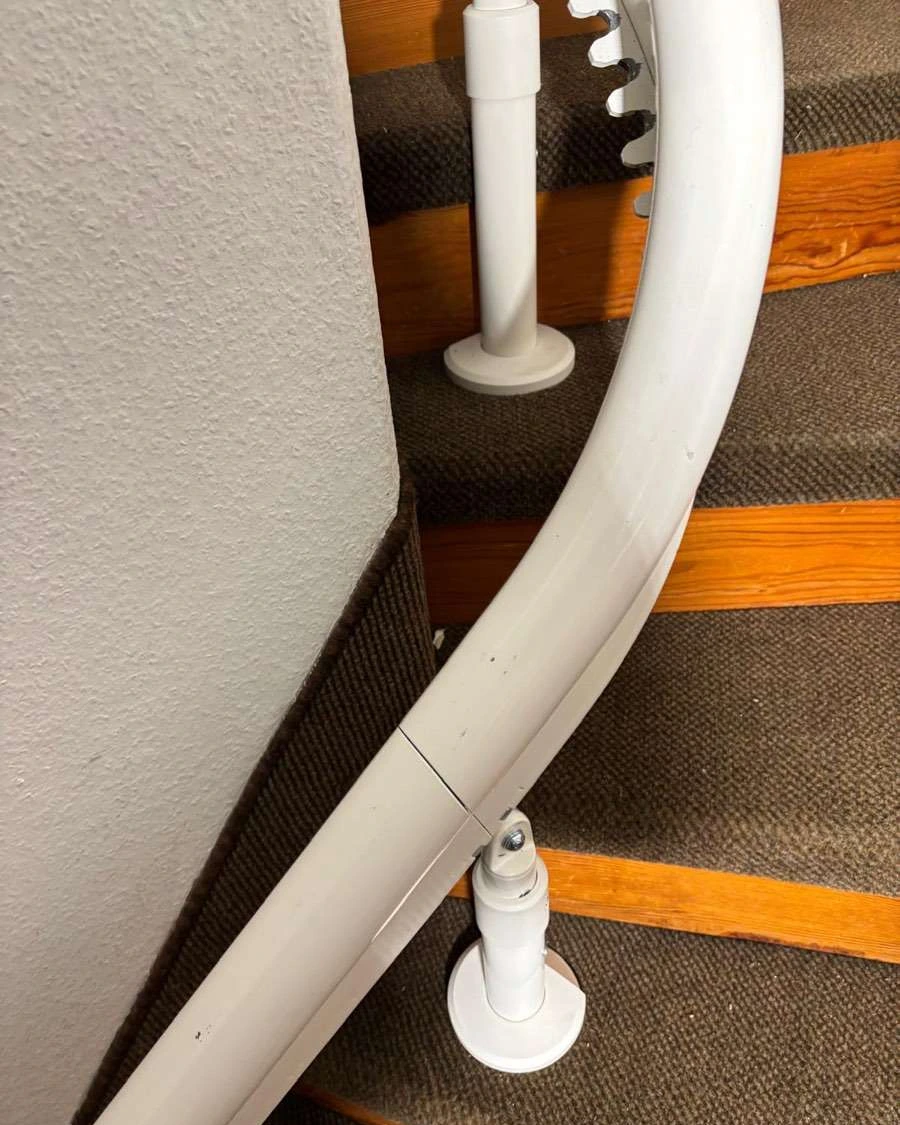
Rack-and-Pinion: The Industry Standard
A toothed gear (pinion) meshes with a toothed rail (rack). The pinion is typically a hardened steel gear with 12–20 teeth, 2–3 inches in diameter. Motor: 24V DC with planetary gearbox. Travel speed: 14–20 feet per minute.
Strengths
- Positive engagement: Teeth lock together mechanically. No slippage on steep inclines, in wet conditions, or under heavy loads.
- Sealed gearbox: Modern units use sealed planetary gearboxes requiring no user maintenance.
- Predictable wear: Pinion gear wears slowly over 15–25 years and can be replaced independently.
- Universal parts supply: Every parts supplier and service tech in the US has components in stock.
Weaknesses
- Noise: Metal teeth produce a low mechanical hum — typically 50–55 dB at the rider's ear.
- Rack maintenance outdoors: Teeth collect debris, road salt, corrosion. Outdoor units need periodic cleaning.
Cable Drive: The Budget Workhorse
A steel cable (typically 3/16" or 1/4" aircraft-grade braided steel) runs the full rail length. One end anchors at the top, the other at the bottom. The cable wraps around a motorized drum in the carriage.
Strengths
- Cost: Least expensive stairlifts on the market. AmeriGlide Rubex AC starts around $1,500–$2,200 for unit alone.
- Simplicity: Fewer moving parts than rack-and-pinion.
- Quieter at low speeds: Less mechanical noise — no metal-on-metal gear meshing.
Weaknesses
- Cable wear: Individual strands fray and break over 5–8 years. Replacement: $150–$300 plus labor.
- Slippage on steep inclines: On inclines above 40 degrees or with heavy riders, drum slippage is possible.
- Track lubrication: Cable-drive tracks need greasing twice a year.
Worm Gear Drive: The Old Guard
A helical screw (worm) meshes with a circular toothed wheel. Found in older Brooks, Minivator, and legacy Stannah units.
Strengths
- Self-locking: When the motor stops, the worm cannot be back-driven by gravity. The carriage stays put during power loss.
- Smooth and quiet: Teeth mesh at an angle, distributing load across multiple teeth simultaneously. 45–50 dB.
Weaknesses
- Efficiency: More energy lost to friction. Batteries drain faster.
- Lubrication: Requires regular lubrication every 6–12 months. Dried-out lubrication causes rapid wear.
- Parts availability: Components increasingly scarce as manufacturers shifted to rack-and-pinion.
Friction (Beltless) Drive: The Newcomer
A polyurethane or rubber drive wheel presses against a smooth rail surface. The Handicare 1100 is currently the only major residential stairlift on the US market using friction drive.
Strengths
- Quietest available: No metal-on-metal contact. 40–48 dB — the volume of a quiet library.
- Low maintenance: No rack teeth to clean, no cable to inspect, no gears to lubricate. Wipe rail with a cloth.
- Clean operation: No grease, no lubricant, no metal shavings. Runs dry.
Weaknesses
- Traction limit: Marginal in wet outdoor environments, steep inclines above 42 degrees, or near 300 lb capacity limits.
- Wheel replacement: Drive wheel needs replacement every 3–5 years ($30–$60 for wheel, $100–$150 for service).
- Single-brand availability: Only Handicare uses friction drive. Parts supply uncertain if discontinued.
Head-to-Head Comparison
| Feature | Rack & Pinion | Cable | Worm Gear | Friction |
|---|---|---|---|---|
| Noise level | 50–55 dB | 45–52 dB | 45–50 dB | 40–48 dB |
| Max incline | 50–52° | 40–45° | 50° | 42° |
| Max weight | 600 lb | 300 lb | 350 lb | 302 lb |
| User maintenance | Annual silicone | Biannual grease + cable check | 6–12 mo lubrication | Wipe rail |
| Drive life | 15–25 yr | 5–8 yr (cable) | 15–20 yr | 3–5 yr (wheel) |
| Self-locking | No | No | Yes | No |
| Outdoor suitable | Yes | Limited | No | No |
| US parts availability | Excellent | Good | Declining | Handicare only |
Which Brands Use Which Drive
| Brand | Models | Drive Type |
|---|---|---|
| Bruno | Elan SRE-3000, Elite SRE-2010, Outdoor SRE-2010E, CRE-2110 curved | Rack-and-pinion (all models) |
| Stannah | Siena 160, Siena 260, Starla 600 | Rack-and-pinion (pre-2010: worm gear) |
| Harmar | Pinnacle SL300, SL350, SL600HD | Rack-and-pinion (grease-free rack) |
| Handicare | 1000, 2000 curved | Rack-and-pinion |
| Handicare | 1100 | Friction drive |
| Acorn | 130, Superglide | Rack-and-pinion |
| AmeriGlide | Rubex AC, Rubex DC | Cable drive |
| AmeriGlide | Rave, Rave 2 | Rack-and-pinion |
If you buy from any of the five name brands (Bruno, Stannah, Harmar, Handicare, Acorn), you are getting rack-and-pinion unless you specifically choose the Handicare 1100.
Noise: Measured Decibels by Drive Type
Measured at the rider's ear during a standard-speed ride on a 13-step straight flight:
| Drive Type | Decibel Range | Equivalent |
|---|---|---|
| Friction (Handicare 1100) | 40–48 dB | Quiet library |
| Worm gear (legacy Stannah/Brooks) | 45–50 dB | Quiet room |
| Cable (AmeriGlide Rubex) | 45–52 dB | Quiet room to conversation |
| Rack-and-pinion (Bruno, Stannah, Harmar) | 50–55 dB | Quiet conversation |
Context: a normal refrigerator runs at 40–50 dB. A standard conversation at arm's length is 55–65 dB. Even the loudest stairlift drive (55 dB) is quieter than talking.
So Which One Is Best?
- Standard indoor use, any weight, best parts supply: Rack-and-pinion — the default for a reason.
- Noise-sensitive environments (bedroom wall, nighttime, light sleepers): Friction drive (Handicare 1100) — measurably quieter.
- Budget-constrained: Cable drive (AmeriGlide Rubex) — least expensive upfront, but factor in cable replacement at 5–8 years.
- Used/refurbished market: Worm gear units provide excellent, smooth, quiet rides — confirm parts availability first.
Maintenance Requirements by Drive Type
| Drive Type | User Maintenance | Frequency | Annual Cost |
|---|---|---|---|
| Rack-and-pinion | Dry silicone spray on rack surface | Annual, 5 min | $8 |
| Cable | Grease track + inspect cable for frayed strands | Biannual | $15 + inspection |
| Worm gear | Lubricate gearbox (service tech job) | Every 6–12 mo | $100–$200/service |
| Friction | Wipe rail with cloth | Periodically | $0 (wheel: $130–$210 every 3–5 yr) |
Frequently Asked Questions
Rack-and-pinion accounts for roughly 70% of residential stairlift installations in the US. It handles the widest range of inclines (up to 52 degrees) and weight capacities (up to 600 lb) with excellent long-term parts availability.
Friction drive (Handicare 1100) at 40–48 dB — about the volume of a quiet library. Rack-and-pinion measures 50–55 dB, still quieter than a normal conversation but audible through a shared wall.
Cable-drive stairlifts are safe when properly maintained. The cable is aircraft-grade braided steel rated for far more than the rider's weight. The concern is cable wear over 5–8 years. Annual cable inspection is required, not optional — if you see any broken strands, call for immediate replacement.
Depends on drive type. Rack-and-pinion: annual dry silicone spray (5 min). Cable: biannual greasing. Worm gear: semi-annual gearbox lubrication by a tech. Friction (Handicare 1100): no lubrication — just wipe the rail. Never use WD-40 on any stairlift rail.
Related Guides
Ready to Get Started?
Free in-home assessment within 24 hours. No pressure, no obligation.