Standing Stairlifts: Perch Models for Knee Issues
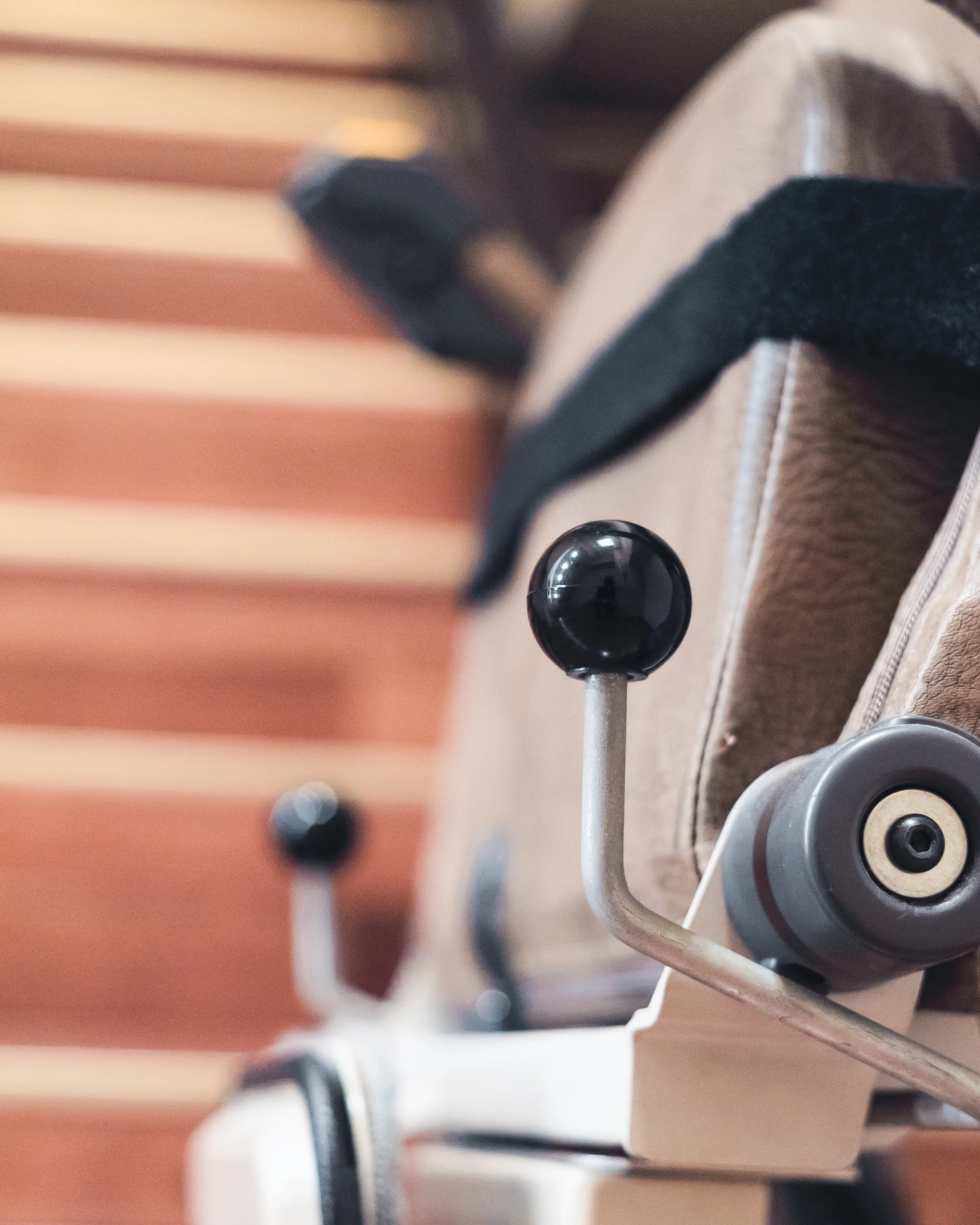
A standing stairlift (perch stairlift) replaces the seated chair with a padded saddle the rider leans against while standing. Built for people who physically cannot bend at the knee enough to sit. Same rail and motor as a seated model. $3,500-$6,000 installed. Requires reliable standing balance -- not safe for everyone.
What a Standing Stairlift Is
A standing stairlift uses the same rail system, rack-and-pinion drive motor, and DC battery power as a seated stairlift. The difference is above the carriage:
- Perch pad: Contoured, padded support at hip height. Rider leans back, legs remain straight or nearly straight. Tilted ~15 degrees backward.
- Standing platform: Flat foot platform, typically 14 x 18 inches, non-slip surface. Larger than a seated model's footrest.
- Handlebars or armrests: Waist-height handles for stability during the ride.
- Safety harness: Waist-level strap -- not optional on a standing stairlift. It's the primary containment.
Who It's For (and Who It's Not For)
Conditions That Commonly Require a Standing Stairlift
- Post knee-replacement recovery (early weeks): First 4-8 weeks, most patients can't flex past 60-70 degrees. A standing model bridges the gap. Many families rent for 2-3 months, then switch to seated.
- Severe knee arthritis (bone-on-bone): When the knee can't flex past 60-70 degrees without extreme pain.
- Leg bracing or casting: A rigid brace or full-leg cast physically prevents bending.
- Certain obesity presentations: Where seated position compresses the abdomen and restricts breathing.
The rider must have reliable standing balance for 30-60 seconds. If any of the following apply, a standing stairlift is not appropriate -- and we will not install one:
- Balance disorders -- vertigo, vestibular dysfunction, inner-ear conditions
- Parkinson's disease -- unpredictable freezing episodes and postural instability
- Post-stroke weakness -- hemiparesis or impaired postural control
- Severe peripheral neuropathy -- loss of sensation in feet
- Significant cognitive impairment -- dementia or confusion
- Lower-limb amputation -- requires two-foot weight bearing
If any of these apply and the rider also can't sit in a standard stairlift, the right answer is usually a wheelchair platform lift.
Two Models We Install
| Spec | Bruno SRE-1550 | Handicare Perch 1000 |
|---|---|---|
| Rail | Straight only (Elan rail) | Straight or curved (Freecurve) |
| Capacity | 300 lb | 300 lb |
| Speed | 20 ft/min | 16 ft/min |
| Perch Height | Adjustable, 28-33 in | Adjustable, 27-32 in |
| Platform Size | 14 x 18 in, non-slip | 13 x 17 in, non-slip |
| Harness | Retractable waist belt, buckle | Adjustable waist belt, clip |
| Warranty | 5-yr parts, 2-yr labor, lifetime rail | 5-yr parts, 2-yr labor, lifetime rail |
| Installed Price | $3,500-$5,000 | $3,800-$5,500 (straight) / $11,000-$16,000 (curved) |
The Handicare Perch 1000 on the Freecurve rail system is the only perch stairlift we know of that handles curved staircases. If your staircase turns and you can't sit, call us directly -- this is specialist work.
Real Pricing: $3,500-$6,000 Installed
Rental Option for Post-Surgery Recovery
If the standing stairlift is for post-surgical recovery (knee replacement, hip replacement), a rental may make more financial sense than a purchase. Typical rental: $250-$400/month for 2-3 months, with the option to convert to a standard seated model purchase at the end of recovery. We apply a portion of rental fees toward the seated unit purchase price.
How You Ride a Standing Stairlift
The ride takes 30-60 seconds on a typical 13-step flight -- about the same time you'd stand waiting for a microwave to finish.
When a Standing Stairlift Is the Wrong Answer
| Actual Problem | Better Solution |
|---|---|
| Can sit but has trouble getting in/out of seat | Seated stairlift with powered swivel seat and raised seat height |
| Can't stand OR sit reliably | Wheelchair platform lift -- no transfer needed |
| Narrow staircase | Slim-profile seated unit (perch doesn't save width) |
| Knee restriction is temporary (surgery recovery) | Rent a standing model 2-3 months, convert to seated purchase |
Alternatives to a Standing Stairlift
Frequently Asked Questions
A stairlift where the rider stands upright and leans against a padded perch instead of sitting. Feet bear weight on a platform, back leans into support, waist harness keeps rider secure. Same rail and motor as a seated stairlift.
People who cannot bend at the knee enough to sit -- post knee-replacement recovery (first 4-8 weeks), severe knee arthritis (bone-on-bone), rigid leg bracing, or certain obesity presentations. The rider must have reliable standing balance.
Straight: $3,500-$5,500 installed (~$500-$1,000 more than equivalent seated model). Curved: $11,000-$16,000. Short-term rentals for post-surgery: $250-$400/month. See our cost guide.
Yes, for the right rider. Waist harness, non-slip platform, and handlebars provide three security points. However, rider must have reliable standing balance. We will not install for riders with balance disorders, Parkinson's, post-stroke weakness, significant neuropathy, or cognitive impairment.
Yes. Short-term rentals at $250-$400/month, typically for 2-3 months post-surgery. If you transition to a seated stairlift purchase, we apply a portion of rental fees toward the purchase price.
Yes, but options are limited. The Handicare Perch 1000 on the Freecurve rail is the primary curved perch option. Installed: $11,000-$16,000. Contact us for a curved perch assessment -- this is specialist work.
30-60 seconds on a typical 13-step flight. Travels at 16-20 ft/min, same as seated. Rider maintains standing balance for that duration -- about the same as standing at a kitchen counter.
Standard standing models: 300 lb. Heavy-duty standing options are limited -- contact us if the rider weighs over 275 lb and needs a perch model. In some cases, a platform lift is the better solution for heavier riders who can't sit.
Ready to Get Started?
Free in-home assessment within 24 hours. No pressure, no obligation.