Heavy-Duty Stairlifts: 400 lb & 600 lb Models
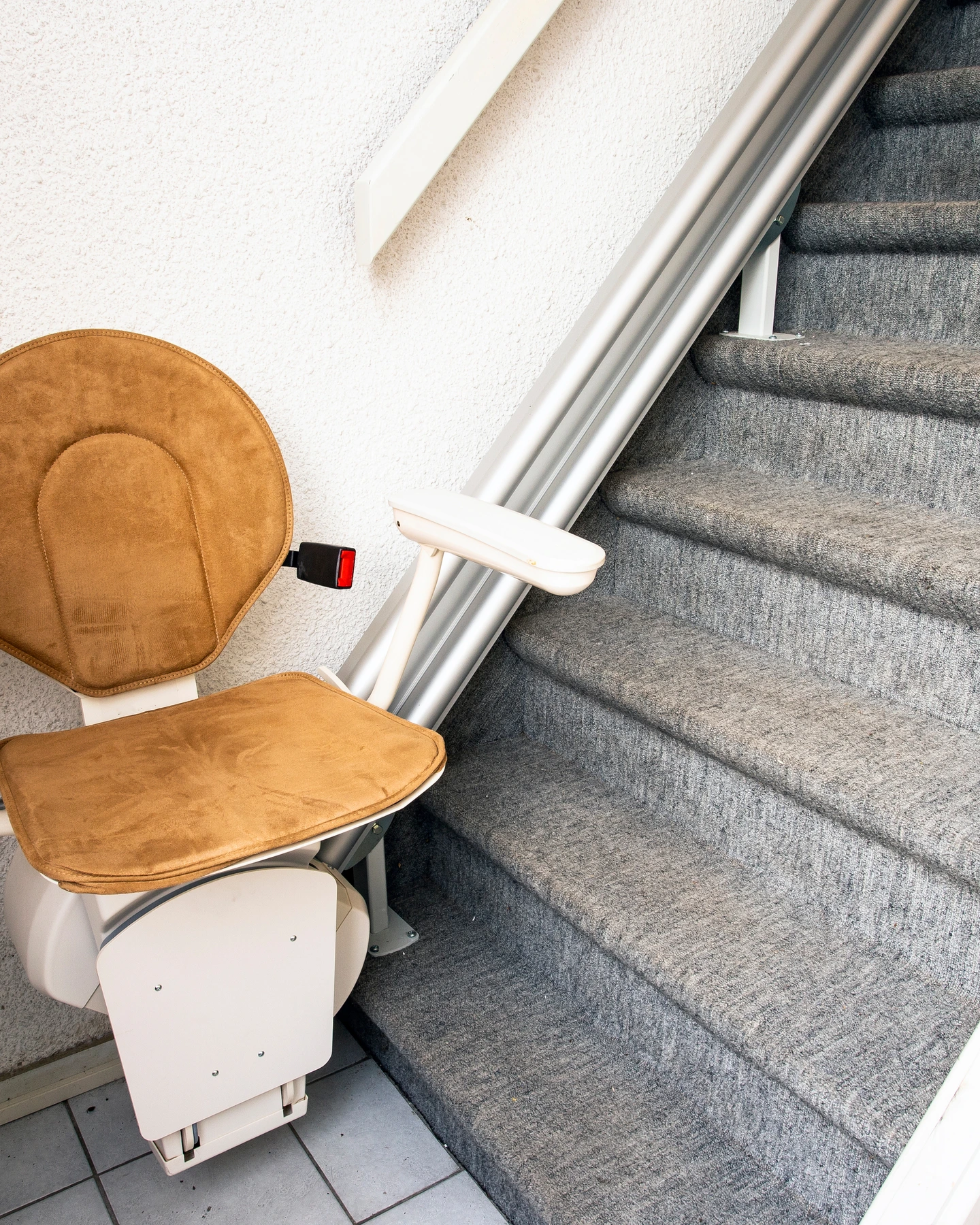
Standard stairlifts max out at 300 pounds. If you weigh more than that—or if you and your doctor agree you might in the future—you need a unit built for it. Heavy-duty stairlifts use reinforced rails, wider seats, and beefier drive systems to safely carry riders up to 600 pounds. They mount the same way as standard units, and most installs take under four hours.
I install heavy-duty units every week. The hardware is different, but the process is not. The rail bolts to your stairs, not the wall. The seat is wider. The motor is stronger. That is the entire difference. If your stairs can hold you walking up them, they can hold the lift.
Three Weight Tiers: Which One Fits?
Heavy-duty is not one category. Manufacturers build for three distinct weight ranges, and each tier uses different engineering. Picking the right tier matters—underbuy and the motor strains, overbuy and you spend more than you need to.
Model-by-Model Comparison
Three models dominate the heavy-duty market. Each has trade-offs worth understanding before you commit.
| Spec | Bruno Elite SRE-2010 | Harmar SL600HD | Handicare 950+ |
|---|---|---|---|
| Weight Capacity | 400 lbs | 600 lbs | 400 lbs |
| Seat Width | 22 in | 26 in | 23 in |
| Rail Type | Extruded aluminum, straight | Heavy-gauge steel, straight | Aluminum twin-tube, straight |
| Drive System | Rack & pinion, DC | Cable drum, DC | Rack & pinion, DC |
| Speed | 20 ft/min | 18 ft/min | 18 ft/min |
| Swivel Seat | Manual, 90° | Power, 90° | Manual, 90° |
| Folding Rail | Manual flip-up | Not available | Power fold (optional) |
| Warranty — Motor | 5 years | 3 years | 5 years |
| Warranty — Parts | 2 years | 2 years | 2 years |
| Installed Price (Straight) | From $5,050 | From $7,500 | From $5,200 |
| Best For | Reliability, resale value | Riders over 400 lbs | Budget-conscious, features |
Bruno Elite SRE-2010: The Industry Standard
Bruno Elite SRE-2010 — 400 lb Capacity
Why installers recommend it: Bruno is the brand we see the fewest service calls on. The SRE-2010 uses the same proven rack-and-pinion system as their standard models, scaled up for heavier loads. The extruded aluminum rail keeps weight down—important when you are bolting 20 feet of metal to wooden stair treads.
Pros:
- Highest resale value of any heavy-duty model
- Quiet operation—40 dB average
- Covered footrest prevents tripping
- Manual folding rail keeps the bottom of the staircase clear
- 5-year motor warranty, best in class at this tier
Cons:
- 400 lb limit—no option to go higher with this chassis
- Manual swivel only (no powered option)
- Seat padding thinner than competitors
- Straight rail only—no curved version available
Harmar SL600HD: When 400 lbs Is Not Enough
Harmar SL600HD — 600 lb Capacity
Why it exists: This is the only residential stairlift rated to 600 pounds. Harmar builds it on a commercial chassis with a heavy-gauge steel rail and cable-drum drive. It is a different class of machine—heavier, wider, slower, and significantly more expensive.
Pros:
- 600 lb capacity—nothing else comes close in residential
- 26-inch seat width, widest available
- Power swivel standard—important at this weight range
- Industrial motor handles repeated daily trips without overheating
- Steel rail will not flex under max load
Cons:
- Price: $7,500–$10,000+ installed
- Heavier rail requires additional stair reinforcement in some homes
- No folding rail option—bottom clearance can be an issue
- Louder than aluminum-rail competitors
- Shorter warranty than Bruno (3 years motor)
- Special order only—2–4 week lead time
Handicare 950+: Features on a Budget
Handicare 950+ — 400 lb Capacity
Why consider it: The 950+ hits the same 400-pound capacity as the Bruno at a slightly lower price point. Its twin-tube aluminum rail design distributes weight well, and it offers a power-fold rail option that neither competitor has.
Pros:
- Optional power-fold rail—clears the stairway bottom hands-free
- 23-inch seat, slightly wider than Bruno
- Thicker seat cushion for longer rides
- Competitive pricing: from $5,200 installed
- 5-year motor warranty matches Bruno
Cons:
- Twin-tube rail is slightly bulkier visually
- Fewer dealer networks than Bruno—parts can take longer
- No bariatric option if needs change
- Power fold adds $400–$600 to price
Does Your Staircase Need Reinforcement?
This is the question everyone asks, and the answer is usually no. Here is why: a stairlift rail bolts directly to the stair treads, not the wall. The load transfers straight down through the stringers to the floor structure. If your stairs hold you walking up them, they hold the lift in almost every case.
That said, there are situations where reinforcement is necessary:
- Prefab/floating stairs: Open-riser stairs without a center stringer may not support the concentrated point loads from rail brackets. A steel support plate under each bracket fixes this.
- Stairs over 25 years old: Older dimensional lumber (true 2x10 vs. modern 1.5x9.25) is actually stronger, but check for rot, especially in basements.
- Rider + unit over 700 lbs combined: The Harmar SL600HD weighs about 350 lbs itself. At max capacity, that is 950 lbs on 14–16 bracket points. Most stairs handle this fine, but we verify with a structural check during the home assessment.
- Cantilevered landings: If the stair meets a landing that extends beyond the wall below, the landing framing needs evaluation.
- Carpet over plywood subfloor: Not a structural issue, but we often need longer lag bolts to reach the tread beneath thick carpet and pad.
Our free home assessment includes a stair structure evaluation. We check tread thickness, stringer condition, and bracket point integrity before confirming the install plan. If reinforcement is needed, we handle it as part of the install—typically adding $200–$500 to the project.
Installation: What Changes with Heavy-Duty?
Honestly, not much. The process is the same as a standard stairlift. We measure, cut the rail to length on-site, bolt it to the treads, mount the carriage, wire the charging stations, and test. The differences are all in degree, not kind:
- Heavier rail: The SL600HD rail needs two installers to carry and position. Bruno and Handicare rails are manageable solo.
- Larger brackets: Heavy-duty brackets are wider and use 3/8" lag bolts instead of 5/16". More torque, same technique.
- Electrical: Identical. All three models run on standard 110V household current. A dedicated outlet at the top or bottom of the stair is preferred but not required—we can run a line if needed.
- Time: Standard install takes 2–3 hours. Heavy-duty adds 30–60 minutes for the heavier components. Budget half a day to be safe.
Cost Breakdown: What You Actually Pay
| Component | 350 lb Tier | 400 lb Tier | 600 lb Tier |
|---|---|---|---|
| Unit + Rail (Straight, 12–14 ft) | $2,800–$3,500 | $3,800–$5,000 | $6,000–$8,000 |
| Installation Labor | $400–$600 | $500–$700 | $700–$1,000 |
| Structural Reinforcement (if needed) | Rarely needed | $200–$500 | $300–$700 |
| Extended Warranty (optional) | $200–$400 | $300–$500 | $400–$600 |
| Total Installed Range | $3,200–$4,200 | $5,050–$6,500 | $7,500–$10,000+ |
Financing is available from $79/month. The VA HISA grant covers up to $6,800 toward a heavy-duty install for eligible veterans—enough to cover most 400-lb tier units completely.
How to Choose the Right Capacity
Do not buy for your exact weight. Buy for your weight plus a margin. Here is the rule of thumb I use after 15 years of installs:
Luis’s Sizing Rule
Take your current weight. Add 50 pounds. That is your minimum capacity. If your weight fluctuates or you carry anything on the lift (laundry basket, oxygen tank), add 75 pounds instead.
A 280-pound rider should look at 350-lb units minimum. A 340-pound rider needs a true 400-lb unit. And anyone over 380 should seriously consider the 600-lb Harmar—not because they need it today, but because they might in two years, and swapping lifts is expensive.
Also consider what you carry. An oxygen concentrator adds 15–20 pounds. A small bag of groceries adds 10. These seem minor, but they add up over thousands of trips.
Maintenance for Heavy-Duty Units
Heavy-duty stairlifts need the same maintenance as standard units, just on a slightly tighter schedule because the components work harder:
- Rail wipe-down: Monthly. Use a dry cloth to remove dust and lint from the rail. Do not use WD-40 or any lubricant—the drive gear is designed to run dry on aluminum rails.
- Battery check: Every 6 months. The lift charges at the top and bottom parking positions. If you notice slower travel speed, the batteries may be weakening. Replacements run $150–$250.
- Annual service: A technician checks drive gear wear, belt tension (on cable-drum models), safety sensors, and swivel mechanism. Runs $100–$175. Worth it—catching a worn gear early saves a $600 replacement later.
- Upholstery: Heavy-duty seats see more compression. Budget for a seat cushion replacement every 3–5 years ($75–$150) if you use the lift more than 6 times daily.
Heavy-Duty Stairlift FAQ
No. The rail mounts with lag bolts into the stair treads, the same way a standard lift does. The bolts are slightly larger (3/8" vs. 5/16"), but the holes are small and easily patched with wood filler if you ever remove the lift. The rail does not touch your walls.
The 350-lb tier has curved options from most manufacturers. At 400 lbs, curved options are limited—Handicare offers one, Bruno does not. At 600 lbs, the Harmar SL600HD is straight-only. If you have curved stairs and need 400+ lb capacity, we may recommend a vertical platform lift as an alternative.
Minimum 28 inches for the 350-lb tier, 30 inches for 400-lb models, and 32 inches for the Harmar SL600HD. The seat folds up when not in use, leaving about 12–14 inches of rail protrusion from the wall. Most residential staircases are 36–42 inches wide, which works for all three tiers.
Medicare does not cover stairlifts of any kind. Some Medicaid waiver programs do—it depends on your state. The VA HISA grant (up to $6,800) is the most reliable funding source. Some long-term care insurance policies cover home modifications including stairlifts. We provide the documentation needed for any of these claims.
All three models run on battery power with AC charging. During a power outage, the lift continues to operate on its internal batteries for approximately 10―15 round trips. The batteries recharge automatically when power returns. This is the same system standard lifts use—heavy-duty units just have larger battery packs.
No. Stairlifts are single-rider devices. The weight capacity is for one person plus anything they are carrying. Even the 600-lb Harmar is designed for one rider. This is a safety standard, not a suggestion.
With annual maintenance, expect 10–15 years from a quality heavy-duty unit. The Bruno SRE-2010 and Handicare 950+ both have long track records. The Harmar SL600HD is newer to the market but built on commercial components rated for higher cycle counts. Battery replacements every 3–5 years are the main recurring cost.
Different tools for different situations. A vertical platform lift (VPL) goes straight up, like a small elevator. It is better if you use a wheelchair and cannot transfer to a seat, or if your stairs are too narrow or curved for a heavy-duty rail. But VPLs cost $5,000–$15,000, require more structural work, and take up floor space at both levels. If you can sit in a stairlift seat, the stairlift is almost always the simpler, cheaper option.
Get Your Free Home Assessment
Most of my heavy-duty installs start with a phone call where someone says, 'I didn't think a stairlift could hold me.' It can. We just need to match the right unit to your stairs and your weight. The home assessment takes 45 minutes and costs nothing.
Every heavy-duty install starts with a free home assessment. We measure your stairs, evaluate the structure, discuss your needs, and recommend the right model and capacity. No sales pressure—just an honest recommendation from an installer who does this every day.
Ready to Get Started?
Free in-home assessment within 24 hours. No pressure, no obligation.