Stairlift for Spinal Cord Injury: SCI Mobility & VA Funding
SCI Classification: Neurological Level and ASIA Scale
Equipment selection for spinal cord injury depends on two variables: neurological level (where the spinal cord is injured) and completeness (how much function remains below the injury). Higher injuries affect more function. Cervical injuries (C1–C8) typically eliminate the trunk stability needed for transfers. Thoracic injuries below T10 and lumbar injuries often work well with stairlifts.
The American Spinal Injury Association (ASIA) scale ranges from A (complete, no function below injury) to E (normal function). This classification drives equipment recommendations and transfer capability assessment.
Equipment Recommendations by Injury Level
Stairlift Typically Appropriate
- Incomplete SCI (ASIA B–D) at any level with functional arm strength
- Complete SCI at T10 or below with good sitting balance
- Lumbar or sacral SCI with weight-bearing ability
- Ambulatory patients using cane or walker
Platform Lift Typically Needed
- Complete SCI at C1–C8 (tetraplegia)
- Complete SCI at T1–T9 with limited trunk control
- Full-time power wheelchair users
- Patients with unsafe transfers per PT/OT evaluation
The critical question is transfer ability: can the rider safely move from their wheelchair or standing position into the stairlift seat and back?
When Stairlifts Work for SCI
Four criteria must be met:
- Functional upper-body strength — arm and shoulder strength to grip armrests and lower into seat
- Adequate sitting balance — ability to sit upright with seatbelt for 30–90 seconds
- Safe transfer confirmed by PT/OT — professional observation and clearance required
- Manual wheelchair or ambulatory — independent parking, locking, and transfer capability
Platform Lift Alternatives
| Equipment | Cost Range | Max Rise | Best For |
|---|---|---|---|
| Vertical platform lift (VPL) | $6,000–$15,000 | 6 ft (residential) | Single-floor, beside stairway |
| Inclined platform lift (IPL) | $12,000–$25,000 | Staircase length | Wheelchair rolls on/off at each end |
| Home elevator | $30,000–$60,000 | Multi-story | Full multi-floor access, 8–16 week lead |
| Straight stairlift | $2,500–$5,500 | Staircase length | Transfer-capable SCI with PT clearance |
Transfer Considerations for SCI
Bottom Transfer
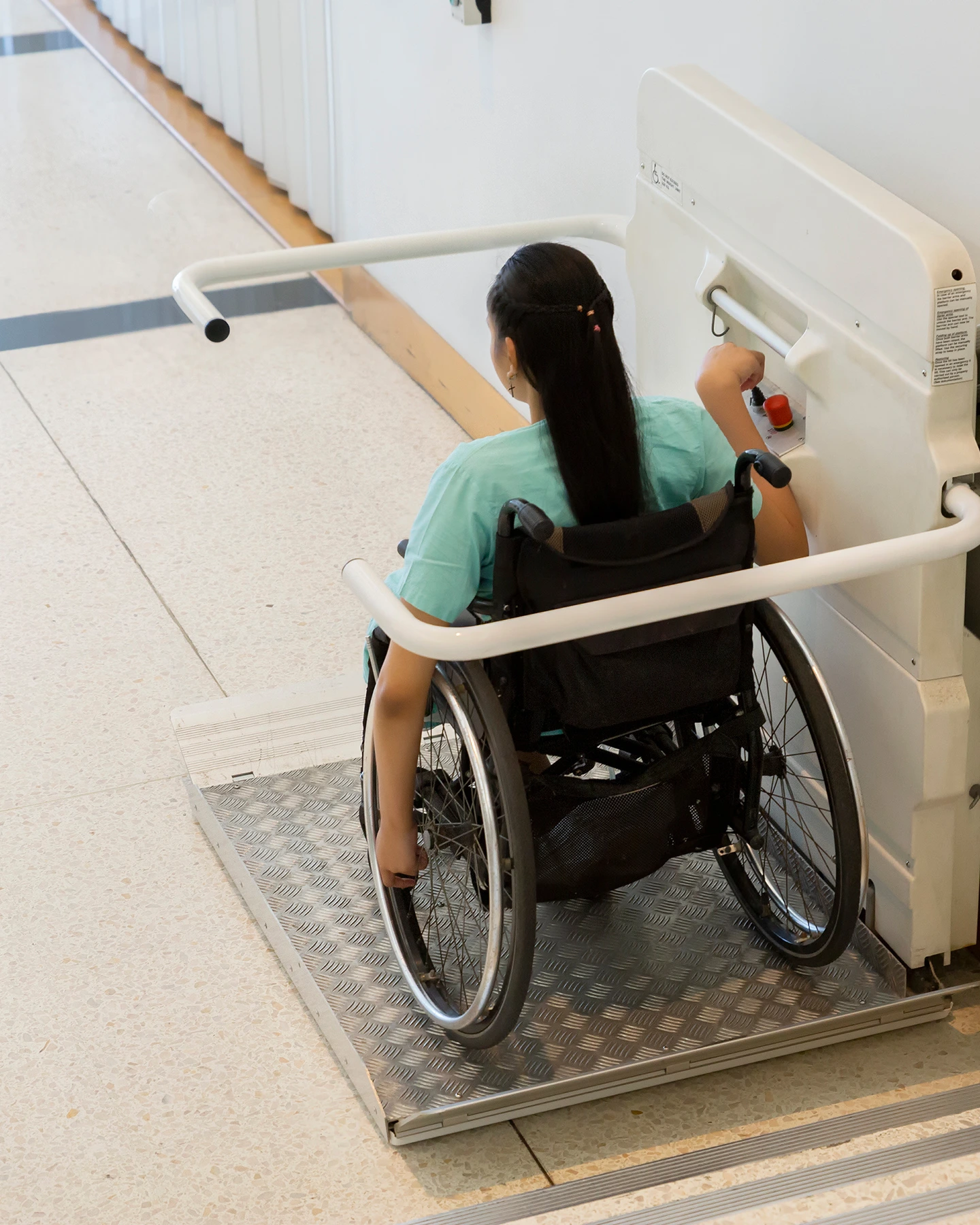
Stairlift seat height is 19–21 inches, approximately 2 inches higher than typical wheelchair seats. This requires an upward transfer movement — assess with your PT before installation.
Top Transfer
Seat swivels to face the landing. Rider transfers to standing or to a second wheelchair positioned on the upper floor.
Assisted Transfers
Caregiver can assist using gait belt or standing pivot technique — standard SCI transfer protocol. Confirm caregiver capability during the PT assessment.
Transfer Board Option
Sliding transfer boards can bridge gaps for riders with good upper-body strength. Requires a flip-up armrest design for clearance — verify model compatibility before purchasing.
VA SCI/D System of Care
The VA operates the largest integrated system of care for spinal cord injuries in the United States: 25 SCI/D Centers and over 100 SCI/D support clinics. Services include DME, home modification assessment, equipment prescription, and smart-home technology.
Access Pathway
- Enroll in VA healthcare
- Request SCI/D Center referral from your primary care provider (separate from standard VA care)
- Complete occupational therapist home assessment
- Coordinate equipment prescription and grant application
VA Grants: HISA, SAH, and SHA
| Grant | Maximum | Eligibility | Covers |
|---|---|---|---|
| HISA | $6,800 (service-connected) $2,000 (non-service) |
Any veteran with disability | Ramps, bathroom mods, doorways. Stairlifts classified as removable equipment — may limit coverage. |
| SAH | $117,014 (2026) | Permanent total service-connected: loss of use of both lower extremities. Most complete SCI above L2 qualifies. | Major adaptations: elevators, accessible bathrooms, roll-in showers. |
| SHA | $23,444 (2026) | Loss of use of both hands, severe burn injuries | Similar to SAH at lower maximum. |
HISA is a lifetime benefit, not annual. The $6,800 maximum covers all modifications over the veteran's lifetime. Plan usage carefully — prioritize permanent modifications over removable equipment when possible.
Complementary Home Modifications
| Modification | Cost Range | Purpose |
|---|---|---|
| Roll-in shower | $4,000–$10,000 | Eliminates tub step-over |
| Grab bars (per bar) | $100–$300 | Bathroom, hallway, bedroom support |
| Widened doorways (per door) | $300–$800 | 30–32" to 36" for wheelchair access |
| Threshold ramps (each) | $50–$200 | Interior and exterior transitions |
| Raised/wall-mounted toilet | $50–$500 | Adjusts transfer height |
| Environmental control units | Varies (VA covers for eligible) | Voice/switch-operated smart home for limited hand function |
Cost and Funding Summary
| Equipment | Cost | Primary Funding |
|---|---|---|
| Straight stairlift | $2,500–$5,500 | VA HISA (partial), Medicaid HCBS, IRS deduction |
| Curved stairlift | $9,000–$15,000 | VA HISA + SAH combination, Medicaid HCBS |
| Vertical platform lift | $6,000–$15,000 | VA SAH, Medicaid HCBS |
| Inclined platform lift | $12,000–$25,000 | VA SAH |
| Home elevator | $30,000–$60,000 | VA SAH |
Non-veterans: contact your state Medicaid HCBS waiver agency. 47 states cover stairlifts with typical lifetime caps of $7,500–$10,000 and 30–90 day processing time.
Frequently Asked Questions
Depends on injury level and completeness. ASIA B–D incomplete injuries with functional arm strength and complete injuries at T10 or below with good sitting balance are often candidates. Physical therapist clearance of transfer safety is mandatory before installation.
VA offers multiple programs. HISA provides up to $6,800 but classifies stairlifts as removable equipment, potentially limiting coverage. SAH grant (up to $117,014 in 2026) covers major adaptations including elevators and platform lifts for permanent total service-connected disabilities. Most complete SCI above L2 qualifies for SAH.
If safe transfer is confirmed by PT/OT, a stairlift at $2,500–$5,500 for straight rail is more affordable. If transfer is unsafe (common with complete cervical SCI), a platform lift ($6,000–$25,000) or home elevator ($30,000–$60,000) is required. The PT/OT assessment determines which path.
Key challenges: reduced trunk stability (injuries above T10), limited grip strength (cervical injuries), and the 2-inch height difference between wheelchair and stairlift seat. Transfer boards and flip-up armrests help. PT/OT training is required before first use.
A network of 25 SCI/D Centers and 100+ support clinics providing lifelong care: DME, home modification assessment, equipment prescriptions, smart-home technology, and grant coordination. Separate from standard VA primary care — request a specific SCI/D referral from your primary care provider.
Related Guides
Ready to Get Started?
Free in-home assessment within 24 hours. No pressure, no obligation.