Straight Stairlifts: Prices, Models & Install
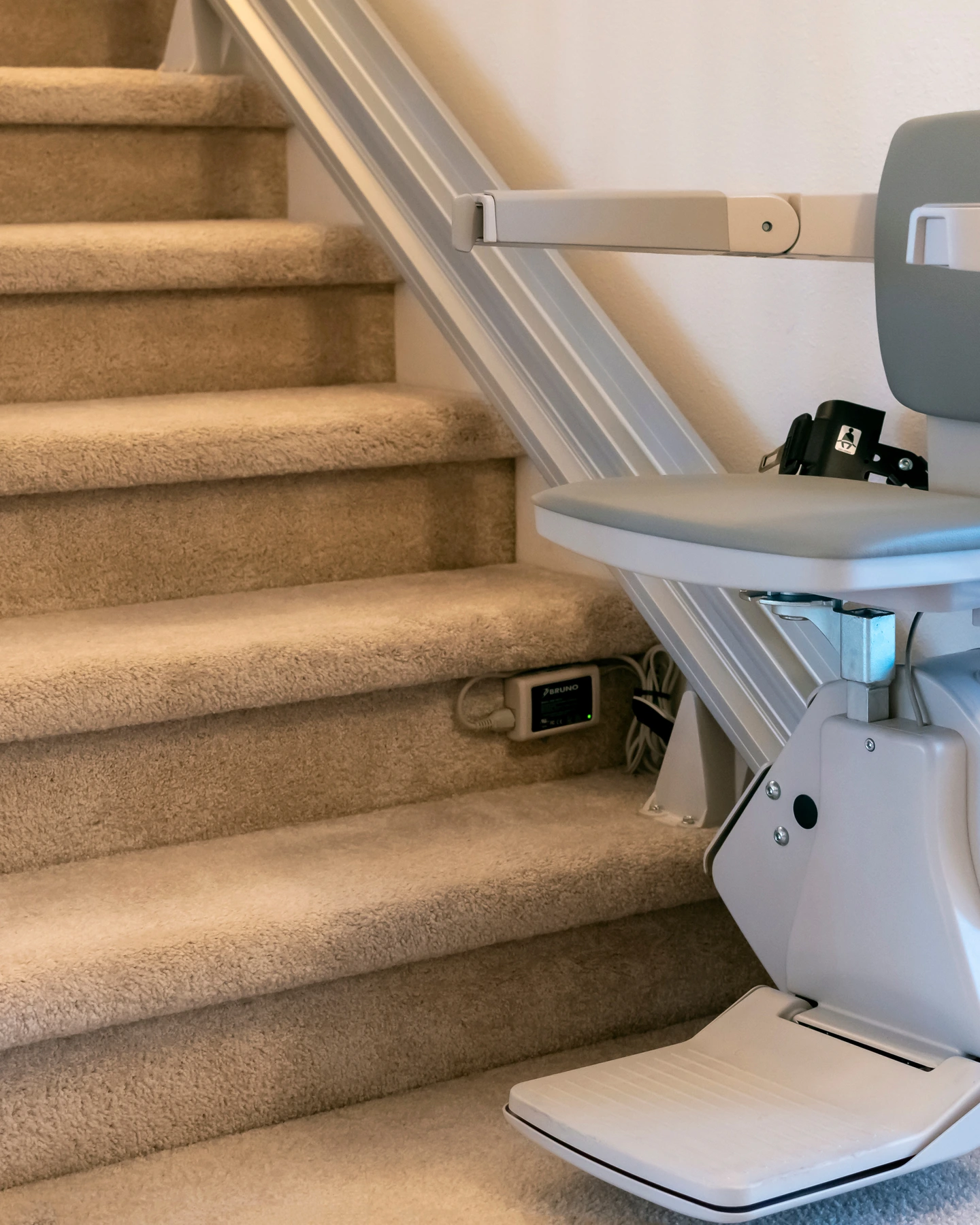
A straight stairlift is a motorized chair riding a steel rail bolted to your stair treads. DC battery power, works during outages. $2,500-$5,500 installed, sweet spot $3,200-$4,500. Installs in 2-4 hours -- you ride it the same afternoon. Covers 70% of American homes with a standard single-flight staircase.
What a Straight Stairlift Is (and What It Isn't)
A straight stairlift is the simplest, most affordable, and most reliable type of residential stairlift. The rail is a single-piece or two-piece steel extrusion -- typically aluminum or galvanized steel -- that runs parallel to the staircase from bottom to top. A motorized carriage rides along the rail carrying a padded swivel seat, armrests, a footrest, and a seatbelt. Two 12-volt sealed lead-acid batteries power the DC motor, trickle-charged from a standard 120V grounded outlet at the base of the stairs.
A straight stairlift from Bruno or Handicare in 2026 has soft-start/soft-stop motor control, obstruction sensors on the footrest and carriage, a seat-occupancy sensor that prevents empty runs, battery backup for 15-20 round trips without power, and a swivel seat that locks at the top landing so the rider dismounts facing the hallway instead of the open stairwell.
Not a curved stairlift. If your staircase has any turn -- a 90-degree bend, a mid-flight landing, an L-shape -- a straight rail will not work. You need a custom curved rail.
Not construction. The rail bolts into the stair treads, not the wall, not the banister. No drywall, no carpentry, no permits in most jurisdictions.
Not a medical device. The FDA does not clear residential stairlifts. For tax purposes, it's classified as durable medical equipment under IRS Publication 502.
Who Needs a Straight Stairlift
- Your staircase is a single continuous flight -- bottom to top, no turns, no landings. Typically 10-16 steps, rail lengths of 10-20 feet.
- The rider can transfer from standing to seated and has enough upper-body control to sit upright for 30-60 seconds.
- The rider weighs under 300 lb (or under 400 lb with a heavy-duty model). If either rider weighs 275 lb+ dressed, step up to 400 lb.
The typical buyer: homeowner aged 65-85, two-story home built 1950-2010, standard 13-step staircase, 26-inch minimum clear width. Knee replacement recovery, hip surgery recovery, COPD, heart failure, general age-related mobility decline -- these conditions drive 90% of straight stairlift purchases.
Three Models We Install and Recommend
| Spec | Bruno Elan SRE-3000 | Handicare 1000 | Acorn 130 |
|---|---|---|---|
| Our Pick | #1 seller | Quietest | Budget option |
| Capacity | 300 lb | 300 lb (XXL: 400 lb) | 300 lb |
| Speed | 20 ft/min | 16 ft/min | 18 ft/min |
| Drive | Rack-and-pinion, DC | Helical worm gear, DC | Rack-and-pinion, DC |
| Seat Width | 20 in | 19.5 in | 18.5 in |
| Rail Profile | Standard aluminum | 5.5 in from wall (slimmest) | Slimline steel tube |
| Warranty | 5-yr parts, 2-yr labor, lifetime rail | 5-yr parts, 2-yr labor, lifetime rail | 1-yr full, 5-yr motor, lifetime rail |
| Installed Price | $3,200-$4,200 | $3,400-$4,500 | $2,500-$3,500 |
Bruno Elan SRE-3000
The Honda Civic of stairlifts -- affordable, reliable, boring in the best way. In production since 2008 with incremental updates. Parts available everywhere. Any Bruno-certified tech can service it. That long production run means the unit installed today will still have replacement gears, batteries, and circuit boards in 2040.
Narrow staircase? The Handicare 1000's slim rail profile buys you an extra inch of clearance compared to the Bruno. In a tight 1960s Colonial, that can be the difference between code-legal and not.
Acorn is a UK-based direct-to-consumer manufacturer. The unit is good, the install is competent, but the service network runs through their own call center and technicians. In rural areas, you may wait 3-5 days for a service call. Bruno and Handicare have thousands of independent certified techs nationwide -- including us -- so service availability is broader.
Real Pricing: $2,500-$5,500 Installed
What's Always Included
- Equipment (motor, seat, batteries, electronics, remotes)
- Rail, cut to length on site
- Professional installation by factory-certified tech
- Electrical outlet install if needed (within 6 feet)
- Full 9-point safety test sequence
- 15-minute hands-on rider training
- 48-hour and 30-day follow-up calls
- Manufacturer warranty activation
- Our install labor warranty (minimum 2 years)
What's Never in Our Price
Travel fees. Site assessment fees. "First-year service plan" upsells. Training fees. Permit fees (we absorb these where applicable).
Install Day: What Actually Happens (2-4 Hours)
What's Included in Every Install
- Equipment: Motor, carriage, seat assembly, armrests, footrest, seatbelt, two 12V batteries, charge station, two wireless remotes
- Rail: Stock aluminum or steel, cut to your exact stair length on site. Hinged bottom rail available (+$200-$350)
- Installation labor: Factory-certified technician, all hardware, drop cloths, cleanup
- Electrical: Outlet install if needed (120V grounded, within 6 feet)
- Safety testing: Full 9-point test documented on your install certificate
- Rider training: 15-minute hands-on session -- rider operates unassisted before we leave
- Follow-up: Phone check at 48 hours and 30 days
- Documentation: Install certificate, warranty card, owner's manual, our 24/7 service number
How a Straight Stairlift Works (Mechanically)
Understanding the mechanism helps you maintain it and spot BS from salespeople pushing unnecessary upsells.
The rail is an extruded aluminum or galvanized steel profile bolted to the stair treads. It carries a toothed rack along its length. The motor is a DC gear motor powered by two sealed 12V lead-acid batteries, driving a pinion gear that meshes with the rack. Rack-and-pinion -- the same mechanism as your car's steering system, just slower (16-20 ft/min).
The batteries trickle-charge from a 120V outlet at the base station. A full charge provides 15-20 round trips. During a power outage, the lift runs entirely on stored battery power.
The seat swivels at the top landing and locks in place so the rider dismounts facing the hallway. Folding the seat also folds the footrest and armrests, reducing the profile to about 12 inches from the wall.
When a Straight Stairlift Won't Work
| Situation | What You Need Instead |
|---|---|
| Staircase has any turn, landing, or curve | Curved stairlift with custom-fabricated rail |
| Staircase too narrow (under 27 in clear) | Slim-profile model (Handicare 1000, 5.5 in rail) or platform lift |
| Rider weighs over 300 lb | Heavy-duty model (400-600 lb), still straight rail |
| Rider can't sit | Standing / perch stairlift |
| Rider uses wheelchair, can't transfer | Platform lift |
| Stairs are outside | Outdoor-rated straight stairlift |
Maintenance: What to Do and What to Skip
Do These (5 Minutes, Once a Month)
- Wipe the rail with a dry cloth. Dust and pet hair accumulate and can gum up the pinion gear.
- Check the charging light. Green = fully charged. Amber = charging. Red or nothing = check the outlet (most "dead lift" calls are a tripped GFCI).
- Run it once. If unused for over a week, run it up and down to condition batteries and lubricate gears.
Skip These (They're Upsells, Not Maintenance)
Annual "tune-up" plans ($200-$600/year): There is no annual tune-up that justifies this price. The motor is sealed. Batteries cost $60-$100 to replace every 3-5 years. If an installer pushes an annual contract, they're selling peace of mind at a 400% markup.
Scheduled battery replacement: Replace when performance degrades, not on a calendar.
"Lubrication service": Modern rack-and-pinion systems are designed to run dry. Adding grease attracts dust and creates abrasive paste that accelerates wear. If a tech wants to grease your rail, they don't know the product.
For the full maintenance guide, see stairlift maintenance: what to do and what to skip.
Frequently Asked Questions
$2,500-$5,500 fully installed -- equipment, rail, labor, electrical, training, warranty. Sweet spot: $3,200-$4,500 for a Bruno Elan or Handicare 1000 with 5-year warranty and same-day install. See our complete cost guide.
2-4 hours on site. Rail is stock, cut to length on the truck. Most installs scheduled within 3-7 days of signing. You ride the lift the same afternoon. See our installation guide.
Most staircases 27 inches or wider can accommodate a straight stairlift and meet building code. The Handicare 1000 has the slimmest rail at 5.5 inches from the wall. We measure at the free assessment. See our narrow staircase guide.
Yes. When parked, the seat, footrest, and armrests fold to about 12 inches from the wall. A hinged bottom rail (+$200-$350) folds the rail out of the way at ground level.
The lift keeps working. DC battery power stores enough for 15-20 full round trips without any power. During hurricanes, blizzards, or grid failures, it operates normally.
Standard: 300 lb. If either rider weighs 275 lb+ dressed, we recommend a 400 lb heavy-duty variant -- same straight rail, beefier motor and carriage. True bariatric: up to 600 lb.
Yes, but it rarely makes financial sense. Removal: $500-$800. Reinstall at new home: $800-$1,200. Most families sell the used unit (resale: 40-60% of original) and buy new. See our removal guide.
12-20 years with normal use (4-8 rides/day). Motor and gearbox are the long-life components. Batteries: every 3-5 years ($60-$100). Upholstery: 8-12 years. See our maintenance guide.
Modern stairlifts are quiet. Bruno Elan: ~55 dB (normal conversation). Handicare 1000: ~50 dB. You won't hear it through a closed bedroom door.
No prescription required to buy or install. However, a physician's letter strengthens your case for VA HISA grants ($6,800), Medicaid waivers, and IRS medical deductions. We help you get the documentation. See our veterans guide.
Ready to Get Started?
Free in-home assessment within 24 hours. No pressure, no obligation.