Stairlift FAQ: 50+ Questions Answered (2026)
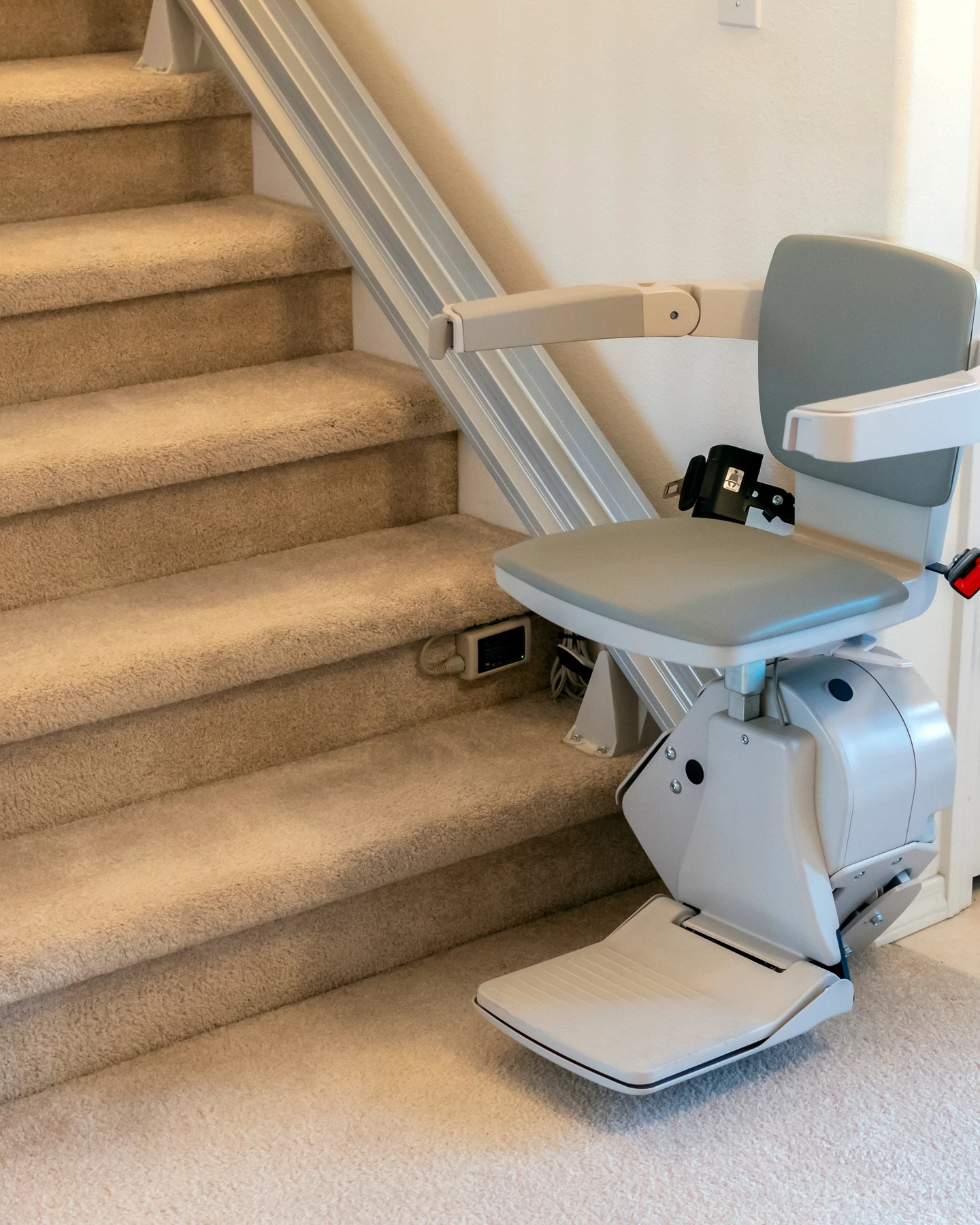
Every answer below comes from our installation and service team—not a copywriter. We've compiled the real questions homeowners ask during consultations, on service calls, and after installation. Each answer includes specific numbers, not vague reassurances.
Cost & Pricing
A straight stairlift costs from $2,800 installed, including the rail, carriage, seat, and professional installation. Price varies by rail length, weight capacity, and optional features like powered swivel or folding rail. Most straight installations fall between $2,800 and $4,500. Full pricing breakdown.
Curved stairlifts start at $9,000 installed. The higher price reflects custom rail manufacturing—every curved rail is bent to match your exact staircase geometry. Staircases with multiple turns, intermediate landings, or spiral sections push costs toward $12,000–$15,000. The rail alone accounts for 40–50% of the total cost.
The rail. Straight rails are cut from standard extruded stock in minutes. Curved rails are custom-manufactured on CNC bending machines using your staircase's exact measurements. Each curved rail is a one-off production piece. The carriage and motor components are similar in cost to straight models—it's the rail engineering that drives the price difference.
Yes. We offer financing from $79/mo for qualified buyers. Terms range from 12 to 60 months. No prepayment penalties. The application takes about 10 minutes during your in-home consultation, and most homeowners get approval within 24 hours.
No. Medicare classifies stairlifts as home modifications, not durable medical equipment (DME), so they're excluded from coverage. However, some Medicare Advantage plans offer home modification benefits that may partially cover a stairlift. Check your specific plan's supplemental benefits. See all funding options.
Some state Medicaid programs cover stairlifts under Home and Community-Based Services (HCBS) waiver programs. Coverage varies widely by state. States like Pennsylvania, New York, and California have waiver programs that may fund home accessibility modifications including stairlifts. Your local Area Agency on Aging can confirm eligibility.
Yes, through two VA programs. The HISA grant provides up to $6,800 for service-connected disabilities or $2,000 for non-service-connected disabilities. The SAH grant covers larger home modifications. Both require a VA physician's prescription confirming the mobility need. Processing takes 4–8 weeks. VA funding details.
Certified refurbished straight stairlifts save 30–40% and are a solid option when sourced from a reputable dealer. The rail is always new (cut to your stairs), while the carriage and motor are factory-reconditioned. We only sell refurbished Bruno and Handicare units—brands whose components hold up through a second lifecycle. Avoid refurbished curved rails; they're custom-bent to another staircase.
Installation
Straight rail: 2–4 hours from arrival to testing. Curved rail: 4–6 hours. We install the rail first (mounted to stair treads, not walls), attach the carriage, wire the charging station, and run a full test cycle. No structural modifications to your home are needed. Most installations are completed in a single visit.
The stairs. Every stairlift rail mounts to the stair treads using heavy-duty brackets. No wall mounting, no structural modifications, no load-bearing concerns. The rail and brackets can be removed later with only small bolt holes remaining in the treads—easily filled and invisible under carpet.
28 inches is the standard minimum. With the seat folded, premium models like Bruno (12 in) and Stannah (11 in) leave 16–17 inches of clear stair width on a 28-inch staircase. If your stairs are narrower than 28 inches, a vertical platform lift may be more appropriate. We measure during the free in-home assessment.
Yes. The mounting brackets bolt through the carpet and pad into the stair tread beneath. This is standard practice and doesn't affect carpet condition. If the stairlift is removed later, the bracket holes are hidden under the carpet pile. No carpet removal or modification is needed.
Yes, with a custom curved rail. Spiral staircases require precise 3D measurement—usually using a laser templating system—and a rail manufactured to follow the exact helix of your staircase. Brands like Stannah and Bruno excel at spiral applications. Expect 4–6 weeks for rail manufacturing and costs from $10,000+.
Yes, one standard 110V/15A grounded outlet near the bottom of the stairs. The stairlift's charging station plugs into this outlet. The lift runs on rechargeable batteries (not direct AC power), so it operates during power outages. If no outlet exists nearby, an electrician can add one for $150–$300.
Minimal impact. The rail brackets create small bolt holes in the stair treads—4 to 6 holes per bracket, spaced every 3 treads. On hardwood stairs, these holes can be filled and refinished. On carpeted stairs, they're invisible. No wall damage, no structural modification, and complete removal takes about an hour.
"Homeowners worry about damage, but I've removed over 200 stairlifts and the stairs always look fine afterward. A few filled holes in the treads—that's it. The wall is never touched."
Products & Brands
Bruno ranks #1 in our installer data for reliability, build quality, and total cost of ownership. Their Elan SRE-3050 (straight) and CRE-2110 (curved) have the lowest service call rates of any brand we install. See our full 2026 brand rankings.
Rack-and-pinion uses a toothed gear on a toothed rail—positive engagement, zero slip, minimal maintenance. Belt-driven uses a reinforced belt that requires re-tensioning every 12–18 months and eventually replacement. For long-term reliability, rack-and-pinion (used by Bruno, Harmar, Savaria) is the superior mechanism.
Standard models handle 300–400 lbs. Heavy-duty models like the Harmar Pinnacle SL600 are rated to 600 lbs. Weight capacity affects rail gauge, motor power, and carriage construction. Always choose a unit rated at least 50 lbs above your weight for optimal performance and longevity.
Stairlift batteries last 3–5 years under normal use. Replacement batteries cost $80–$150 depending on the brand and model. Signs of battery wear: slower travel speed, not reaching the top of the rail on a single charge, or the unit stopping mid-run. Battery replacement is a 15-minute service call.
Yes, but only with a curved rail model. Straight rail stairlifts cannot navigate turns. Curved stairlifts use custom-manufactured rails that follow any staircase geometry: 90-degree turns, 180-degree switchbacks, intermediate landings, and spiral configurations. Each curved rail is a custom production piece.
Not really. All residential stairlifts require a permanently mounted rail. However, straight rail stairlifts can be removed and reinstalled in a new location (the rail gets re-cut). Some families rent stairlifts for temporary recovery periods—rental programs typically run $150–$250/month including installation and removal.
Safety
Yes. Modern stairlifts include multiple safety systems: seatbelts, swivel-lock seats (preventing exit toward the stairs), obstruction sensors that stop the unit if anything blocks the rail, overspeed governors, and battery backup for power outages. Stairlifts are regulated under ASME A18.1 safety standards.
The stairlift keeps working. All modern units run on rechargeable batteries that charge when the lift is parked at the charging station. A full battery charge provides 8–15 round trips depending on the model and stair length. As long as the batteries were charged before the outage, you have reliable operation for hours or days.
On most staircases, yes. With the seat, footrest, and armrests folded, premium models leave 11–13 inches of rail profile from the wall. On a standard 36-inch staircase, that leaves 23–25 inches of clear walking space—enough for most adults. Narrower staircases (28–30 inches) may be tighter.
All stairlifts have manual release levers that allow the carriage to be gently rolled along the rail to either landing by a helper. The most common cause of mid-staircase stops is an obstruction on the rail (a shoe, a toy) triggering the safety sensor. Clear the obstruction and the lift resumes. Actual mechanical failures mid-run are extremely rare.
Most stairlifts include a key lock switch that prevents unauthorized operation—useful for dementia patients or young grandchildren. With the key removed, the lift won't respond to controls. Some families add a wireless call/send feature so a caregiver can operate the lift from upstairs or downstairs using a remote.
Funding & Financial Assistance
Several: VA HISA grants ($6,800 service-connected / $2,000 non-service-connected), state Medicaid HCBS waiver programs, Area Agency on Aging grants, USDA Rural Development housing repair loans (Section 504), and various nonprofit assistance programs. Eligibility depends on veteran status, income, disability, and state of residence. Complete funding guide.
Yes, if your doctor provides a Letter of Medical Necessity (LMN) documenting that the stairlift is medically required for your condition. With an LMN, the full purchase price qualifies as a tax-advantaged medical expense through your HSA or FSA. Ask your physician during your next visit.
Potentially. If your doctor certifies the stairlift as medically necessary, the cost qualifies as a medical expense deduction on your federal tax return. Medical expenses exceeding 7.5% of your adjusted gross income are deductible. Consult your tax advisor with your Letter of Medical Necessity.
Standard homeowners policies do not cover stairlift purchases. However, once installed, the stairlift is covered as a permanent fixture under your dwelling coverage (fire, theft, storm damage). Some long-term care insurance policies include home modification benefits that may apply. Check your specific policy.
"Most families don't realize how many funding options exist. Between VA grants, state programs, and tax deductions, I've seen homeowners cover 50–80% of their stairlift cost. It takes some paperwork, but the savings are real."
Maintenance & Service
Annual preventive maintenance is recommended: lubricate the rail, check battery condition, inspect safety sensors, tighten mounting brackets, and test all controls. A professional service visit takes 30–45 minutes and costs $100–$175. Between service visits, wipe the rail with a dry cloth monthly to remove dust buildup.
Quality stairlifts last 10–15 years with annual maintenance. The rail is essentially permanent—aluminum doesn't corrode indoors. Motors typically last 8–12 years. Batteries need replacement every 3–5 years. Seats and upholstery may show wear after 7–10 years. Total cost of ownership over 10 years averages $500–$1,200 in maintenance for top brands.
Service calls typically run $125–$250 including labor and common parts (batteries, fuses, switches). Major repairs like motor replacement cost $400–$800 including parts and labor. Brands with proprietary parts (like Acorn) charge significantly more because you can't source components independently.
Basic maintenance, yes: wiping the rail, checking for obstructions, and keeping the charging station clear. Anything involving the motor, gearbox, safety sensors, or electrical system should be handled by a certified technician. Improper service can void your warranty and create safety risks on a device that carries people up and down stairs.
Battery replacement. Batteries degrade after 3–5 years and cause slow operation or mid-run stops. It's a 15-minute swap costing $80–$150. Second most common: safety sensor recalibration after pets, shoes, or objects repeatedly trigger the obstruction sensor. Third: charging station contact cleaning when the unit won't charge.
Special Situations
Yes, with landlord permission. Under the Fair Housing Act, landlords must allow reasonable disability modifications at the tenant's expense. The stairlift can be removed when you move out, restoring the stairs to original condition. Get the landlord agreement in writing and clarify who pays for removal.
No. Residential stairlifts are rated for single-rider use only. The weight capacity, motor power, and braking systems are designed for one person. Doubling the load creates safety risks and voids the warranty. If two household members need the lift, they ride one at a time—the call/send remotes make this easy.
Minimally. In the general housing market, stairlifts are neutral to slightly negative for resale—most buyers prefer stairs without a rail. However, in areas with high senior populations, a stairlift can be a selling point. Either way, removal takes about an hour and leaves only small filled holes in the treads. The accessibility benefit while living in the home far outweighs any resale consideration.
Straight rail stairlifts: yes. The carriage, motor, and seat transfer directly. The rail gets re-cut to the new staircase length. Relocation costs $800–$1,500 including removal, transport, new rail cutting, and reinstallation. Curved rail stairlifts: almost never, because the custom rail won't match a different staircase.
Hinged rail sections or folding rail ends solve this. A hinged rail flips up at the top or bottom of the staircase, clearing the door swing path. Power-fold options add $300–$500 and operate with a remote. Manual hinged rails are less expensive. This is a common installation scenario we handle regularly.
Yes, with a purpose-built outdoor model. Outdoor stairlifts use marine-grade aluminum rails, UV-resistant covers, sealed electrical connections, and weather-rated motors. Brands like Bruno (Elite Outdoor) and Harmar build dedicated outdoor units starting from $4,000. Standard indoor stairlifts cannot be used outdoors—moisture destroys the electronics within months.
Buying Process
Three factors determine the right stairlift: staircase shape (straight vs. curved), user weight (standard vs. heavy-duty), and location (indoor vs. outdoor). Start with a free in-home assessment—we measure your stairs, discuss mobility needs, and recommend specific models. See our 2026 brand rankings for model comparisons.
Straight stairlifts: 3–7 days from order to installation. We stock popular models and cut rails on-site. Curved stairlifts: 4–6 weeks because the rail is custom-manufactured to your staircase measurements. Rush options may be available for straight models in urgent medical situations.
Yes—get at least two. Compare the total installed price (not just the unit price), warranty terms, the brand and model offered, and whether the company uses its own installers or subcontractors. Avoid companies that pressure you to sign the same day or quote without measuring your stairs first. A legitimate company will measure before quoting.
Key questions: What brand and model are you recommending, and why? What's included in the price (removal of old unit, warranty, training)? Who does the installation—your employees or subcontractors? What's your average service response time? Can I see the warranty terms in writing before I sign? Do you offer a maintenance plan?
"If a salesperson shows up and gives you a price without measuring your stairs, walk away. Every staircase is different. Anyone quoting blind is either going to surprise you with add-ons later or install something that doesn't fit right."
After Installation
Sit down, fasten the seatbelt, and hold the toggle or joystick in the direction you want to travel. Release the control to stop. The lift moves at a fixed safe speed (about 20 feet per minute). At the top or bottom, the seat swivels to face the landing for safe exit. We train every user during installation—most people are comfortable within two rides.
About 20 feet per minute, which translates to roughly 30–45 seconds for a standard 12–15 stair flight. Speed is regulated by safety standards (ASME A18.1) and cannot be adjusted. The speed feels gentle and controlled—similar to a slow escalator.
Yes. Used straight stairlifts in good condition resell for 30–50% of original purchase price. Bruno and Stannah units hold value best. The buyer needs professional removal and reinstallation (the carriage transfers, but the rail gets re-cut). Curved stairlifts have almost no resale value because the custom rail won't fit another staircase.
Monthly: wipe the rail with a dry cloth to remove dust (don't use lubricant—the rail is self-lubricating on most models). Weekly: check that the footrest, seat, and armrests fold and unfold smoothly. Immediately: clear any objects from the rail path. Annually: schedule a professional service visit for the full inspection ($100–$175).
Last updated: April 2026. Have a question we didn't cover? Call us directly—our installation team answers the phone, not a call center.
Ready to Get Started?
Free in-home assessment within 24 hours. No pressure, no obligation.