Stairlift Safety Features Explained (2026)
How Stairlift Safety Works: Layers, Not Luck
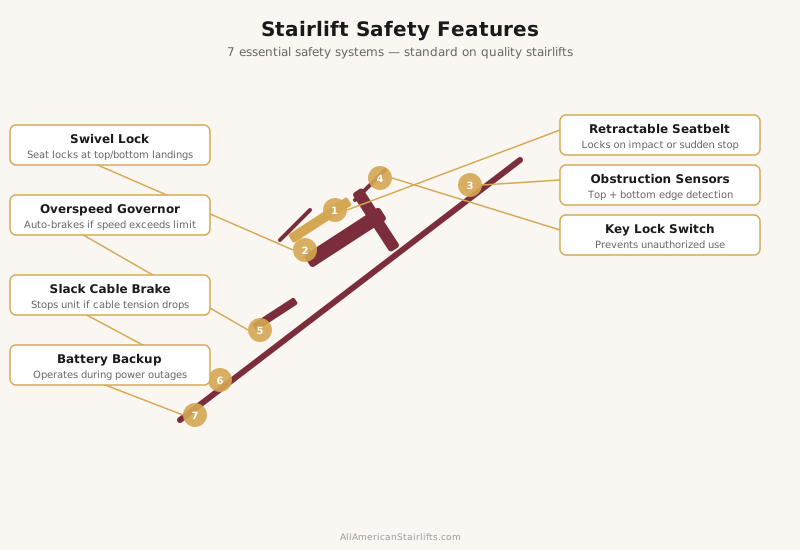
Stairlift safety relies on defense in depth — multiple independent systems where each layer operates independently of the others. Every standard name-brand unit includes all safety features; none are optional upgrades. The question is not "does it have safety features" but "which ones matter most for your situation."
Obstruction Sensors (Footrest and Carriage)
Detects objects in the stairlift's path and stops immediately.
Footrest safety edges: Pressure-sensitive strips on front and sides trigger stops upon contact. Sensitivity is calibrated so that a coin standing on edge on a step will trigger the stop.
Carriage underpan sensor: Catches items between carriage and rail — towels, cords, clothing.
Both systems use normally-closed circuits, meaning broken wires trigger the safety stop rather than disabling it. Fail-safe by design.
Seat-Present Sensor
A switch preventing operation unless someone is seated. Stops the lift if riders stand mid-ride or prevents engagement if the seat is folded. On some models (Bruno Elite, Stannah Siena), it works with seatbelt sensors for a hard lockout; on others (Acorn 130, Handicare 1000), the belt sensor only beeps.
Seatbelt
Every residential stairlift includes a retractable lap seatbelt. Falls from stairlifts are rare — the industry estimates fewer than 1 incident per 10,000 installed units per year — and most of the reported incidents involve riders who were not wearing the belt.
Descending at roughly walking pace creates enough momentum to pitch unbelted riders forward. Despite resistance from riders, wearing it is essential.
Overspeed Governor
Mechanically brakes if speed exceeds 125–150% of normal. Catches catastrophic motor failures. The overspeed governor is mechanical, not electronic — it does not depend on the control board, the battery, the wiring, or any software. All major brands include this standard.
Soft-Start and Soft-Stop
Motor control features ramping speed gradually over 1–2 seconds at the beginning and end of each ride. Prevents lurching backward or pitching forward. Bruno Elite and Stannah Siena offer the smoothest transitions. Reduces mechanical wear and prevents cumulative discomfort for riders with back or joint sensitivity.
Emergency Stop Button
A large, clearly marked button (usually red) within thumb reach that cuts motor power instantly. Pressing it stops the lift wherever it is on the rail — it does not return the lift to the bottom or top. Provides psychological safety and control for anxious riders.
Swivel Seat Lock
A mechanical latch preventing seat rotation during motion and preventing motion while swiveled. At the top landing, riders swivel 90 degrees to face the landing before exiting. The safety interlock prevents movement during sideways positioning.
Battery Backup (DC Drive)
2x 12V sealed lead-acid batteries. 8–20 round trips per full charge. 100% of name-brand models use DC drive. Batteries are consumables lasting 3–5 years, costing $75–$150 to replace.
Battery backup prevents stranding during power outages — precisely when riders may need to evacuate. During Hurricane Ian in 2022, users without backup became trapped. Every quality stairlift sold in 2026 runs on DC battery power. AC-drive models are obsolete.
Key Lock Switch
Some models include a physical key lock preventing operation without the key inserted. Framed as preventing unsupervised child use.
The key lock is the least important safety feature on the list. Lost keys cause stranded riders and service calls. The exception: memory care situations where dementia poses unsafe operation risks.
Overtravel Limit Switches
Mechanical or magnetic switches at both rail ends defining travel boundaries. Primary and secondary switches create belt-and-suspenders redundancy. Both are normally closed (fail-safe), meaning broken wires stop motors rather than allowing overtravel.
Which Features Matter Most — Our Ranking
| Rank | Feature | Why |
|---|---|---|
| 1 | Battery backup (DC drive) | Prevents stranding during power outages |
| 2 | Obstruction sensors | Most likely daily activation; catches pets, shoes, cords |
| 3 | Seatbelt | Simplest, most often skipped; prevents the most common injury |
| 4 | Overspeed governor | Catches catastrophic failures independently of electronics |
| 5 | Soft-start / soft-stop | Prevents cumulative discomfort and balance disruption |
| 6 | Swivel seat lock | Prevents exit hazards at top landing |
| 7 | Emergency stop | Psychological and physical safety; instant control |
| 8 | Seat-present sensor | Prevents empty-chair runaway |
| 9 | Overtravel limit switches | Silent background protection at rail ends |
| 10 | Key lock | Skip unless managing memory care situations |
Frequently Asked Questions
Yes. The seatbelt holds the rider in the seat, the swivel seat lock lets them exit facing the landing (not the staircase), and the soft-start and soft-stop prevent lurching. Power swivel seats with seatbelt interlock are recommended for severe balance issues.
DC battery models continue normally during outages. A power outage does not cause a mid-ride stop. The only thing that happens is the trickle charger stops until power returns. Battery depletion requires 8–20 round trips of drainage.
Monthly checks (under two minutes): place an object in the path to test obstruction sensors, press the emergency stop, check seatbelt function, and test the swivel lock. Professional service every 18–24 months covers sensors, batteries, and drive mechanisms.
No. The weight capacity (300 lb standard, 400 lb heavy-duty, up to 600 lb bariatric) is an engineering rating for the motor, rail, and frame — not an on-board measurement. Select models rated above your weight with 25 lb recommended headroom.
Depends on model. Bruno Elite and Stannah Siena use hard interlocks — the lift will not move until the belt is fastened. Acorn 130 and Handicare 1000 trigger advisory beeping only. For forgetful riders, choose a model with hard interlock.
Related Guides
Ready to Get Started?
Free in-home assessment within 24 hours. No pressure, no obligation.