Platform Lifts

Wheelchair Platform Lifts: Vertical and Inclined Options

A stairlift requires the rider to transfer from a wheelchair to a seat. For people who can't make that transfer — severe spinal cord injury, advanced MS, bilateral lower-limb amputation, or any condition where seated transfer is unsafe or impossible — a platform lift carries the wheelchair itself. The rider stays in the chair the entire time. Two types: vertical platform lifts that go straight up, and inclined platform lifts that ride a rail along the staircase.

(800) XXX-XXXX
featured-platform

Two types of platform lift

Vertical vs. inclined — the core difference

A vertical platform lift (VPL) goes straight up — like a small, open elevator. It's installed adjacent to a staircase or against an exterior wall, and the platform rises vertically from one level to the next. An inclined platform lift rides a rail along the staircase — same concept as a stairlift, but with a flat platform instead of a seat, so the wheelchair rolls on and rides the rail.

Vertical (VPL)Inclined
How it movesStraight up/down, like an elevatorAlong the staircase rail, like a stairlift
Rise range1–14 ft (residential) / up to 23 ft (commercial)Any staircase length
FootprintNeeds floor space at both levels (typically 3x5 ft to 4x6 ft)Rail along staircase, platform folds when not in use
Best forShort rises (porch entry, split-level), indoor or outdoor, ADA entrancesFull-flight staircases where a VPL can't fit
Installed price$6,000–$12,000$8,000–$15,000
Capacity550–750 lb (rider + wheelchair)550–600 lb (rider + wheelchair)
Install time1–2 days1–3 days

Who needs a platform lift vs. a stairlift

The decision tree is simple:

  1. Can the rider transfer from their wheelchair to a stairlift seat? If yes → a stairlift is more affordable, faster to install, and takes up less space.
  2. Can the rider transfer with assistance? If yes → a stairlift is still usually the right answer. A caregiver helps the rider transfer at the bottom, the rider rides up seated, and the caregiver brings the wheelchair up separately (or keeps a second wheelchair on the upper level).
  3. Can the rider NOT transfer at all, even with assistance? If yes → a platform lift is the answer. The wheelchair rolls onto the platform, the rider stays in the chair, and the platform carries everything to the other level.

Platform lifts are also the right answer in commercial and public-access settings where ADA requires wheelchair-accessible vertical access — churches, offices, community centers, medical buildings, retail spaces, and public buildings. ADA does not recognize a stairlift as accessible because it requires a transfer out of the wheelchair.

Vertical platform lifts (VPL): how they work

A vertical platform lift is essentially a simplified elevator without an enclosed shaft. It consists of a steel platform (typically 36 x 54 inches to 42 x 60 inches), a vertical tower or mast, and a hydraulic or screw-drive motor that raises and lowers the platform between two levels.

Key specifications

  • Rise: Residential VPLs handle rises of 1 to 14 feet. That covers porch entries (2–4 ft), split-level transitions (4–8 ft), and full floor-to-floor rises in homes with standard 8–9 ft ceilings. Commercial VPLs (under ASME A18.1 code) handle rises up to 23 feet.
  • Platform size: Minimum 36 x 54 inches to accommodate a standard wheelchair. Larger platforms (42 x 60 inches, 48 x 60 inches) accommodate power wheelchairs and scooters.
  • Capacity: 550–750 lb, covering the rider, the wheelchair, and any personal items. Power wheelchair users should verify total weight — a heavy power chair (100–150 lb) plus a 250 lb rider is 350–400 lb, well within spec.
  • Speed: 6–12 ft/min. Slower than a stairlift, but the rides are shorter (a 4-foot porch rise takes about 30 seconds).
  • Drive: Hydraulic (quieter, smoother) or screw-drive (lower maintenance, no hydraulic fluid). Both are reliable for residential use.
  • Enclosure: Residential VPLs typically have a half-wall enclosure (42-inch safety rails) with a gate at each level. Commercial VPLs may require a full enclosure depending on local code.

Where VPLs fit

A VPL needs floor space at both the lower and upper levels. The platform sits at the lower level when idle, and rises to the upper level for access. You need a clear area at both levels for the platform footprint (3x5 ft minimum) plus wheelchair approach space (5 ft turning radius for ADA). This makes VPLs ideal for:

  • Porch or entry access (the most common residential VPL application)
  • Split-level homes with a 4–8 ft elevation change
  • Garages with a step-up to the house
  • Deck access from ground level
  • Church and community building entrances
  • Commercial buildings without an elevator

Inclined platform lifts: how they work

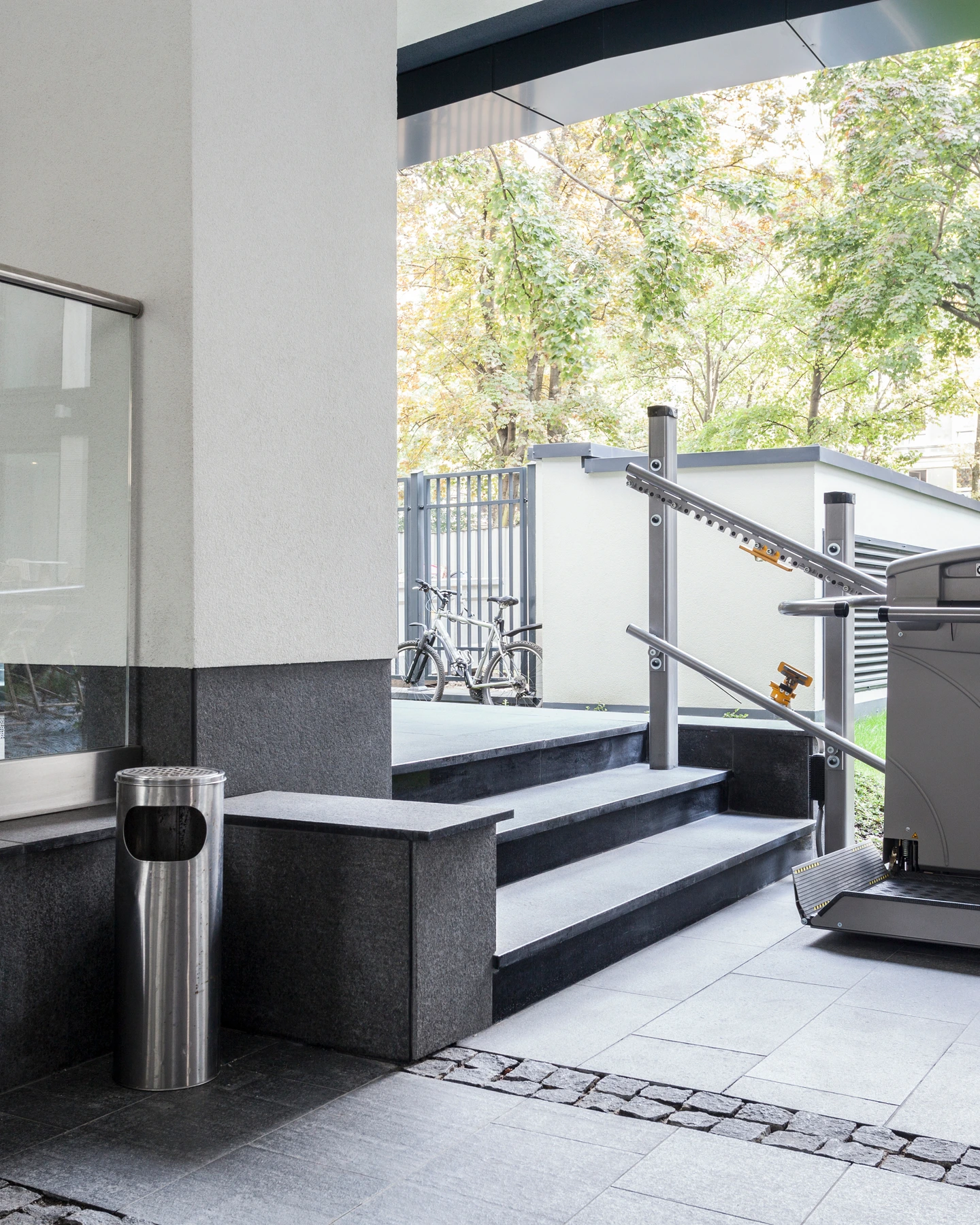
An inclined platform lift rides a rail along the staircase — same principle as a stairlift, but instead of a seat, the carriage holds a flat platform that a wheelchair rolls onto. The platform folds up against the wall when not in use, restoring the staircase to normal walking width.

Key specifications

  • Rise: Any staircase length. Inclined platform lifts handle straight and curved configurations, just like stairlifts.
  • Platform size: 30 x 36 inches to 34 x 48 inches (folded width: 12–16 inches against the wall).
  • Capacity: 550–600 lb (rider + wheelchair).
  • Speed: 15–20 ft/min along the rail.
  • Drive: DC battery, rack-and-pinion — identical to stairlift drive systems.
  • Staircase width requirement: Minimum 40 inches between walls (wider than a stairlift requires). The platform needs clearance to deploy and for the wheelchair to roll on safely.

When inclined makes more sense than vertical

  • No floor space for a VPL. If the upper or lower landing doesn't have room for a platform footprint (3x5 ft), an inclined platform runs along the existing staircase without consuming floor space.
  • Full-flight rise. For a standard floor-to-floor rise (10–14 ft) in a home where adding a VPL would require structural modification, an inclined platform uses the existing staircase as its path.
  • Multi-story. An inclined platform can span multiple flights (with curved rail through landings), which a standard residential VPL cannot.

The trade-off

Inclined platform lifts take up more staircase width than a stairlift (the platform is wider than a seat), and the staircase must be at least 40 inches wide to accommodate one and still meet code for emergency egress. In narrow staircases, a VPL adjacent to the stairs is the better option.

Real pricing: $6,000–$15,000

$6,000–$10,000residential VPL installed
$8,000–$12,000residential inclined platform installed
$10,000–$15,000commercial VPL with full ADA compliance

Platform lift pricing is driven by three factors: rise height (how far the platform travels), type (vertical vs. inclined), and whether it's residential or commercial (commercial requires ADA features, full enclosure, and more involved permitting).

Residential VPL: $6,000–$10,000

  • Low rise (1–4 ft, porch/entry): $6,000–$7,500. The most common residential VPL install. Short rise, simple foundation, typically 1 day on site.
  • Mid rise (4–8 ft, split-level): $7,500–$9,000. Taller tower, deeper foundation pad (if outdoor), 1–2 days on site.
  • Full rise (8–14 ft, floor-to-floor): $9,000–$10,000+. Requires structural evaluation at both levels, possibly a concrete pad at the base. 2 days on site.

Residential inclined: $8,000–$12,000

  • Shorter flights (10–14 ft rail): $8,000–$10,000.
  • Longer flights (15–20+ ft rail): $10,000–$12,000.
  • Curved inclined: $13,000–$18,000+ (custom rail fabrication, same as curved stairlifts).

Commercial VPL with ADA: $10,000–$15,000

Includes full enclosure, emergency controls, Braille labels, audible signals, and all permitting. Site prep (concrete pad, electrical service, enclosure construction) may add $2,000–$5,000 depending on the building.

What's included in our install

  • Equipment (platform, tower/rail, motor, controls, safety gates)
  • Foundation pad or mounting hardware
  • Electrical hookup (dedicated circuit for VPL, standard outlet for inclined)
  • All safety testing and code verification
  • Training for rider and caregivers
  • Warranty activation and documentation
  • Permitting (we handle all permit applications)

Get your free platform lift assessment — includes site evaluation and installed price

ADA compliance for commercial installations

The Americans with Disabilities Act (ADA) requires public buildings, commercial spaces, and places of worship to provide wheelchair-accessible vertical access between levels. A platform lift is one of three ADA-compliant solutions (the others being a passenger elevator and a LULA elevator — limited use/limited application elevator).

ADA requirements for platform lifts

  • Platform size: Minimum 30 x 48 inches clear floor space (ADA minimum wheelchair footprint). Most commercial VPLs provide 36 x 54 inches or larger.
  • Controls: Mounted 15–48 inches above the platform floor (ADA reach range). Operable with one hand, without tight grasping or twisting.
  • Enclosure: Required for rises over 3 feet in most jurisdictions. Full enclosure with safety gates at each level.
  • Emergency features: Emergency stop at both levels, emergency lowering (battery-powered), audible arrival signal, visual status indicator.
  • Braille and tactile labeling: Required on all controls and level indicators.
  • Approach clearance: 60 x 60 inches turning radius at each level for wheelchair approach.

When a platform lift is the right ADA solution

A platform lift makes sense when the rise is 23 feet or less, the building doesn't have an elevator shaft, and the cost of a full passenger elevator ($50,000–$100,000+) or LULA elevator ($30,000–$60,000) is prohibitive. Churches, small offices, community halls, and historic buildings are the most common commercial platform lift installations we do.

Code: ASME A18.1

All platform lifts installed in the US must comply with ASME A18.1 (Safety Standard for Platform Lifts and Stairway Chairlifts). This covers design, construction, installation, operation, testing, and maintenance. We install to ASME A18.1 on every job — residential and commercial — and we can provide the compliance documentation your local code official needs for inspection.

Residential vs. commercial applications

Residential: most common uses

  • Porch entry access. A VPL alongside the front steps, rising 2–5 feet from ground to porch. The most common residential platform lift install. Outdoor-rated unit with weather enclosure.
  • Split-level transition. A VPL between the entry level and the living level in a split-level home. Indoor installation, typically 4–6 foot rise.
  • Garage-to-house step. A short-rise VPL (1–3 feet) at the door between an attached garage and the home's main level.
  • Full floor-to-floor. A VPL or inclined platform between the first and second floors. Less common residentially (most families choose a stairlift if the rider can transfer), but necessary when the rider cannot transfer.

Commercial: most common uses

  • Churches and places of worship. Platform lifts at the entrance, between the narthex and sanctuary, and at the altar/stage area. These often involve historic buildings where elevator installation would require structural modification that historic preservation codes don't allow.
  • Small offices and retail. ADA-compliant access between a street-level entrance and a raised or lowered interior. Common in older downtown buildings with a half-flight of stairs at the entrance.
  • Community centers and public buildings. ADA-compliant access between levels in buildings without elevators. Community centers, VFW halls, Masonic lodges, and small municipal buildings.
  • Medical offices. ADA-compliant access in medical buildings, particularly older buildings converted from residential use.

Installation process for platform lifts

Platform lift installations are larger projects than stairlift installations. Here's what to expect.

VPL installation (1–3 days)

Day 1: Foundation and tower. For outdoor VPLs, we pour or install a concrete pad at the base level (if one doesn't exist). The vertical tower/mast is erected and anchored. For indoor VPLs, the tower mounts to the subfloor and may anchor to an adjacent wall for lateral stability.

Day 2: Platform, motor, and electrical. The platform assembly mounts to the tower. The motor (screw-drive or hydraulic) installs at the base. Electrical service runs to the unit — a VPL requires a dedicated 20-amp circuit, unlike a stairlift which runs off a standard outlet. Safety gates install at each level.

Day 2–3: Testing and commissioning. Full safety test sequence: emergency stop at both levels, emergency lowering on battery, gate interlocks (platform won't move with a gate open), obstruction sensors on the platform edges, level-sensing for accurate platform positioning. For commercial installs, the local code official may inspect at this stage.

Inclined platform installation (1–3 days)

Similar to a curved stairlift install but with a larger carriage. Rail mounting along the staircase, motor and platform assembly, electrical routing, safety testing. The platform fold/unfold mechanism gets additional testing — it must lock firmly in both deployed and folded positions.

Training: Platform lift training is more involved than stairlift training. We train both the rider and any caregivers on: rolling the wheelchair onto the platform, securing the wheelchair (some models have wheel chocks), operating the controls, using the emergency stop, manually lowering the platform during a power failure. Allow 30–45 minutes for training.

Schedule your free platform lift assessment — residential or commercial

Frequently asked

Common questions

What's the difference between a vertical and inclined platform lift?
A vertical platform lift (VPL) goes straight up, like a small elevator. It needs floor space at both levels but doesn't use the staircase. An inclined platform lift rides a rail along the staircase, like a stairlift but with a flat platform for the wheelchair. VPLs are better for short rises and porch access. Inclined platforms are better for full-flight staircases where there's no floor space for a VPL.
How much does a wheelchair platform lift cost?
Residential VPLs: $6,000–$10,000 installed. Residential inclined platforms: $8,000–$12,000 installed. Commercial VPLs with ADA compliance: $10,000–$15,000 installed. Price depends on rise height, platform size, and whether the installation is residential or commercial.
Can a platform lift carry a power wheelchair?
Yes. Platform lifts carry 550–750 lb, which covers the rider plus a power wheelchair (typically 100–150 lb for the chair). Verify that the platform size accommodates your specific power chair dimensions. Most residential VPLs offer a 36x54 inch or 42x60 inch platform, which fits standard and mid-size power wheelchairs.
Is a platform lift ADA compliant?
Platform lifts can be ADA compliant when installed with the required features: minimum platform size (30x48 in), accessible controls (15–48 in height, one-hand operable), enclosure for rises over 3 ft, emergency stop/lowering, audible signals, and Braille labels. Our commercial installations always include full ADA compliance. Residential installations follow ASME A18.1 standards but are not required to meet ADA.
How much space does a vertical platform lift need?
The platform itself requires a 3x5 ft to 4x6 ft footprint at both levels. Add a 5x5 ft turning radius at each level for wheelchair approach. For outdoor porch installations, the VPL typically sits adjacent to the existing stairs. For indoor installations, it needs floor space at both the lower and upper levels — often in a closet or alcove.
Can a platform lift be installed outdoors?
Yes. Outdoor VPLs are common for porch and entry access. They use weather-sealed motors, marine-grade finishes, and outdoor-rated electrical components. A concrete pad at the base is required for outdoor VPL installations. Outdoor models add 10–20% to the indoor equivalent price.
What maintenance does a platform lift need?
Monthly: visual inspection of the platform, gates, and controls. Check for unusual noises during operation. Quarterly: lubricate gate hinges and platform fold mechanisms. Annually: professional service for motor inspection, hydraulic fluid level (hydraulic models), electrical connections, and safety device testing. Platform lifts need more regular maintenance than stairlifts due to their higher complexity.
Do I need a permit for a platform lift?
Usually yes. Most jurisdictions require a building permit for platform lifts, particularly VPLs. The permit process involves a plan review and a post-installation inspection by the local code official. Commercial installations always require permits. We handle all permit applications and coordinate inspections.
Ready when you are

Your free home assessment is one phone call away

No deposit. No obligation. No high-pressure sales. A certified installer visits your home, measures once, and gives you a written quote that's honored for 30 days. It takes about 45 minutes. More than 15,000+ homeowners have said yes over the last 15 years.

  • Licensed in all 50 states
  • $2M liability insured
  • BBB A+ since 2012
  • 15+ years in business
Contact information — Step 1 of 2