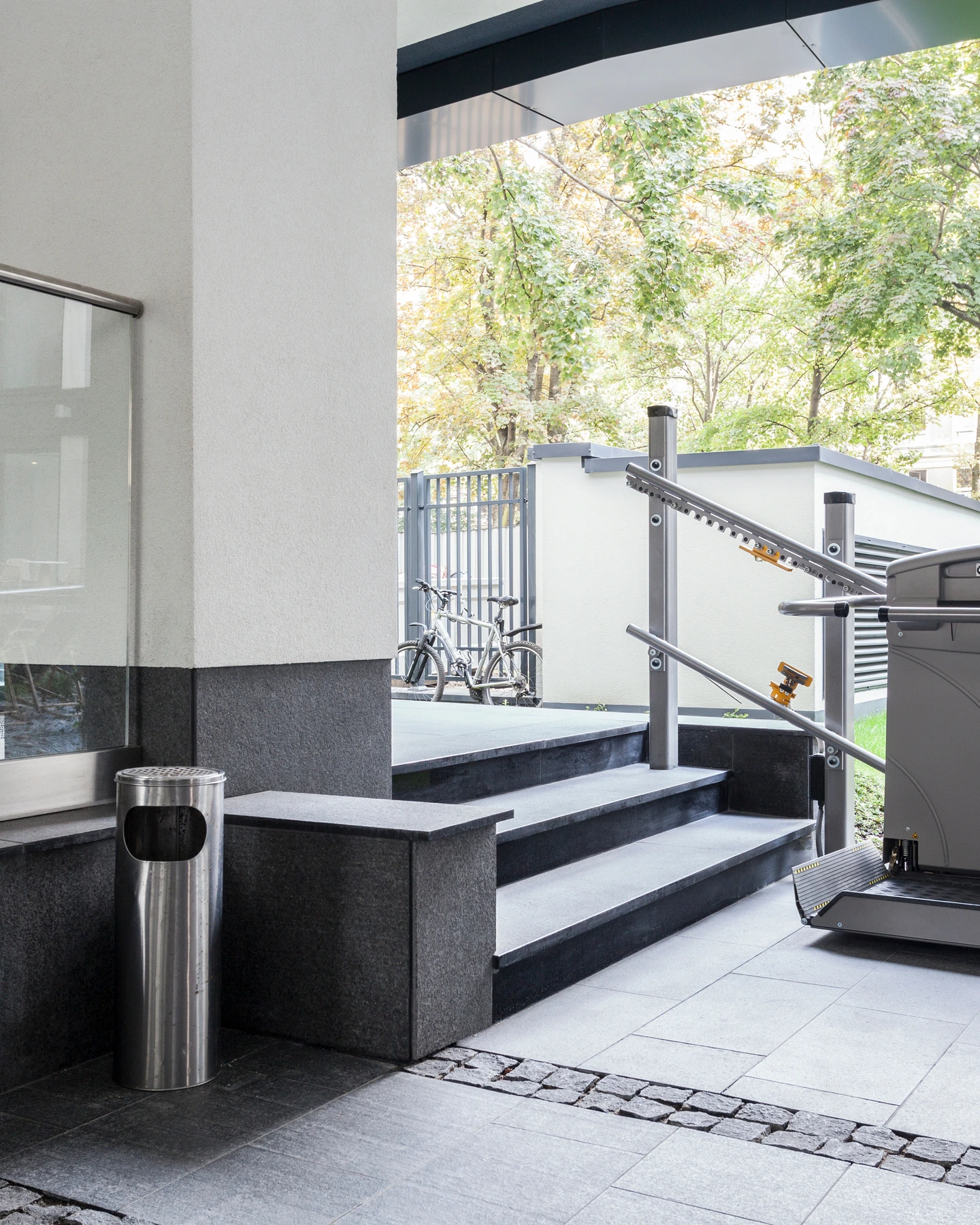
Stairlift, Elevator, Ramp, or Platform Lift? A Side-by-Side Decision Guide
Five different products solve the same problem — getting a person from one level to another inside or outside a home. They range from $1,000 to $75,000. They each work brilliantly in the right situation and waste money in the wrong one. This guide walks through every option with real installed costs, honest drawbacks, and the specific home conditions where each one wins. We sell stairlifts for a living. We will tell you when you should not buy one.
The 5-second decision tree
Answer two questions — can the person transfer out of a wheelchair? and what's your realistic budget? — and you've already eliminated half the options.
Every mobility solution maps to a combination of physical ability and budget. Here's how to cut through the noise in about ten seconds:
Can the person walk, even with a cane or walker? If yes, a stairlift or a ramp handles almost every situation. A stairlift carries them up interior stairs. A ramp handles the 1–6 steps at the front door or back porch. Many homes need both — a ramp at the entry and a stairlift on the inside stairs.
Does the person use a wheelchair full-time and cannot transfer to a seat? A stairlift is off the table. They need a solution that moves the wheelchair itself: a vertical platform lift, a through-floor lift, or a home elevator. Ramps work too, but only for short rises — you need 12 feet of ramp for every 1 foot of height, so a full flight of stairs would require a 36-foot ramp, which doesn't fit in any normal house.
Budget under $6,000? Your realistic options are a straight stairlift ($2,500–$5,500 installed) or a modular aluminum ramp ($1,000–$5,000 installed). Everything else starts above that line.
Budget $6,000–$15,000? You can afford a curved stairlift ($9,000–$15,000), a basic vertical platform lift ($9,000–$15,000 for short rises), or a longer/more complex ramp system. These three solve different problems — a curved stairlift for L-shaped or switchback stairs, a platform lift for wheelchair users needing porch-to-ground access, a ramp for entries with moderate height.
Budget $15,000–$50,000+? The full menu opens. Home elevators ($25,000–$75,000), through-floor lifts ($15,000–$30,000), and enclosed platform lifts ($12,000–$30,000) all become options. At this budget, the question shifts from cost to construction impact — how much work are you willing to do to the house?
Now let's dig into each one.
Stairlifts — when they win (and when they don't)
A stairlift is a motorized chair on a rail bolted to your stair treads. The rider sits down at the bottom, buckles a seatbelt, presses a button, and rides to the top. The rail attaches to the stairs — not the wall, not the banister. Removal later leaves a handful of small screw holes in the treads, nothing structural.
Where stairlifts are the obvious answer
- Interior stairs, 1 flight, person can walk. This is the bread-and-butter scenario. A straight stairlift handles 8 to 16 standard steps for $2,500–$5,500 installed, same-day. No construction, no permits, no contractor scheduling. It's the fastest path from problem to solution in the entire accessibility market.
- Narrow staircases. A stairlift needs only about 26 inches of stair width. That's less than any platform lift or elevator. For older homes with 30–34 inch staircases where an elevator physically will not fit, a stairlift is often the only powered option.
- Renters or people who may move. A straight stairlift can be removed in 2 hours and reinstalled in another home. Curved rails are custom-fabricated and typically can't be reused, but straight units hold resale value — a used straight stairlift sells for $800–$2,000 depending on age and brand.
- Budget matters. At $2,500–$5,500 for a straight install, a stairlift is 5 to 15 times cheaper than a home elevator solving the same problem.
Where stairlifts are the wrong answer
- Full-time wheelchair users who can't transfer. You have to get out of the wheelchair, sit in the stairlift chair, ride up, then transfer back into a second wheelchair at the top. If the person can't do that transfer safely, a stairlift doesn't work.
- Need to move heavy items between floors. A stairlift carries a person, not a laundry basket, not an oxygen concentrator on wheels, not a loaded walker. If moving equipment between floors is part of the daily routine, a through-floor lift or elevator handles both the person and the gear.
- More than 2 floors. Stairlifts work flight by flight. A 3-story home needs two separate stairlifts — one per flight — with a walk-across at each landing. Doable, but at $5,000+ per flight, you're approaching the cost territory where a single home elevator starts making financial sense.
- Home resale is the priority. A stairlift doesn't add resale value to most homes. An elevator can add $20,000–$50,000 to a home's value in markets where aging-in-place features are in demand. If you're spending $12,000 on a curved stairlift and plan to sell the house within 5 years, run the numbers on a shaftless elevator instead.
For a complete breakdown of stairlift types, brands, and what to watch for in quotes, read our Stairlift Buyer's Guide. For pricing detail by component, see the 2026 Stairlift Cost Guide.
Home elevators — when they're worth the investment
A home elevator is a fully enclosed cab inside a shaft (called a hoistway) that travels between floors. It requires structural work — cutting floor openings, building or reinforcing the shaft, running electrical, and sometimes pouring a pit at the base. This is a construction project, not an equipment install.
The four types of home elevator
Hydraulic. Smooth, quiet, handles up to 1,000 lb. Requires a machine room (roughly 4×5 feet). Installed: $30,000–$50,000 for two floors.
Cable-driven (traction). Similar to commercial elevators, scaled down. No machine room in modern designs. Good for 2–4 floors. Installed: $25,000–$45,000.
Pneumatic (vacuum). Clear polycarbonate tube, no shaft, no pit, no machine room. Minimal construction. But the cab is small (37-inch single rider, 52-inch wheelchair), weight limit is 350–450 lb, and they're the loudest type. Installed: $35,000–$60,000.
Winding drum. Simpler cable system, lower cost but limited to 2 floors. Installed: $20,000–$35,000.
Where home elevators are the obvious answer
- Full-time wheelchair user in a 2+ story home. An elevator moves the person and wheelchair together. No transfers, no second wheelchair upstairs. For 10+ years of use, the $30,000–$50,000 cost amortizes to $250–$400/month.
- Multiple people with mobility needs. An elevator serves everyone. A stairlift is one-rider-at-a-time.
- 3+ story homes. A single shaft serves every floor. Multiple stairlifts ($10,000–$30,000 combined) still require walking between lifts at each landing.
- Home value matters. In aging-demographic markets (Florida, Arizona, Carolinas, Pacific Northwest), elevators add $20,000–$50,000 to home value — roughly a 10% premium.
Where home elevators are overkill
- Single straight flight of stairs, ambulatory person. Spending $30,000 on an elevator when a $3,500 stairlift solves the same problem is not a rational use of money unless you're also building equity.
- Tight timelines. Elevator installation takes 2–6 weeks of active construction. A stairlift takes an afternoon. If someone just had surgery and needs help with stairs next week, the elevator won't be ready.
- Older homes without closet stacks. An elevator needs a vertical shaft through every floor it serves. In older homes without aligned closets or utility chases, creating that shaft can mean major framing work — pushing costs to $50,000–$75,000+.
The maintenance question
Home elevators require annual inspections in most states ($150–$300 per visit), plus periodic maintenance on the motor, cables or hydraulic fluid, door mechanisms, and safety systems. Budget $300–$800 per year. Stairlifts, by comparison, need a lubrication and safety check roughly once a year at $100–$200. See our Stairlift Maintenance Guide for what that looks like.
Ramps — the cheapest path to access
A ramp is the oldest accessibility solution and still the most practical in certain situations. It requires no electricity, no batteries, no motor, no annual service contract. A person walks up it, rolls a wheelchair up it, or pushes a walker up it. Gravity and friction are the only moving parts.
Types of ramps
Threshold ramps ($50–$300). Small wedges that bridge a 1–4 inch height difference at a doorway. Same-day purchase-and-place — no installation needed.
Portable folding ramps ($200–$800). Lightweight aluminum, fold for storage, handle 1–3 steps. Good for temporary needs — post-surgery recovery, visiting relatives in a wheelchair.
Modular aluminum ramps ($1,500–$8,000 installed). The workhorse category. Bolt-together sections with non-slip surfaces, handrails, and landing platforms. Configurable for straight runs, L-shapes, and switchbacks. Install: 2–6 hours. Last 20+ years with zero maintenance.
Concrete ramps ($2,000–$8,000+). Permanent and maintenance-free, but once poured, it's poured. Best for new construction where the ramp will never be removed.
Wood ramps ($1,000–$4,000). Cheaper upfront than aluminum, but wood rots, warps, and gets slippery when wet. In humid climates, expect resurfacing every 2–3 years.
Where ramps are the obvious answer
- Entry access with 1–6 steps. For getting into the house through the front door, back door, or garage, a modular ramp is the most cost-effective solution. A 3-step entry (about 21 inches of rise) needs roughly 21 feet of ramp at a 1:12 slope — achievable with a switchback configuration in most yards.
- Wheelchair or scooter users. Unlike stairlifts, ramps let the user roll straight from the driveway into the house without transferring out of their chair. No button to press, no mechanical failure risk, no power dependency.
- Tight budgets. A $2,000 modular ramp solves the same entry-access problem as a $12,000 vertical platform lift. If the rise is 4 steps or fewer and the yard has space, the ramp wins on cost every time.
- VA and Medicaid coverage. Both the VA's Home Improvements and Structural Alterations (HISA) grant and many state Medicaid waiver programs cover ramp installation. A modular aluminum ramp often falls entirely within the HISA grant cap. For details on VA funding, see our Veterans Stairlift Guide.
Where ramps fall short
- Interior stairs. You cannot ramp a standard flight of interior stairs. A 36-inch rise (13 steps) requires 36 feet of ramp length at minimum code slope. No interior hallway has that space. Ramps work for entries, porches, and garage transitions — not for getting between the first and second floor.
- High rises. Even outdoors, anything above 30 inches of rise (about 4–5 steps) starts requiring switchbacks, intermediate landings, and significant yard space. At 48+ inches of rise, a vertical platform lift usually makes more sense than the sprawling ramp system required.
- Aesthetics and property lines. A long ramp changes the visual character of a home's exterior. Some HOAs restrict ramp placement and materials. In dense neighborhoods, the ramp may extend close to property lines or sidewalks, triggering setback requirements.
The ADA slope rule
Residential ramps aren't technically required to follow ADA commercial standards, but the 1:12 slope ratio is the accepted safety benchmark — 12 inches of horizontal run for every 1 inch of vertical rise. Steeper than 1:12 is harder to push a wheelchair up and dangerous when wet. Any ramp builder who suggests a steeper angle to save space is cutting a safety corner.
Platform / wheelchair lifts — the wheelchair solution
A platform lift — also called a wheelchair lift or vertical platform lift (VPL) — is a flat platform that moves vertically between two levels. The user rolls their wheelchair onto the platform, the gates close, and the platform rises or lowers. No transferring out of the chair, no shaft construction, no hoistway.
Two types
Vertical platform lifts (VPLs). The platform moves straight up and down, like a small open elevator. Most residential VPLs handle a rise of 6 to 14 feet (roughly 1 full floor). They mount outdoors on a concrete pad or indoors through a floor cutout. Enclosed models look like a small elevator; unenclosed models have a platform, gate, and railing. Installed cost: $9,000–$20,000, with enclosed units at the higher end. Weight capacity: 500–750 lb.
Inclined platform lifts (IPLs). The platform rides a rail bolted to the staircase — same concept as a stairlift, but carrying a flat platform instead of a chair. Less common in homes (they're everywhere in public buildings for ADA compliance), but viable for homes with wide staircases (36+ inches required). Installed cost: $4,000–$8,000 for straight runs. They avoid cutting any floor openings.
Where platform lifts are the obvious answer
- Wheelchair user, porch entry, 3–8 steps. A VPL sits next to the porch steps and lifts the person from ground level to porch level. No ramp sprawl across the yard, no loss of landscaping, minimal visual impact. This is the most common residential VPL scenario.
- Wheelchair user, split-level home, half-floor rise. Split-levels have that awkward 4–6 step transition between the living room and the den. A VPL handles that rise in a 5×5 foot footprint without touching the stairs.
- Outdoor use in tight spaces. Where a ramp would need 20+ feet of run length that the yard doesn't have, a VPL goes straight up in a 5×5 foot footprint. The tradeoff is cost — a VPL at $12,000 vs a ramp at $3,000 — but when space is the constraint, the VPL wins.
Where platform lifts don't make sense
- Full floor-to-floor rise in a 2-story home. Most residential VPLs max out at 14 feet of travel. A full floor rise (typically 9–10 feet floor-to-ceiling plus the floor/ceiling structure) is at the edge of that range. If your floor-to-floor height is over 12 feet, or you need more than 1 floor of travel, a through-floor lift or home elevator is the better match.
- Ambulatory person who just needs help with stairs. If the person can walk but struggles with stairs, a $3,500 stairlift solves the problem at a quarter of the cost of a VPL. Platform lifts exist for wheelchair transport — using one just to carry a walking person is like buying a pickup truck to commute to an office job.
- Speed. VPLs are slow — most travel at about 8–12 feet per minute. A full-floor rise takes 45–90 seconds. That doesn't sound like much until you're riding it four times a day. Stairlifts move at roughly 20–25 feet per minute. Elevators are faster still.
Through-floor lifts — the option nobody talks about
A through-floor lift — sometimes called a shaftless elevator or homelift — is a self-contained unit that travels through a hole cut in the floor/ceiling between two levels. It doesn't need a hoistway (shaft), a machine room, or a pit. The unit creates its own enclosure as it moves. When the platform is on the upper floor, the opening on the lower floor is covered by a flush panel. When it descends, the opening on the upper floor is covered.
This category sits in a pricing and capability gap between stairlifts and full home elevators. It's the option that most comparison articles either leave out entirely or mention in a single sentence. That's a mistake, because for a specific set of homes, it's the right answer.
How they work
The installer cuts a rectangular opening in the ceiling/floor between two levels — about 36×54 inches for a standing model or 36×60 inches for wheelchair access. The unit contains its own motor, platform, safety gates, and enclosure panels. No external shaft is built. Travel speed: 6–10 feet per minute. Weight capacity: 330–550 lb depending on model. Limited to one floor of travel.
Where through-floor lifts are the obvious answer
- Older homes where an elevator shaft is impractical. Homes built before 1970 often have no aligned closet stacks, no utility chases, and balloon framing that makes shaft construction expensive and invasive. A through-floor lift needs a 3×5 foot floor opening and about 7×5 feet of room space on each level. That's a corner of a bedroom and a corner of a living room — not a construction project.
- Wheelchair user on a $15,000–$30,000 budget. This is the price gap where through-floor lifts live. Too expensive for a stairlift solution, but $10,000–$40,000 cheaper than most home elevators. If the need is one-floor travel for a wheelchair user, a through-floor lift delivers elevator-like functionality at platform-lift pricing.
- Minimal construction tolerance. Some homeowners — especially elderly couples living alone — cannot handle weeks of construction disruption. A through-floor lift installs in 2–5 days, most of which is the floor cutout and electrical work. Compare that to 2–6 weeks for a traditional elevator.
Where through-floor lifts fall short
- More than 2 floors. Through-floor lifts are single-floor devices. Period. If you need to go from the ground floor to the second floor and also to the basement, you need two units or a real elevator.
- High weight capacity needs. Most top out at 450–550 lb. If you need 700+ lb capacity (bariatric rider plus heavy power wheelchair), a hydraulic home elevator is the only option.
- Speed and frequency. At 6–10 feet per minute, a full floor rise takes over a minute. For someone making 6–8 trips between floors per day, that adds up. An elevator at 30–40 feet per minute is noticeably faster for high-frequency users.
- Resale optics. A through-floor lift leaves a visible platform and a floor opening in two rooms. Some buyers see accessibility equipment as a negative (unfairly, but it happens). An elevator behind a standard door reads as a luxury upgrade. A through-floor lift reads as medical equipment.
Brands worth knowing
Stiltz, Terry Lifts (UK-made, sold in the US through dealers), and Savaria are the primary through-floor lift manufacturers with US distribution. Stiltz is the most recognizable name in this category — their duo and trio models are the most commonly installed residential through-floor lifts in America. Savaria's Telecab is a direct competitor at similar pricing. If you're quoted a through-floor lift from a brand you've never heard of, ask for the UL or CSA certification number before signing.
The big comparison table
| Solution | Installed Cost | Install Time | Best For | Key Drawback |
|---|---|---|---|---|
| Straight stairlift | $2,500–$5,500 | 2–4 hours | Ambulatory person, single straight flight | Requires ability to transfer; no wheelchair transport |
| Curved stairlift | $9,000–$15,000 | 1–2 weeks (fab) + 1 day install | L-shaped, switchback, or spiral stairs | Custom rail can't be reused; higher cost |
| Modular ramp | $1,500–$8,000 | 2–6 hours | Entry access, 1–6 steps, wheelchairs and walkers | Needs significant yard space for higher rises |
| Portable ramp | $200–$800 | Immediate | Temporary access, 1–3 steps, visiting wheelchair user | Short rise only; must be set up each use |
| Vertical platform lift (VPL) | $9,000–$20,000 | 1–3 days | Wheelchair user, porch/deck access, split-levels | Slow; limited to ~14 ft travel; requires concrete pad |
| Inclined platform lift | $4,000–$8,000 | 1–2 days | Wheelchair user, wide staircase, public ADA compliance | Requires 36"+ stair width; slow; uncommon in homes |
| Through-floor lift | $15,000–$30,000 | 2–5 days | Wheelchair user, 1-floor travel, no shaft space | Single floor only; lower weight capacity; slow |
| Home elevator (hydraulic) | $30,000–$50,000 | 3–6 weeks | Full wheelchair independence, 2–4 floors, home value | Requires shaft, pit, machine room; major construction |
| Home elevator (pneumatic) | $35,000–$60,000 | 1–3 weeks | Minimal construction, dramatic design, 2–3 floors | Small cab; lower weight limit; louder; expensive |
| Home elevator (cable/traction) | $25,000–$45,000 | 3–6 weeks | Multi-floor travel, moderate budget, no machine room | Shaft required; structural work; ongoing maintenance |
These ranges reflect 2026 national averages for professional installation. Regional variation is real — expect 10–20% higher costs in the Northeast, Pacific Northwest, and coastal California. Rural areas with fewer certified installers may also see premium pricing due to travel charges. Always get three local quotes.
Four families, four different answers
Abstract specs only go so far. Here's how real household situations map to real solutions.
Scenario 1: Margaret, 74, recovering from knee replacement in a 1970s ranch with 3 front porch steps
Margaret walks with a cane. She'll improve over 6 months of PT, but three front-door steps are a fall risk. Interior is all one level.
Best solution: modular aluminum ramp ($1,800–$2,500 installed). Three steps is about 21 inches of rise, needing roughly 21 feet of ramp at 1:12 slope. An L-shaped ramp fits along her walkway. Install takes a morning. When she recovers, the modular sections unbolt and resell easily.
Scenario 2: Robert and Linda, both 79, in a 2-story Colonial with a straight 13-step interior staircase
Both use the second floor daily — bedroom and only full bathroom are upstairs. Robert has COPD, Linda has knee arthritis. Neither uses a wheelchair. Budget: $5,000–$7,000.
Best solution: straight stairlift ($3,000–$4,500 installed). Single straight flight, both ambulatory, budget aligns. Call/send controls let Robert send the chair down for Linda. If they later need entry access, a ramp at the back door adds $1,500. Total under $6,000.
For help understanding what a fair quote looks like in this scenario, see our 2026 Stairlift Cost Guide.
Scenario 3: David, 62, spinal cord injury, full-time power wheelchair, in a 2-story Cape Cod with a narrow L-shaped staircase
David can't transfer out of his wheelchair. Bedroom is on the second floor. Staircase is 32 inches wide with a 90-degree turn. He plans to stay permanently. Has a VA Specially Adapted Housing (SAH) grant.
Best solution: through-floor lift ($18,000–$25,000 installed). A stairlift is out — David can't transfer. The house has no aligned closet stack for an elevator shaft, and building one in a Cape Cod would cost $60,000+. A through-floor lift cuts a 3×5 foot opening between floors, installs in 3–4 days, and carries David and his power chair. The SAH grant (up to $109,986 in 2026) covers the full cost.
Scenario 4: The Nguyen family building a new 3-story home, planning for aging parents to move in within 5 years
No current mobility issues, but the family wants to future-proof. Home is under construction. Budget: $35,000–$50,000.
Best solution: home elevator ($30,000–$45,000 installed during construction). During new construction, the framing crew boxes in the shaft during the normal build schedule — no retrofit cutting, no structural surprises. A 3-stop elevator handles all three floors, carries a wheelchair if needed later, and adds $30,000–$50,000 to resale value. Installing during construction saves $10,000–$20,000 vs retrofitting later.
FAQ
Can I install a stairlift myself to save money?
Some straight stairlift models are sold for DIY installation (AmeriGlide and Harmar offer kits). You'll save $500–$1,000 on labor, but you lose the professional safety inspection and installer warranty. If you're handy with power tools, it's doable for straight rails. Curved stairlifts are never DIY — the rail fabrication and calibration require factory-trained technicians.
Does Medicare pay for any of these solutions?
Medicare does not cover stairlifts, home elevators, ramps, platform lifts, or through-floor lifts. It classifies these as home modifications, excluded from Parts A through D. Some Medicare Advantage plans (Part C) include a home modification benefit ($1,000–$3,000/year) that can partially offset costs. Medicaid waiver programs in many states cover stairlifts and ramps, but coverage varies by state. The VA covers all five solutions under SAH, SHA, and HISA grants. Full breakdown: Stairlift Funding Guide.
Which option adds the most home resale value?
A home elevator is the only option that consistently adds resale value — 7–10% premium in markets with aging demographics. Stairlifts, ramps, platform lifts, and through-floor lifts do not add value. Stairlifts and modular ramps can be removed before sale ($500–$1,500 and $200–$500 respectively). A through-floor lift leaves a floor opening that must be patched if removed.
How long does each solution last?
Stairlifts: 10–15 years (batteries replaced every 2–3 years at $150–$300). Home elevators: 20–30 years with proper maintenance. Aluminum ramps: 20+ years, zero maintenance. Wood ramps: 7–12 years. VPLs and through-floor lifts: 15–20 years. All motorized solutions need motor or hydraulic component replacements around the 8–12 year mark.
What if I need access to my front door AND between floors?
This is the most common two-part problem. The usual combination is a ramp at the entry (solving the porch steps) plus a stairlift on the interior stairs (solving the floor-to-floor problem). For a walking person, that combination runs $4,000–$8,000 total — a $2,000 ramp plus a $3,000–$5,000 stairlift. For a wheelchair user, the combination shifts to a VPL at the entry ($12,000–$18,000) plus a through-floor lift or elevator inside. Budget $25,000–$45,000 for the full wheelchair-accessible package.
Are permits required?
It depends on the solution and your municipality. Stairlifts: typically no permit required — they bolt to existing stairs with no structural modification. Ramps: some municipalities require a building permit for permanent ramps, especially if they change the home's footprint or approach a property line. Modular ramps that bolt together without a foundation often skip this requirement. Platform lifts: permit requirements vary; outdoor VPLs on concrete pads may trigger a permit. Through-floor lifts: almost always require a permit because you're cutting a structural floor opening. Home elevators: always require permits, structural engineering review, and inspections — this is a regulated construction project in every US jurisdiction.
Can I rent instead of buy?
Stairlifts and modular ramps are the two solutions commonly available for rental. Straight stairlift rentals run $100–$250 per month, with an installation fee of $500–$1,000. If you need the lift for less than 18–24 months (post-surgery recovery, temporary caregiver situation), renting can be cheaper than buying. Modular ramp rentals run $100–$200 per month. Home elevators, through-floor lifts, and platform lifts are not typically available for rental — the installation and removal costs are too high to make rental economics work.
What about used or refurbished equipment?
Used straight stairlifts save 30–50% — a refurbished Bruno Elan or Handicare 1000 runs $1,500–$2,500 installed. Buy from a dealer offering 12+ months warranty who replaces batteries and safety sensors. Used curved stairlifts rarely fit another home (custom rails), so that market is thin. Used aluminum ramps hold value perfectly. Used elevators and platform lifts require professional inspection — a worn cable is a safety issue, not just maintenance.
Which solution works during a power outage?
Stairlifts run on DC batteries and work during outages — typically 15–20 round trips per charge. Ramps need no power. VPLs and through-floor lifts usually require AC power; some offer limited battery backup (2–4 trips). Home elevators require power, though hydraulic models have a manual lowering valve for emergencies. In hurricane zones and rural grids, the stairlift's battery independence is a real safety advantage.
I'm not sure which solution I need. What's the first step?
Start with a free in-home assessment. A qualified mobility consultant will look at your staircase geometry, measure doorways and hallways, evaluate the person's physical capabilities, and discuss budget constraints — then recommend the right category of solution before you ever see a price. The assessment itself should be free and come with no purchase obligation. If an assessor pushes a specific brand or product during the first visit without measuring anything, find a different company. Request your free assessment here.
Your free home assessment is one phone call away
No deposit. No obligation. No high-pressure sales. A certified installer visits your home, measures once, and gives you a written quote that's honored for 30 days. It takes about 45 minutes. More than 15,000+ homeowners have said yes over the last 15 years.
- Licensed in all 50 states
- $2M liability insured
- BBB A+ since 2012
- 15+ years in business