Stairlifts for Parkinson’s, MS & Progressive Conditions (2026)
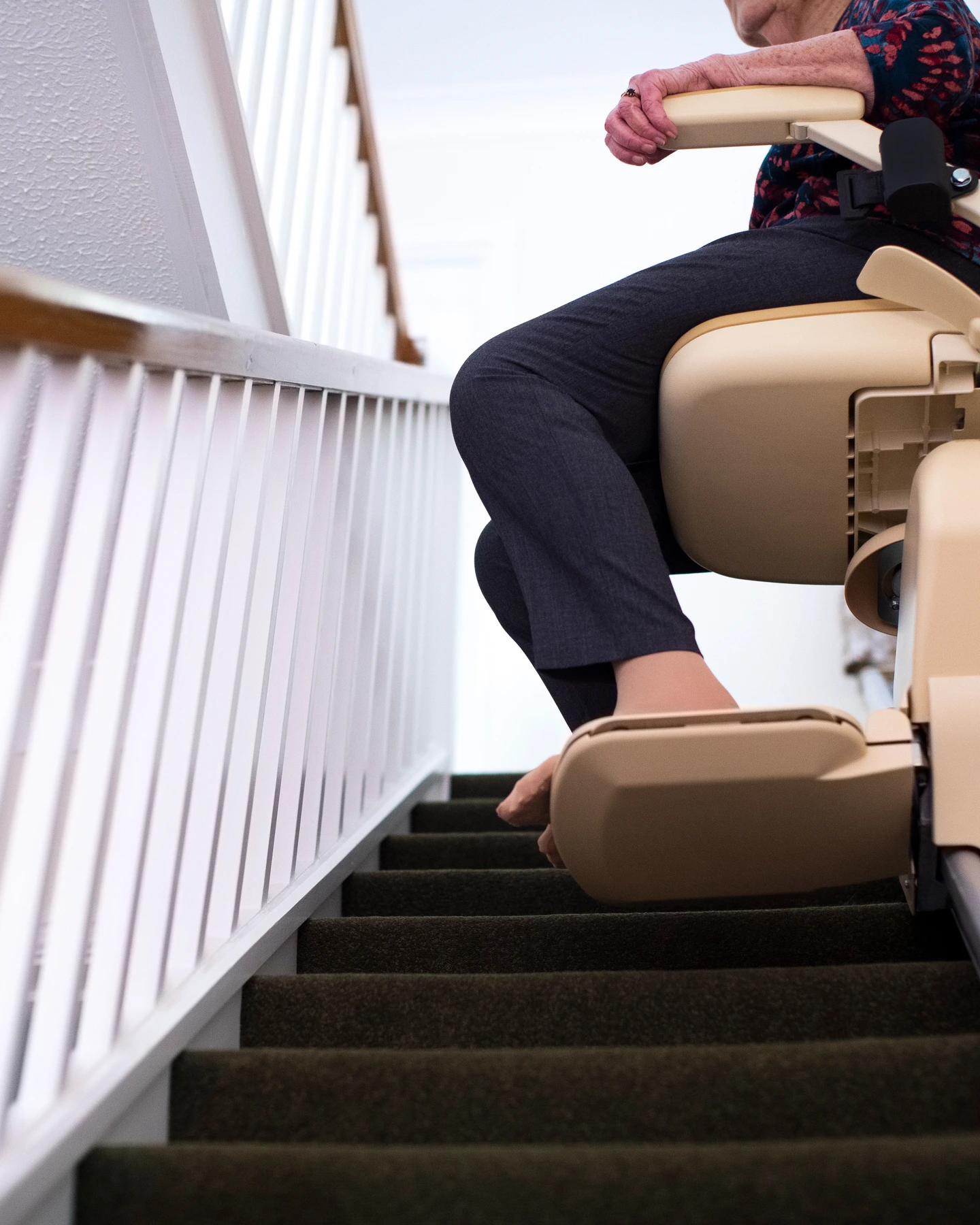
Why Progressive Conditions Change the Stairlift Conversation
A stairlift for someone with arthritis or a hip replacement serves a stable need — the condition is not expected to worsen dramatically. Progressive neurological conditions (Parkinson's disease, multiple sclerosis, ALS, Huntington's disease) introduce a fundamentally different calculus: the rider's abilities will change over time, sometimes rapidly.
This guide covers the condition-specific features that matter, the timing question ("when should we install?"), and the funding paths available to people with progressive diagnoses.
Parkinson's Disease: Tremor, Freezing, and the On/Off Problem
The standard stairlift toggle switch requires sustained pressure — release the toggle and the lift stops. For someone with tremor, maintaining steady pressure is difficult. Solutions:
- Paddle control: A large flat paddle replaces the small toggle. The rider rests their forearm on it rather than pinching a switch. Tremor-friendly because it requires gross motor control, not fine motor.
- Remote control: A wireless remote with large buttons allows a caregiver to operate the lift from the landing. Useful during "off" periods when the rider has limited hand control.
- Constant-on mode: Some models offer a mode where one button press starts the ride and it continues to the end without sustained pressure. The rider just needs to press once.
Freezing of gait — where the feet feel glued to the floor — is common in mid-to-late Parkinson's. The critical moment is the transition from standing to sitting on the stairlift seat, and from sitting to standing at the landing.
- Powered swivel seat: The seat rotates 90 degrees at the landing, positioning the rider to step directly forward instead of twisting. Eliminates the pivot step that triggers freezing episodes.
- Seat height adjustment: Setting the seat height to match the rider's natural sitting position reduces the squat-to-sit distance, which is difficult during freezing.
- Landing clearance: Position the top landing stop so the rider has 2-3 feet of clear floor in front of the swiveled seat, providing time to overcome a freeze before stepping off.
Levodopa creates "on" periods (medication working, symptoms controlled) and "off" periods (medication wearing off, symptoms return). Stairlift usage should be planned around medication timing when possible — but a stairlift must be safe to use during off periods too, because emergencies and bathroom needs do not wait for medication.
This is why the paddle control and powered swivel matter most for Parkinson's: they make the lift usable even during off periods when fine motor skills and balance are at their worst.
Multiple Sclerosis: Relapses, Fatigue, and Heat
Relapsing-remitting MS (RRMS) creates periods where stair climbing is impossible (during relapses) alternating with periods where it is merely difficult (remissions). The stairlift must handle both states:
- During remissions: the rider may use the stairlift for some trips and walk other times
- During relapses: the stairlift becomes essential, often multiple times per day
- The stairlift must be available 24/7 because relapses are unpredictable
For progressive MS (PPMS or SPMS), the trajectory is more predictable and the stairlift becomes a permanent daily-use device. Consider a powered swivel and heavy-duty model for long-term progressive use.
MS fatigue is not ordinary tiredness — it is a neurological symptom that worsens with exertion. Climbing stairs during a fatigue episode can exhaust the entire day's energy budget. A stairlift preserves energy for the activities that matter: cooking, bathing, spending time with family.
Many MS patients use the stairlift selectively — walking the stairs when energy is good, riding when it is not. This flexible usage pattern is perfectly normal and extends the useful life of the stairlift.
Uhthoff's phenomenon — worsening of MS symptoms with heat — is relevant for outdoor stairlift installations. A metal stairlift seat in direct summer sun can reach 140°F+. Solutions: always use the seat cover, install on the shaded side of the porch if possible, and consider a weather canopy over the landing area. See our winter guide for cold-weather considerations.
ALS: Planning for Rapid Progression
ALS progresses faster than Parkinson's or MS. There is a window of time — typically months, not years — when a stairlift is the right solution: the person can still transfer to a seat and operate controls, but cannot safely walk stairs. Before this window, stairs are manageable. After it, a stairlift is no longer sufficient (a through-floor lift or elevator becomes necessary).
Install at the first sign of stair difficulty. Do not wait for a fall. The HISA grant process takes 30-90 days, and ALS progression does not pause for paperwork.
For ALS patients, a stairlift should be part of a phased plan:
- Phase 1: Stairlift installation ($2,500-$5,500). Provides 6-18 months of independent stair access.
- Phase 2: First-floor bedroom/bathroom setup. Eliminates the need for regular stair use.
- Phase 3: Through-floor lift or home elevator if full-home access remains important and the person transitions to a wheelchair.
VA SAH grants (up to $109,986) can fund the entire progression from stairlift through elevator for service-connected ALS veterans. The ALS Association also maintains a list of equipment loan programs.
When to Install: Before the Fall, Not After
The most common mistake with progressive conditions is waiting until a fall happens. Falls on stairs cause hip fractures, traumatic brain injuries, and hospitalizations that accelerate decline.
- Using the handrail with both hands
- Pausing mid-staircase to rest
- Avoiding the stairs entirely (sleeping on the couch, skipping showers)
- Near-misses or minor stumbles
- Taking stairs only during "on" medication periods
- Family members hovering or spotting on the stairs
Any one of these signals is reason to get a stairlift assessment. Do not wait for all of them.
Funding Paths Specific to Progressive Conditions
| Funding Source | Parkinson's | MS | ALS |
|---|---|---|---|
| VA HISA ($6,800) | If service-connected | If service-connected | Presumptive SC for all veterans |
| Medicaid waivers | Most states | Most states | Most states |
| Disease-specific nonprofits | Parkinson's Foundation | National MS Society | ALS Association |
| Equipment loan programs | Limited | MS Society chapters | ALS loan closets |
| Tax deduction | Yes | Yes | Yes |
ALS is a presumptive service-connected condition for all veterans, regardless of when or where they served. This means every veteran diagnosed with ALS qualifies for the full $6,800 HISA grant — no need to prove the connection between service and diagnosis. See our veteran stairlift guide for application steps.
The Caregiver's Role in the Decision
With progressive conditions, the person who needs the stairlift is often not the person making the decision. Caregivers — spouses, adult children, home health aides — drive the purchasing process.
- The rider may resist. Accepting a stairlift means accepting that the condition has progressed. Give the rider control over timing and model selection where possible.
- The caregiver needs the stairlift too. Spotting someone on stairs is physically exhausting and dangerous for the spotter. A stairlift protects the caregiver as much as the rider.
- Plan for caregiver transitions. If the current caregiver is the spouse and both are aging, the stairlift may eventually serve both people.
Controls and Features That Matter for Neurological Conditions
| Feature | Why It Matters | Best For |
|---|---|---|
| Paddle control | Requires forearm pressure, not finger dexterity | Tremor (Parkinson's) |
| Powered swivel | Eliminates pivot step at landing | Freezing (Parkinson's), balance (MS) |
| Remote control | Caregiver can operate from landing | Off periods, severe relapses |
| Powered footrest | Folds automatically, no bending required | All progressive conditions |
| Heavy-duty model (400+ lbs) | Wider seat, higher weight capacity | Wheelchair transfer, larger riders |
| Constant-on mode | One press starts full ride | Tremor, hand weakness (ALS) |
When a Stairlift Is No Longer Enough
A stairlift requires the ability to transfer to and from a seat and at least minimal hand/arm control. When a progressive condition advances beyond these capabilities:
- Through-floor lift: Handles a wheelchair directly. $15,000-$30,000. See our comparison guide.
- Home elevator: Full wheelchair access between floors. $20,000-$75,000+.
- First-floor living: Bedroom, bathroom, and kitchen on one level eliminates the stair problem entirely.
- Stair climbing chair: A caregiver-operated tracked device that carries a seated or wheelchair-bound person. See our climbing chair comparison.
Planning the transition before it is urgent prevents the panic decisions that lead to unnecessary expense or unsafe situations.
Frequently Asked Questions
Yes, with the right controls. A paddle control replaces the small toggle with a large flat surface operated by forearm pressure. A constant-on mode requires only one button press to start the ride. A wireless remote allows a caregiver to operate the lift during severe off periods.
Install when relapses make stairs unsafe or when fatigue from stair climbing reduces quality of life. For RRMS, install before a major relapse forces a crisis decision. For progressive MS, install at the first sign of consistent stair difficulty. Do not wait for a fall.
Yes. ALS is a presumptive service-connected condition for all veterans. Every veteran with ALS qualifies for the full $6,800 HISA grant regardless of service branch, MOS, or deployment history. Apply through VA Prosthetics immediately upon diagnosis.
For ALS-related hand weakness, the constant-on mode (one press starts the full ride) combined with a wireless caregiver remote provides the most flexibility. As hand strength decreases, the caregiver can take over operation without any hardware changes.
Living with a Progressive Condition?
A 15-minute assessment helps us understand your specific condition, current abilities, and likely progression. We recommend the controls, features, and configuration that will serve you longest — and we plan ahead for what comes next.
Request your free assessment — mention your diagnosis so we can prepare condition-specific recommendations before the visit.
Ready to Get Started?
Free in-home assessment within 24 hours. No pressure, no obligation.