Stairlift After Hip Replacement: Recovery Timeline & Rental Math (2026)
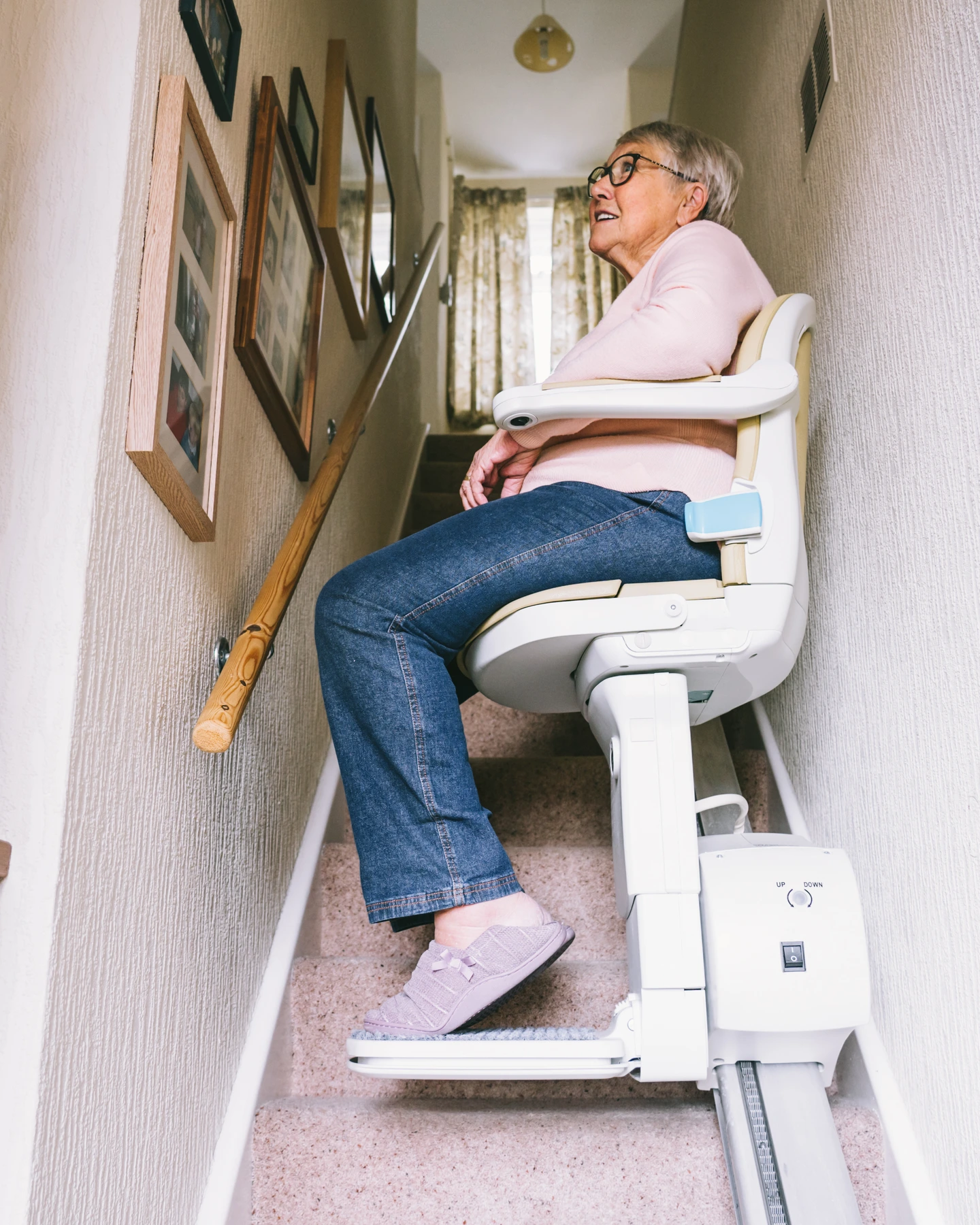
Over 450,000 hip replacements are performed in the US every year. Hospital stays have shortened to 1-2 days. That means a patient goes from operating room to their own staircase in about 48 hours. The staircase did not change. The patient's ability to climb it did. This is the most common medical reason families call us, and the timeline is always tight.
The hip replacement recovery timeline
- Day 0-1: Surgery. Most patients walking (with walker) within hours.
- Day 1-2: Hospital discharge. PT clears for home if you can walk 150 feet with walker. Notice what is NOT on the clearance list: stair climbing.
- Week 1-2: Walker-dependent. Stairs technically possible with "good leg up, bad leg down" but painful, slow, and risky.
- Week 3-6: Walker to cane. Stairs require significant effort and concentration.
- Week 6-12: Cane to independent walking on flat. Stairs manageable with handrail but still harder than before surgery.
- Month 3-6: Full recovery for most patients.
The critical stairlift window is Week 1 through Week 12. Some patients need support for the full 6 months. A small percentage (complications, bilateral, pre-existing conditions) need a stairlift permanently.
Why stairs are the problem after hip surgery
- Hip flexion beyond 90 degrees: Stair climbing requires ~65-70 degrees — within safe range but close enough that patients are cautious, move slowly, and tire quickly.
- Single-leg loading: Each step requires the ascending leg to bear full body weight while the hip is in flexion. Surrounding muscles (gluteus medius, iliopsoas) are weakened from surgery and take 6-12 weeks to regain functional strength.
- Balance disruption: Anesthesia, pain medications (especially opioids in weeks 1-2), and altered gait all affect balance.
- Fear: Patients who experienced degenerating hip pain develop stair-avoidance behavior before surgery. The learned fear response persists after surgery even when physical pain is gone.
Temporary vs permanent: reading the signals
The honest assessment
About 70-80% of hip replacement stairlift needs are temporary — the patient recovers enough stair-climbing ability within 3-6 months. The remaining 20-30% become permanent users due to pre-existing conditions the hip replacement did not address.
| Signals: temporary (3-6 months) | Signals: may be permanent |
|---|---|
| First-time, unilateral replacement | Bilateral (both hips), simultaneous or staged |
| Was climbing stairs (with difficulty) before surgery | Was already avoiding stairs due to other conditions |
| No other significant mobility limitations | Other conditions remain (knee arthritis, COPD, heart failure) |
| Engaged in PT, progressing normally | Age over 80 with multiple comorbidities |
| Age under 75, no major comorbidities | Lives alone, no one to spot on stairs during recovery |
Rental math: when renting beats buying
The crossover point: 5 months
If you need a stairlift for less than 5 months, renting is cheaper. If more than 5 months, buying is cheaper.
| Duration | Rental cost | Purchase cost (net after resale) | Verdict |
|---|---|---|---|
| 3 months | $950-$1,750 | $1,000-$3,000 | Rent |
| 3-5 months | $1,150-$2,250 | $1,000-$3,000 | Close call |
| 5+ months | $1,400-$2,500+ | $1,000-$3,000 | Buy |
| Bilateral (both hips staged) | $2,300-$4,000+ | $1,000-$3,000 | Buy |
Rental costs: $500-$1,000 install fee (one-time) + $150-$250/month. Purchase: $2,500-$4,500 new installed; resale value $800-$1,500 after 6 months. We offer both and will tell you honestly which makes sense.
Seated angle and hip precautions
Posterior approach (older but still common)
- No hip flexion beyond 90 degrees
- No internal rotation
- No crossing legs
- Duration: 6-12 weeks
Anterior approach (newer, increasingly standard)
- Generally fewer restrictions — many surgeons allow flexion beyond 90 degrees from day one
- No hyperextension
- Duration: 2-6 weeks
How this affects stairlift use
A standard stairlift positions the rider at ~90-95 degrees of hip flexion — similar to a dining chair. Key adjustments:
- Raise the seat height. 1-2 inches above standard reduces flexion to ~80-85 degrees — well within precautions for both approaches. Available on Bruno Elite and Stannah Siena.
- Powered swivel seat. Eliminates the need to twist the operated hip at the top landing. The single most valuable upgrade for hip replacement patients. $300-$600.
- Footrest position. Knee at or slightly below hip level — never above, which pushes flexion past 90 degrees.
The occupational therapist recommendation
Before discharge, the OT assesses stair climbing and makes one of three recommendations:
- Can manage stairs — no stairlift needed (minority of Day 1-2 post-op patients)
- Can manage with difficulty/risk — stairlift recommended for recovery (the majority)
- Cannot safely attempt stairs — stairlift required or stay on one level
Why the OT letter matters
- Satisfies Medicaid HCBS waiver documentation
- Supports IRS medical deduction (proof of medical necessity)
- Basis for VA HISA grant application
- Satisfies condo/HOA board approval requirements
- Some Medicare Advantage plans require OT/PT recommendation specifically
Ask your OT for a written letter before discharge. One paragraph, on letterhead, stating a stairlift is medically recommended. It takes 5 minutes and opens every funding and approval door.
Discharge planning: the 48-hour window
Start before surgery, not after
2-4 weeks before surgery
Call us for a free assessment. Mention the surgery date and surgeon. We measure, confirm model, and give you a quote. Reserve the rental unit or order equipment for delivery before surgery.
1-3 days before surgery
We install the stairlift. The patient test-rides while still mobile and comfortable. Pre-surgery test rides build confidence and familiarity with controls — post-surgery is not the time to learn new equipment.
Surgery day through discharge (Day 0-2)
The stairlift is already installed and waiting. Patient arrives home, walks to the staircase with walker, sits on the stairlift, rides to the bedroom, and rests. No stair climbing on Day 1.
Surgery within the week and you have not called yet?
Call today. Straight rail: installed within 3-5 business days of assessment. Same-day assessment and install within 48 hours often possible.
Will insurance pay for a post-surgery stairlift?
| Source | Covers stairlifts? | Details |
|---|---|---|
| Medicare Part B | No | Classified as home modification, not DME |
| Private health insurance | No | Nearly all exclude home modifications |
| Workers' comp | Rarely | Only if injury is work-related |
| Medicare Advantage (Part C) | Maybe | Some plans include supplemental home-modification benefits |
| Medicaid HCBS waivers | Yes (47 states) | $7,500-$10,000 typical cap; 30-90 day application |
| VA HISA grant | Yes | Up to $6,800 service-connected |
| IRS medical deduction | Always | Full cost deductible if you itemize |
We handle paperwork for all programs at no additional cost. Full funding guide.
What to do right now if surgery is scheduled
- Check your staircase. Straight or curved? How many steps? Grounded outlet within 6 feet? Take phone photos from bottom and top.
- Talk to the OT. Get the written recommendation letter before surgery if possible.
- Call us. Mention surgery date. Free assessment within days, equipment reserved or installed before surgery.
- Decide rent vs buy. First-time unilateral in a patient under 75? Start with 3-month rental. Convert to purchase later if needed.
- Check funding. Veteran? Start VA HISA now. Medicaid-eligible? Start HCBS waiver now. Both take weeks to process.
The single biggest mistake: waiting until after surgery to think about the staircase. Two phone calls before surgery — one to us, one to the OT — solves the problem before it starts.
Frequently asked questions
Most patients benefit from a stairlift for the first 6-12 weeks. Hospital discharge happens within 1-2 days, but full stair-climbing recovery takes 3-6 months. About 70-80% of needs are temporary. Your hospital OT will assess stair-climbing ability before discharge.
If you expect to need it for less than 5 months, rent ($950-$1,750 for 3 months). If 5+ months or bilateral replacement, buy. The rental cost exceeds purchase-minus-resale around the 5-month mark.
Yes. Standard seat positions at ~90-95 degrees, within safe range for both approaches. Raising the seat 1-2 inches reduces flexion to 80-85 degrees. A powered swivel eliminates the need to twist the operated hip — the single most valuable upgrade for hip replacement patients.
We recommend 1-3 days before surgery. The patient test-rides while still mobile. A straight rail takes 2-4 hours to install. If surgery is within the week, same-day assessment and install within 48 hours is often possible.
Traditional Medicare does not cover stairlifts, even with a surgeon's prescription. Some Medicare Advantage plans offer supplemental benefits. The IRS medical deduction always applies. VA HISA covers up to $6,800. Medicaid HCBS waivers cover stairlifts in 47 states.
Related guides
Ready to Get Started?
Free in-home assessment within 24 hours. No pressure, no obligation.