Product Guide · 10 min read · Updated April 2026

Stairlift Seat Options: Swivel, Perch, Fold, Power
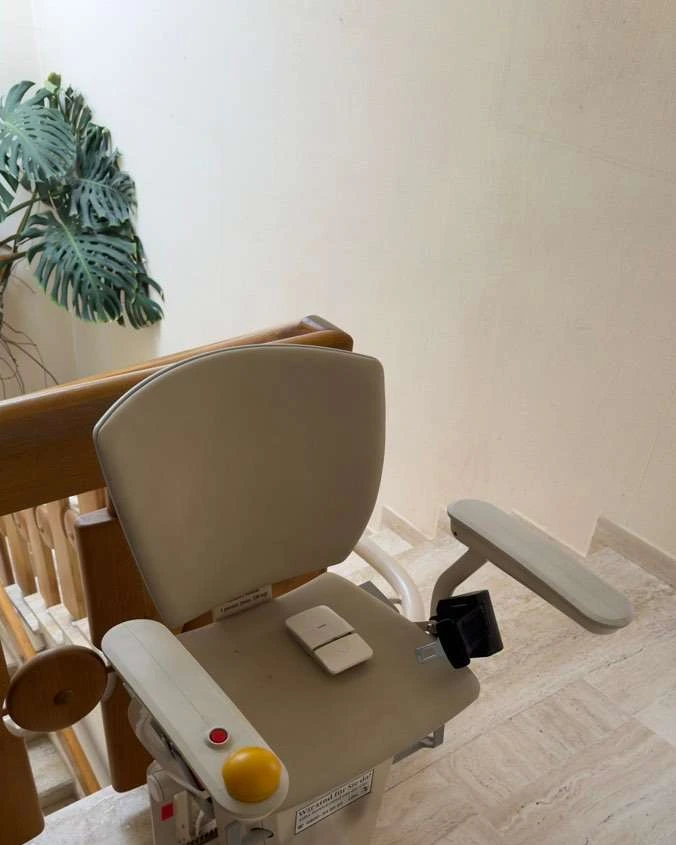
The seat is the part of the stairlift you actually live with. The motor, the rail, and the safety systems do their job invisibly. But the seat is what you sit in multiple times a day, what you swivel at the top landing, what you fold against the wall when the grandkids visit. Picking the wrong seat type is the most common source of buyer regret we see. This guide covers every seat option available on residential stairlifts in 2026 and which conditions steer you toward which type.

(800) XXX-XXXX
featured-seat-options

The five seat types at a glance

5seat types available
90%of riders use a standard or swivel seat
$0-$500typical seat upgrade cost

Residential stairlifts in the US market offer five distinct seat configurations. Most riders end up with one of the first three. The perch and bariatric seats serve specific medical and physical needs.

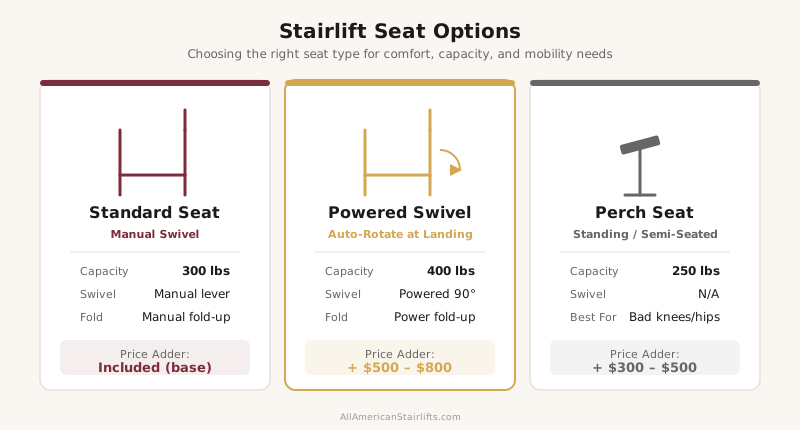
  1. Standard fold-up seat — the base configuration on every model. Folds up against the wall when not in use.
  2. Manual swivel seat — rotates 90 degrees at the top landing for safer exit. Operated by a hand lever.
  3. Power swivel seat — same rotation, operated by a button. No hand strength required.
  4. Perch (standing/semi-standing) seat — a narrow saddle that supports the rider in a semi-standing position with knees slightly bent.
  5. Bariatric wide seat — a reinforced, wider seat pan for riders over 300 lb.

These are not tiers from cheap to expensive. They are configurations matched to different bodies and different medical situations. A 140-pound rider with full mobility might be perfectly served by a standard fold-up with no swivel. A 180-pound rider who just had a knee replacement needs a power swivel. A 350-pound rider needs a bariatric seat regardless of their mobility. The seat choice follows the rider, not the budget.

Standard fold-up seat

The standard fold-up seat is the base configuration that ships with every residential stairlift. When the rider is using the lift, the seat is down, the armrests are down, and the footrest is down. When the rider is done, they stand, fold the seat up against the wall, and the armrests and footrest fold with it through a mechanical linkage. The folded profile is 11-13 inches, depending on the model — narrow enough to leave the rest of the staircase width open for other household members to walk past.

The seat pan is typically 16-18 inches wide and 15-17 inches deep, with a slight contour and lightly padded vinyl or fabric upholstery. All major manufacturers offer two to four neutral color options (tan, ivory, dark gray, occasionally a burgundy or blue) at no additional cost. Color upgrades beyond the standard palette run $100-$200 and are, in our professional opinion, not worth the money.

The fold-up mechanism is manual on all models. There is no power fold-up seat on the residential market — the loads are small enough and the mechanism is simple enough that a motor adds complexity without meaningful benefit. The fold requires pulling the seat bottom upward until it clicks into the locked position. Total effort: about the same as closing a kitchen cabinet. Riders with severe upper-body weakness may need a caregiver to fold the seat after each ride.

The standard fold-up seat does not swivel. The rider exits facing the staircase, which means turning their body 90 degrees on the top step to face the landing. For riders with full hip and knee mobility, this is fine. For riders with limited rotation, the swivel versions below are worth the upgrade.

Manual swivel seat

The manual swivel adds a rotating mechanism under the seat pan. At the top of the stairs, the rider pulls a lever (usually located under the seat edge or on the armrest) and rotates the seat 90 degrees — sometimes 180 degrees on certain models — to face the landing. The rider stands up facing the hallway, not the staircase. A safety interlock prevents the lift from moving while the seat is in the swiveled position.

The swivel addresses the single most common exit-point hazard on a stairlift: a rider stepping off the seat at the top of the stairs while facing the wrong direction. When you exit a non-swivel seat, you are facing downhill, toward the staircase. Your first step is a turn, and you are turning on a surface that drops away behind you. A swivel eliminates that turn entirely.

How the manual swivel works

  1. The lift arrives at the top of the stairs and stops.
  2. The rider reaches for the swivel lever — typically a paddle under the seat edge on the landing side.
  3. The rider pulls the lever, which releases the swivel lock.
  4. Holding the lever, the rider uses their legs or their free hand on the armrest to rotate the seat 90 degrees toward the landing.
  5. The swivel lock clicks into the exit position.
  6. The rider releases the lever, unbuckles the seatbelt, and stands facing the hallway.

The force required to rotate a manual swivel seat with a seated rider is about 5-8 pounds of push. Not heavy for most people. But for riders with weak arms, arthritis in the hands, or limited grip, that 5-8 pounds plus the coordination of holding a lever while rotating can be difficult. That is where the power swivel earns its price.

Manual swivel upgrade cost: $0-$150 depending on model and brand. Many models include it as standard.

Power swivel seat

Who needs this

Riders with weak grip strength, limited arm mobility, arthritis in the hands, or anyone who struggles to self-rotate in a seated position. Also recommended for all riders over age 80 as a future-proofing measure.

The power swivel does exactly what the manual swivel does, but the rotation is motor-driven. The rider presses a button on the armrest, and the seat rotates smoothly to the exit position. No lever, no pushing, no coordinating grip-and-rotate simultaneously.

On most models, the power swivel offers 90-degree rotation toward the landing. Some curved-rail models — particularly the Handicare 2000 and Stannah Siena 260 — offer 180-degree power rotation, which parks the rider facing directly into the hallway even if the top landing geometry is unusual.

When the power swivel is worth the money

  • Arthritis in the hands or wrists. Pulling the manual swivel lever with arthritic fingers is painful and sometimes impossible on cold mornings when stiffness is worst.
  • Post-stroke weakness on one side. If the rider has hemiparesis (weakness on one side of the body), the manual lever may be on their weak side. The power button works with either hand.
  • Shoulder or rotator cuff injuries. The reaching and pulling motion of the manual lever stresses the shoulder. The power button does not.
  • Cognitive decline. The power swivel is a one-step action (press button) versus a multi-step action (find lever, pull lever, rotate body, release lever). Simpler is better for riders with early-stage dementia.
  • Future-proofing. If the rider is 80+ and currently has good grip strength, a power swivel is an investment in the next 5-10 years. Grip strength declines predictably with age. Buying the power swivel now saves a $300-$500 retrofit later.

Power swivel upgrade cost: $200-$500 above a manual swivel, depending on model and brand. On the Bruno Elite SRE-2010, the power swivel is a $350 add-on. On the Handicare 2000 curved, it is included in certain configurations.

Perch (standing/semi-standing) seat

The perch seat is fundamentally different from the other four options. Instead of a full chair, it is a narrow saddle — think of a tall, thin bicycle seat with a backrest — that supports the rider in a semi-standing position with their knees slightly bent (about 130-150 degrees of flexion, compared to the 90 degrees of a standard seated position).

Why the perch seat exists

Some riders physically cannot sit in a standard chair at 90-degree knee flexion. The most common reasons:

  • Recent knee replacement — the first 6-12 weeks post-surgery often come with a flexion limit of 90-110 degrees, which makes a standard seat uncomfortable or medically contraindicated.
  • Severe knee arthritis — advanced osteoarthritis in the knee joint can make full flexion extremely painful.
  • Fused knee or hip joint — surgical fusion locks the joint at a fixed angle that may not allow 90-degree sitting.
  • Extremely narrow staircase — a perch seat has a much narrower profile than a standard seat, which can solve width problems on staircases under 28 inches.

How the perch seat works

The rider backs up to the perch seat and leans against it while standing. Their feet remain on the footrest, their weight rests partially on the saddle and partially on their legs, and the backrest supports their lower back. The seatbelt crosses over the hips. The ride is stable but requires more leg strength than a standard seated ride because the rider is bearing some of their own weight throughout the trip.

Limitations

A perch seat is not for everyone. The rider must be able to stand with partial weight-bearing for the duration of the ride (30-90 seconds on most staircases). Riders with severe leg weakness, full lower-body paralysis, or poor standing balance are not candidates for a perch seat. A perch seat also lacks the armrest stability of a full chair, which reduces the rider's lateral support on the rail.

Availability: Handicare offers perch seats on their curved stairlift platform. Stannah offers a perch option on the Siena line. Bruno does not offer a factory perch seat, though aftermarket perch conversions exist. Perch seats are less common in the US than in the UK, where narrower Victorian-era staircases make them more necessary.

Cost: $300-$600 above a standard seat on models that offer it.

Bariatric wide seat

A bariatric seat is a wider, reinforced seat pan designed for riders who exceed the 300-pound standard weight capacity of a residential stairlift. The seat is typically 20-22 inches wide (compared to 16-18 inches on a standard seat), with heavier-duty hinges, a reinforced armrest frame, and a wider seatbelt.

Bariatric seating is paired with a heavy-duty motor, reinforced rail brackets, and a higher-capacity drive system. You cannot put a bariatric seat on a standard-capacity frame — the entire unit is specified as a heavy-duty package.

Weight capacity tiers

  • Standard: 300 lb — covers about 90% of residential riders. Seat width 16-18 inches.
  • Heavy-duty: 400 lb — available as an upgrade on Bruno Elite, Handicare 1000/2000, and Stannah Siena. Seat width 18-20 inches. Adds $300-$600 to the install.
  • Bariatric: 500-600 lb — specialty units. Harmar Pinnacle SL600 is the market leader at 600 lb capacity, with a 22-inch-wide seat. Adds approximately 40% to the cost of a standard install.

We strongly recommend that any rider weighing 275 lb or more dressed (clothes, shoes, anything they carry up the stairs) step up to at least the 400 lb capacity. You want engineering headroom, not the edge of the spec. A stairlift motor that routinely operates at 90-95% of its rated capacity wears out faster, generates more heat, and drains the batteries faster than one operating at 60-70% of capacity.

If the rider weighs over 400 lb, the Harmar SL600 is essentially the only option on the US residential market. It is a well-built, well-supported unit — Harmar manufactures in Sarasota, Florida, and their parts pipeline is same-week anywhere in the lower 48.

Powered footrest: upgrade or gimmick?

The powered footrest is a motorized version of the manual fold-up footrest. Instead of reaching down or using the seat-linkage mechanism to fold the footrest up when the ride is over, the rider presses a button and the footrest folds on its own.

Our honest opinion: skip it in most cases. Here is why.

On most modern stairlifts, the footrest folds automatically via a mechanical linkage when the seat is raised to its folded position. You fold the seat up, and the footrest follows. You do not have to bend over and fold the footrest separately. The powered footrest is marketed as though you would otherwise need to bend down to fold it — but the linkage already handles that.

Where the powered footrest has genuine value: riders who use the stairlift but do not fold the seat between rides. If the seat stays down all day (common in homes where only the rider uses the stairs), the footrest stays down too, and the rider needs a way to get it out of the way when they are standing at the bottom. In that specific scenario, the powered footrest button saves them from bending over.

Cost: $200-$400. For most riders, that money is better spent on a power swivel, which addresses a real safety concern, not a convenience preference.

Which conditions need which seat

This is the practical decision matrix we use during every assessment. Your medical condition does not dictate a single answer, but it does narrow the field:

ConditionRecommended seatWhy
Full mobility, no limitationsStandard fold-up with manual swivelSimplest, cheapest, sufficient
Arthritis in hands/wristsPower swivelEliminates lever grip requirement
Post-stroke hemiparesisPower swivel + seatbelt interlockOne-hand operation, prevents unbelted riding
Recent knee replacement (0-12 weeks)Perch seatAvoids 90-degree knee flexion
Severe knee or hip arthritisPerch seat or power swivelPerch if flexion is limited; power swivel if seated flexion is possible
Fused knee or hip jointPerch seatFixed joint angle prevents standard sitting
Weight 275-400 lbHeavy-duty bariatric seat (400 lb)Engineering headroom on capacity
Weight over 400 lbHarmar SL600 bariatric (600 lb)Only residential option at this capacity
Dementia / cognitive declinePower swivel + seatbelt interlock + key lockSimplest operation, prevents unsafe use
Poor standing balanceStandard seat with power swivel (not perch)Full seat provides lateral support; perch requires standing ability
Very narrow staircase (<28 inches)Slim-profile or perch seatPerch has narrowest folded width

When in doubt, the answer is almost always a standard seat with a power swivel. It covers the widest range of conditions, it future-proofs against declining grip strength and mobility, and the cost premium ($200-$500) is small relative to the total install price.
Schedule a free assessment and we will match the seat type to your rider's specific situation.

Seat options by brand

Not every seat type is available on every brand and model. Here is what each manufacturer offers as of 2026:

Bruno

  • Standard fold-up: all models
  • Manual swivel: Elan SRE-3000, Elite SRE-2010, Elite CRE-2110
  • Power swivel: Elite SRE-2010, Elite CRE-2110 (add-on, ~$350)
  • Perch seat: not available from factory
  • Bariatric: Elite SRE-2010 available in 400 lb configuration; no 600 lb Bruno model

Handicare (Savaria)

  • Standard fold-up: all models
  • Manual swivel: 1000, 1100, 2000
  • Power swivel: 2000 curved (included in some configurations)
  • Perch seat: available on curved platform
  • Bariatric: 1000 available in 350 lb configuration

Stannah

  • Standard fold-up: all models
  • Manual swivel: Siena 160, Siena 260
  • Power swivel: Siena 260 curved (add-on)
  • Perch seat: available on Siena line
  • Bariatric: Siena 160 available in 352 lb configuration

Harmar

  • Standard fold-up: all models
  • Manual swivel: Pinnacle SL300, SL350, SL600
  • Power swivel: available on SL600 bariatric
  • Perch seat: not available
  • Bariatric: Pinnacle SL600 — 600 lb capacity, widest seat in the US residential market (22 inches)

Acorn

  • Standard fold-up: 130
  • Manual swivel: 130 (standard)
  • Power swivel: not available on the 130
  • Perch seat: available on Acorn curved models (UK market; limited US availability)
  • Bariatric: not available
Frequently asked

Common questions

What is the most popular stairlift seat type?
The standard fold-up seat with a manual swivel is by far the most common configuration. About 70% of our installs use it. Another 20% use a power swivel, mostly for riders with arthritis, post-stroke weakness, or age-related grip decline. Perch seats and bariatric seats account for the remaining 10% — they serve specific medical and physical needs rather than general preference.
Can I switch seat types after installation?
On most models, yes. Swapping from a manual swivel to a power swivel is typically a 30-60 minute job that does not require removing the rail. Swapping to a perch seat is more involved because the mounting geometry is different, but it is still a field service call, not a new installation. Upgrading from a standard-capacity seat to a bariatric seat usually requires replacing the entire drive unit, not just the seat, because the motor and frame must match the higher weight rating.
Do I need a power swivel if I have good grip strength now?
If you are under 70 with good grip strength and no conditions affecting your hands, a manual swivel is fine. If you are over 80, or if you anticipate using the stairlift for 5-10 years, we recommend the power swivel as a future-proofing measure. Grip strength and hand dexterity decline predictably with age. The $200-$500 cost of the power swivel at install time is significantly less than the $300-$500 cost of a retrofit later.
How narrow is a perch seat when folded?
A perch seat folds to about 8-10 inches wide, compared to 11-13 inches for a standard seat. This makes it the best option for extremely narrow staircases where every inch matters. On a 26-inch-wide staircase, a perch seat leaves 16-18 inches of clear passage, while a standard seat leaves 13-15 inches.
Can a perch seat be used long-term after knee replacement?
Most riders transition from a perch seat to a standard seat 3-6 months after knee replacement, once their flexion range improves beyond 110-120 degrees. The perch seat is a bridge for the recovery period, not necessarily a permanent solution. If you expect the recovery to allow full seated flexion eventually, consider starting with a standard seat and using a cushion or wedge to reduce the flexion angle during recovery, rather than buying a perch and converting later. Discuss with your surgeon and your stairlift installer.
Ready when you are

Your free home assessment is one phone call away

No deposit. No obligation. No high-pressure sales. A certified installer visits your home, measures once, and gives you a written quote that's honored for 30 days. It takes about 45 minutes. More than 15,000+ homeowners have said yes over the last 15 years.

  • Licensed in all 50 states
  • $2M liability insured
  • BBB A+ since 2012
  • 15+ years in business
Contact information — Step 1 of 2