The Caregiver’s Stairlift Decision Guide (2026)
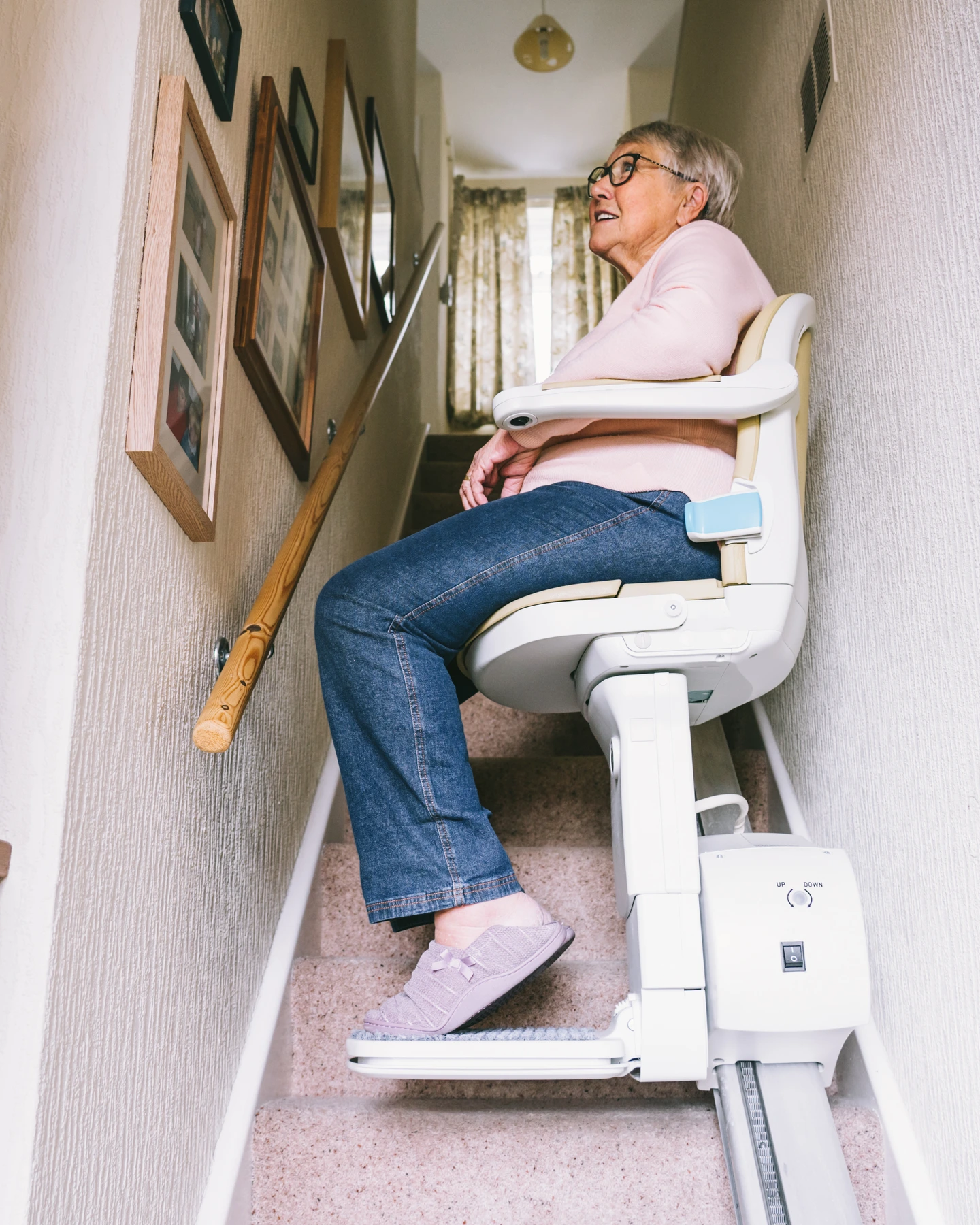
This Page Is for the Adult Child, Not the Senior
Most stairlift content is written for the person who will ride the lift. This page is not. It is written for the person who will research the lift, pay for some or all of it, manage the installation logistics, and carry the emotional weight of the decision — which, in roughly 70% of our installations, is an adult child between 40 and 65 years old.
If your parent is actively researching stairlifts on their own and ready to buy, they probably want our buyer's guide instead. If you are the one doing the research while your parent does not know you are reading this, keep going.
How to Bring It Up Without Triggering Defensiveness
The phrase "I think you need a stairlift" activates every fear an aging parent has: I am losing independence, my kids think I am frail, this is the first step toward a nursing home. Even if all three fears are irrational, they are real, and they shut the conversation down.
"Mom, you spend half your energy getting upstairs. What if you saved that energy for the things you actually want to do?" Works particularly well for parents with heart conditions, COPD, arthritis, or any condition where stair climbing measurably depletes their daily energy budget.
"I noticed you haven't been going upstairs much. Is there anything that would make that easier?" Open-ended, non-judgmental, puts the parent in the driver's seat. If they say "I'm fine," don't push. Bring it up again in a month.
"Uncle Bill got a stairlift last year and says he wishes he'd done it five years ago." Social proof from a peer — especially a male peer for a resistant father — is more persuasive than any argument you can make.
- "You're going to fall and break a hip." (Threat. Shuts down.)
- "I can't keep worrying about you on those stairs." (Makes it about your anxiety.)
- "You're not as steady as you used to be." (Direct challenge to competence.)
- "We need to talk about the stairs." (Formal tone signals a confrontation.)
The Warning Signs That It's Time
The signs are progressive, not binary. Your parent will not wake up one day unable to do stairs — they will gradually adapt their behavior around the stairs until the stairs are effectively off-limits.
For the full 7-sign clinical framework, see our Aging in Place guide. Here is the quick-reference version:
When You Live in a Different City
About 15% of our installations are arranged by an adult child who lives in a different state. The hard part is the information gap — when you live 500 miles away, you rely on phone calls where your parent says "I'm fine" and holiday visits where you notice changes that accumulated for months.
Tools for the Remote Caregiver
- Ask their neighbors. The neighbor who sees your parent get the mail every day knows more about their daily mobility than you do. A five-minute phone call gets you better intelligence than any wellness check.
- Ask the home health aide or cleaning person. If your parent has any regular home visitor, that person has seen the stairs problem. Give them permission to tell you.
- Ask the primary care physician. You can tell the doctor your concerns without needing HIPAA authorization. "I'm worried about my mother on the stairs. Can you assess her stair safety at the next visit?"
- Install a camera (with permission). A simple security camera aimed at the staircase — with your parent's knowledge and consent — lets you see what is actually happening.
If you are managing this from out of state, schedule a free assessment and we will send you the photos, measurements, and quote directly.
Stairlift vs. Moving vs. Remodel vs. Doing Nothing
| Option | Cost | Best When |
|---|---|---|
| Stairlift | ,800-$15,000 | Parent wants to stay, home is otherwise suitable, stairs are the primary barrier |
| Move | $15,000-$50,000+ | Multiple accessibility problems beyond stairs, or parent actively wants to downsize |
| Remodel | $5,000-$50,000 | Unused ground-floor space, parent prefers not to use a stairlift, budget supports renovation |
| Do nothing | $0 now / $35,000+ after a fall | Never. One in four adults over 65 who break a hip die within 12 months. |
The Guilt Factor: 'Am I Giving Up on Them?'
This is the question adult children do not ask out loud, but it sits underneath every stairlift conversation: By installing this, am I admitting my parent is declining? Am I accelerating it by removing the exercise? Am I one step closer to putting them in a home?
Your parent's condition — whether arthritis, Parkinson's, heart disease, or age-related weakness — is going to progress at the same rate regardless of whether they climb stairs or ride a lift. The only thing stair climbing adds is risk.
If your parent is gripping both rails, pausing mid-flight, or descending sideways, the exercise benefit is negligible and the fall risk is enormous. A 15-minute walk on flat ground provides better exercise with a fraction of the fall risk. Encourage the walk. Eliminate the stairs.
You are keeping them out of one. The single most common trigger for a permanent move to assisted living is a fall-related injury. A stairlift removes the highest-risk fall zone in the house.
How to Involve the Primary Care Physician
A stairlift recommendation from a doctor carries more weight than the same recommendation from an adult child. It is not fair, but it is true — and smart caregivers use it deliberately.
You do not need HIPAA authorization to give information — only to receive it. Call and say: "I'm [name]'s son/daughter. I have concerns about their safety on the stairs. Can the doctor assess stair safety at the next visit?" The office can note your concern without giving you medical information back.
A PT or OT can conduct a formal home safety assessment with a written report that documents fall risk and recommends specific modifications. This report is the documentation needed for Medicaid waivers, VA claims, and insurance appeals. Ask the doctor to write the referral for "home safety evaluation with emphasis on stair mobility."
A physician's prescription is not required for purchase but is required for most funding paths. Medicaid HCBS waivers need a physician's order. VA HISA grants need service-connected condition documentation. The IRS medical expense deduction requires the device to be "prescribed by a physician." Get the prescription now, even if paying out of pocket — it keeps every future funding door open.
The Cost Conversation: Who Pays
A straight-rail stairlift runs $2,500 to $5,500 installed. A curved rail runs $9,000 to $15,000. These are real numbers — not "starting at" marketing figures. Who absorbs this cost varies by family.
Simplest path. A stairlift is a medical expense under IRS Publication 502 and is deductible if total medical expenses exceed 7.5% of adjusted gross income — which many seniors with ongoing medical care already reach.
Common among siblings. Designate one person to manage the vendor relationship — too many decision-makers slows the process. Whoever coordinates should be at the home during assessment and available on install day.
Medicaid HCBS waivers: Available in 43+ states for income-qualifying seniors. Covers the full stairlift cost. Requires physician order, OT assessment, and caseworker approval — timeline is 30-90 days. Full state-by-state guide.
VA HISA grant: Up to $6,800 for service-connected conditions, $2,000 for non-service-connected.
State and local programs: Many states run home modification programs through Area Agencies on Aging.
Nonprofit grants: Rebuilding Together, Habitat for Humanity, and local Lions Clubs chapters occasionally fund stairlifts for low-income seniors.
What Happens After You Say Yes
Once the decision is made, the process moves fast.
Add 1-2 weeks between assessment and installation for custom rail fabrication. The factory works from photos or a laser scan taken during the assessment.
On installation day, someone should be present who can relay instructions to your parent. If you live nearby, be there. If you are remote, ask a local sibling, friend, or neighbor to attend.
Frequently Asked Questions
Respect it, but do not drop it. Come back in 30 days with a different angle: the cost comparison, the Medicaid coverage, the peer who has one. Acceptance of assistive devices often takes multiple conversations over 3 to 6 months. Pushing harder does not accelerate it.
Schedule a free assessment and we send you the photos, measurements, and quote directly. Your parent only needs to let us in the door. For installation day, ask a local contact to be present. We handle everything else.
No. There is no clinical evidence that daily stair climbing slows the progression of any condition that has already made stairs unsafe. If your parent can no longer safely climb stairs, the exercise benefit is negligible and the fall risk is enormous. A 15-minute daily walk provides better exercise.
Ready to Get Started?
Free in-home assessment within 24 hours. No pressure, no obligation.