Stairlifts for Heart Failure & COPD: Cardiac & Pulmonary Patient Guide (2026)
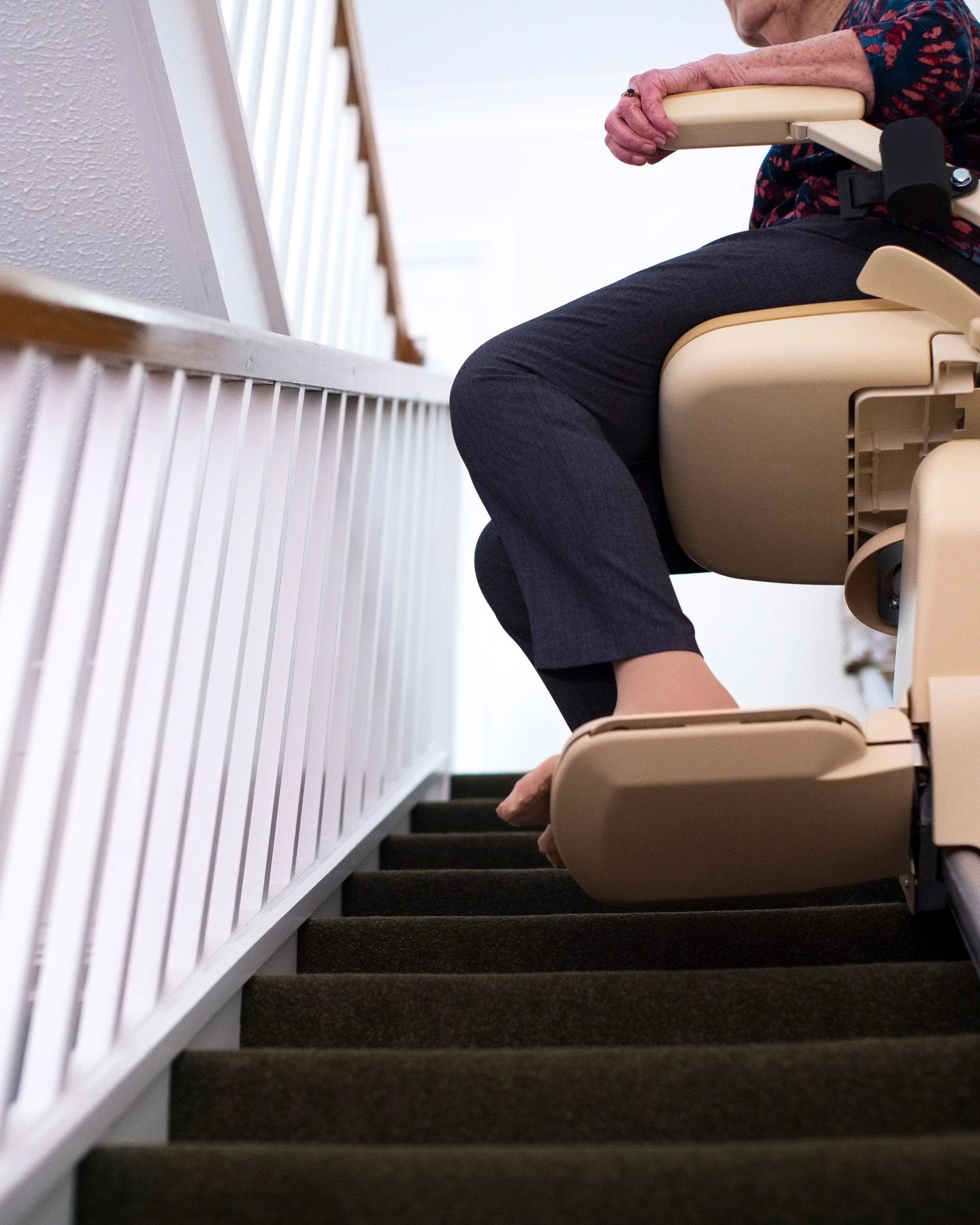
Stair climbing is the single most physically demanding routine activity in a home. Research published in the American Journal of Cardiology measured stair climbing at 8-10 METs — the metabolic equivalent of jogging or vigorous cycling. For a patient with congestive heart failure or chronic obstructive pulmonary disease, that level of exertion causes dangerous spikes in heart rate, blood pressure, and oxygen demand that the compromised heart or lungs may not be able to meet. This guide is written for cardiac and pulmonary patients and the families watching them grip the banister and gasp at the top.
Why stairs are the most dangerous daily activity
The metabolic equivalent (MET) is a standard measure of energy expenditure. One MET equals the energy cost of sitting quietly. Walking on flat ground at normal pace is about 3.5 METs. Stair climbing, per research in Medicine and Science in Sports and Exercise, clocks in at 8.6 METs — roughly equivalent to jogging at 5 mph.
For a healthy 70-year-old, 8-10 METs is within physiological capacity. For a patient with NYHA Class II or III heart failure — the stages where most patients still live at home — the comfortable exertion ceiling is 4-6 METs. Stair climbing exceeds that ceiling by 50-100%.
For COPD patients, the European Respiratory Journal showed that stair climbing produces more prolonged lung hyperinflation, higher blood lactate, and more severe dyspnea than flat walking at comparable intensity. The clinical term is exertional intolerance. The plain-English version: stairs are too hard for your heart or lungs to handle safely.
Congestive heart failure and stairs
Heart failure affects approximately 6.7 million American adults (AHA). Patients are classified by the NYHA functional classification:
| NYHA Class | Symptoms | Stairlift recommendation |
|---|---|---|
| Class I | No symptoms during ordinary activity | Not typically needed |
| Class II | Ordinary activity causes fatigue, breathlessness, palpitations | Conversation begins here |
| Class III | Less-than-ordinary activity causes symptoms | Strongly recommended |
| Class IV | Symptoms at rest | Should not climb stairs at all |
What happens physiologically
The weakened heart cannot increase cardiac output enough to meet the 8-10 MET demand. Blood pressure rises but perfusion falls short. The body compensates by shunting blood away from skin and digestive system. The result: breathlessness from pulmonary congestion, fatigue from inadequate muscle perfusion, dizziness from cerebral underperfusion, and — in worst cases — syncope (fainting) mid-flight. A patient who faints on a staircase falls. A fall in a 75-year-old on anticoagulation therapy can result in traumatic brain injury or hip fracture.
COPD and stair climbing
COPD — emphysema and chronic bronchitis — affects roughly 16 million diagnosed Americans. Classified by GOLD stages based on FEV1:
| GOLD Stage | FEV1 | Stair impact | Stairlift recommendation |
|---|---|---|---|
| I (Mild) | 80%+ predicted | Manageable with mild breathlessness | Not typically needed |
| II (Moderate) | 50-79% | 1-3 min recovery | Discussion appropriate |
| III (Severe) | 30-49% | 3-5+ min recovery; may stop mid-flight | Strongly recommended |
| IV (Very Severe) | <30% | May not be possible | Essential |
Dynamic hyperinflation: why COPD makes stairs worse than walking
COPD patients have trouble exhaling completely. During stair climbing, breathing rate increases but lungs cannot empty fast enough. Air gets trapped — dynamic hyperinflation. The trapped air reduces space for inhalation, triggering a suffocating sensation and panic, which further increases breathing rate. This vicious cycle can escalate from breathlessness to a full exacerbation in minutes. A stairlift ride takes 30-60 seconds at ~1 MET. The hyperinflation cycle never starts.
Warning signs that stairs have become unsafe
Call us if any of these are true
- Stopping mid-flight to rest. A healthy person climbs 13 stairs without pausing. If the patient stops at step 5, 7, or 9, the exertion exceeds safe capacity.
- Breathlessness persisting more than 2 minutes after reaching the top. Brief breathlessness (30-60 seconds) is expected. Two or more minutes indicates insufficient cardiac or pulmonary reserve.
- Chest pain, pressure, or tightness during or after climbing. Any chest symptom in a heart failure patient warrants immediate medical evaluation — and a stairlift before the next trip upstairs.
- Dizziness, lightheadedness, or graying of vision. Cerebral underperfusion — the heart is not sending enough blood to the brain. A fall is imminent.
- Using both hands on the handrail to pull up. When the cardiovascular system cannot do the work, the arms compensate. Two-hand pulling is a fall risk — if either hand slips, nothing catches the person.
- Avoiding stairs entirely. Sleeping on the couch, using the downstairs half-bath instead of the upstairs full bath. The body's self-protective response to exertion it cannot handle.
- SpO2 drops below 88% during stair climbing. If you have a pulse oximeter, check at the bottom and top. A drop below 88% is clinically significant.
Oxygen management during the stairlift ride
Portable oxygen concentrator (POC)
A battery-powered unit (3-10 lbs) that sits on the rider's lap or hangs from the armrest. Nasal cannula stays connected. No special setup needed.
Stationary oxygen concentrator
Too heavy (30-50 lbs) to move between floors. Standard solution: one concentrator on each floor. Connect to the downstairs unit, ride the stairlift (30-60 seconds), connect to the upstairs unit. Most pulmonologists will prescribe two stationary units for a two-story home.
Avoid long tubing runs
A 50-foot tube can technically reach from bottom to top, but it creates a trip hazard on the stairs and can get caught in the stairlift mechanism. The two-concentrator setup is safer and recommended.
Battery backup: critical for oxygen-dependent patients
Non-negotiable
Every stairlift we install for cardiac or pulmonary patients runs on DC battery power with trickle charging. The stairlift works during power outages. This is non-negotiable because a power outage knocks out both the stationary oxygen concentrator and the stairlift simultaneously if the stairlift runs on AC power.
Every modern quality stairlift (Bruno, Handicare, Stannah, Harmar) runs on DC power from two 12V sealed lead-acid batteries that trickle-charge from a wall outlet. During outages, the batteries drive the stairlift for 8-20 up-and-down cycles — enough for at least a full day.
Additional recommendations for oxygen-dependent patients
- Portable oxygen concentrator as backup: Battery-powered, produces oxygen for 2-8 hours depending on model and flow rate.
- Battery backup (UPS) for stationary concentrator: A 1500VA UPS can power a stationary concentrator for 1-3 hours. Cost: $200-$400.
Which stairlift for cardiac and pulmonary patients
Must-have features
- DC battery drive with trickle charging. Non-negotiable. All Bruno, Handicare, Stannah, and Harmar residential models include this.
- Soft-start and soft-stop. Prevents momentary blood-pressure spikes from abrupt starts. Standard on Bruno Elite, Handicare 1000/2000, Stannah Siena.
- Powered swivel seat. $300-$600 upgrade. The rider should not stand and pivot at the top — that is an exertion event.
- Seatbelt. Cardiac patients on blood thinners are at elevated bleed risk from any fall. Keeps the rider securely seated.
Recommended models
Progressive conditions: planning ahead
Heart failure and COPD are progressive conditions. Planning for declining function is part of the stairlift conversation.
Early stage (NYHA II / GOLD II): stairlift as convenience
The patient can still climb stairs but it is noticeably harder. A stairlift saves energy for activities they actually enjoy — walking the dog, playing with grandchildren, cooking a meal. The stairlift saves energy for life, not for stairs.
Mid stage (NYHA III / GOLD III): stairlift as necessity
Stair climbing causes significant symptoms. The stairlift is no longer optional. Most families call us at this stage. Straight rail install within a week of the call.
Late stage (NYHA IV / GOLD IV): stairlift plus single-floor plan
The patient is symptomatic at rest. The stairlift handles the staircase, but daily living should happen on one floor. If no ground-floor bedroom and full bathroom exist, adding them is a higher priority than a stairlift.
Cost and funding
Standard pricing: $2,500-$5,500 straight, $9,000-$15,000 curved. The powered swivel ($300-$600) is the only add-on we recommend specifically for this population.
Funding paths especially relevant for CHF/COPD
- Medicaid HCBS waivers: Many NYHA Class III and GOLD III-IV patients meet the nursing-home level-of-care assessment. Coverage: up to $7,500-$10,000.
- VA HISA grant: Agent Orange exposure is a known COPD risk factor for Vietnam-era veterans. Up to $6,800.
- IRS medical deduction: Full cost deductible under Publication 502 if you itemize.
- Medicare Advantage supplemental benefits: Some MA plans cover home modifications for documented CHF or COPD.
We file the paperwork for all of these at no charge. The physician's letter documenting the diagnosis and the stair-climbing limitation is the key document.
Frequently asked questions
Stair climbing demands 8-10 METs — roughly equivalent to jogging. For NYHA Class II-III patients whose safe exertion ceiling is 4-6 METs, stair climbing significantly exceeds cardiac capacity. Warning signs include stopping mid-flight, breathlessness lasting 2+ minutes, chest symptoms, dizziness, and SpO2 drops below 88%. A stairlift ride requires about 1 MET.
Yes. A portable concentrator sits on your lap or hangs from the armrest. For stationary concentrators, the best setup is one unit on each floor — connect downstairs, ride 30-60 seconds, connect upstairs. Most pulmonologists will prescribe two units for a two-story home.
Yes, if it has DC battery backup — which every quality residential stairlift in 2026 does. Two 12V sealed lead-acid batteries provide 8-20 cycles during outages. This is especially critical for oxygen-dependent patients who need to get downstairs to backup oxygen or exit the home.
Battery backup (non-negotiable), soft-start motor (prevents blood-pressure spikes), powered swivel seat (eliminates exertion of standing and pivoting at the top), and seatbelt (prevents falls if dizzy at end of ride). Bruno Elite SRE-2010 and Handicare 1000 both offer all of these.
Medicaid HCBS waivers in 47 states cover stairlifts as environmental modifications for patients meeting the nursing-home level-of-care assessment. Many NYHA Class III and GOLD III-IV patients qualify. Typical caps: $7,500-$10,000. Application takes 30-90 days. We handle the paperwork at no charge.
Related guides
Ready to Get Started?
Free in-home assessment within 24 hours. No pressure, no obligation.