Product Guide · 18 min read · Updated April 2026

Outdoor Stairlifts: Which One Fits Your Porch, Entry, or Hillside?

About one in five stairlift consultations we do involves an outdoor staircase. The porch at a raised ranch in Boston. A 40-step hillside down to a lake house in the Ozarks. A three-step concrete stoop in Phoenix where the surface hits 160°F in July. Each of these is a different engineering problem, and each one has a different answer. This guide covers the hardware, the climate considerations, the real 2026 pricing, and the installation details that separate a 15-year outdoor lift from a rust pile in three seasons.

(800) XXX-XXXX
featured-outdoor-guide

The 4 types of outdoor lifts

Every outdoor accessibility lift falls into one of four categories. Which one you need depends on the staircase geometry, whether the rider stays seated or uses a wheelchair, and how many steps are involved.

1. Straight outdoor stairlift

This is the most common outdoor install by a wide margin. A motorized chair rides a single straight rail bolted to the stair treads. Works for front porch steps, raised entries, deck stairs, and any exterior flight that runs in a straight line without turns or landings. Typical range: 3 to 18 steps. The rail is stock extruded aluminum cut to length on site — no factory lead time, same-day install in most cases.

Best for: front porches, raised ranch entries, deck access, split-level exterior stairs, garage-to-house steps.

2. Curved outdoor stairlift

Required when the outdoor staircase has a turn, a landing, a switchback, or follows the contour of a hillside. Every curved outdoor rail is custom-fabricated from a laser measurement or detailed photo survey of your specific staircase. The rail is powder-coated galvanized steel with marine-grade protection. Lead time is typically 1–3 weeks for rail fabrication, then a single day for on-site installation.

Best for: hillside properties with switchback stairs, curved garden paths with steps, wraparound porch entries, lake and waterfront access with terrain changes.

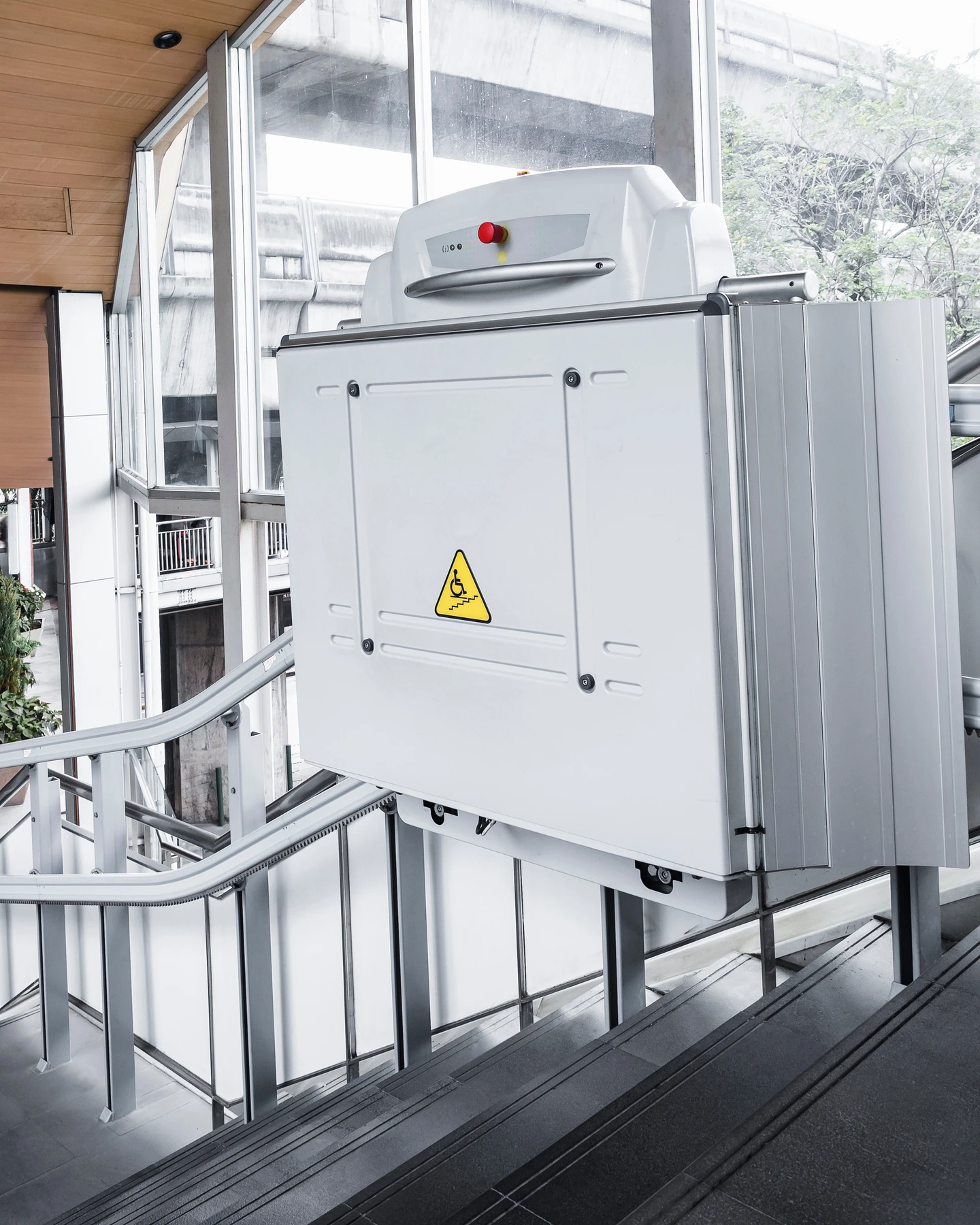
3. Vertical platform lift (porch lift)

A vertical platform lift is essentially a small open elevator. The rider — standing or in a wheelchair — rolls onto a platform at ground level, and the platform rises straight up to porch, deck, or entry height. No staircase required. Maximum residential travel height is typically 14 feet (about 12–14 steps equivalent), though most porch installs are 3–6 feet of rise. These are the only outdoor option that accommodates a full-size wheelchair without a transfer.

Best for: wheelchair users who cannot transfer to a stairlift seat, ADA-compliant entries, homes where the porch or deck has no existing staircase or the staircase is too narrow for a rail.

Key models: Bruno VPL-3210B (up to 14 ft travel, 750 lb capacity), Harmar Highlander RPL (weather-rated, 750 lb), Savaria Multilift (commercial-grade build, residential pricing).

4. Inclined platform lift

An inclined platform lift rides a rail up the staircase — like a stairlift — but instead of a chair, it carries a flat platform large enough for a wheelchair. The rider rolls on at the bottom and rolls off at the top without transferring. These are less common in residential outdoor use because they require a wide staircase (minimum 36–42 inches clear width for the platform, plus the rail) and cost significantly more than a seated stairlift. Where they shine: long outdoor runs on wide concrete or stone stairs at public-facing properties, churches, municipal buildings, and large residential estates.

Best for: wide exterior staircases where the rider cannot leave their wheelchair, public-access buildings, properties where ADA compliance is required.

What makes an outdoor rail “outdoor”

Key point

You cannot use an indoor stairlift outdoors, even on a covered porch. The first hard rain will kill the control board, and moisture in the motor housing will corrode the drive gear within a single season.

An outdoor stairlift is not just an indoor unit with a cover thrown over it. Six engineering differences separate the two categories:

Sealed motor and drive housing

The DC motor, gearbox, and rack-and-pinion drive are enclosed in a sealed housing rated against water ingress. Indoor units have vented motor housings designed for climate-controlled air. Outdoor units use gaskets and O-rings at every seam. On a Bruno SRE-2010E, the motor housing carries an effective IP44 rating — protected against splashing water from any direction.

Marine-grade rail coating

Indoor rails are typically bare extruded aluminum or lightly anodized. Outdoor rails get a two-stage treatment: the aluminum extrusion is first clear-anodized for corrosion resistance, then the mounting brackets and steel components receive a marine-grade powder coat. Bruno and Harmar both use a powder-coat-over-galvanized process on all steel parts. In coastal markets, this is the difference between a 15-year rail life and visible rust at year two.

UV-stabilized seat and upholstery

Indoor seats use standard vinyl or fabric. Outdoor seats use marine-grade vinyl with UV stabilizers — the same material used on boat seats and outdoor restaurant furniture. Without UV protection, a vinyl seat in direct Arizona sun will crack and split within 18 months. Marine-grade vinyl is rated for 1,500+ hours of direct UV exposure before measurable degradation.

Weather cover system

Every outdoor stairlift ships with a fitted weather cover that protects the seat, controls, and electronics when the unit is parked. On the Bruno SRE-2010E and Harmar SL350OD, the cover travels with the chair — it's attached to the carriage, not draped over the unit like a tarp. This matters because a loose cover blows off in the first 30 mph gust. A cover that travels with the unit stays put.

Weather-rated battery housing

All modern stairlifts run on two 12-volt sealed lead-acid batteries trickle-charged from a standard household outlet. Indoor units house these batteries in a vented compartment. Outdoor units seal the battery compartment against moisture and include a wider operating temperature range. The Bruno SRE-2010E batteries are rated 0°F to 125°F. The Harmar SL350OD matches that range. Below 0°F, battery output drops significantly — a point we’ll address in the climate section.

Drainage and tread design

The footrest on an outdoor unit has drainage slots or perforations so rainwater doesn’t pool. Indoor footrests are solid. The stair treads where the rail mounts also need consideration: concrete, stone, composite decking, and pressure-treated wood all require different anchor types and corrosion-resistant fastener grades. A good outdoor installer carries stainless steel wedge anchors (for concrete), stainless lag bolts (for wood), and composite-rated fasteners — not the zinc-plated lag bolts that are fine indoors but corrode outdoors within two years.

Climate-specific hardware: salt, heat, cold, hurricane, fog

The US has at least five distinct climate zones that affect outdoor stairlift performance differently. Here’s what matters in each one and what to specify when you order.

Climate zonePrimary threatHardware requirementMaintenance frequency
Coastal salt air (FL, Gulf Coast, Carolinas, Southern CA, HI)Salt corrosion on steel and aluminum, accelerated by humidity316 stainless steel fasteners (not 304), anodized aluminum rail, marine-grade powder coat on all steel, sealed electronics. Within 1 mile of ocean: request dealer-applied sacrificial anode tape on rail brackets.Wipe rail and brackets monthly. Full service every 6 months.
Extreme dry heat (AZ, NV, inland TX, NM)UV degradation of vinyl and plastics; concrete surface temps above 150°F; battery stress above 110°F ambientUV-stabilized marine vinyl seat (standard on all outdoor models). Consider an aftermarket shade canopy over the parking station. Battery compartment heat shield available from Bruno as a dealer-installed option.Inspect seat vinyl annually for cracking. Replace batteries every 2 years instead of 3.
Hurricane and tropical storm (FL, Gulf Coast, Carolinas, PR, VI)130+ mph wind, driving rain, flying debris, multi-day power lossBattery backup is non-negotiable (standard on all DC-drive units). Secure the weather cover with the integrated strap system — do not rely on gravity. For Category 3+ storms: the unit itself is not the concern (it’s 200+ lb bolted to concrete); the concern is debris striking the seat and control panel. Some owners install a removable plywood shroud before hurricane season.Post-storm inspection: flush rail with fresh water to remove salt spray, check all electrical connections, test battery charge level.
Cold and freeze (Upper Midwest, New England, Mountain states)Ice on rail, snow accumulation on seat, battery output drop below 20°F, lubricant thickeningCold-weather lubricant on rail (silicone-based, not petroleum). Weather cover mandatory. Battery heater wrap available as aftermarket for extreme cold (below -10°F). Heated outdoor stairlift covers from third-party suppliers exist but add $200–$400.Clear snow and ice from rail before each use. Apply cold-weather lubricant before first freeze. Check battery charge weekly November–March. Full service in October and again in April.
Marine fog and Pacific damp (Pacific Northwest, Northern CA coast, Great Lakes shoreline)Persistent moisture without salt (or low salt), mold and mildew on vinyl, slow corrosion of dissimilar metalsStandard outdoor anodized rail is sufficient. Mildew-resistant seat treatment (available from Bruno as a factory option). Ensure all fastener metals match — galvanic corrosion from mixed metals accelerates in constant dampness.Wipe down rail and seat weekly during fog season. Treat vinyl with marine mildew inhibitor twice yearly.

One cross-climate note on batteries: sealed lead-acid batteries lose roughly 30–40% of their rated capacity at 0°F compared to their 77°F rated output. A healthy pair of 12V batteries that delivers 20+ round trips per charge at room temperature may only deliver 12–14 trips at 0°F. In practice, most residential users make 4–6 round trips per day, so this rarely causes a problem unless the batteries are already 3+ years old. The fix: replace outdoor batteries on a 2-year cycle in cold climates instead of the 3-year cycle recommended for indoor units.

Real 2026 pricing: outdoor straight vs. curved vs. platform

Outdoor stairlifts cost $2,000–$3,500 more than their indoor equivalents. That premium pays for the sealed motor, marine-grade rail coating, UV seat, weather cover, and outdoor-rated fastener hardware. Here’s what each category actually costs installed in 2026:

TypeInstalled price rangeWhat drives costTypical install time
Straight outdoor stairlift$3,500–$7,500Rail length (3–18 steps), weight capacity (300 vs. 400 lb), brand, anchoring substrate (wood vs. concrete vs. stone)2–4 hours, same day
Curved outdoor stairlift$10,000–$18,000Custom rail fabrication (60% of total cost), number of turns, total rail length, anchoring complexity on hillside terrain1–3 weeks fabrication + 1 day install
Vertical platform lift (porch lift)$4,500–$12,000Travel height (3–14 ft), weight capacity (500–750 lb), enclosure options, concrete pad requirement at base1–2 days including pad work
Inclined platform lift (wheelchair)$12,000–$25,000+Rail length, custom fabrication, platform size, ADA compliance requirements, structural reinforcement of stair treads1–4 weeks fabrication + 1–2 days install

A few pricing realities worth knowing:

  • The $3,500 floor exists because a legitimate outdoor install requires outdoor-rated hardware, stainless steel anchors, a proper electrical connection, and a trained installer who carries liability insurance. Anyone quoting below $3,000 for a straight outdoor stairlift is either using indoor hardware outdoors, skipping the stainless fasteners, or not carrying insurance. All three of those shortcuts will cost you more than the $500 you saved.
  • Curved outdoor rails above 20 feet enter a different pricing tier because the rail must be fabricated in sections and joined on-site with precision couplings. A 35-foot curved outdoor rail for a hillside switchback can run $12,000–$14,000 for the rail alone, before the seat unit and installation.
  • Concrete anchoring adds $200–$600 to any outdoor install compared to wood-tread mounting. Concrete requires drilling with a hammer drill and setting stainless wedge anchors or sleeve anchors rated for the rail’s shear load. Stone (bluestone, marble, brownstone) adds more because the installer must avoid cracking the material.
  • Electrical outlet installation is often an additional $150–$400 if your outdoor staircase doesn’t have a weatherproof GFCI outlet within 6 feet of the charging station. This almost always requires a licensed electrician and sometimes a permit.

Brand comparison: Bruno, Handicare, Harmar

Three manufacturers account for the large majority of outdoor stairlift installations in the US market. Here’s how they compare on the specs that actually matter outdoors.

SpecBruno Elite Outdoor SRE-2010EHandicare 1000 OutdoorHarmar Summit SL350OD
Weight capacity400 lb300 lb (standard), 350 lb (with HD option)350 lb
Speed25 ft/min18 ft/min20 ft/min
Temperature rating0°F to 125°F14°F to 125°F0°F to 125°F
Rail materialClear anodized aluminumAnodized aluminumExtruded aluminum
Seat materialMarine-grade vinylUV-protected vinylMarine-grade vinyl
Weather coverIntegrated, travels with unitFitted, travels with unitIntegrated header + large body cover
Seat swivel90° offset at top and bottom90° at top90° at top and bottom
Battery2 x 12V SLA, trickle-charged2 x 12V SLA, trickle-chargedStandard 115V AC (not battery DC)
Warranty5-year limited5-year limited3-year limited
Made inUSA (Oconomowoc, WI)Netherlands (assembled in NA)USA (Sarasota, FL)
Installed price (typical)$5,500–$7,500$4,000–$6,000$4,500–$6,500

Our take on each

Bruno Elite Outdoor SRE-2010E is the unit we install most often. The 400 lb capacity means we never have to have an awkward weight conversation with a client. The 0°F low-end temperature rating covers every US market except extreme high-altitude mountain properties. The integrated weather cover that travels with the chair is the best-designed cover in the category — it deploys and stows without fuss. The five-year warranty is industry-leading for outdoor units. Downsides: it’s the most expensive of the three, and Bruno’s dealer network is tighter than Harmar’s, which means fewer local service options in rural areas.

Handicare 1000 Outdoor is the quietest outdoor stairlift on the market, running its patented four-wheel drive system at a lower decibel level than Bruno or Harmar. The slimmer rail profile leaves more stair width for foot traffic. It’s a strong choice for covered porches where noise and space are priorities. Downsides: the 300 lb standard capacity is tight for larger riders, the 14°F low-end temperature rating means it’s not rated for upper Midwest or mountain winters without the optional cold-weather kit, and Handicare’s US parts distribution has historically been slower than Bruno’s after major storm events.

Harmar Summit SL350OD is the one we reach for in hurricane markets. Harmar is headquartered in Sarasota, Florida. Their outdoor units are designed and tested in the salt-air, heat, and storm conditions of the Gulf Coast. Parts availability after a hurricane is same-week from their Florida warehouse, which matters when Bruno and Handicare are shipping from Wisconsin and the Netherlands respectively. The 350 lb capacity splits the difference between Handicare and Bruno. Downsides: the AC-drive system (not battery DC) means the unit does not operate during a power outage, which is ironic for a hurricane-market unit. If your area loses power regularly, pair it with a UPS backup ($200–$400 aftermarket) or choose the Bruno instead.

Hillside installations (30–60+ step runs)

Hillside stairlifts are the most complex outdoor installations in the residential market. A lakefront property in the Ozarks, a cliffside home in Malibu, a terraced backyard in San Francisco, a bluff house on Lake Michigan — these aren’t porch jobs. They’re major equipment projects that require site engineering.

What makes hillside different

  • Run length. A typical porch install is 6–12 feet of rail. A hillside install can be 40–120 feet. At 60+ feet, the rail must be fabricated in multiple sections and precision-joined on site. Rail cost scales linearly with length, but installation labor scales faster because of terrain access.
  • Grade calculation. Stairlifts are designed for a specific incline range, typically 25°–50° from horizontal. A hillside with a grade steeper than 50° requires either a switchback staircase (which means a curved rail) or a terraced approach with multiple shorter runs. The installer must measure the actual grade with an inclinometer, not estimate it by eye.
  • Anchor depth. Porch steps sit on a foundation. Hillside steps often sit on compacted earth, timber cribbing, or poured concrete pads set into the slope. The rail anchors must reach solid substrate. On timber-crib hillside stairs, this means through-bolting with stainless carriage bolts into the crib framing, not just lag-screwing into tread surfaces. On poured concrete pads, standard wedge anchors work, but the concrete must be a minimum 4 inches thick and fully cured (28 days).
  • Drainage. Water runs downhill. On a hillside staircase, every rain event sends water flowing across the treads and past the rail mounts. The rail mounting points must be designed so water flows around them, not pools under the brackets. Standing water under a bracket is the number-one cause of premature corrosion on hillside installs.
  • Access for installation. Getting a 120-foot curved rail section, a 200 lb seat unit, tools, and a concrete drill down a 45° hillside with no vehicle access is a logistical challenge. Most hillside installs require at least two installers for two full days, plus a pre-install site preparation day for clearing brush, leveling anchor pads, and running the electrical conduit.

Hillside pricing

A straight hillside run of 40–60 steps with no turns typically costs $6,000–$10,000 installed, depending on rail length and anchoring substrate. A curved hillside run with switchbacks can range from $14,000 to $25,000+. The custom-fabricated rail is 55–65% of the total cost. Labor and site prep account for most of the rest.

The reality check

Not every hillside is a candidate for a stairlift. If the grade exceeds 50°, if the stairs are in severe disrepair, if there’s no electrical service within 100 feet, or if the terrain is actively eroding, a stairlift may not be the right solution. In those cases, an inclined elevator (a fully enclosed cabin on a hillside rail, such as the Marine Innovations HillMaster) or a funicular-style lift may be more appropriate — but those start at $30,000 and go up from there. A free site assessment will determine which category your hillside falls into.

Porch and stoop installations (3–8 steps)

The most common outdoor stairlift installation in the US is a short run of 3–8 steps at a front porch, side entry, or raised stoop. These are fast installs — typically 2–3 hours — but the anchoring details matter more per step than on a longer run because every anchor point carries a larger share of the total load.

Anchoring by material

Poured concrete steps. The most common substrate for outdoor stairs. Rail mounts are secured with 3/8-inch stainless steel wedge anchors set 2.5–3 inches into the concrete. The installer drills with a rotary hammer drill, blows out the dust, sets the anchor, and torques to spec. This is a 10-minute process per anchor point, and a typical 5-step run has 6–8 anchor points.

Brownstone and natural stone. Common in the Northeast — Boston, Brooklyn, Philadelphia, Baltimore row houses. Brownstone is softer than concrete and more prone to cracking. The installer uses a lower-torque setting on the hammer drill and may use sleeve anchors instead of wedge anchors to reduce expansion stress. On high-value brownstone stoops, some installers use a diamond-core drill to create clean holes without fracture risk. Expect a $200–$400 premium for brownstone anchoring.

Marble and granite steps. Found on higher-end homes, particularly in the Southeast and in historic districts. These materials are harder than brownstone but brittle under impact. Diamond-core drilling is standard. The installer must also consider the finish — drilling into polished marble leaves visible holes if the stairlift is later removed. Discuss this with the homeowner before drilling.

Brick masonry steps. Common in the Midwest and Mid-Atlantic. The anchor should go into the mortar joints where possible, not into the brick face. Anchoring into brick face risks cracking the brick, especially on older (pre-1950) soft-fired brick.

Composite and wood decking. The rail cannot anchor into decking boards alone — composite and wood decking does not have the shear strength to hold the rail under load. The anchors must pass through the decking and into the underlying joist or stringer framing. The installer should verify joist locations with a stud finder or by visual inspection from below before drilling.

Short-run stairlift vs. vertical platform lift

For 3–5 step porches, homeowners face a genuine choice between a short stairlift and a vertical platform lift. Here’s how to decide:

  • Choose a stairlift if the rider can transfer from a wheelchair or walker to a seated position, the staircase is at least 26 inches wide, and the budget is $3,500–$5,500.
  • Choose a vertical platform lift if the rider cannot leave their wheelchair, the porch rise is under 6 feet, and the budget allows $4,500–$8,000. A platform lift also eliminates the need for any staircase at all — it can mount adjacent to the porch with its own concrete pad at ground level.

Pool deck and garage entry lifts

Two outdoor use cases that don’t fit neatly into the porch or hillside categories: pool deck access and garage-to-house entries.

Pool deck stairlifts

Pool deck stairlifts typically cover 3–6 steps between a house or patio level and a lower pool deck. The environment combines every challenge: constant moisture from splash, chlorine or salt-chlorine vapor in the air, direct sun on concrete that can exceed 150°F surface temperature, and barefoot traffic that creates slip-and-fall liability concerns.

Hardware considerations specific to pool decks:

  • Salt-chlorine generators are now standard on most new pools. The chlorine gas they produce is more corrosive to aluminum and steel than traditional tablet chlorine. If the stairlift rail is within 15 feet of a salt-chlorine pool, specify 316 stainless fasteners and request a dealer-applied anti-corrosion sealant on all rail bracket contact points.
  • Slip-resistant footrest. Standard outdoor footrests have drainage perforations. Near a pool, you also want a textured surface — wet bare feet on smooth perforated aluminum is a fall risk. Harmar offers a rubberized footrest pad as a dealer-installed accessory.
  • GFCI protection. The charging outlet for any stairlift near a pool must be on a GFCI-protected circuit. This is already code in every US jurisdiction for outlets within 20 feet of a pool, but verify that the existing outlet is actually GFCI-protected — not just labeled as such.

Garage-to-house entry lifts

Many homes have 2–4 steps between the garage floor and the house entry. This is often the most-used entry point in the home, and it’s where a lot of fall injuries happen — carrying groceries, coming in from the car, navigating the steps in dim light.

Garage entries occupy a middle ground between indoor and outdoor. The environment is sheltered from rain and direct sun, but it’s not climate-controlled — garage temperatures swing from below freezing to over 100°F depending on geography, and garages collect road salt, dust, and vehicle exhaust. We recommend outdoor-rated hardware for garage entry installs even though they’re technically indoors.

  • A straight outdoor stairlift covers most garage-to-house entries for $3,500–$5,500 installed.
  • For wheelchair users, a short-travel vertical platform lift ($4,500–$7,000) is often a better fit because the garage floor provides a natural loading area for the wheelchair.
  • The electrical outlet is almost always already present in the garage, so the $150–$400 outlet installation cost is usually avoided.

Permits for outdoor installs

Most outdoor stairlift installations in the US do not require a building permit. The majority of jurisdictions classify a stairlift as a removable mechanical appliance — similar to a window air conditioner or a portable ramp — rather than a structural modification. The rail bolts into existing stair treads and can be fully removed, returning the staircase to its original condition.

However, three situations do require permits or approvals:

1. Historic districts

If your property is in a designated local, state, or National Register historic district, any visible exterior modification — including a stairlift rail mounted on a front-facing staircase — may require approval from the local historic preservation commission or architectural review board. This is the most common permit-related delay on outdoor stairlift projects. The review process can take 2–8 weeks and may require submitting photos, drawings, and a description of the equipment.

Practical guidance: if your home is in a historic district and the stairlift will be visible from the street, contact the review board before signing a purchase agreement. In many cases, mounting the rail on the interior side of the staircase (closer to the house wall) rather than the exterior side (closer to the street) satisfies the review board’s visual impact requirements. For brownstone and row house districts in the Northeast, this is a common negotiation.

2. Electrical work

If the installation requires a new outdoor GFCI outlet or an extension of an existing circuit, that electrical work typically requires an electrical permit and inspection in most municipalities. The stairlift itself doesn’t need the permit — the outlet does. Your installer should either hold an electrical license or subcontract to a licensed electrician who pulls the permit. Cost for the permit is usually $50–$150; the inspection is included.

3. Concrete pad or footer work

Vertical platform lifts that require a new concrete pad at the base may trigger a building permit if the pad exceeds a certain size (typically 100–200 square feet, varying by jurisdiction) or if it’s within a setback zone. A 4x6-foot pad for a standard porch lift almost never hits these thresholds, but check with your local building department if you’re adding a platform lift with a larger footprint.

HOA restrictions: Homeowners associations can be pickier than building departments. Some HOAs restrict visible accessibility equipment on front-facing elevations. However, the federal Fair Housing Act and most state fair housing laws require HOAs to grant reasonable accommodations for disability-related modifications, including stairlifts. If your HOA objects, a letter from the rider’s physician documenting the medical necessity usually resolves it. If it doesn’t, the HOA is likely violating federal law.

Maintenance: what outdoor units need that indoor don’t

An indoor stairlift needs a service visit roughly once per year and a battery replacement every 3–5 years. An outdoor unit needs more. Here’s the full maintenance schedule for an outdoor stairlift, by frequency.

After every use (rider responsibility)

  • Deploy the weather cover over the seat and controls after each use. This is the single most impactful maintenance habit for outdoor units. A covered unit lasts dramatically longer than an uncovered one.

Monthly (rider or family member)

  • Wipe the rail with a dry cloth to remove dust, pollen, bird droppings, and surface moisture. In coastal areas, wipe weekly.
  • Check the weather cover for tears, loose stitching, or UV fading. A damaged cover should be replaced immediately — replacement covers cost $80–$200 from the manufacturer.
  • Visually inspect the mounting brackets at the top and bottom of the rail for any signs of rust, loosening, or water pooling.

Quarterly (rider or handy family member)

  • Lubricate the rail with the manufacturer-specified lubricant. For cold climates, switch to a silicone-based lubricant before the first freeze. For hot climates, standard lithium grease works year-round.
  • Check the charging indicator light at the base station. A solid green light means the batteries are fully charged. A blinking or amber light means the charging connection may be compromised — check the outlet and the power cord for damage.
  • Test the safety sensors by placing a small object (a shoe works fine) on the footrest sensor and on the rail obstruction sensor. The unit should stop immediately in both cases.

Annually (professional service visit)

  • Full diagnostic of motor, gearbox, and drive system.
  • Battery load test. Replace batteries if they hold less than 70% of rated capacity.
  • Tighten all rail mounting anchors to spec. Freeze-thaw cycles in cold climates can work anchors loose over time.
  • Inspect all wiring harnesses and electrical connections for corrosion, cracking, or rodent damage. Outdoor wiring is more exposed to rodents than indoor wiring.
  • Lubricate all pivot points (seat swivel, footrest hinge, armrest hinges) with marine-grade waterproof grease.

Every 2–3 years

  • Battery replacement. Indoor units: every 3–5 years. Outdoor units: every 2–3 years, and every 2 years in extreme heat or extreme cold climates. A pair of replacement 12V SLA batteries costs $80–$150 and can be swapped by the homeowner or during a service visit.
  • Weather cover replacement. Marine-grade vinyl covers last 3–5 years in moderate climates, 2–3 years in direct desert sun or constant coastal salt exposure.

Annual professional service visits for outdoor stairlifts typically cost $150–$350, depending on the market and the installer. Some dealers offer a two-visit-per-year plan for outdoor units at $250–$500 per year. We recommend twice-yearly professional service for outdoor units in coastal, desert, and freeze-thaw climates; once per year is fine for temperate inland areas.

Frequently asked questions about outdoor stairlifts

Ready when you are

Your free home assessment is one phone call away

No deposit. No obligation. No high-pressure sales. A certified installer visits your home, measures once, and gives you a written quote that's honored for 30 days. It takes about 45 minutes. More than 15,000+ homeowners have said yes over the last 15 years.

  • Licensed in all 50 states
  • $2M liability insured
  • BBB A+ since 2012
  • 15+ years in business
Contact information — Step 1 of 2