Stairlifts for Split-Level Homes: The #1 Stairlift Home Type (2026)
Why Split-Levels Dominate Our Install Calendar
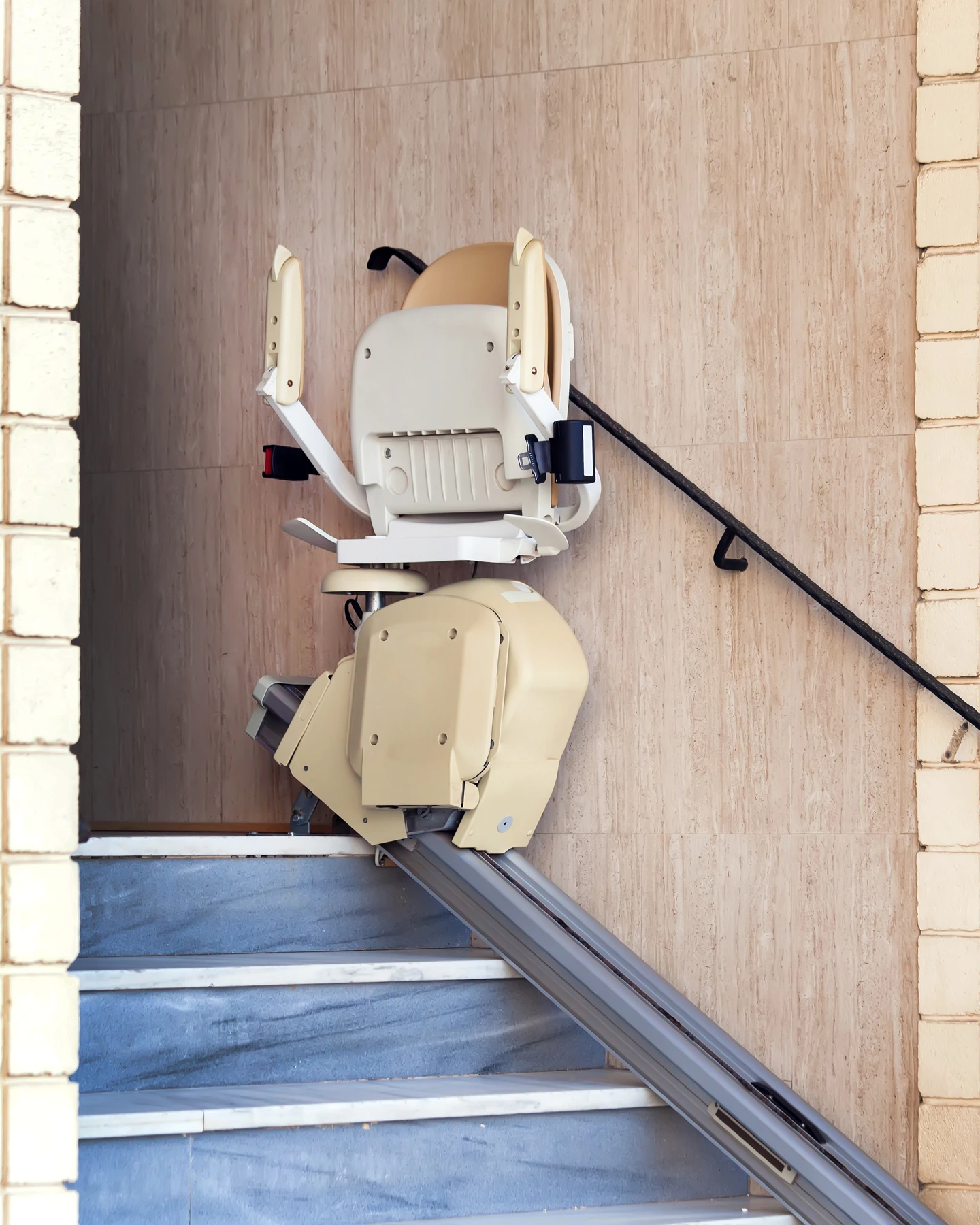
Split-level homes are the most common stairlift installation scenario we see — and the most complex to plan. Built primarily between 1950 and 1980, these homes have multiple short staircases connecting half-levels, which means one stairlift rarely covers the entire home.
This guide covers the three split-level types, three installation options with cost math, and the half-landing problem that makes split-levels unique.
Anatomy of a Split-Level Staircase
Standard split-level
Three or four levels connected by short half-flights (5-8 steps each). You enter at the middle level and go up a half-flight to bedrooms or down a half-flight to the family room/basement. The transition between flights involves a half-landing — a small platform where the staircase turns 90-180 degrees.
Side-split
One side of the home is two stories; the other side is one story with a basement. The staircase connects all levels on the two-story side, while the one-story side has no stairs. The stairlift serves the two-story section.
Raised ranch
Entry is at ground level, between floors. One flight goes up to the main living area; another goes down to the basement/garage. This is the simplest split-level to equip — often a single straight stairlift on the entry-to-main-floor flight handles the daily need. See our ranch homes guide for raised ranch overlap.
Three Installation Options (and When to Use Each)
| Option | Configuration | Cost | Best When |
|---|---|---|---|
| Option 1: Two straight rails | One stairlift per half-flight, transfer at the landing | $5,000–$11,000 | Budget-conscious, rider can walk across the landing |
| Option 2: One continuous curved rail | Single custom rail navigating the turn | $8,000–$15,000 | Rider cannot walk at the landing, wants one continuous ride |
| Option 3: Entry half-flight only | One straight rail on the most-used flight | $2,500–$5,500 | Only the entry flight is a problem, other levels are optional |
Option 1: Two straight rails
Install a straight stairlift on each half-flight. The rider takes one lift up to the landing, walks 3-5 feet across the landing, and takes the second lift up the next flight. Two separate lifts, two separate sets of controls.
- Pros: Cheaper than curved. Each unit can be serviced or replaced independently. If only one flight is a problem, you can start with one and add the second later.
- Cons: The rider must walk across the landing. If balance or mobility makes that walk dangerous, this option does not solve the problem.
Option 2: One continuous curved rail
A single custom-manufactured rail follows the entire path — up the first flight, around the turn, and up the second flight. One ride, no walking at the landing.
- Pros: No landing walk. One set of controls. Smoother experience.
- Cons: Costs $8,000-$15,000 because the rail is custom-manufactured. Lead time of 4-8 weeks for the custom rail (vs. same-day for straight).
Option 3: Entry half-flight only
The most common split-level install. One straight stairlift on the entry-level flight that causes the most daily difficulty (usually the entry-to-bedroom flight). The rider can still use the other levels by walking if those flights are manageable.
The Half-Landing Problem: Swivel Seat vs. Powered Turn
The half-landing is what makes split-levels tricky. When two straight rails meet at a landing, the rider needs to get from one lift to the other.
Standard on most stairlifts. The seat rotates 90 degrees at the landing, allowing the rider to step off facing the landing rather than the stairs. The rider then walks to the second stairlift. This works when the rider can walk 3-5 feet on level ground.
Motor-driven swivel activated by a button. Useful for riders with limited upper-body strength who cannot manually rotate the seat. Adds $200-$500 to the cost.
Eliminates the landing walk entirely. The rider stays seated through the turn. This is the best option when the rider has significant balance issues, uses a walker, or has a progressive condition. Cost: $8,000-$15,000.
Two Straight Rails vs. One Curved Rail: The Math
- First straight stairlift: $2,500-$5,500
- Second straight stairlift: $2,500-$5,500
- Total: $5,000-$11,000
- Install time: 1 day (both units)
- Requires landing walk between lifts
- Custom curved stairlift: $8,000-$15,000
- Total: $8,000-$15,000
- Install time: 1 day (after 4-8 week rail manufacturing)
- No landing walk — one continuous ride
The decision: If the rider can walk 3-5 feet on the landing, two straights save $3,000-$4,000. If the landing walk is unsafe or unworkable, the curved rail is worth the premium.
The Entry-Level Half-Flight Nobody Thinks About
In standard split-levels, the entry door opens at the mid-level. A half-flight goes up to bedrooms/bathrooms; another goes down to the family room. Most families focus on the bedroom flight — but the entry flight matters too.
If the front door is at the mid-level and the garage entry is at the lower level, the garage-to-living-area transition involves stairs. A single straight stairlift on this entry flight ($2,500-$5,500) solves the most-used daily path.
The Basement Flight: Laundry, Workshop, Family Room
Many split-levels have a finished basement one half-flight below the entry level. Access to laundry, a workshop, or the family room requires this flight. If the rider can live without basement access, skip this flight. If the laundry is down there and moving it is not practical, add a straight stairlift.
What a Split-Level Install Actually Costs
| Configuration | What It Covers | Cost |
|---|---|---|
| Entry flight only (straight) | Most-used daily path | $2,500–$5,500 |
| Two straight rails | Entry + bedroom flights with landing walk | $5,000–$11,000 |
| One curved rail | Entry + bedroom flights, no landing walk | $8,000–$15,000 |
| Full-house (3 flights) | Entry + bedroom + basement | $7,500–$16,500 |
Real Split-Level Installs We Have Done
Standard split-level with 7 steps up and 7 steps down from the entry. Owner needed bedroom access (up) and laundry access (down). Two straight Bruno Elan stairlifts: $7,400 total. Landing walk of 4 feet between lifts — manageable with the owner's walker. Installed in one day.
Side-split with a 90-degree turn at the landing. The owner had Parkinson's and could not safely walk the landing. One Handicare 2000 curved stairlift: $11,200. Custom rail manufactured in 5 weeks. No landing walk needed. Owner reports "it changed everything."
Raised ranch with entry at ground level, living area one flight up. Owner only needed access to the main floor — basement was optional. One straight Harmar Pinnacle: $3,200. VA HISA grant covered the full cost ($6,800 available). Installed in 3 hours.
Frequently Asked Questions
Yes. Split-levels are our most common installation. Options include two straight stairlifts (one per flight with a landing walk), one continuous curved rail (no landing walk), or a single straight on the most-used flight only.
Only if the landing walk is unsafe. If you can walk 3-5 feet on level ground, two straight stairlifts work and save $3,000-$4,000. If the landing walk is a fall risk (Parkinson's, severe balance issues, walker dependency), a curved rail eliminates it.
Entry flight only: $2,500-$5,500. Two straight rails: $5,000-$11,000. One curved rail: $8,000-$15,000. Full-house (3 flights): $7,500-$16,500. Funding programs can reduce or eliminate your cost.
Prioritize the flight to the bedroom/bathroom. If the entry flight is also a daily problem (garage to living area), it is second priority. The basement flight is lowest priority — consider relocating laundry to the main floor instead.
1950s-1970s split-levels often have 32-36 inch stairs — standard width for stairlifts. Some have narrower basement stairs (28-30 inches) that need a slim-profile model. See our narrow stairs guide for models that fit in 26+ inches.
Own a Split-Level?
Send us a quick description of your split-level layout (number of flights, number of steps per flight, which levels you need access to) and we will recommend the best configuration before the home visit.
Request a free split-level assessment — our most experienced installers handle these jobs because we know them inside and out.
Ready to Get Started?
Free in-home assessment within 24 hours. No pressure, no obligation.