Every Way to Pay Less for a Stairlift (2026) | VA, Medicaid, IRS

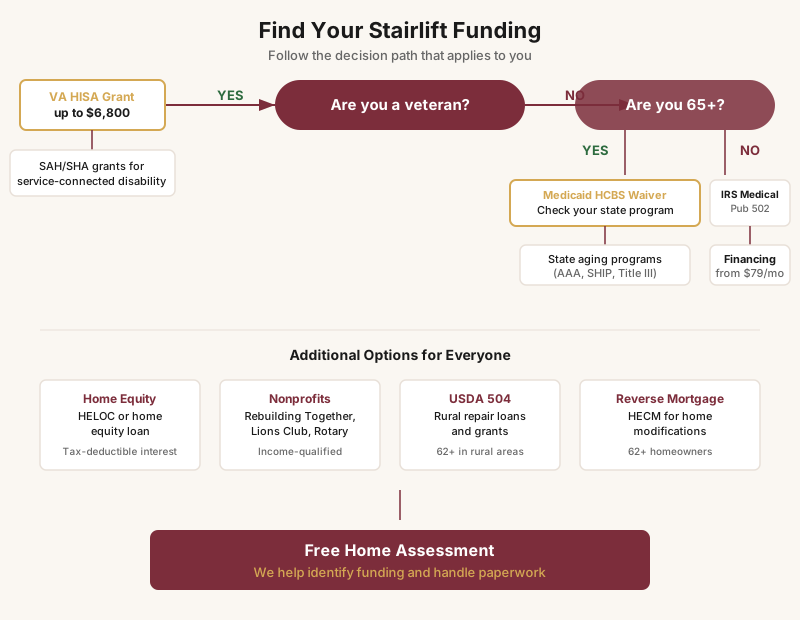
Medicare does not cover stairlifts. That sentence ends the conversation for about 60% of families who call us — they assume there is no help and write a check. They are wrong. There are twelve legitimate paths to reduce or eliminate the cost of a stairlift, and most families qualify for at least two of them. This guide maps every one.
Medicare — the reality
Original Medicare (Parts A and B) explicitly excludes stairlifts from durable medical equipment coverage. The classification is "home modification" rather than medical equipment, and the exclusion has been consistent since 1989.
Medicare Advantage exception
Some private Medicare Advantage plans offer supplemental benefits that may include home safety modifications. These plans require pre-authorization and typically cap coverage at $500-$2,000 annually. Verify by calling the member services number on your card and asking for the supplemental benefits section.
Medigap plans
Medigap supplements only fill gaps in Original Medicare coverage. Since Original Medicare does not cover stairlifts, Medigap provides no assistance.
Medicaid HCBS waivers — the 47-state patchwork
Home and Community-Based Services (HCBS) waivers operate under Section 1915(c) of the Social Security Act, allowing state Medicaid programs to fund services that keep beneficiaries in their homes rather than nursing facilities. Stairlifts typically fall under "environmental modifications."
Three-gate eligibility
- Financial eligibility: Income roughly under 300% of SSI federal benefit rate (~$2,901/month for individuals in 2026); assets capped at $2,000 individual / $3,000 married. Primary residence, one vehicle, and personal effects excluded.
- Medical eligibility: Functional assessment demonstrating nursing-home level of care need. Difficulty climbing stairs plus two or more ADL limitations typically qualifies.
- Care plan inclusion: Case manager drafts Plan of Care listing the stairlift with medical justification from PCP or PT/OT. Families do not write checks.
State-specific programs
| State | Program | Cap | Phone |
|---|---|---|---|
| Florida | SMMC-LTC Managed Care | $7,500 | 1-800-963-5337 |
| Texas | STAR+PLUS Waiver | $7,500-$10,000 | 1-800-964-2777 |
| California | HCBA / MSSP | $10,000 lifetime | 1-800-541-5555 |
| New York | NHTD / MLTC | $15,000 (highest nationally) | 1-518-474-5271 |
| Washington | COPES Waiver | No fixed ceiling | 1-800-422-3263 |
| Pennsylvania | Community HealthChoices | $6,000/yr; $10,000 lifetime | 1-800-757-5042 |
| Illinois | Home Services Program | Varies by assessment | 1-800-843-6154 |
| Ohio | PASSPORT Waiver | $10,000 lifetime | 1-866-243-5678 |
| Massachusetts | Frail Elder Waiver | ~$10,000 lifetime | 1-800-243-4636 |
Application steps
- Contact local Area Agency on Aging or state Medicaid helpline
- Complete phone screening (15-20 questions)
- Schedule in-home functional assessment
- Wait 30-60 days for waiver approval letter
- Case manager drafts Plan of Care with stairlift line item
- Credentialed provider submits quote; state issues Prior Authorization
- Installation occurs; Medicaid billed directly
Common rejection reasons and solutions
- Asset rejection: Spend down through legitimate expenses or explore Miller Trusts/Qualified Income Trusts with a Medicaid planning attorney ($500-$2,000 investment).
- Level of care not met: Request formal functional assessment from PCP or home safety evaluation from PT.
- Medical necessity rejection: Obtain physician letter specifying diagnosis, ADL limitations, stair obstacle, and why stairlift prevents nursing-facility placement.
- Provider not credentialed: Switch to provider enrolled with state Medicaid. We are credentialed in 34 states.
VA benefits — 5 programs stacked
VA HISA grant — Home Improvements and Structural Alterations
HISA grant maximums
- Service-connected disability: $6,800 lifetime
- Non-service-connected (enrolled in VA healthcare): $2,000 lifetime
- Type: Grant (not loan), paid directly to provider, does not reduce other benefits
- Typical approval: 4-8 weeks
Eligibility: VA healthcare enrollment; prescription from VA provider; home is primary residence. Service-connected disability is not required for the $2,000 tier.
SAH grant — Specially Adapted Housing
Maximum $117,014 in FY2026. Narrow eligibility for specific service-connected conditions (loss of both lower extremities, certain severe burns, blindness with lower-extremity loss). Intended for full home adaptation.
SHA grant — Special Housing Adaptation
Maximum $23,444 in FY2026. For conditions including blindness in both eyes, loss of both hands, severe respiratory/burn injuries. Can stack with HISA.
Aid & Attendance pension
~$2,300/month for married wartime veterans (FY2026). For low-income wartime veterans needing ADL assistance. Can fund equipment or in-home care. Stacks with HISA.
State veteran programs
~20 states run supplemental veteran home-modification programs. Texas Fund for Veterans' Assistance ($2,000-$10,000), CalVet county-level grants, Illinois supplemental adapted housing, and New York county-level veterans service agency funds. All stack with federal HISA.
HISA application process
- Schedule PACT team primary care visit at VA medical center
- Request prescription of medical necessity for stairlift
- Provider documents mobility issue and issues prescription on letterhead
- Route to VA prosthetics department or social worker
- HISA-credentialed installer submits itemized quote and Form 10-0103
- Veteran signs Form 10-0103
- Submit packet through prosthetics office
- VA approves within 4-8 weeks
- Installer completes work; VA pays provider directly
The IRS medical expense deduction
Stairlifts qualify as qualified medical expenses on Schedule A (Form 1040) when recommended in writing by a licensed physician. Authority: IRS Publication 502.
Two critical rules
- Itemization required: Total itemized deductions must exceed the standard deduction (~$15,000 single / ~$30,000 MFJ in 2026, plus additional amounts for 65+). ~87% of taxpayers take the standard deduction.
- 7.5% AGI threshold: Only medical expenses exceeding 7.5% of Adjusted Gross Income become deductible.
Worked example
Scenario: 72-year-old single filer, $70,000 AGI
- Total medical expenses: $11,000 (includes $6,000 stairlift)
- Threshold (7.5% of $70,000): $5,250
- Deductible medical: $5,750
- Total itemized: $14,450
- Standard deduction (65+): $16,950
- Result: Standard deduction wins. No tax benefit in this scenario.
The math works when combined with high mortgage interest, SALT, or a catastrophic medical year with $10,000+ unreimbursed expenses. Most seniors should take the standard deduction.
Required documentation
- Physician letter (signed, dated, on letterhead, specifying condition)
- Itemized installer invoice (date, equipment, address, amount)
- Proof of payment (bank/credit card statement)
- Completed Schedule A with Form 1040
- Keep documents minimum three years for audit purposes
State and local grant programs
Property tax exemptions
Over 40 states offer senior, disability, or veteran property-tax exemptions providing recurring annual savings of $500-$2,000, effectively freeing cash flow for stairlift financing. Common types: Senior Homestead Exemption (FL, TX, IL, NY, GA), Senior Freeze (IL, NJ, TX, CA), Disabled Persons Exemption, and Disabled Veteran Exemption (TX 100% disabled veterans get full exemption).
Area Agencies on Aging (AAAs)
622 federally recognized AAAs operate emergency home modification funds, typically capping grants at $500-$3,000 per household annually. For low-income seniors who do not qualify for Medicaid, these represent accessible funding. Access via Eldercare Locator: eldercare.acl.gov or 1-800-677-1116.
Nonprofit home-modification organizations
Financing options
If grants and programs do not cover the full cost, financing bridges the gap. Three types are worth considering; three others should be avoided entirely.
| Type | APR | Term | Verdict |
|---|---|---|---|
| 0% APR promotional | 0% | 12-24 mo | Good — if you pay on time |
| Fixed-rate installment | 6-12% | 36-60 mo | Safest option |
| HELOC | ~7% variable | Flexible | Cheapest long-term |
| Credit cards (22%+) | 22%+ | Open | Never |
| Rent-to-own | 25-40% effective | 36 mo | Never |
| Dealer promissory notes | 15-24% | Varies | Never |
For financing details, payment math, and the deferred-interest trap to avoid, see the full stairlift financing guide.
Stacking strategies — how families actually pay
The typical veteran path
VA HISA ($6,800 service-connected) + state veteran grants ($2,000-$5,000) = $8,800-$11,800 in stacked funding on a $4,500 straight-rail install. Covers curved rails outright in states with supplemental programs.
The typical Medicaid path
State HCBS waiver covers full install; family writes no check. Tradeoff: 30-90 day timeline.
The typical middle-income retiree path
Cash from savings ($4,500-$6,000) + IRS medical deduction (recover $400-$1,200 in April) + 12-month 0% financing if needed. Effective net cost: $3,500-$5,500.
The low-income non-veteran non-Medicaid path
Property tax exemption ($500-$2,000/yr) + AAA emergency fund ($500-$3,000) + Rebuilding Together (free, with waiting list) + service club ask + 0% financing on remainder + family contribution ($1,000-$2,000). Result: $0 upfront + ~$60/month for 18 months possible.
The 3 biggest mistakes families make
Mistake 1: Assuming Medicare covers it
~60% of callers believe Medicare covers stairlifts. After learning it does not, they conclude all funding is unavailable and write a check — missing Medicaid HCBS, VA HISA, or AAA grants worth $2,000-$8,000. Fix: Before paying out-of-pocket, call your state Medicaid helpline, VA medical center, or Eldercare Locator (1-800-677-1116).
Mistake 2: Paying in full and missing the tax deduction
The IRS deduction applies only to the tax year the expense was paid — a one-year window. Medicaid HCBS waivers rarely allow retroactive reimbursement if the family paid the provider directly. Fix: Create a documentation folder on contract-signing day. Never pay the provider directly if on a waiver.
Mistake 3: Skipping VA HISA because "disability isn't service-connected"
HISA has two tiers: $6,800 for service-connected and $2,000 for non-service-connected. The $2,000 version is available to any veteran enrolled in VA healthcare — no disability rating, combat service, or Purple Heart required. Fix: If you are a veteran, call your nearest VA medical center this week.
Frequently asked questions
No. Medicare Parts A and B exclude stairlifts. Exception: some Medicare Advantage (Part C) plans include home safety modifications as supplemental benefits. Verify by calling the member services number on the back of your card.
Typical 8-14 weeks: ~2 weeks for PACT visit and prescription, ~1 week for installer to prepare the VA Form 10-0103 packet, 4-8 weeks for VA approval, 1-2 weeks for install scheduling. Faster in under-subscribed VA systems; slower in high-demand centers (Phoenix, Tampa, Los Angeles).
Rarely for the same line item (both are payers of last resort). They do stack across different service categories — for example, HISA pays for the stairlift while Medicaid HCBS funds personal care attendants. Coordinate through your case manager or PACT social worker.
Four items: (1) physician's letter of medical necessity (dated, on letterhead), (2) itemized installer invoice, (3) proof of payment (bank/credit card statement), (4) completed Schedule A with Form 1040. Keep three years minimum.
Varies by state. Washington COPES and New York NHTD have no caps and routinely approve curved rails. Florida, Texas, and Pennsylvania cap at $7,500-$10,000, so curved rails are approved up to the cap with the family covering the difference. Confirm with your case manager during the Plan of Care conversation.
Related guides
Ready to Get Started?
Free in-home assessment within 24 hours. No pressure, no obligation.