Stairlift Rental Guide: When Renting Makes Sense (2026) | All American Stairlifts
When Renting a Stairlift Makes Financial Sense $100–$250 monthly rental cost 12–18 mo break-even vs buying $500–$1,500 typical upfront deposit Renting a stairlift is the right financial decision in a narrow set of circumstances. Outside those circumstances, buying — even buying used — is cheaper within 12–18 months. The rental industry does not make this […]
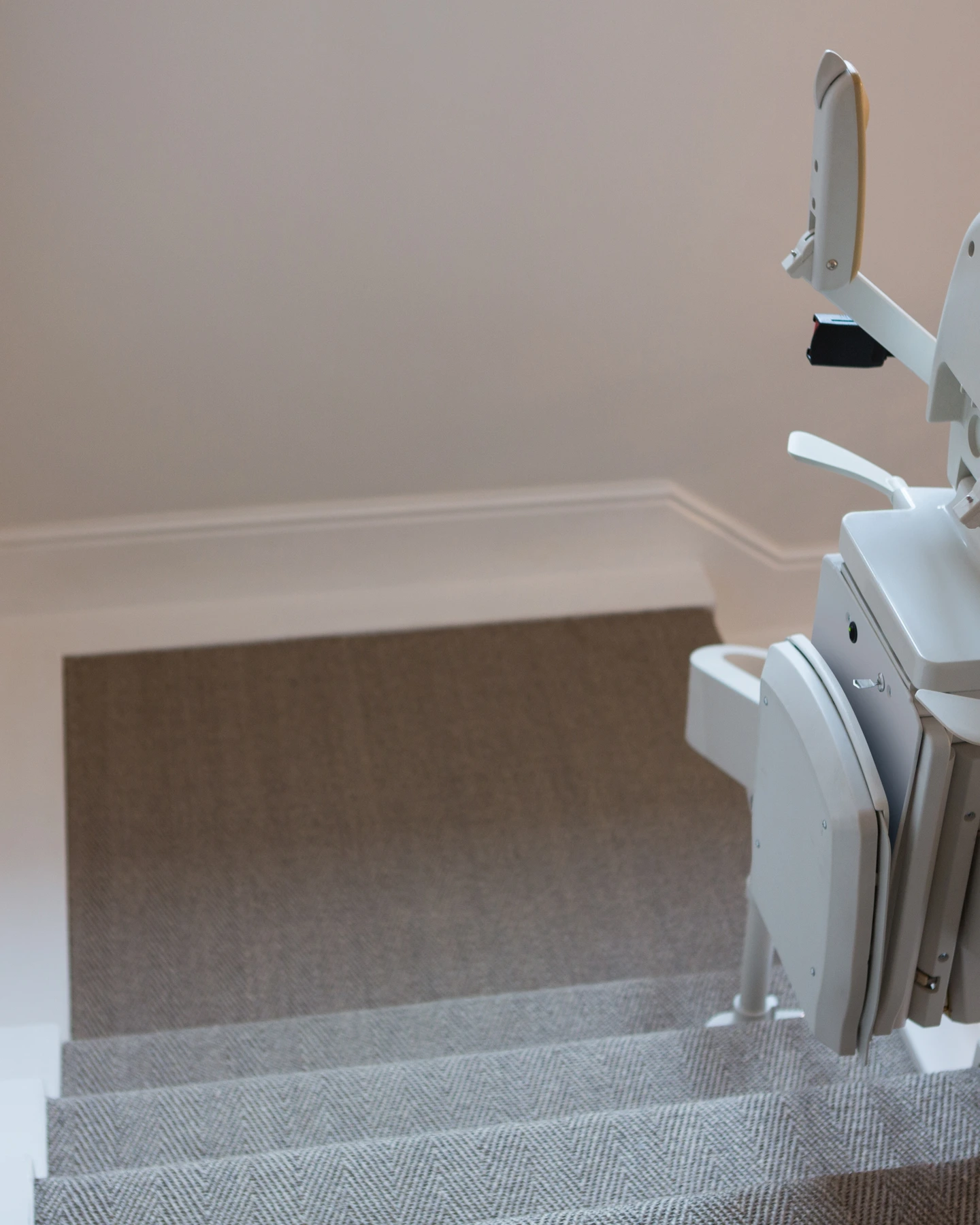
When Renting a Stairlift Makes Financial Sense
Renting a stairlift is the right financial decision in a narrow set of circumstances. Outside those circumstances, buying — even buying used — is cheaper within 12–18 months. The rental industry does not make this comparison easy to see, because the monthly payment looks small next to a $3,000–$5,000 purchase price. It is not small when you multiply it.
Here are the five situations where rental genuinely saves money:
- Post-surgical recovery under 6 months. Hip replacement, knee replacement, ankle fracture. The stairlift is a bridge. Once physical therapy restores stair-climbing ability, the rental goes back. Total rental cost at $150/mo: $900. Purchase plus removal would cost $3,500+.
- Hospice or end-of-life care. When a prognosis is measured in months, not years, the math favors rental. No resale coordination, no removal logistics during an already difficult time.
- Trial period before committing to purchase. Unsure whether a stairlift solves the actual problem? A 3-month rental at $150/mo costs $450 plus deposit — a reasonable price for certainty before a $4,000 purchase decision.
- Temporary living arrangement. Staying with family for 4–6 months during home renovation, between moves, or while assisted living space opens up.
- Rental property with a short-term tenant need. The landlord does not want permanent modifications. A rental stairlift installs and removes with minimal footprint. See our landlord and tenant guide for the legal framework.
What Stairlift Rental Actually Costs
Rental pricing has three components that companies present separately to make the total look smaller than it is. Here is the real cost structure:
| Cost Component | Typical Range | Notes |
|---|---|---|
| Installation fee (one-time) | $500–$1,500 | Covers delivery, rail fitting, mount. Sometimes called “setup” or “deposit” |
| Monthly rental | $100–$250/mo | Straight rail. Curved starts at $300–$500/mo |
| Removal fee (at end) | $0–$300 | Some include in monthly; others charge separately |
| Minimum term | 3–6 months | Breaking early usually forfeits deposit |
| Maintenance | Included | Most rental agreements cover repairs and battery replacement |
Real-World Cost Scenarios
| Duration | Total Rental Cost | Purchase + Removal Cost | Winner |
|---|---|---|---|
| 3 months | $950–$1,750 | $3,000–$5,500 | Rental saves $1,500–$3,750 |
| 6 months | $1,100–,800 | $3,000–$5,500 | Rental saves $900–$3,000 |
| 12 months | $1,700–$4,000 | $3,000–$5,500 | Close to break-even |
| 18 months | $2,300–$5,500 | $3,000–$5,500 | Purchase wins from here |
| 24 months | $2,900–$7,000 | $3,000–$5,500 | Purchase saves $0–$1,500 |
| 36 months | $4,100–$10,000 | $3,000–$5,500 | Purchase saves $1,100–$4,500 |
The break-even point for rental vs purchase on a straight-rail stairlift is 12–18 months. If you expect to need the lift longer than 18 months, buy. If shorter than 12 months, rent. Between 12 and 18 months, compare specific quotes.
When NOT to Rent a Stairlift
Rental companies are not going to tell you this. We will.
- You expect to need it longer than 18 months. The math does not work. Purchase a new unit ($2,800–$5,500 straight) or a certified refurbished unit ($1,500–$2,500) and save $1,000–$5,000 over a 3-year period.
- You have a curved staircase. Curved rail rentals are rare, expensive ($300–$500/mo), and the break-even window shrinks to 6–9 months. Most curved users need the lift permanently. Buy.
- You weigh over 300 lbs. Heavy-duty rental units are scarce. The few available are older, less maintained, and may not meet current capacity ratings. Purchase a new heavy-duty unit with a proper warranty.
- The condition is progressive. MS, ALS, Parkinson’s, advanced arthritis — if the stair-climbing difficulty will increase over time, not decrease, a rental becomes a purchase at 2x the price. Buy early and own the asset.
- You are comparing to a used purchase. A certified refurbished straight-rail unit costs $1,500–$2,500 installed. That is 10–15 months of rental payments. If you need it longer than a year, the refurbished unit wins.
What Comes With a Rental Stairlift
Typically Included
- Straight-rail stairlift unit (usually a refurbished model, 1–5 years old)
- Professional installation and rail fitting to your staircase
- Maintenance and repairs during the rental period
- Battery replacement if batteries fail during rental
- Professional removal at end of rental term
- Basic safety orientation and operating instructions
Typically NOT Included
- Curved rail configurations (most rentals are straight-rail only)
- Outdoor-rated units (limited availability, higher monthly rate)
- Power swivel seats (standard manual swivel only on most rental units)
- Choice of brand (you get whatever the rental company has in stock)
- Stair restoration after removal (cosmetic patching of bolt holes is your responsibility)
Rental vs Buying vs Refurbished: Full Comparison
| Factor | Rental | Buy New | Buy Refurbished |
|---|---|---|---|
| Upfront cost | $500–$1,500 | $2,800–$5,500 | $1,500–$2,500 |
| Monthly cost | $100–$250 | $0 | $0 |
| Total cost (2 years) | $2,900–$7,500 | $2,800–$5,500 | $1,500–$2,500 |
| Warranty | Rental period only | 2–5 years | 1–2 years |
| Equipment age | 1–5 years (refurb) | New | 2–7 years |
| Brand choice | No | Full selection | Limited |
| Curved available | Rare, expensive | Yes | No (custom rail) |
| Resale value | None (not yours) | $400–$2,000 | $200–$800 |
| Best for | Under 12 months | Permanent need | 12–36 month need |
Rental Contract: What to Watch For
Read the contract before you sign. These are the clauses that cost renters money:
- Auto-renewal without notice. Some contracts auto-renew monthly after the minimum term with no reminder. You keep paying until you actively cancel. Require 30-day written cancellation notice both ways.
- Non-refundable “installation deposit.” A deposit should be refundable minus reasonable wear. If the contract calls it “non-refundable,” it is a fee, not a deposit — negotiate or walk.
- Damage liability beyond normal wear. You should not be liable for mechanical failures, battery degradation, or sensor wear. Cosmetic damage to the seat (tears, stains) is fair. Mechanical wear is not.
- Removal window penalties. Some contracts require 30–60 days advance notice for removal and charge a penalty ($200–$500) for “expedited removal.” Negotiate this down or out.
- Insurance requirements. Some rental agreements require you to carry specific liability coverage. Check whether your homeowner’s policy already covers it before buying additional insurance.
- Rate escalation clauses. A 3–5% annual rate increase is common in long-term rental agreements. Ask for a fixed rate through the expected rental period.
- Exclusivity clauses. Some contracts prohibit you from purchasing a stairlift from another company during the rental term. This limits your options if you decide to buy.
- Stair restoration responsibility. Confirm in writing who pays for bolt hole patching after removal. Most contracts put this on the renter — budget $50–$150 for DIY restoration.
How the Rental Process Works
- Home assessment. A technician visits to measure your staircase, confirm straight-rail compatibility, and verify electrical outlet access. Same process as a purchase assessment. Takes about 45 minutes.
- Contract and deposit. Sign the rental agreement, pay the installation deposit ($500–$1,500). Read every clause — see red flags above.
- Installation. Same-day or next-day installation in most markets. The technician fits the rail, mounts the drive unit, tests all safety systems, and walks you through operation. Takes 2–3 hours.
- Rental period. Monthly payments via auto-pay. Maintenance included — call the rental company for any issues. Battery replacement, sensor calibration, and mechanical repairs are their responsibility.
- Return. Give the required notice (check your contract — typically 30 days). The company removes the unit and rail, usually within 1–2 weeks of your notice. You handle stair restoration.
Where to Find Stairlift Rentals
Stairlift rental availability varies significantly by market. Large metro areas have multiple rental providers; rural areas may have zero within reasonable driving distance.
Three sources to check:
- National stairlift dealers. Most major dealers (including us) offer rental programs for straight-rail configurations. Call and ask specifically about rental — many do not advertise it because purchase margins are higher.
- Medical equipment rental companies. Companies that rent hospital beds, wheelchairs, and lift chairs sometimes carry stairlifts. Check your local DME providers.
- Medicaid HCBS waiver programs. In some states, Medicaid Home and Community-Based Services waivers cover stairlift rental for qualifying individuals. Contact your state Medicaid office — 47 states have some form of HCBS coverage for mobility equipment.
Frequently Asked Questions
Monthly stairlift rental runs $100–$250 for a straight-rail unit. Curved-rail rentals, where available, start at $300–$500 per month. On top of the monthly rate, expect a one-time installation fee of $500–$1,500 and potentially a removal fee of $0–$300 at the end. Total cost for a 6-month straight-rail rental: approximately $1,100–$2,500 all-in.
Rental is cheaper when you need the stairlift for less than 12 months. Purchase is cheaper for anything longer than 18 months. The break-even point for a straight-rail unit falls between 12 and 18 months depending on the specific rental rate and purchase price. For needs over 18 months, a certified refurbished purchase ($1,500–$2,500) is the most cost-effective option — cheaper than both new purchase and rental.
Curved stairlift rentals exist but are rare and expensive. The rail must be custom-fabricated for your staircase, which costs the rental company $5,000–$8,000 in hardware alone. Monthly rates start at $300–$500, and the break-even against purchase shrinks to 6–9 months. Most people who need a curved stairlift need it long-term. In nearly all curved-rail cases, purchasing is the better financial decision.
No. Medicare does not cover stairlift purchase or rental. Medicare classifies stairlifts as home modifications rather than durable medical equipment (DME). Medicaid HCBS waiver programs in 47 states do cover stairlifts for qualifying individuals — contact your state Medicaid office. VA HISA grants cover up to $6,800 for veterans with service-connected disabilities. Some state programs and nonprofit organizations also provide funding assistance.
You give the rental company the required cancellation notice (typically 30 days — check your contract). They schedule a removal appointment, usually within 1–2 weeks. A technician removes the drive unit and rail in 1–2 hours. You are left with 8–16 small bolt holes in the stair treads, which you can fill with wood filler in 30 minutes. The rental company handles equipment haul-away and disposal. Your refundable deposit is returned minus any damage charges. See our stairlift removal guide for full restoration details.
Some rental companies offer a rent-to-own option where a percentage of your monthly payments apply toward the purchase price. This is worth asking about upfront, but do the math: rent-to-own total cost is usually 30–50% higher than a direct purchase of the same unit new. If you suspect you will want to keep the stairlift, buying new or refurbished from the start is almost always cheaper.
Stairlift rental payments may qualify as a medical expense deduction under IRS Publication 502 if prescribed by a physician for a medical condition. Medical expenses exceeding 7.5% of your adjusted gross income are deductible. Keep all receipts and the physician’s recommendation letter. Consult your tax professional — this applies to both rental and purchase costs.
Related Guides
Ready to Get Started?
Free in-home assessment within 24 hours. No pressure, no obligation.