Stairlift for Knee Problems: Arthritis, Replacement & Chronic Pain (2026)
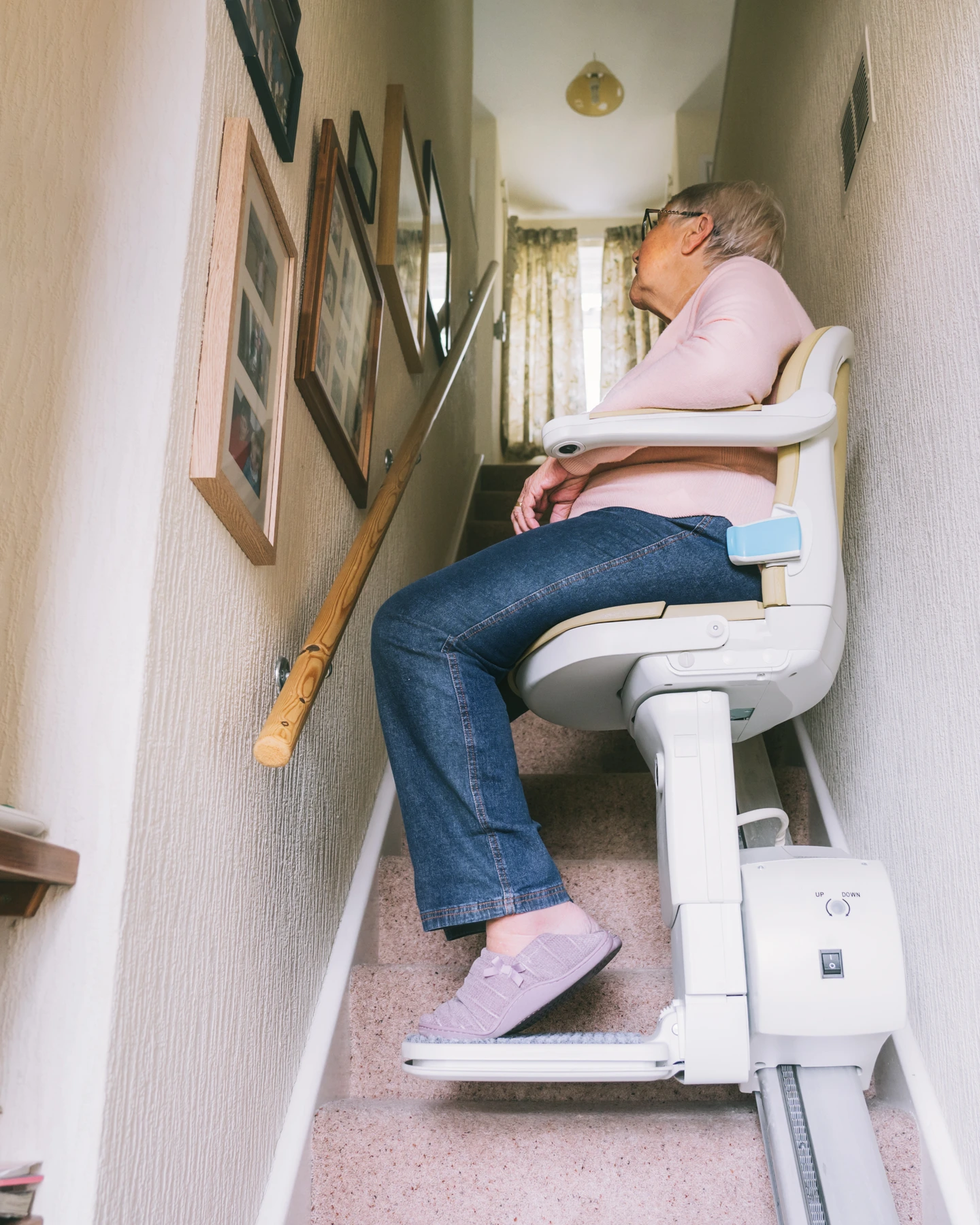
Knee problems are the single most common reason adults over 65 stop using their stairs. Not a catastrophic event — just the slow accumulation of pain that makes the staircase intolerable. Osteoarthritis wears down the cartilage. A knee replacement takes months to recover from. Chronic pain from old injuries makes every step feel like the joint is grinding glass. The result: people stop going upstairs. And that is when the real damage starts.
The pain-avoidance-deconditioning cycle
Knee pain makes stairs hurt. You stop using them. Your leg muscles weaken. Weaker muscles mean less joint support. Less support means more pain. More pain means even less activity. This is the pain-avoidance-deconditioning cycle — the most destructive pattern in geriatric mobility.
We see this in about half of knee-pain calls. The person has not fallen, has not had surgery, has not had a specific event. Over 6-18 months they went from using stairs normally, to gripping the handrail with both hands, to limiting trips to twice a day, to sleeping on the couch. Their world has contracted to one floor of their own home.
A stairlift breaks this cycle two ways: it eliminates the pain of stair climbing (immediate fix) and restores access to the full home so the person resumes normal daily patterns (long-term fix).
Knee conditions that lead to stairlift need
Osteoarthritis (OA)
Over 32 million US adults. Cartilage wears down causing bone-on-bone contact. Stair climbing loads the knee at 3-4x body weight per step — for a 180 lb person, that is 540-720 lbs of force through an arthritic knee. The pain is physics, not psychology.
Total or partial knee replacement
Over 1 million annually — the most common major joint replacement. Recovery: 1-2 days in hospital, 6-12 weeks restricted stair use, 3-6 months full recovery. More painful in weeks 1-4 than hip replacement due to greater soft-tissue swelling.
Rheumatoid arthritis (RA)
Autoimmune. Flares unpredictably — good weeks and bad weeks. Stairlift need can be intermittent. A permanent installation used "as needed" makes more sense than a rental because flares are unpredictable.
Meniscus tears and chronic knee injuries
Torn meniscus, ACL/MCL injuries, Baker's cyst, patellar tendinitis. More common in patients 50s-60s. Often temporary stairlift needs.
Post-surgical stiffness (arthrofibrosis)
Excessive scar tissue limits range of motion. If the knee cannot bend past 80-90 degrees, standard seated stairlift is uncomfortable. Primary use case for a perch (standing) stairlift.
Seated stairlift vs perch (standing) stairlift
| Seated stairlift | Perch (standing) stairlift | |
|---|---|---|
| Position | Rider sits fully, weight off legs | Rider leans against raised saddle seat |
| Knee flexion | ~90 degrees | 15-20 degrees |
| Weight distribution | 100% seat | 60% legs / 40% seat |
| Best for | Most knee arthritis, post-replacement | Cannot bend past 80 degrees |
| % of installs | 90%+ | 3-5% |
| Weight capacity | 300-400 lbs | 250 lbs |
For most knee patients, a standard seated stairlift works fine. The knee is at 90 degrees but unloaded during the ride — different biomechanics, no pain. The exception: patients whose knees physically will not bend to 90 degrees.
The perch stairlift: who it is for and how it works
The rider stands on a platform with knees bent only 15-20 degrees while a higher, narrower saddle-style seat supports weight from behind. Body weight is shared approximately 60% legs, 40% seat.
Who needs a perch stairlift
- Knee arthrofibrosis or stiffness — cannot bend past 80 degrees
- Severe knee/hip arthritis where the sit-to-stand transfer is more painful than stair climbing itself
- More stable standing than sitting (certain neuropathies, balance disorders)
- Narrow staircases where a standard seated unit is too wide
Models available
Limitations
- Lower weight capacity (250 vs 300-400 lbs)
- Requires partial weight-bearing through legs for entire ride
- Rider must have reasonable standing balance
- Fewer model options and limited availability
Stairlifts after knee replacement surgery
Recovery timeline
- Day 0-2: Surgery and discharge. Walking with walker within hours.
- Week 1-3: ROM 60-80 degrees. Stairlift essential.
- Week 3-6: ROM improving toward 90 degrees. PT 2-3x/week. Stairs possible but painful and slow.
- Week 6-12: ROM typically 100-110 degrees. Most patients begin weaning off the stairlift.
- Month 3-6: ROM goal 120+ degrees. Most patients climb stairs normally with handrail.
Key difference from hip replacement
More pain and swelling in weeks 1-4. The seated position increases knee swelling if held at 90 degrees for extended periods — but a stairlift ride is 30-60 seconds, too short to cause significant additional swelling.
Rent vs buy
Same math as hip replacement: rent if under 5 months, buy if 5+ months or bilateral. See the hip replacement guide for full rental math.
When both knees are the problem
Bilateral knee osteoarthritis changes the calculation. When only one knee is bad, the "good" leg compensates. When both are bad, every step is painful in both directions. Bilateral patients are more likely to need a stairlift permanently.
If bilateral knee replacement is planned (typically staged 3-6 months apart), the stairlift covers both recoveries (6-12 months minimum). Buying makes more sense than renting.
Bilateral patients and the perch option
Bilateral patients with reduced ROM in both knees are the primary candidates for perch stairlifts. If both knees struggle to reach 90 degrees, a perch at 15-20 degrees keeps both knees in the pain-free range.
Exercises alongside a stairlift (not instead of)
Important distinction
A stairlift is not a substitute for physical therapy. It removes the barrier (pain during stair climbing) so the patient can focus on rehabilitation without daily stair-climbing trauma. The best outcomes are stairlift + PT, not stairlift instead of PT.
Common PT-recommended exercises for stairlift users
The goal: build enough strength that the stairlift becomes a convenience rather than a necessity — or, if the condition is permanent, maintain overall strength so the stairlift user stays mobile in every other context.
Cost and options for knee patients
| Type | Straight rail | Curved rail |
|---|---|---|
| Standard seated | $2,500-$5,500 | $9,000-$15,000 |
| Perch (standing) | $4,000-$7,000 | $12,000-$18,000 |
| Rental (straight only, seated) | $500-$1,000 install + $150-$250/mo | N/A |
Powered swivel seat ($300-$600): Strongly recommended for knee patients. Eliminates the stand-and-pivot at the top landing — a movement that loads the knee under rotation.
All standard funding programs apply: VA HISA (up to $6,800), Medicaid HCBS waivers, IRS medical deduction, Medicare Advantage supplemental benefits. An OT/PT letter strengthens every application. Full funding guide.
Frequently asked questions
For most knee patients, a standard seated stairlift works well — knees at 90 degrees but unloaded during the ride. If your knees cannot bend to 90 degrees, a perch (standing) stairlift keeps knees at 15-20 degrees. Powered swivel seat ($300-$600) is recommended for all knee patients to eliminate the painful stand-and-pivot at the top.
A raised saddle-style seat that the rider leans against rather than sits on. Knees bend only 15-20 degrees. Weight shared 60% legs, 40% seat. Available from Stannah (Sadler 260) and Handicare. 250 lb capacity, lower than standard seated models. Represents 3-5% of installs.
Not if you combine it with a strengthening program. The stairlift removes the aggravating activity (loaded stair climbing) while you build strength through PT exercises. The worst outcome is stairlift + no exercises. The stairlift stops the pain cycle; the exercises rebuild strength.
Before. Install 1-3 days before surgery so you can test-ride while still mobile. Most patients need the stairlift for 6-12 weeks. Rental is cost-effective for a single knee; purchase makes sense for bilateral.
If knee pain has caused you to avoid stairs, sleep on a different floor, or limit stair trips to once or twice daily, a stairlift will significantly improve daily quality of life. Stair climbing loads the knee at 3-4x body weight — a stairlift eliminates that load entirely.
Related guides
Ready to Get Started?
Free in-home assessment within 24 hours. No pressure, no obligation.