The Complete Stairlift Buyer’s Guide (2026) | All American Stairlifts
Quick Summary A stairlift is equipment, not construction. The rail bolts into your existing stair treads — it does not touch your wall, banister, or floor joists. Removal leaves a handful of small holes in the treads. A straight stairlift costs $3,200-$4,500 installed and takes 2-4 hours. A curved stairlift costs $9,000-$15,000 and takes 4-6 […]
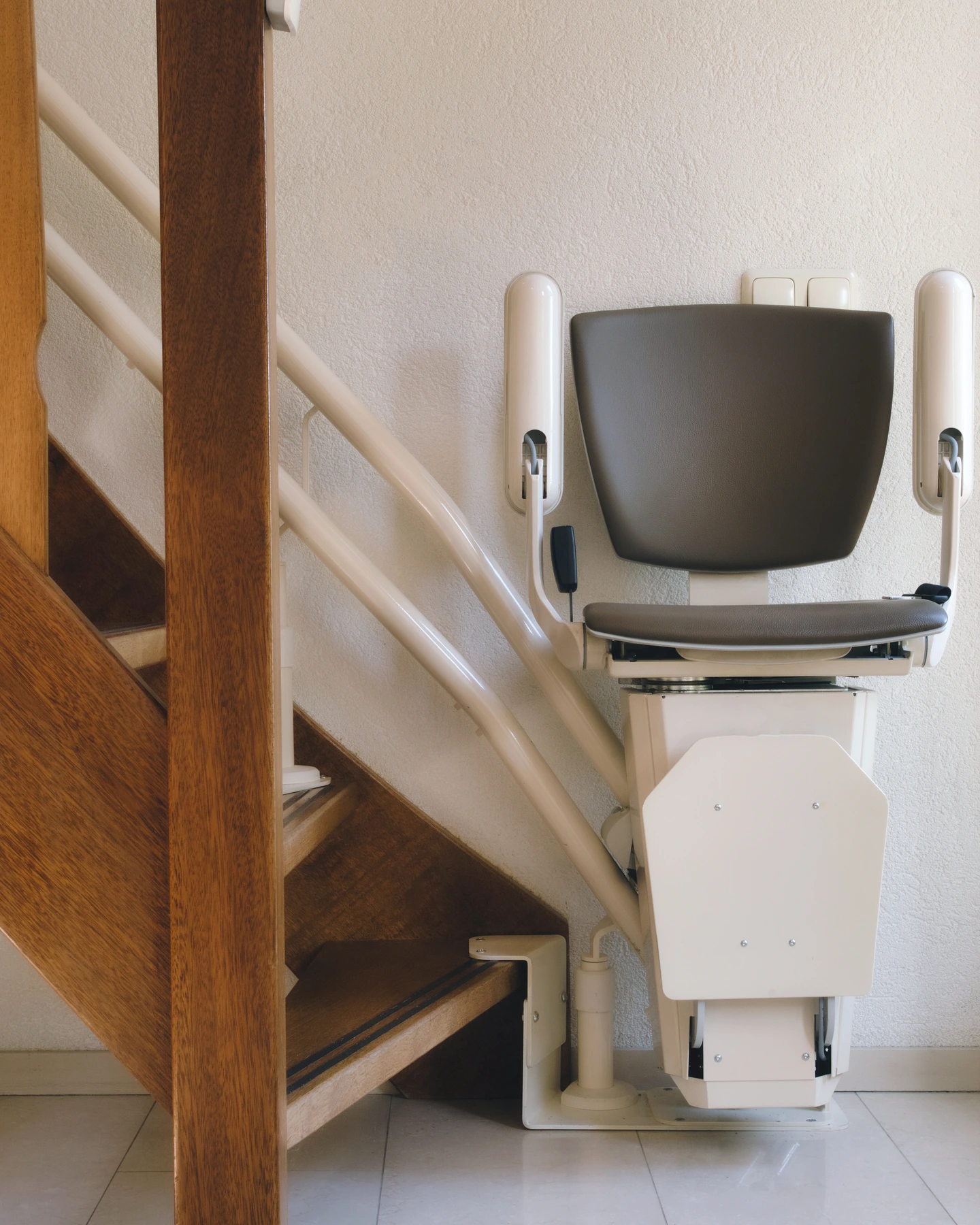
A stairlift is equipment, not construction. The rail bolts into your existing stair treads — it does not touch your wall, banister, or floor joists. Removal leaves a handful of small holes in the treads. A straight stairlift costs $3,200-$4,500 installed and takes 2-4 hours. A curved stairlift costs $9,000-$15,000 and takes 4-6 weeks (custom rail fabrication) plus one day for installation.
What a Stairlift Actually Is (and What It Is Not)
A stairlift is a motorized chair that rides a rail mounted to your stair treads. It carries one seated person between floors. It is not a construction project, a home renovation, or a permanent structural change. The rail attaches with lag bolts directly into the stair treads (not the wall), and the entire unit can be removed in under an hour, leaving only small bolt holes.
Understanding this distinction matters because it affects permits (rarely needed), installation time (hours, not days), and resale considerations (fully removable).
The Three Types That Cover 95% of Homes
| Type | Your Stairs | Cost Installed | Timeline | Key Fact |
|---|---|---|---|---|
| Straight | No turns, no landings, single flight | $3,200-$4,500 | 2-4 hours | 70% of all installations. Rail is stock length, cut on-site. |
| Curved | Any turn, landing, spiral, or L-shape | $9,000-$15,000 | 4-6 weeks + 1 day install | Rail is custom-fabricated from laser measurements of your staircase. No two are identical. |
| Outdoor | Porch entry, deck, hillside | $3,500-$7,500 (straight) / $10,000-$16,000 (curved) | 1-3 days (straight) / 4-6 weeks (curved) | Weather-sealed motor, marine-grade coatings, IP55+ rated. See our outdoor stairlift guide. |
The 4 Things That Actually Matter
1. Weight capacity
Standard stairlifts hold 300 lbs. Heavy-duty models hold 400-600 lbs. If the primary rider weighs over 250 lbs, specify a heavy-duty model upfront. Upgrading later means replacing the entire unit — the motor, rail, and seat are all sized together.
2. Seat-to-floor height and swivel
The rider must be able to sit down from standing and stand up from sitting at both ends of the staircase. Seat height adjustment (16-20 inches) and a powered or manual swivel at the top landing are the features that determine whether your parent can actually use the stairlift safely every day.
3. Rail parking position
The rail extends slightly past the top and bottom steps. At the top, it must not block a doorway or hallway. At the bottom, it must not block a landing or entry. Folding rails, hinge tracks, and overrun options solve most clearance issues, but you must discuss them during the consultation, not discover them during installation.
4. Warranty terms (read the actual document)
Most warranties cover the motor for 5 years, the drivetrain for 3-5 years, and batteries for 1-2 years. Labor is typically covered for 1 year only. The critical question: does the warranty cover the technician’s visit or just the replacement part? A “5-year parts warranty” that does not cover labor means you pay $150-$250 per service call on a “covered” repair.
The 6 Things That Do Not Matter (Despite What Dealers Say)
Safety standards limit stairlift speed to about 0.15 m/s (roughly 20 feet per minute). Every brand travels at essentially the same speed. A dealer who promotes “faster” models is either misinformed or stretching the truth. The ride takes 30-90 seconds depending on staircase length. Speed is not a differentiator.
Modern stairlifts operate at 50-55 dB — about the volume of a quiet conversation. This is true across brands. A dealer emphasizing “whisper-quiet” technology is marketing a standard feature as a premium benefit. If a stairlift is loud, something is wrong with it, not its design.
Straight stairlift rails are 10-12 inches wide. The folded seat protrudes 12-14 inches from the wall. Differences of 1-2 inches between brands are negligible. If staircase width is genuinely tight (under 27 inches), you need a specific narrow-staircase solution, not a “slim” standard model.
The fundamental design (DC motor, battery-powered, rack-and-pinion drive on a rail) has been the same for 25+ years. Improvements are incremental: better battery chemistry, refined safety sensors, quieter gears. A 2026 stairlift is not meaningfully “more advanced” than a well-maintained 2018 model. Do not pay a premium for “innovation” that does not exist.
Bruno, Handicare, Harmar, and Stannah all make reliable stairlifts. The differences are in dealer support, parts availability, and warranty terms — not in the mechanical quality of the equipment. Choose based on your local dealer’s service reputation, not the manufacturer’s national marketing.
Pick whatever color you prefer and move on. Spending 30 minutes of your consultation discussing upholstery colors is 30 minutes not spent on weight capacity, swivel mechanism, and warranty terms. Dealers like discussing colors because it shifts the conversation from price to preference.
What a Fair Price Actually Looks Like
Too cheap: Under $2,500 for a straight stairlift installed usually means used equipment, no warranty, or a bait-and-switch where the installer adds fees on installation day.
Too expensive: Over $5,500 for a standard straight stairlift or over $18,000 for a single-turn curved stairlift means you are being overcharged. Get a second quote.
For a detailed component-level breakdown of where your money goes, see our complete cost guide.
Funding: 6 Paths Worth Exploring
For the full breakdown on Medicare, Medicaid, and VA funding, see our Medicare stairlift coverage guide.
The 10-Question Consultation Checklist
Print this list and bring it to your in-home consultation. If the dealer cannot answer all 10 questions clearly, get a second opinion.
- What is the total installed price, and what exactly does it include? Get a single number that covers equipment, rail, installation, and removal of packaging. No “starting at” pricing.
- Is this a straight or curved installation, and how did you determine that? Some dealers quote curved pricing for stairs that only need a straight rail. A straight staircase with a 90-degree entry at the top can often use a straight rail with a hinge track, saving $5,000+.
- What is the weight capacity of this model? Match to the heaviest person who will use it, plus a 50-lb safety margin.
- Does the seat swivel at the top landing, and is it manual or powered? Powered swivel costs more but is essential for riders with limited mobility or post-stroke hemiplegia.
- Where does the rail end at the top and bottom? Will it block a doorway, hallway, or landing? Are folding rail or hinge track options included in the quoted price?
- What does the warranty cover: parts only, or parts and labor? Get the answer in writing. “5-year warranty” means nothing if it does not cover the $200 service call to install the warranty part.
- Who services the stairlift after installation? Is it the same company, or are you handed off to a third-party service provider? What is the typical response time for a service call?
- What happens if the stairlift breaks down after hours or on a weekend? Is emergency service available? What does it cost?
- Can I see the stairlift operate before I commit? Any reputable dealer has a showroom or demo unit. If they refuse to demonstrate, question why.
- What is the removal process if we no longer need it? Who removes it, what does removal cost ($200-$500 typical), and how many holes are left in the treads?
Brands Worth Your Attention (and One to Avoid)
| Brand | Headquarters | Straight Models | Curved Models | Weight Capacity | Warranty (Motor) | Parts Availability |
|---|---|---|---|---|---|---|
| Bruno | USA (Wisconsin) | Elan, Elite | Custom Curved | Up to 400 lbs | 5 years | Excellent (US-made) |
| Handicare | Netherlands / USA | 1100 | Freecurve, 2000 | Up to 302 lbs | 5 years | Good |
| Harmar | USA (Missouri) | Pinnacle SL600 | Helix (via Handicare) | Up to 350 lbs | 3 years | Good |
| Stannah | UK / USA | Siena, Sadler | Solus, Sofia | Up to 310 lbs | 5 years | Good (UK parts supply) |
Acorn Stairlifts uses a direct-to-consumer model with aggressive sales tactics. Common complaints include: high-pressure in-home consultations with same-day purchase pressure, prices significantly above market ($5,000-$7,000 for a straight stairlift that competitors install for $3,500-$4,500), proprietary parts that cannot be sourced from third-party suppliers, and service contracts that auto-renew. Acorn makes a functional stairlift, but their sales process and pricing warrant getting a competing quote before signing.
Install Day: What Actually Happens
Maintenance: What Most Families Get Wrong
The biggest maintenance mistake is not parking the stairlift at the charging station. The second biggest is oiling the rail when the manufacturer says not to. The third is ignoring the batteries until they die.
- Always park at the charging station. The stairlift charges only when parked at the designated station (top or bottom of stairs). Parking it mid-staircase drains batteries.
- Do not oil the rail unless your manual says to. Most modern stairlifts use dry-running gear systems. Oil attracts dust, which becomes abrasive paste, which wears the drive gear faster.
- Replace batteries proactively. SLA batteries last 2-3 years. Replace them before they fail, not after your parent gets stuck mid-staircase. See our battery guide.
- Keep the stairs clear. Shoes, vacuum cords, and pet toys trigger safety sensors and stop the stairlift. Clear the staircase daily.
- Schedule annual service. A $100-$200 annual inspection catches wear before it becomes a $500 repair. See our breakdown guide.
When a Stairlift Is the Wrong Answer
A stairlift is wrong when the person uses a wheelchair full-time (consider a through-floor lift or home elevator), when the staircase is too narrow (under 25 inches), when the person cannot safely sit down or stand up even with a swivel seat, or when the home has other accessibility barriers that make single-floor living the better solution. See our 8 stairlift alternatives for other options.
The One Thing We Wish Every Family Knew
Most families wait too long. They wait until after the fall, after the hospital stay, after the discharge planner says the house is not safe. By then, the decision is made under pressure with limited options. If your parent is avoiding the stairs, gripping the railing with white knuckles, or going up and down on their hands and knees — the stairlift conversation is overdue.
Related Guides
Frequently Asked Questions
Original Medicare (Parts A, B, and Medigap) does not cover stairlifts. Some Medicare Advantage plans include home modification benefits that may cover partial costs. See our full Medicare coverage guide for details and 5 alternative funding paths.
Straight stairlifts cost $3,200-$4,500 installed. Curved stairlifts cost $9,000-$15,000 (custom rail fabrication drives 60% of the cost). Outdoor straight stairlifts run $3,500-$7,500. See our complete cost guide for component-level breakdowns.
A well-maintained stairlift lasts 15-20 years. The motor and rail last the longest. Batteries need replacement every 2-3 years (SLA) or 5-8 years (LiFePO4). Annual service inspections ($100-$200) catch wear before it becomes expensive repair.
Technically possible for straight stairlifts (some brands sell DIY kits for $2,000-$3,000), but not recommended. Incorrect installation creates safety hazards, voids the warranty, and may not meet local code requirements. Professional installation takes 2-4 hours and ensures the safety sensors, rail alignment, and charging system are properly calibrated.
A stairlift rail bolts into the stair treads with lag bolts. It does not attach to walls, banisters, or floor joists. When removed, you are left with 6-10 small bolt holes in the treads that can be filled with wood filler in minutes. No structural damage occurs.
Straight stairlift installation takes 2-4 hours. You can use it immediately after. Curved stairlifts take 4-6 weeks for custom rail fabrication, then one day for installation. The actual in-home work is 4-6 hours for curved installations.
Ready to Get Started?
Free in-home assessment within 24 hours. No pressure, no obligation.