Stairlifts for Condos & Apartments: Board Packets to Building Codes (2026)
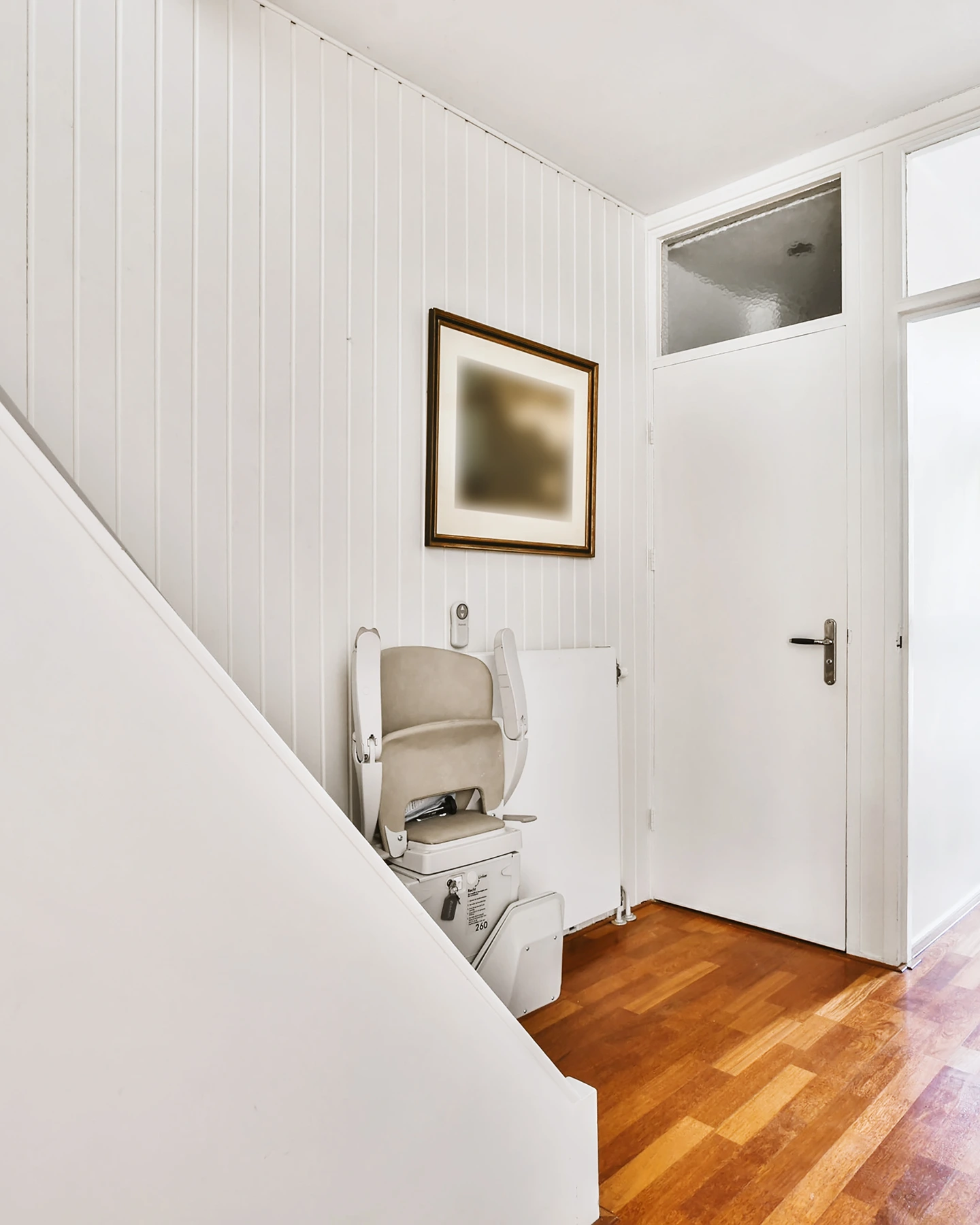
Two Completely Different Installs
About 15% of our stairlift installations go into multi-unit buildings — condos, co-ops, townhomes, and apartments. These installs split into two categories with very different processes.
In-Unit Stairlifts: The Easy Version
If the stairs are inside your unit — a duplex condo, townhome, or loft mezzanine — the installation is functionally identical to a single-family home. No board approval needed. No fire code review. No neighbor notifications.
- Duplex condos: Internal staircase connecting two floors within one unit. Standard straight or curved stairlift.
- Townhomes: Multi-floor unit with private staircase. Same as a single-family home installation.
- Loft mezzanines: Open staircase to a loft level. Often straight rail with minimal footprint.
In all three cases, you own the staircase and can modify it without board involvement.
Common-Stair Installs: Where It Gets Real
Installing a stairlift on a shared staircase involves board approval, fire marshal sign-off, and federal disability law. This section covers the full process.
The basic sequence
- Document the need. Physician's letter stating stairs are medically dangerous for you.
- Notify the board in writing. Request a "reasonable modification" under the Fair Housing Act. (More on this below.)
- Submit our approval packet. We assemble a 40+ page packet covering engineering specs, egress compliance, insurance documentation, and installation/restoration plan.
- Fire marshal review. Required in most municipalities for common-stairway modifications. We handle the submission.
- Board vote or management approval. Typical timeline: 4-10 weeks from initial notification.
- Install and document. Same-day installation with before/after photos for the board file.
Your Federal Rights Under the Fair Housing Act
The Fair Housing Act (42 U.S.C. § 3604) prohibits discrimination against people with disabilities in housing. This includes the right to make "reasonable modifications" to your dwelling — even in common areas — at your own expense.
A condo board, HOA, co-op board, or landlord cannot deny a disability-related modification if: (1) you have a disability, (2) the modification is necessary for full use of the premises, and (3) you pay for it and agree to restore the area when you leave.
"I don't want it in my building" is not a legal basis for denial. "The other residents don't like it" is not a legal basis. "It looks ugly" is not a legal basis.
The only legitimate grounds for denial: the modification creates a genuine safety hazard (e.g., blocks the only fire exit below minimum egress width) that cannot be resolved with an alternative configuration.
If your board denies the request, you can file a complaint with HUD's Fair Housing Office or with your state's civil rights agency. Most boards approve once they understand the legal framework — which is why our approval packet includes a summary of the law.
Condo vs. Co-op: The Practical Difference
| Factor | Condo | Co-op |
|---|---|---|
| Ownership structure | You own the unit + share of common areas | You own shares in a corporation that owns the building |
| Modification approval | Board review, but FHA limits their authority to deny | Board has broader approval power, but FHA still applies |
| Who pays | Resident pays installation + restoration | Resident pays, but co-op may require their contractor |
| Insurance requirements | Resident's HO-6 policy + general liability from installer | Co-op may require additional insurance naming the corporation |
| Restoration obligation | Required upon sale/move-out (unless next buyer wants it) | Almost always required |
"Co-op boards ask more questions and take longer to approve — but they have never legally been able to deny a disability modification under the FHA. The process is slower, but the outcome is the same."
— Luis Ramírez, Lead Installer, All American Stairlifts
Rent-Stabilized Tenants and Section 8
Rent-stabilized tenants have the same FHA rights as condo owners. The landlord must permit reasonable modifications at the tenant's expense. In New York City, rent-stabilized tenants may also qualify for DRIE (Disability Rent Increase Exemption) — freezing rent increases while receiving disability benefits. This frees up budget for accessibility modifications.
Section 8 tenants can request modifications under the FHA. Some housing authorities have separate accessibility modification budgets that may help fund the installation. Contact your local housing authority to ask about accessibility funding before paying out of pocket.
Fire Code, Egress Width, and the Fire Marshal Sign-Off
The primary concern with common-stair stairlifts is egress width — the clear walking space that must remain available for fire evacuation.
Solutions when egress is tight
- Slim-profile models: Folded width as low as 10 inches. See our narrow stairs guide for specific models.
- Automatic fold-away: The seat, footrest, and armrests fold automatically when not in use, maintaining maximum stair width.
- Rail-side installation: Mounting the rail on the wall side (rather than the banister side) sometimes provides an extra inch of clearance.
- Fire marshal variance: In some jurisdictions, the fire marshal can grant a variance for disability accommodations, especially when the stairlift includes automatic fold-away.
Our 40+ Building Approval Packet
We assemble a comprehensive packet designed to get first-review approval. Boards deny requests when they lack information — our packet eliminates that problem.
- Engineering specifications — equipment dimensions, weight, mounting method, electrical requirements
- Egress compliance analysis — measured stair width with stairlift folded, compared to applicable fire code
- Insurance documentation — our general liability certificate naming the building/association
- Installation plan — scope of work, timeline, crew size, noise and access requirements
- Restoration plan — what we remove and restore when the stairlift is no longer needed
- Fair Housing Act summary — the legal framework for reasonable modifications
- Manufacturer safety certifications — UL listing, ASME A18.1 compliance
- Photo examples — stairlifts installed in similar buildings with egress measurements
Cost: Who Pays for What
- Stairlift equipment and installation ($2,500-$15,000)
- Any electrical work required (typically $200-$500)
- Building application fees (if any, typically $0-$500)
- Restoration upon removal ($200-$500)
Funding: VA HISA ($6,800), Medicaid waivers, and state programs apply to condo/apartment installations the same as single-family homes. The stairlift is a modification to your dwelling, regardless of building type.
Removal and Restoration Obligations
Under the FHA, the building can require you to restore the common area to its original condition when the stairlift is no longer needed (you move, sell, or no longer require it). This typically involves:
- Professional removal of the stairlift (2 hours, included with most service agreements)
- Patching 4-6 small bracket holes in the stair treads
- Touching up paint if the wall side was used for mounting
- Total restoration cost: $200-$500
Some buildings allow the next owner/tenant to keep the stairlift if they also have a disability. Document this possibility in the initial agreement to avoid unnecessary removal.
Frequently Asked Questions
Not if you have a documented disability and the modification is necessary for full use of the premises. The Fair Housing Act protects your right to make reasonable modifications. The board can set reasonable conditions (insurance requirements, restoration obligations) but cannot deny the modification outright.
The resident requesting the modification pays for installation and restoration. The building is not required to share the cost (though some choose to). VA, Medicaid, and state funding programs apply regardless of building type.
You must notify your landlord, but they cannot legally deny a disability-related modification under the FHA. They can require you to pay for the modification and restore the premises when you leave.
The stairlift itself needs about 26 inches minimum. For common stairways, the remaining clear width after installation must meet fire code (typically 36 inches, or 44 inches for buildings with 50+ occupants). Slim-profile models that fold to 10-12 inches work in most common stairways. See our narrow stairs guide.
Yes. The FHA applies to all housing types, including rent-stabilized apartments. The landlord must permit the modification at the tenant's expense. In NYC, rent-stabilized tenants may also qualify for DRIE (Disability Rent Increase Exemption) which frees up budget for accessibility modifications.
Live in a Condo or Apartment?
We have installed stairlifts in 200+ multi-unit buildings. Our 40+ page approval packet handles the board process so you do not have to navigate it alone. We also coordinate with fire marshals and building management directly.
Request a free assessment — tell us your building type and we will outline the exact approval process for your situation.
Ready to Get Started?
Free in-home assessment within 24 hours. No pressure, no obligation.