Stairlift Electrical Requirements: Outlets, Circuits & Permits
Ninety percent of installs plug into an existing 120V household outlet and draw less power than a table lamp. This guide covers the exact electrical specifications for every scenario — including the 10-15% of homes that need a new outlet, a GFCI upgrade, or a dedicated circuit.
The basic electrical setup
Modern stairlifts use DC-powered, battery-driven systems. A 120V AC household outlet powers a transformer that converts AC to DC, which trickle-charges two 12V onboard batteries. The charger draws 1.5-2 amps — about 200 watts. The motor runs on battery power during rides. Full recharge takes 4-8 hours; normal daily use keeps batteries from ever fully depleting.
Standard outlet specification
Required: 120V, 15A, grounded (NEMA 5-15R)
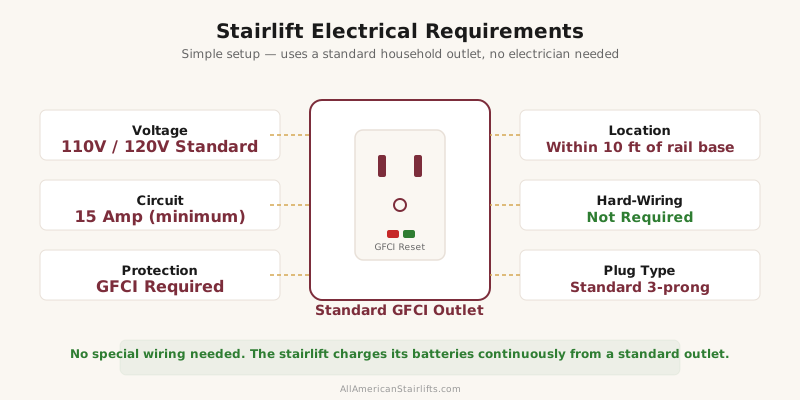
A standard US 120-volt, 15-amp, three-prong grounded receptacle. The charger must be within 6 feet of the charging station location (charger cords are 6-8 feet). This scenario applies to 85-90% of residential installs.
Older homes with two-prong outlets
The stairlift charger has a three-prong plug. Three-to-two adapters ("cheater plugs") eliminate ground-fault protection and create shock hazards in damp locations. The correct fix: an electrician replaces the two-slot outlet with a grounded three-slot outlet ($100-$250).
Dedicated circuit: when needed and when not
When NOT needed (the majority)
A 15-amp circuit delivers 1,800 watts continuously. The stairlift charger draws about 200 watts. There is ample headroom for typical residential loads sharing the same circuit.
When needed (~10-15% of homes)
- Existing circuit heavily loaded with always-on appliances with inrush spikes (sump pump, dehumidifier, chest freezer)
- Voltage dips could trigger low-voltage faults on the stairlift
- Measured voltage below 110V under load at the outlet
- Old or undersized circuit in pre-1950 homes
GFCI requirements by location
A Ground Fault Circuit Interrupter (GFCI) trips the circuit within milliseconds if it detects current leaking to ground. NEC Article 210.8(A) requires GFCI protection on all 125V outlets in:
| Location | GFCI required? | Stairlift implication |
|---|---|---|
| Main indoor staircase (hallway/living area) | No | Standard outlet is fine |
| Unfinished basement | Yes | GFCI-protected outlet required |
| Garage | Yes | GFCI-protected outlet required |
| Outdoor | Yes | GFCI + weather-rated required |
| Bathroom | Yes | GFCI-protected outlet required |
| Laundry area | Yes | GFCI-protected outlet required |
GFCI nuisance tripping
GFCI outlets can trip from the stairlift charger's inrush current — a false alarm, not a fault. Fix: replace the GFCI receptacle with a GFCI circuit breaker at the panel ($75-$150 installed). The breaker provides the same protection with a higher tolerance for inrush current.
Outlet placement
Ideal placement
On the wall behind the bottom of the rail, 12-18 inches above the floor. The cord remains hidden during normal use.
Common problems
- Outlet on opposite wall: Cord crosses the stairway — trip hazard and code violation.
- Outlet too high: Charger cord arcs across the wall, potentially visible or snagging.
- No outlet near stairs: Common in older homes with central hallways. Solution: new circuit from panel ($300-$500).
What the electrician actually does
New outlet (most common scenario when work is needed)
- Identify nearest circuit with available capacity
- Run 14-gauge Romex cable from panel to outlet location
- Install single-gang old-work box
- Wire outlet (hot, neutral, ground), install receptacle and cover plate
- If GFCI required, install GFCI receptacle or breaker at panel
- Test with plug tester and GFCI trip tester
Time: 1-3 hours. Materials: $20-$40. Labor: $100-$300. If quoted more than $500 for a single new outlet in a standard residential setting, get a second quote.
Outdoor electrical requirements
- GFCI protection: Required on all outdoor 125V outlets — non-negotiable
- Weather-rated (WR) receptacle: Must have WR designation for wet-location exposure
- In-use weatherproof cover: Must protect outlet while cord is plugged in, not just when empty
- Conduit or rated cable: EMT or PVC conduit; some jurisdictions accept UF-rated cable for direct burial
Cost: New outdoor GFCI-protected, weather-rated outlet: $250-$500 installed (more than indoor due to weatherproofing and conduit).
Permit requirements
Stairlift itself
Most US jurisdictions classify the stairlift as mechanical furniture — no permit needed. Notable exceptions:
- Michigan: Requires permitting and inspection under the state elevator code
- Pennsylvania: Specific regulations; single-family homes generally exempt
- Some California counties: Require mechanical permit for motorized accessibility devices
Electrical work
- Replacing existing receptacle with GFCI (like-for-like): no permit
- Adding new outlet, running new circuit, modifying panel: permit required in most jurisdictions
- Adding sub-panel or upgrading main panel: always requires permit
Licensed electricians handle permit acquisition as part of the job. Permit fee: typically $50-$150.
Electrical costs summary
| Scenario | Cost |
|---|---|
| No electrical work needed (85-90% of installs) | $0 |
| GFCI upgrade only | $75-$150 |
| New indoor outlet on existing circuit | $150-$300 |
| New indoor outlet on dedicated circuit | $200-$400 |
| New outdoor outlet (GFCI, WR, cover, conduit) | $250-$500 |
| Electrical permit fee | $50-$150 |
| Panel upgrade or sub-panel (rare) | $300-$800 |
Frequently asked questions
No, in 85-90% of installations. The charger draws only 1.5-2 amps — less than a table lamp and phone charger combined. A dedicated circuit is needed only when the existing circuit is heavily loaded with voltage-dip-causing appliances. Your installer checks this during the free assessment.
A standard US 120-volt, 15-amp, three-prong grounded outlet (NEMA 5-15R). It must be within 6 feet of the charging station. In basement, garage, or outdoor locations, the outlet must also be GFCI-protected per NEC code.
Most installs need no electrical work at all ($0). When work is needed: new indoor outlet $150-$300, GFCI upgrade $75-$150, new outdoor GFCI with weatherproofing $250-$500, dedicated circuit $200-$400. Permits $50-$150 when applicable.
No. The charger draws about 200 watts during the charge cycle. At the average US rate of $0.16/kWh, running the charger 8 hours daily costs about $0.26/day or $8/month — less than leaving a porch light on. The motor runs on battery power and draws nothing from the wall during rides.
No. The charger has a three-prong plug that requires a grounded outlet. Three-to-two adapters defeat ground-fault protection and create shock hazards, especially in damp locations. The fix: an electrician replaces the outlet with a grounded three-slot outlet and runs a ground wire ($100-$250).
Related guides
Ready to Get Started?
Free in-home assessment within 24 hours. No pressure, no obligation.