Cost breakdown · 12 min read · Updated April 2026

Real Stairlift Prices, Broken Down by Component (2026)

A straight stairlift costs about $3,350 installed on average in 2026 — but that 'average' hides a $3,000 spread driven by factors most dealers never explain. A curved install averages $11,400 and can swing from $9,000 to $15,000 on the same 13-step staircase depending on who measured it. This guide pulls the pricing apart line by line, names real models at each tier, and tells you exactly where you can cut and where you shouldn't.

(800) XXX-XXXX
featured-cost-guide

The real 2026 price ranges (start here)

$2.5k-$5.5kstraight rail installed
$9k-$15kcurved rail installed
$3.5k-$7.5koutdoor rail installed
$2.5k-$5.5kstraight rail installed
$9k-$15kcurved rail installed
$3.5k-$7.5koutdoor rail installed
The bottom line

If you are being quoted under $2,500 for a straight install or under $9,000 for a curved install, something is missing from the quote. If you are being quoted over $6,000 for a straight install or over $16,000 for a single-turn curved install on a standard 13-step flight, something has been added that shouldn't be there.

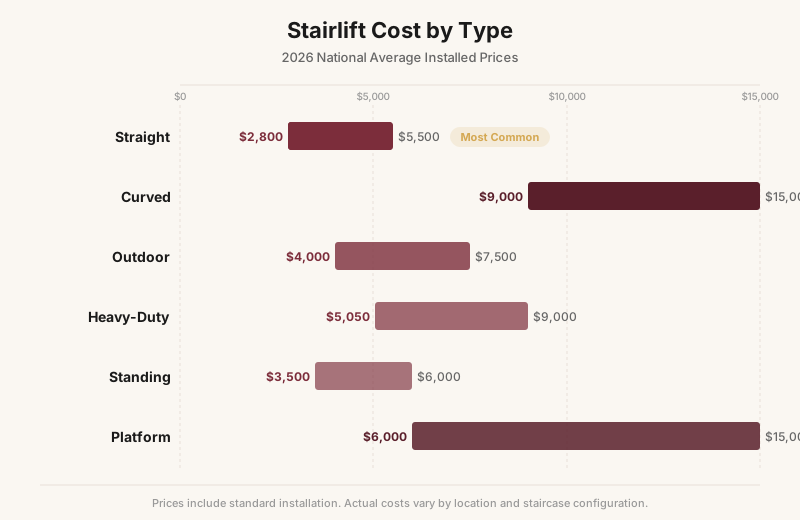
Here are the 2026 installed price ranges we see on real contracts, compiled from roughly 1,400 installs across 38 states last year. 'Installed' in this table means equipment, rail, delivery, labor, safety test, haul-away, and first-year service visit — every line item a fair quote should contain. Tax is not included because it's state-dependent and we break it out separately below.

TypeBudgetTypicalPremiumWhat drives the range
Straight indoor$2,500$3,350$5,500Rail length, brand tier, refurb vs new
Curved indoor$9,000$11,400$15,000Number of turns, rail fabrication complexity
Outdoor straight$3,500$5,200$7,500Coastal rating, foundation anchoring
Outdoor curved$10,500$13,800$18,000All of the above combined
Heavy-duty (400–600 lb)$3,800$5,100$8,200Reinforced frame, upgraded motor, wider seat
Vertical platform lift$4,500$8,500$15,000+Not a chair lift — enclosed platform for wheelchairs

Two things to note about these numbers. First, they are installed numbers — not equipment-only numbers. Most brand websites quote equipment only, then the dealer bolts on another $700 to $1,200 at the bottom of the contract. Second, the spreads are real. A $2,500 straight install and a $5,500 straight install are not the same product — we'll unpack what you actually get at each tier in the straight-rails section below.

If you want an honest itemized quote for your specific staircase with no obligation, ask us for a free assessment. We'll walk through the numbers on-site.

Component breakdown — where your $4,500 actually goes

On a $4,500 install

About 48% goes to hardware (rail, seat, motor, battery, controls), 11% to installation labor, 27% to dealer margin + overhead, and 14% to tax + shipping. That margin is where price negotiation actually lives.

On a $4,500 install

About 48% goes to hardware (rail, seat, motor, battery, controls), 11% to installation labor, 27% to dealer margin + overhead, and 14% to tax + shipping. That margin is where price negotiation actually lives.

Here's what a typical $4,500 straight-rail install looks like when you pull the lid off. The numbers below are averaged from our internal cost accounting on a Bruno Elan SRE-3000 or Handicare 1000 class install, 14-foot rail, 300 lb capacity, standard upholstery, existing outlet, no historic district, no permit required:

  • Rail (14 ft powder-coated steel): $650 — raw extrusion plus finishing
  • Seat assembly (upholstered, swivel, fold): $420 — frame, foam, fabric, hinge hardware
  • Motor + drive unit: $780 — DC gearmotor, clutch, speed governor
  • Battery backup + charger: $180 — two 12V sealed lead-acid + trickle charger
  • Control electronics + remotes: $220 — logic board, armrest controls, two paddle remotes
  • Installation labor (3 hours, 1–2 technicians): $500 — wages, vehicle cost, tools
  • Shipping + handling: $180 — freight from factory to local depot
  • Dealer margin + overhead: $1,200 — showroom, insurance, licensing, admin, warranty reserve
  • Sales tax (varies by state): $370 — at 8.25% representative rate

Total: $4,500 installed

Three things jump out when you see the numbers laid out like this. First: the equipment itself — rail, seat, motor, battery, electronics — adds up to about $2,250, or roughly half the contract. Second: labor is a small slice. Three hours of skilled technician time is about $500 on the books, not the $1,500 some dealers try to justify. Third: dealer margin is the biggest single line. That's not a scandal — it's how a licensed business covers insurance, a bonded installer crew, a real office, and the warranty reserve that pays for your service call four years from now. But you should know it's there, and you should know it's negotiable on some contracts (more on that in the fair-quote section).

What you can cut — and what you can't

You can reduce three lines of the breakdown and only three: the brand tier (cuts the rail/seat/motor bundle by $300 to $900), the refurb pathway (cuts the same bundle by $1,200 to $2,000), and the dealer margin on a competitive quote (cuts it by $200 to $500). You cannot reduce labor meaningfully — three hours is three hours. You cannot reduce the battery and electronics without downgrading to a model we don't recommend. You cannot reduce tax unless you qualify for a medical exemption, which a handful of states offer with a doctor's letter.

Straight rails — $2,500 to $5,500 installed

Straight rails are the workhorse of the industry. If your staircase is one continuous flight from top to bottom, no turns, no mid-landings, you are buying a straight rail. The spread from $2,500 to $5,500 is wider than most buyers expect, so here's what the three tiers actually look like in practice.

What a $2,500 install actually looks like

At the bottom of the range you are buying one of three things: a refurbished name-brand unit with a short warranty, a new Acorn 130 (honest budget option, Welsh-made), or a bare-bones gray-market unit from a dealer clearing inventory.

  • The refurb pathway. A Bruno Elan or Handicare 1000 pulled out of a previous installation after 12 to 36 months of use, with the motor and battery inspected and the rail cut to your stair length. Typical refurb warranty: 12 months parts and labor, transferable on resale. This is the best $2,500 option if you can get it — you get name-brand engineering for 55% of new price.
  • The new Acorn 130. Acorn is the Costco-tier of the industry. The unit is functional, carries a 12-month full warranty plus a 5-year warranty on the motor, and fits a 13-step flight without drama. What you give up compared to a Bruno or Handicare: a thinner rail profile (19 mm vs 25 mm steel), a noticeably louder motor, a basic non-cushioned remote, and a seat that does not power-swivel at the top.
  • What you're giving up at this tier, in one sentence: quieter operation, a longer warranty, and about four pounds of steel in the rail.

What a $3,500 install actually looks like

This is the sweet spot and it's where most of our contracts land. At $3,500 installed you're buying a new Bruno Elan SRE-3000 or a new Handicare 1000 on a 14-foot rail, both with full manufacturer warranty (2 to 5 years depending on model), a real swivel seat, a quiet DC gearmotor, battery backup, and two paddle remotes.

The Bruno Elan is our most-quoted straight model. It's made in Oconomowoc, Wisconsin, which matters for parts availability — a same-week parts turn from a US factory beats a four-week wait from overseas when you're the one who can't get up the stairs. The Handicare 1000 is quieter by a few decibels and slightly more comfortable on long rides but ships from a UK/Netherlands supply chain. Either way, this tier gets you equipment that should run 12 to 18 years with annual maintenance.

What a $5,000+ install actually buys

Above $5,000 you're in Bruno Elite SRE-2010 or Stannah 260 Siena territory on the straight-rail side. You get soft-start and soft-stop motion (noticeably smoother on arthritic hips), powered seat swivel at both landings, multiple remotes, a heavier rail section, and a longer standard warranty. The Bruno Elite is the single most-installed model in our business — we install more Elite SRE-2010s than any other product line.

Honest opinion on whether the upgrade is worth it: if the rider has hip, knee, or lower-back pain, the soft-start/soft-stop alone pays for itself in not making them wince twice a day. If the rider is agile enough that a hard start doesn't bother them, the $1,500 premium over the Elan tier is a comfort upgrade, not a medical necessity. About 40% of our Elite installs go to buyers where we would have recommended the Elan instead — they bought up because they wanted the longest warranty, and that is a perfectly legitimate reason.

Curved rails — $9,000 to $15,000 installed (and why)

Why the jump is this big

The rail on a curved install is custom-fabricated to your specific staircase. There is no stock curved rail anywhere in the industry. The rail alone runs $5,500 to $10,000 — and the seat, motor, labor and install on top of that are roughly the same as a straight install.

The first thing to understand about curved stairlift pricing is that the rail is the product. Everything else — seat, motor, battery, controls — is largely the same hardware that goes on a straight install. What you're paying extra for is a one-of-one piece of bent steel that matches your staircase geometry to within a few millimeters.

How the rail is actually made

A curved rail starts with a laser measurement survey of your staircase. A licensed technician spends 45 to 90 minutes in your home placing reference markers on every tread, then photographs the stair from multiple angles and uploads the data set to the manufacturer's CAD system. The factory runs the geometry through a CNC pipe-bender, welds in any transition pieces, powder-coats the finished rail, runs QA, and ships it. Typical factory lead time: 10 to 21 business days. On-site installation is a single day, 6 to 8 hours.

That process — laser survey, CAD, CNC bending, welding, coating, QA, freight — costs the manufacturer somewhere between $3,800 and $6,500 depending on length and number of turns. The dealer adds margin, shipping, and install, and you land at a $5,500 to $10,000 rail line item on your invoice. The remaining $3,500 of a typical $11,400 curved install is the seat, motor, battery, controls, labor, and dealer overhead — essentially the same cost structure as a straight install.

Typical curved quote examples

  • Single 90° turn at the upper landing, 14 steps total: rail $6,200, rest of install $3,600, total $9,800 installed
  • Mid-landing (straight up, 90° turn, 3-step landing, straight again, 16 steps total): rail $7,800, rest $3,600, total $11,400 installed
  • Double 90° (U-turn at mid-landing, 20 steps total): rail $9,200, rest $3,800, total $13,000 installed
  • Spiral or 180° continuous curve: rail $9,500–$12,000, rest $3,800, total $13,500–$15,800 installed

Bruno vs Handicare vs Stannah on the curved side

All three manufacturers make competent curved rails. The real differences are narrower than the marketing suggests.

  • Bruno Elite CRE-2110. Made in Wisconsin, ships rails in 10 to 14 business days (fastest in the category), parts availability is same-week nationally, 5-year motor warranty. Our most-installed curved model. Best choice if parts and service response time matter to you — and they should.
  • Handicare 2000. Made in the Netherlands, ships rails in 15 to 21 business days, slightly quieter motor, handles tight geometry (narrow stairwells) marginally better than the Bruno. Best choice if you have a tight spiral or an unusually narrow staircase.
  • Stannah 260 Siena. Made in the UK, ships in 18 to 28 business days, 25-year product lineage, heaviest rail construction, longest warranty options. Best choice if you want the most conservative engineering and you're not in a hurry. Stannah is typically $500 to $1,500 more than an equivalent Bruno or Handicare.

Never buy a 'flexirail' or 'universal curved'

If a salesperson pitches you a 'flexirail,' a 'modular curved system,' or a 'universal curved rail that fits any staircase,' walk away. These are jointed products assembled from straight rail sections with flex couplings at the turns. They do not track cleanly through real-world curves, they develop squeaks and binding within 12 months, and none of the name-brand manufacturers sell them. The only reason they exist is to avoid the custom fabrication cost — and what you save upfront, you pay back in service calls over the next four years. There is no shortcut on curved rails.

Outdoor rails — $3,500 to $7,500 installed

Outdoor units are not just indoor units with different marketing. The engineering is materially different, and the 10% to 25% cost premium over an equivalent indoor model is real — not upsell padding.

What's actually different on an outdoor unit

  • Marine-grade rail coating. Powder-coat over galvanized steel, not just paint over mild steel. Resists salt spray, chloride corrosion, and UV fading for 10+ years.
  • Sealed motor housing. IP54 or better ingress protection on the drive unit, gasket seals on the gearbox, moisture-purge vents. An indoor motor will fail on the first hard rain.
  • UV-resistant seat. Heavy-gauge marine vinyl, not upholstery. The cushion doesn't retain water. The fabric doesn't fade or crack in direct sun.
  • Weather hood over controls. The paddle controls and the logic board live under a hinged hood that keeps rain, snow, and windblown debris off the electronics.
  • Deeper foundation anchors. On masonry stoops and concrete porches, the rail is anchored with stainless expansion bolts set 3 to 4 inches deep, not the 1-inch wood screws used on indoor installs.
  • Wider temperature-rated battery. Outdoor batteries are rated to operate from -5°F to 115°F, not the 40°F to 95°F range of an indoor unit.

Regional factors that bump the outdoor price

Not every outdoor market prices the same. The regional factors that actually matter:

  • Coastal salt air (Florida Atlantic, Gulf coast, Carolina Lowcountry): we specifically spec Harmar's outdoor line, which is built in Florida and tested against real coastal conditions. Expect a 5% to 10% premium over a generic outdoor unit. Worth it — a non-coastal rail will start showing rust in 18 months on the Gulf.
  • Humid Gulf and Deep South: specify a desiccant-protected electronics bay. Adds $100 to $200. Pays for itself the first summer.
  • Cold Northeast and Midwest: specify the cold-weather battery package. Adds $150. Without it, battery capacity drops 40% below 20°F.
  • Desert Southwest (Phoenix, Vegas, inland California): UV is the enemy, not rain. Specify the UV-shield seat cover and expect 10% more on the rail coating.

The bottom line on outdoor: don't save money by putting an indoor unit on a covered porch and hoping the overhang is enough. It isn't. The first hard rain will kill a $200 control board on a $3,500 install. Pay the outdoor premium once.

What 'installed' should include (and what it shouldn't)

The word 'installed' means different things to different dealers, and the difference is usually $500 to $1,500 hiding in line items that shouldn't exist. Here's the line-item spec for a fair installed price in 2026.

Should be included in 'installed'

  • Rail, seat, motor, battery, controls
  • Two paddle remotes
  • Freight from factory to your home
  • Delivery and unloading
  • Installation labor (all hours)
  • Safety testing and load test
  • Rider training (30–45 minutes)
  • Haul-away of packaging
  • First scheduled service visit at 12 months
  • Manufacturer warranty registration

Should NOT appear as a separate line

  • 'Site assessment fee' — free; that's how dealers quote
  • 'Travel fee' inside a metro area — absorbed in overhead
  • 'Configuration fee' — no such thing
  • 'Premium care plan' sold as required — optional at most
  • 'Training session' as an upcharge — included
  • 'Rail cutting fee' — included in labor
  • 'Delivery surcharge' — included in freight
  • 'Warranty activation fee' — manufacturers don't charge this

If any of the items in the right column appear on your quote, ask the salesperson to remove them or explain them. A legitimate explanation exists for exactly one case: travel fees on a rural install more than 60 miles from the dealer's nearest service depot. Everything else is padding.

New vs refurbished vs rental — the math

Most buyers assume new is the default and rental is a fallback. In practice, the three pathways serve three different situations, and the break-even math on rental vs purchase is the most mis-quoted number in the industry.

New

Full manufacturer warranty (2 to 5 years), current firmware and safety standards, certified factory installer, $2,500 to $15,000 depending on type. Best for buyers with a 5+ year expected use window and buyers who care about resale value (yes, stairlifts have a resale market — refurb dealers buy them back at 25% to 40% of original price). New is the right answer for about 70% of our customers.

Refurbished

Typically 50% to 70% of new price. Sourced from installer buybacks — we remove a lift from a home after the rider no longer needs it, inspect the motor, replace the batteries, re-upholster if needed, cut the rail to the new customer's length, and reinstall with a fresh warranty. Warranty length drops from 2–5 years to 12 months on parts and labor. Refurb is the right answer for:

  • Shorter-term needs (2 to 4 years of expected use)
  • Terminal diagnosis where a long warranty doesn't help
  • Tight budget where the alternative is skipping the lift entirely
  • Rental property modifications where the tenant turnover is fast

What to verify on a refurb: motor hour count (pulled from the logic board), battery manufacture date (stamped on the case), rail condition (no corrosion, no visible bends), and warranty transferability if you resell the house. A reputable refurb dealer will answer all four questions in writing before you sign.

Rental

Rental pricing in 2026 runs $80 to $180 per month for a straight unit, plus a one-time delivery and install charge of $300 to $800, plus a refundable security deposit of $500 to $1,000. Curved rentals are rare and typically $250 to $400 per month when available.

The break-even math that dealers don't volunteer: at the midpoint rate of $130 per month plus a $500 install charge, rental total cost crosses the purchase price of a $3,500 Bruno Elan at month 23. In plain English, if you rent for 23 months you have paid what a new Bruno Elan costs, and at the end of month 23 you own nothing. Rental makes financial sense only when the expected use window is shorter than about 18 months. The situations where it actually pencils:

  • Post-surgery recovery, 3 to 6 months (hip replacement, knee replacement, spinal fusion)
  • Cardiac rehab, 4 to 8 months
  • Short-term rehab stay in a relative's home
  • Terminal hospice care where the timeline is measured in months

Rental does not make sense for any of the following: long-term use by a senior aging in place, unclear timelines that 'might last a while,' or buyers who 'just want to try it first.' If you want to try before you buy, ask for a scheduled in-home demo on an existing install or visit a showroom — don't pay $130 a month for a trial.

Regional price variation — why your city matters

National averages are useful for the first ballpark and nothing after that. Real 2026 prices swing by as much as 20% depending on where you live, driven by three factors: local labor rates, installer density, and permit or historic-district requirements.

RegionVs national averageWhy
Major metros (NYC, SF Bay, LA, Boston, Seattle)+5% to +15%Prevailing wage rates, parking and travel time, higher insurance carrying cost
Sun Belt (Phoenix, Tampa, Houston, Atlanta, Orlando)At or -5%High install volume, multiple dealers competing, short service routes
Mountain West rural (Montana, Wyoming, western Dakotas)+10% to +20%Travel time, low density, longer service response, fewer bidders
Historic preservation districts+5% to +10% premiumSpecialized installers, reversible-anchor protocols, occasional local permit
Alaska, Hawaii, island markets+15% to +30%Freight, certified installer scarcity, longer parts supply chain
Midwest small-town (Iowa, Nebraska, Kansas)-5% to -10%Lower labor rates, short service routes, stable installer base

Two regional notes that most buyers don't hear until they're signing:

First, hurricane-season rush service in Florida and the Gulf coast carries a 10% to 15% premium in August and September. A few installers suspend new installs during peak storm activity to focus on service calls. If you can schedule for May or June instead of August, you'll save material money.

Second, historic preservation districts (Charleston, Savannah, Beacon Hill, French Quarter, Old Town Alexandria, Georgetown, and about 2,300 other registered districts nationally) sometimes require a specific anchoring protocol that uses reversible mounts instead of permanent lag bolts into historic treads. The protocol adds $500 to $2,500 depending on the install, and it occasionally requires a paper permit. It is a legitimate charge when it applies. Ask your installer whether your address falls inside a registered district before you sign.

The 7 real cost drivers (know these before you quote)

If you understand these seven variables, you will be able to read any stairlift quote and know whether the numbers are honest. These are the only factors that meaningfully move the price on a residential install.

  1. Stair length. A 14-foot rail covers most 13-step flights. Each additional foot adds roughly $35 to $55 for straight rails, more for curved. A 16-step flight with a 9-foot ceiling needs a 16- to 18-foot rail and adds $100 to $200 over the base quote.
  2. Number of turns (curved only). Each 90° turn adds $1,500 to $3,000 to a curved install — it's not just longer rail, it's more CNC bending operations and more welding passes at the factory. A double 90° adds $3,000 to $5,500 over a single-turn layout.
  3. Weight capacity. Standard 300 lb capacity covers most buyers. Stepping up to 400 lb adds $300 to $600 and gives you a reinforced frame, a wider seat, and an upgraded motor. A true bariatric 500 lb or 600 lb unit (Harmar Pinnacle SL600 is the class leader) adds $1,200 to $1,800 over standard — it's a specialty order with longer lead time.
  4. Indoor vs outdoor. Outdoor adds 10% to 25% depending on how aggressive the weather package needs to be. Coastal, Gulf, desert and extreme cold all push toward the high end. Covered porch in a mild climate sits at the low end.
  5. Power source at the install location. An existing 120V outlet within 6 feet of the upper or lower landing is free — the charger plugs straight in. No existing outlet means you need a licensed electrician to pull a dedicated circuit, which adds $150 to $400 depending on local rates and whether your panel has a free slot. Check this before the installer arrives — a missing outlet is the single most common reason an install day slips by 48 hours.
  6. Historic preservation requirements. $0 in a normal neighborhood, $500 to $2,500 in a registered historic district. See the regional section above.
  7. Install schedule and season. Rush service in a peak period (hurricane season, holiday rush, post-storm service backlog) adds 10% to 15%. Scheduling 2 to 4 weeks out in a normal period costs nothing extra.

Notice what isn't on this list: brand loyalty, color options, footrest motor, fancy armrest padding, cloud integration, 'smart' diagnostics, or any of the other upsells that get pitched in showrooms. Those are margin. The list above is physics and labor.

How to get a fair quote in 2026

The six-step protocol below is how we tell buyers to shop, including when they are not shopping us. It works in every state and it protects you against the overwhelming majority of pricing games.

  1. Get 2 to 3 written quotes from licensed installers. Verbal quotes are not binding and get revised on install day. Written means PDF or printed on letterhead, with the dealer's license number, the customer's name and address, the exact model, the rail length, and every line item.
  2. Demand itemized line items, not a lump sum. A lump-sum quote ('$4,500 all in') gives you no visibility into where margin is hiding. An itemized quote with rail, seat, motor, labor, delivery, training, and tax broken out is harder to pad.
  3. Require a 30-day price hold in writing. Stairlift prices do not change week to week. A dealer who will only honor today's quote is using pressure tactics. A dealer who will hold price for 30 days is confident in the number and your decision.
  4. Check the installer's state license at the contractor board. Every state has a licensing board — in California it's the CSLB, in Florida it's DBPR, in New York it's Division of Licensing Services, and so on. Type the dealer's business name into the state board's lookup. If they are not listed, or if they have an open complaint, that is not a dealer you want bolting equipment into your house.
  5. Ask for 3 references from the past 90 days inside your ZIP range. Recent references, local references. Call at least one. The question to ask is not 'were you happy' (everyone says yes) — it is 'did anything go wrong, and how did they handle it?' The answer tells you what service looks like when the install is not perfect.
  6. Don't sign the same day. Sleep on it. A fair quote is still fair tomorrow. A pressured quote is the one you regret.

If you want the full 10-question version of this protocol with what to check on licensing, bonding, insurance, warranty transferability, and installer experience, that's covered in the full 10-question checklist inside our buyer's guide.

The 5 price traps to walk away from

5 price games that waste your money

Headline rates under $2,000 assume a perfect stair + existing outlet. Tied financing hides 9% APR behind "$89/month". Rental-to-own costs 1.8x purchase over 18 months. "Free assessment" + paper invoice is a classic bait-and-switch. "Today only" pressure tactics mean walk away.

5 price games that waste your money

Headline rates under $2,000 assume a perfect stair + existing outlet. Tied financing hides 9% APR behind "$89/month". Rental-to-own costs 1.8x purchase over 18 months. "Free assessment" + paper invoice is a classic bait-and-switch. "Today only" pressure tactics mean walk away.

Red flags

If you encounter any of the five tactics below, end the conversation. A fair dealer does not need any of them to close business.

  1. The '$1,999 straight rail!' headline rate. The headline assumes a perfect 12-step stair, an existing outlet at the landing, a customer willing to accept a used or gray-market unit, and — here's the kicker — no installation included in the headline. By the time you get to the bottom of the contract the real number is $4,200. If you see 'starting at $1,999' in a print ad, assume the real price is twice that.
  2. Tied financing with undisclosed APR. '$89 a month, no payments for 90 days!' sounds friendly. What it actually is, on a $5,000 install: a 9% to 14% APR consumer installment loan through a third-party lender, with prepayment language buried in the back page. The total paid over 60 months can be $5,900 to $6,400 on what should be a $4,500 cash contract. Always ask for the cash price and the finance APR separately. If the dealer won't separate them, walk.
  3. 'Used rental' pricing that beats purchase only in year one. A rental program advertised as 'cheaper than buying' typically runs the math for the first 12 months and stops. Over 18 to 24 months, the same rental is 1.5x to 1.8x the cash purchase of an equivalent used unit. Rental is a tool for short windows (post-surgery, rehab, hospice). It is not a long-term savings product.
  4. The 'free assessment' that invoices as a diagnostic fee. A small number of dealers send an assessor to your home, hand you a $150 to $250 invoice on the way out the door, and call it a 'diagnostic evaluation.' Free means free. Before you schedule an in-home visit, ask the dealer in writing: 'Is the in-home assessment free regardless of whether we purchase?' If the answer is anything other than an unambiguous yes, pass.
  5. 'Today's price only' or countdown-timer urgency. Stairlift pricing is not perishable. There is no legitimate reason a fair quote expires at midnight. Any dealer who uses urgency or countdown pressure to close a senior-market sale is running a playbook that the state attorneys general in Texas, Florida, and California have specifically warned about. Walk, and report the tactic to your state AG's consumer protection office if the behavior was aggressive.

What we charge (and why)

In the interest of practicing what we preach about transparency, here are our 2026 price ranges on the most commonly quoted configurations. These are installed prices — equipment, rail, delivery, labor, safety test, haul-away, and the first-year service visit — with everything except sales tax included. Sales tax is quoted separately on every contract because it varies by state.

ConfigurationOur 2026 installed price
Straight rail, Bruno Elan SRE-3000, 14 ft, 300 lb$3,250–$3,650
Straight rail, Bruno Elite SRE-2010, 14 ft, 300 lb$4,500–$5,100
Straight rail, Handicare 1000, 14 ft, 300 lb$3,400–$3,800
Straight rail, Acorn 130, 14 ft, 300 lb$2,500–$2,900
Curved rail, Bruno Elite CRE-2110, single 90° turn$9,400–$10,800
Curved rail, Bruno Elite CRE-2110, mid-landing double turn$11,200–$13,200
Curved rail, Handicare 2000, tight spiral$12,500–$15,000
Outdoor straight, Harmar Pinnacle SL350 Outdoor$4,800–$6,200
Heavy-duty 400 lb, Bruno Elan HD$4,100–$4,700
Bariatric 600 lb, Harmar Pinnacle SL600$5,800–$6,900

What's always included in our 'installed' price

  • Full rail, seat, motor, battery backup, control electronics, two paddle remotes
  • Factory freight and delivery to your home
  • All installation labor (no hourly overruns)
  • Safety test and load test on completion
  • Rider training session (30 to 45 minutes)
  • Haul-away of packaging and any removed equipment
  • First scheduled service visit at 12 months
  • Manufacturer warranty registration in your name

What we never charge extra for

  • In-home assessment and quote (always free, no matter the outcome)
  • Site measurement, whether by tape or laser
  • Written quote or revised quote
  • Price-hold period (30 days standard)
  • Travel inside the metro area of any city we serve
  • Warranty activation
  • The first service call in the warranty period

If you qualify for a VA HISA grant, a Medicaid HCBS waiver, state funding, or an IRS medical deduction, our quote includes the paperwork guidance for those programs at no charge. We cover the funding landscape in detail in our guide to VA and Medicaid options — it maps every stackable program in all 50 states. Installation timing and what to expect on the day the crew arrives is covered in our installation day guide.

Request a free written quote for your staircase →

Frequently asked

Common questions

Is a $2,000 stairlift safe?
A new stairlift at $2,000 installed is almost never safe or complete — that price point typically means equipment-only with install sold separately, or a gray-market unit without proper certification. A refurbished name-brand unit (Bruno, Handicare, or Acorn) with a 12-month warranty at $2,500 to $2,900 installed is a different story and can be perfectly safe. The distinction is the installer, the warranty, and the condition of the motor and battery. Ask for the motor hour count and battery manufacture date before you sign anything under $3,000.
How much does a stairlift installation cost?
Professional installation labor on a residential stairlift runs $400 to $650 for a straight rail (3 hours, one or two technicians) and $700 to $1,100 for a curved rail (6 to 8 hours, two technicians on a single-day install). Those are labor-only numbers. When a dealer quotes 'installation cost' of $1,200 to $1,500, they are bundling labor with dealer overhead and warranty reserve — which is a legitimate way to quote, but you should know the pure labor piece is smaller.
How much is a curved stairlift in 2026?
A curved stairlift averages $11,400 installed in 2026 and runs $9,000 to $15,000 for typical residential configurations. The range depends on rail complexity: a single 90° turn sits around $9,800, a mid-landing double turn around $11,400, and a full spiral $13,500 to $15,800. About 60% of the total is the custom-fabricated rail; the remaining 40% is seat, motor, labor, and dealer overhead.
How much does the VA pay for a stairlift?
The VA's Home Improvements and Structural Alterations (HISA) grant pays up to $6,800 for veterans with a service-connected disability and up to $2,000 for non-service-connected disabilities. The Specially Adapted Housing (SAH) and Special Home Adaptation (SHA) grants go much higher for qualifying severe disabilities. These programs stack — a service-connected veteran can sometimes combine HISA with SHA and cover the entire cost of a curved install. Full program details and the application paperwork are in our VA and Medicaid options guide.
Are stairlifts worth the price?
For aging-in-place buyers, the math is straightforward: an average assisted living facility runs $5,400 to $7,200 per month in 2026, so a $4,500 straight stairlift pays for itself compared to one month of facility care. Even a $13,000 curved install pays back in roughly two months of avoided facility cost. For short-term needs (post-surgery, rehab), rent instead. For any use window longer than 18 to 24 months, purchase is the cheaper answer.
Does installation cost extra, or is it included in the price?
A fair quote in 2026 includes installation, freight, delivery, safety testing, training, and haul-away in the installed price. If a dealer quotes 'equipment only' and installation as a separate line, you should see the two numbers added up before you sign. Any of these line items appearing as a surprise at the bottom of the contract is a red flag: 'site assessment fee,' 'travel fee' within a metro area, 'configuration fee,' or 'warranty activation fee.' None of those should exist on a legitimate quote.
Can I negotiate the price of a stairlift?
On a competitive quote, yes — there is usually $200 to $500 of negotiable margin on a straight install and $400 to $900 on a curved install. The leverage is a written competing quote from another licensed dealer, not pressure tactics. Ask politely: 'I have a written quote from [competitor] at $X. Can you match that?' Most reputable dealers will meet or beat within 5% if they want the work. Refurb pricing, rental rates, and posted financing APRs are generally not negotiable.
How much is a used stairlift?
A professionally refurbished name-brand used stairlift runs $1,800 to $3,200 installed for a straight rail and $6,500 to $9,500 for a curved rail. That's 50% to 70% of new price. What you give up is warranty length (12 months on refurb vs 2 to 5 years on new) and a small amount of residual lifespan (motors last 12 to 18 years new, 8 to 14 years when bought used depending on hour count). Verify motor hours, battery age, and rail condition before you sign.
Why is a curved stairlift so expensive?
The rail is custom-fabricated to your specific staircase geometry. The process runs laser measurement survey, CAD modeling, CNC pipe bending, welding, powder-coating, QA, and freight from the factory. Manufacturing cost of a typical curved rail is $3,800 to $6,500; the dealer adds margin, shipping, and install, landing at a $5,500 to $10,000 rail line item. The rest of the install — seat, motor, battery, labor — is roughly the same as a straight rail. So you're paying about $3,500 for a normal install plus $5,500 to $10,000 for one-of-one bent steel.
What's included in the installed price?
A complete installed price should cover: rail, seat, motor, battery backup, control electronics, two paddle remotes, factory freight, delivery, all labor, safety testing, rider training, haul-away of packaging, first-year service visit, and manufacturer warranty registration. If any of those are missing or listed as extras, the quote is incomplete. Sales tax is typically the only legitimate separate line.
How long should a stairlift quote stay valid?
30 days is the industry-standard price hold, in writing, on the quote document itself. Stairlift prices do not fluctuate week to week, and any dealer who insists on a 24-hour or 'today only' expiration is using pressure tactics. Ask for the 30-day hold explicitly. Reputable dealers grant it without resistance.
Are there hidden fees to watch for?
The most common hidden fees in 2026 are: site assessment or diagnostic fees billed after a supposedly free visit, travel fees on intra-metro installs, rail cutting or configuration fees, warranty activation fees, mandatory first-year premium care plans, and financing APR disclosed only after the contract is signed. All of these are padding — none are legitimate line items on a straightforward residential install. Ask your dealer for a complete itemized quote and cross-check against the 'should not appear' list earlier in this guide.
Ready when you are

Your free home assessment is one phone call away

No deposit. No obligation. No high-pressure sales. A certified installer visits your home, measures once, and gives you a written quote that's honored for 30 days. It takes about 45 minutes. More than 15,000+ homeowners have said yes over the last 15 years.

  • Licensed in all 50 states
  • $2M liability insured
  • BBB A+ since 2012
  • 15+ years in business
Contact information — Step 1 of 2