Stairlift Resale Value: Does a Stairlift Affect Home Value?
The worry goes like this: "If I install a stairlift, will it make my house harder to sell?" It's a reasonable question. You're bolting a piece of medical equipment to your staircase, and that doesn't exactly scream "move-in ready" on Zillow. But the data tells a different story. Here's what actually happens to home value, buyer perception, and your tax position when a stairlift is in the picture.
The real impact on home value
A stairlift has a neutral effect on home value in general-market sales and a slightly positive effect in 55+ and aging-in-place markets. It does not decrease home value in any measurable way.
Here's why this question has a clear answer, even though nobody in real estate wants to give one: a stairlift is a removable fixture. It bolts to the stair treads with lag screws. It plugs into a standard 120V outlet. Removal takes 1-2 hours and costs $200-$500. The only evidence left behind is a handful of small screw holes in the edge of each stair tread, which fill with wood putty and are invisible after staining.
A home appraiser doesn't add value for a stairlift the way they'd add value for a new kitchen or bathroom. The stairlift doesn't create livable square footage, doesn't add a bedroom, doesn't modernize a system. It's a piece of equipment that serves a specific need. When that need is present in the buyer, it's a selling point. When it's not, it's irrelevant -- because it's gone in two hours.
This is fundamentally different from a home elevator ($30,000-$60,000), which requires a shaft, a pit, structural modifications, and major construction to install or remove. An elevator genuinely changes a home's floor plan and can add $10,000-$30,000 in appraised value -- but it also costs 10-20x what a stairlift costs and is not easily reversible. The stairlift's low cost and easy reversibility are precisely what make it value-neutral.
How buyers actually react
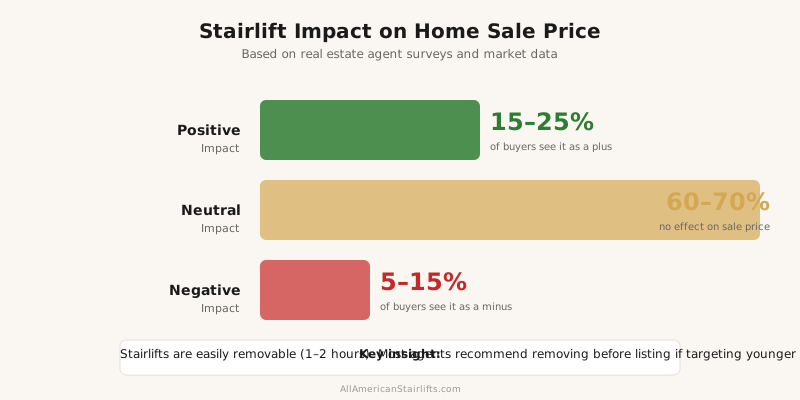
We've talked to real estate agents in dozens of markets where we install, and the feedback is consistent. Buyer reaction to a stairlift in a listing breaks into three groups:
Buyers who see it as a positive (~15-25% of viewers)
These are buyers over 55, buyers with aging parents who may move in, buyers with a disability, or buyers who are specifically shopping for an accessibility-ready home. For this group, a stairlift already installed saves them $2,500-$15,000 and 1-3 weeks of wait time. In markets with high senior populations -- Florida, Arizona, parts of the Carolinas, retirement communities nationwide -- this group can be 30-40% of buyers viewing a two-story listing.
Buyers who are indifferent (~60-70% of viewers)
Most buyers processing a home tour are evaluating kitchens, bathrooms, bedrooms, natural light, storage, and yard. A stairlift on the staircase registers about as strongly as a ceiling fan in the den -- they notice it, they don't care, they move on. If they buy the house, they either keep it ("might be useful for grandma") or ask the seller to remove it as part of the negotiation, which is a $200-$500 cost.
Buyers who see it as a negative (~5-15% of viewers)
A small group of buyers associates a stairlift with "old person's house" or "something must be wrong with this property." This is an emotional reaction, not a financial one. The stairlift doesn't indicate structural problems, health hazards, or deferred maintenance. But perception matters in real estate, and some agents recommend removing the lift before listing to avoid triggering this reaction in the minority of buyers who have it.
What agents recommend
The majority of listing agents we've spoken with recommend one of two approaches:
- Remove before listing if the target buyer pool is families, young professionals, or a general market with low senior density. Cost: $200-$500 for removal plus $50-$100 for patching the tread holes.
- Leave in place and disclose if the target buyer pool includes 55+ buyers, the home is in a retirement community, or the neighborhood has a high percentage of seniors. In this case, the stairlift is a feature, not a liability.
The 55+ community exception
In age-restricted communities (55+), active-adult developments, and neighborhoods with high concentrations of retirees, a stairlift can be a genuine selling point. Here's why.
In these markets, a significant percentage of home shoppers are specifically looking for accessibility features. They're comparing two-story homes with and without modifications. A house with a stairlift already installed, along with grab bars in the bathroom and a walk-in shower on the first floor, signals "this home is ready for the next 20 years" -- which is exactly what a 65-year-old buyer wants to hear.
We've seen this play out in practice. In Sun City-style communities across Florida and Arizona, in 55+ neighborhoods in the Carolinas and Virginia, and in active-adult developments in Texas and the Midwest, homes with accessibility modifications sell at the same price or slightly above comparable homes without them. The stairlift alone doesn't drive the premium -- it's part of a package of age-friendly features. But it contributes.
If you're in a 55+ community and considering a stairlift, the resale concern should be near zero. You're installing a feature that your future buyer pool actively wants.
Removal: cost, process, and what's left behind
If you decide to remove the stairlift before selling -- or after the rider no longer needs it -- here's exactly what the process involves.
What removal costs
- Professional removal by the original installer: $200-$500, typically including haul-away of the equipment
- Removal by a different installer: $300-$600, slightly higher because they're not familiar with the specific install
- DIY removal: Possible on some models, but not recommended. The rail sections are heavy (40-80 lb each), the lag screws require a specific torque to back out without splintering the tread, and improper removal can damage the stair stringer.
What the process looks like
- Seat and carriage are disconnected from the rail. The seat, motor, and battery pack are removed as one unit and carried to the truck. Time: 15 minutes.
- Rail sections are unbolted from the stair treads. Each section is secured with stainless lag bolts (typically two per foot of rail). The bolts back out cleanly if the original installer used stainless hardware and didn't overtorque them. Time: 30-60 minutes depending on rail length.
- Electrical outlet is left in place. The 120V outlet the lift was plugged into stays -- it's a useful outlet regardless. No electrical work needed for removal.
- Bolt holes are patched. Each lag bolt leaves a 3/8" to 1/2" hole in the edge of the tread. These fill cleanly with wood putty, sand flush in 5 minutes after drying, and are invisible after staining or painting. On carpeted stairs, the holes are under the carpet and don't need patching at all.
What's left behind
After removal and patching: nothing visible on hardwood treads (after putty and stain touch-up), nothing at all on carpeted stairs, and a 120V outlet that's useful for a vacuum or holiday lights. No wall damage, no banister damage, no structural modification. The staircase looks like it did before the install, minus a few filled screw holes that no buyer will ever notice. See our full stairlift removal guide for step-by-step details.
Staging a home with a stairlift
If you're keeping the stairlift during showings -- either because the rider still needs it or because the target buyer pool values it -- staging matters more than removal.
Park it at the top
First impressions happen in the first 10 seconds of a showing. If the stairlift is parked at the bottom of the staircase, it's the first thing buyers see when they walk through the front door. Park it at the top. The bottom of the staircase looks like a normal staircase. The top is a hallway that most buyers don't spend much time evaluating.
Fold everything
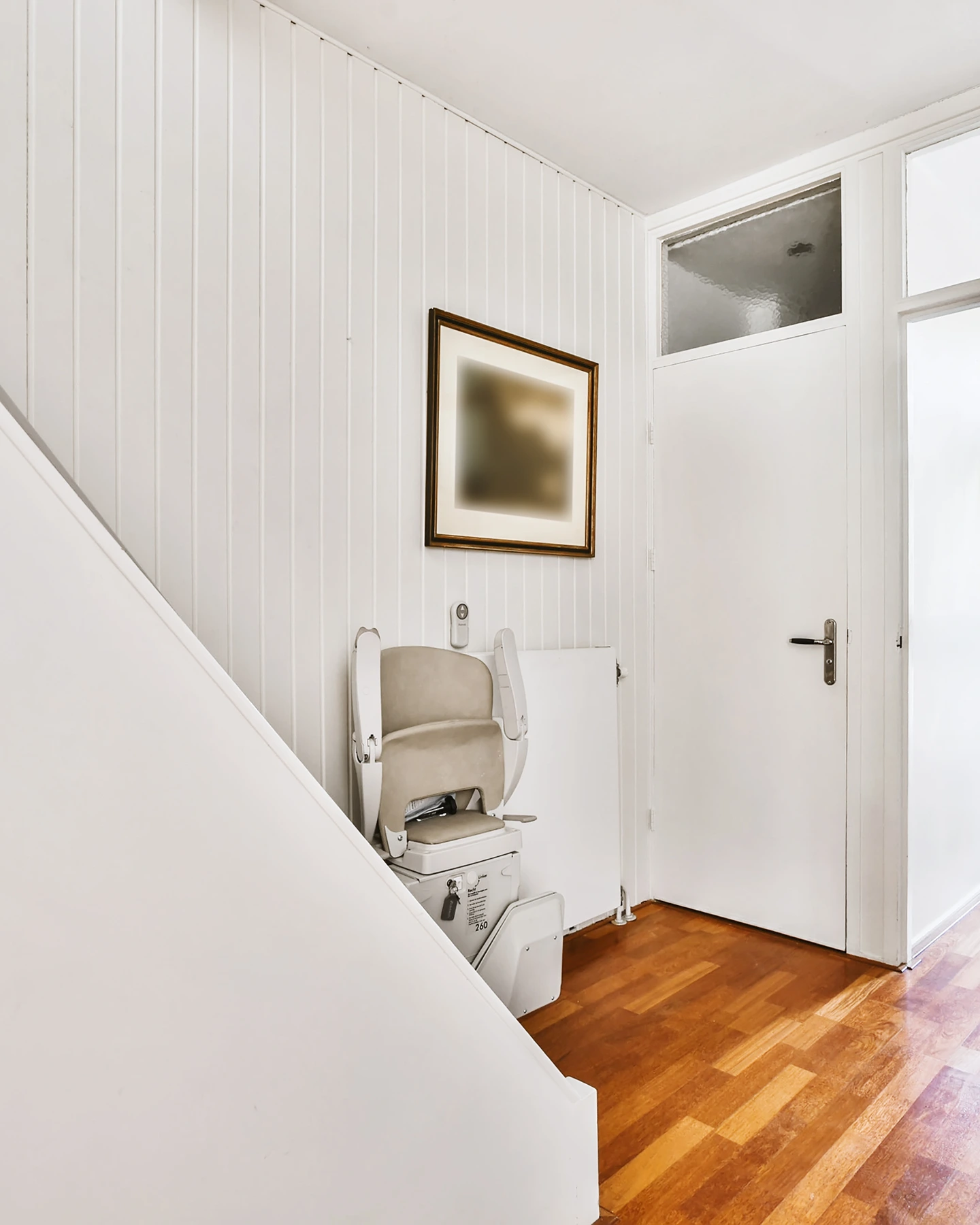
Every modern stairlift has a folding seat, folding footrest, and folding armrests. In the fully folded position, the unit sits against the wall and protrudes only 10-13 inches from the rail. That's less intrusion than a standard wall-mounted handrail. Make sure the lift is fully folded during every showing.
Clean it
A dusty, neglected-looking stairlift signals "old equipment" even if it works perfectly. Wipe the seat, the rail, and the carriage before listing photos and before every open house. A clean stairlift looks like a well-maintained home feature. A dusty one looks like something the seller forgot to remove.
Disclose it
In most states, a permanently installed stairlift is considered a fixture and must be disclosed as either included or excluded from the sale. If it's included, mention it in the listing as "stairlift included -- fully functional, 3 years old, Bruno Elite, $4,200 replacement value." If it's excluded and will be removed before closing, note that in the MLS remarks. Don't leave the buyer guessing.
Listing language that works
Avoid clinical language like "medical stairlift installed." Instead: "Accessibility-ready: professionally installed stairlift with 5-year warranty, full battery backup, easy removal if not needed." This frames it as a feature with an opt-out, not a liability.
The IRS ruling that works in your favor
Here's where the "no impact on home value" story actually benefits you financially.
Under IRS Publication 502, the cost of home improvements made for medical reasons is deductible as a medical expense on Schedule A -- but only to the extent that the improvement does not increase the home's fair market value. If you install a $40,000 home elevator that adds $25,000 to the home's appraised value, your medical deduction is $40,000 minus $25,000 = $15,000.
The IRS has specifically ruled that a stairlift does not increase home value. IRS Regulation 1.213-1(e)(1)(iii) states that improvements made solely for medical reasons that do not improve the property's value qualify in full. A stairlift meets both criteria: it's installed for medical reasons, and it doesn't add appraised value.
That means the full purchase price -- equipment, rail, labor, electrical work, everything on the invoice -- qualifies as a medical deduction. No value-offset calculation. No appraisal needed. For a $4,000 straight stairlift, a homeowner in the 22% federal marginal bracket saves $880 on their federal return. In the 24% bracket: $960. Add state income tax savings where applicable.
To claim the deduction, you need:
- The stairlift invoice showing the full installed cost
- A letter of medical necessity from a physician or occupational therapist (recommended but not strictly required by the IRS -- the deduction is available for any expense that's "primarily for medical care")
- Schedule A itemization (you must itemize, not take the standard deduction)
- Medical expenses exceeding 7.5% of your adjusted gross income (the floor for medical deductions)
Full details in our stairlift tax deduction guide.
We provide IRS-ready documentation. Every install includes a detailed invoice formatted for Schedule A submission, plus a template letter of medical necessity your physician can sign. Get a free assessment and a written quote.
Reselling the stairlift itself
If you remove the stairlift and it's still in good working condition, the unit itself has resale value. How much depends on the type, age, and brand.
Straight-rail units: real resale market
A used Bruno Elan or Bruno Elite straight-rail stairlift in good condition, less than 7 years old, has a resale value of roughly $800-$2,500. Some installers (including us) will credit this against the removal cost, effectively making removal free or close to it. The rail is reusable because straight rails are stock extrusions -- the next buyer just needs the same or shorter length.
The resale market for straight units is active because the demand for affordable stairlifts outstrips the supply of new budget options. A refurbished Bruno Elan at $1,800-$2,500 installed is a legitimate product for a family on a tight budget. See our used and refurbished stairlift guide.
Curved-rail units: almost no resale value
A curved rail is custom-fabricated to your specific staircase geometry. The chances of another home having the exact same rail configuration are effectively zero. The seat, motor, and carriage from a curved unit have some parts value ($300-$800), but the rail itself -- which is 60% of the original cost -- is scrap. This is the one scenario where removal is a pure cost, not a cost-minus-resale. Budget $400-$600 for curved-rail removal with no buyback credit.
Where to sell a used unit
- Your original installer. Many installers (including us) buy back straight-rail units they originally installed. We know the service history and can warranty the refurbished unit to the next buyer.
- Stairlift resale dealers. Several regional dealers specialize in buying, refurbishing, and reselling used units. They'll typically pick up the unit for free and pay $500-$1,500 for a working straight-rail unit.
- Online marketplaces. Facebook Marketplace and Craigslist have active stairlift resale sections in most metro areas. Expect $400-$1,200 for a self-sold unit, but you're responsible for removal and the buyer is responsible for installation -- which limits the pool to handy buyers or buyers with their own installer.
When the unit has no resale value
Units older than 12-15 years, units with expired warranties, units from defunct brands, and units with known mechanical issues have no meaningful resale value. In these cases, removal is a disposal job. Most installers haul the unit away as part of the removal fee. Metal components go to scrap recycling.
Common questions
Does a stairlift decrease home value?
Should I remove the stairlift before selling my house?
How much does it cost to remove a stairlift?
Is a stairlift tax deductible because it doesn't increase home value?
Can I sell my used stairlift?
Your free home assessment is one phone call away
No deposit. No obligation. No high-pressure sales. A certified installer visits your home, measures once, and gives you a written quote that's honored for 30 days. It takes about 45 minutes. More than 15,000+ homeowners have said yes over the last 15 years.
- Licensed in all 50 states
- $2M liability insured
- BBB A+ since 2012
- 15+ years in business