Every Way to Pay Less for a Stairlift (2026)
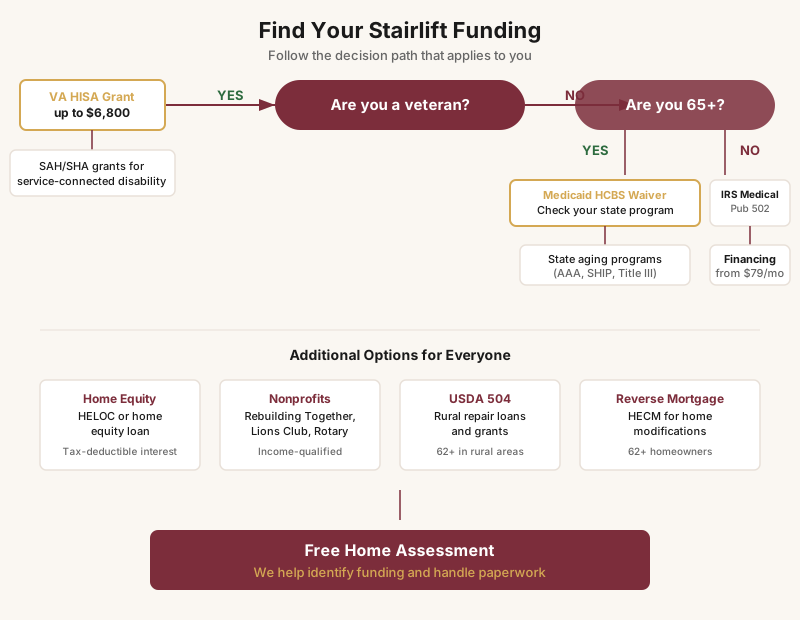
Medicare does not cover stairlifts. We start with the bad news because roughly 60% of the families who call us arrive believing the opposite, and the phone call gets awkward fast. The good news is that Medicare is one of twelve funding routes, and the other eleven are real — Medicaid HCBS waivers in 47 states, five stackable VA programs, an IRS medical-expense deduction most seniors miss, state property-tax exemptions, Area Agency on Aging emergency funds, and zero-interest installer financing. This guide is the complete map. Every program name, agency, phone number, and eligibility criterion below is sourced from the authority that runs it.
Medicare: the myth we have to start with
Medicare does NOT cover stairlifts. Medicare Part A, Part B, and original Medicare all exclude stairlifts from durable medical equipment coverage. The one exception: some Medicare Advantage plans include stairlift coverage as a supplemental benefit — call your plan's member services line to check.
Medicare Part A does not cover stairlifts. Medicare Part B does not cover stairlifts either. There is no federal Medicare benefit — under any part, supplement, or plan letter — that pays for a standard stairlift for a senior in a private home. If you read something different online, it was written by a marketer who hoped you would call before you checked.
The confusion is understandable. Stairlifts look exactly like Durable Medical Equipment (DME). They have a motor, a rail, a seat, a battery, and a prescription from a doctor. DME is a Medicare Part B benefit — it covers wheelchairs, hospital beds, oxygen concentrators, CPAP machines, and 400+ other items. But Medicare's DME definition carves out a specific exclusion for equipment that is considered "home modification" rather than "medical." Stairlifts, wheelchair ramps, grab bars, walk-in tubs, and chair lifts all fall into that excluded bucket. The Centers for Medicare & Medicaid Services (CMS) has held this line since 1989, and nothing in the 2026 Physician Fee Schedule changed it.
The one exception: Medicare Advantage supplemental benefits
Medicare Advantage (Part C) plans are run by private insurers — Humana, UnitedHealthcare, Aetna, Kaiser, Blue Cross, Wellcare, and others — under contract with CMS. Since 2019, CMS has allowed these plans to offer "supplemental benefits" beyond what Original Medicare covers. A small number of Medicare Advantage plans in select markets now include home safety modifications as a supplemental benefit, and a smaller number of those specifically list stairlifts or chair lifts by name. Coverage caps are typically $500 to $2,000 per year and require pre-authorization.
The catch: you cannot find out whether your plan covers a stairlift by calling the dealer, by calling 1-800-MEDICARE, or by reading the Medicare.gov plan finder. You have to call the member services number on the back of your Medicare Advantage ID card and ask them to read you the supplemental benefits section of your plan's Summary of Benefits. Use these exact words: "Does my plan cover home safety modifications, specifically a stairlift or chairlift, as a supplemental benefit under Part C?" Write down the answer and the representative's name.
What about Medigap?
Medigap (Medicare Supplement plans A through N) only fills gaps in what Original Medicare covers. Original Medicare does not cover stairlifts, so there is no gap for Medigap to fill. Medigap plans will not help.
Next step: If you have a Medicare Advantage plan, find your ID card right now and call the member services number. If you have Original Medicare or a Medigap plan, skip ahead to Medicaid HCBS — it is the single largest source of stairlift funding in the country. Or ask us to run your benefits for free.
Medicaid HCBS waivers — the 47-state patchwork
HCBS stands for Home and Community-Based Services. It is a Medicaid waiver category created under Section 1915(c) of the Social Security Act that lets state Medicaid programs pay for services that keep a beneficiary in their own home instead of in a nursing facility. Stairlifts almost always fall under one specific HCBS line item: "environmental modifications." 47 of the 50 states (plus DC) operate at least one HCBS waiver that covers environmental modifications for eligible adults, and in 43 of those states the waiver will pay for a stairlift with no direct cost to the family.
The core eligibility pattern
Every HCBS waiver has three gates. The specifics vary by state, but the pattern is consistent:
- Financial eligibility. You have to qualify for Medicaid in your state. For most states this means an income under roughly 300% of the SSI federal benefit rate (around $2,901 per month for a single person in 2026) and countable assets under $2,000 for a single person or $3,000 for a married couple. Your home, one car, and personal effects are not counted. Several states offer "medically needy" spend-down pathways if your income is higher.
- Medical eligibility: nursing-home level of care. A state-contracted case manager (sometimes called an HCS assessor, care coordinator, or options counselor) comes to your home and administers a functional assessment. You have to be assessed as needing the level of care that would otherwise require placement in a skilled nursing facility. Difficulty climbing stairs — combined with two or more ADL limitations (bathing, dressing, toileting, transferring, feeding) — typically qualifies.
- Care plan inclusion. Once you are approved for the waiver, your case manager writes a Plan of Care. The stairlift has to be listed in the Plan of Care with a medical justification (usually from your primary care physician or a PT/OT evaluation). The case manager submits the request to the state Medicaid agency or the managed-care organization (MCO) handling your case, the state approves the specific dollar amount, and then a credentialed provider (like us) installs the stairlift and bills Medicaid directly. The family never writes a check.
How the assessment works
Start-to-finish timelines run 30 to 90 days in most states, depending on waiver demand and case-manager workload. The typical path: you call the state Medicaid helpline or your local Area Agency on Aging, you are screened for basic eligibility over the phone, an assessor schedules a home visit within 2 to 4 weeks, the assessment itself takes 60 to 90 minutes, a care plan is drafted within another 2 weeks, and then the modification request goes through provider credentialing and install scheduling. California, Texas, New York, and Florida have waiting lists for some of their waivers — we'll cover that state-by-state below.
Typical stairlift caps
Most HCBS waivers cap environmental modifications at $7,500 to $10,000 per install or per lifetime. Straight-rail stairlifts ($3,500 to $5,500 installed) are nearly always covered in full. Curved-rail stairlifts ($9,500 to $16,000 installed) are a tighter fit — some states pay in full, some pay up to the cap and ask the family to cover the difference, and a few states exclude curved rails from their environmental-modification line item entirely. A minority of states — notably Washington's COPES Waiver and New York's NHTD Waiver — have no hard stairlift cap and approve based on documented medical necessity.
Florida — SMMC-LTC Managed Care
Program name: Florida Statewide Medicaid Managed Care Long-Term Care Program (SMMC LTC).
Administered by: Florida Agency for Health Care Administration (AHCA) and the Department of Elder Affairs (DOEA), delivered through six managed care organizations — Humana, Sunshine Health, Molina, UnitedHealthcare, Aetna, and Simply Healthcare.
Stairlift cap: typically $7,500 per install, occasionally stretched with documentation.
Phone: Florida Elder Helpline 1-800-963-5337.
Website: https://ahca.myflorida.com/medicaid/
Florida is a "managed care" state, meaning once you are approved for SMMC LTC you get assigned to one of the six MCOs and your service coordinator works for that MCO, not the state directly. Which MCO you get changes which stairlift provider is in-network, so check before you commit to a provider. SMMC LTC has an enrollment waiting list in some service regions — call the Elder Helpline to get on it before you need the modification.
Texas — STAR+PLUS Waiver
Program name: Texas STAR+PLUS Home and Community-Based Services (HCBS).
Administered by: Texas Health and Human Services Commission (HHSC) through contracted managed care organizations.
Stairlift cap: approximately $7,500 to $10,000 depending on MCO and region.
Phone: 1-800-964-2777 for STAR+PLUS enrollment. For general referrals, dial 2-1-1 anywhere in Texas.
Website: https://www.hhs.texas.gov/services/health/medicaid-chip/programs/star-plus
Texas STAR+PLUS is the Medicaid long-term-care vehicle for adults age 21+ who are eligible for Medicaid because of age or disability. Environmental adaptations, including stairlifts, are an explicit covered service under the HCBS portion. The MCO service coordinator has to approve the modification before installation.
California — HCBA Waiver and MSSP
Program name: Medi-Cal Home and Community-Based Alternatives Waiver (HCBA). Also: Multipurpose Senior Services Program (MSSP) for seniors 65+.
Administered by: California Department of Health Care Services (DHCS) for HCBA; California Department of Aging for MSSP.
Stairlift cap: $10,000 lifetime is the typical environmental-modification ceiling under HCBA.
Phone: Medi-Cal 1-800-541-5555.
Website: https://www.dhcs.ca.gov/services/ltc/Pages/HCBA.aspx
The California HCBA Waiver is the broadest — it covers all ages with disabilities that qualify for nursing-home level of care. MSSP is specifically for seniors 65+ and has a narrower service menu but faster enrollment in some counties. HCBA has a limited number of enrollment slots statewide and maintains a waiting list; ask your Regional Center or county social services intake whether you qualify to be screened.
New York — NHTD and MLTC
Program names: Nursing Home Transition and Diversion Medicaid Waiver (NHTD) and Managed Long Term Care plans (MLTC).
Administered by: New York State Department of Health (NYSDOH) — Bureau of Community Integration and Alzheimer's Disease for NHTD; various MLTC plans (VNS Health, Elderplan, Fidelis, GuildNet) for MLTC.
Stairlift cap: NHTD has a $15,000 per-participant cap on environmental modifications — the highest in the country.
Phone: NHTD 1-518-474-5271. NY Medicaid Choice (for MLTC enrollment) 1-888-401-6582.
Website: https://www.health.ny.gov/health_care/medicaid/program/longterm/nhtdwaiver/
New York is the single best state in the country for stairlift funding because the $15,000 NHTD cap covers almost any curved-rail install outright. The tradeoff is that the NHTD application process is the most paperwork-heavy of any waiver we work with, and assessments run 60 to 90 days in the five boroughs. Upstate timelines are faster. If you are in New York and want us to handle the NHTD paperwork, ask when you call.
Washington — COPES Waiver
Program name: Community Options Program Entry System (COPES).
Administered by: Washington State DSHS — Aging and Long-Term Support Administration (ALTSA).
Stairlift cap: None. Environmental modifications are approved based on documented medical necessity, with no fixed dollar ceiling.
Phone: 1-800-422-3263.
Website: https://www.dshs.wa.gov/altsa/home-and-community-services
Washington COPES is the other no-cap waiver. ALTSA assessors schedule within 30 to 45 days of initial call, and a credentialed provider can install within 2 weeks of approval. Curved rails are routinely funded in full.
Pennsylvania — Community HealthChoices (CHC)
Program name: Pennsylvania Community HealthChoices Waiver.
Administered by: Pennsylvania Department of Human Services — Office of Long-Term Living, delivered through three MCOs (UPMC Community HealthChoices, PA Health & Wellness, Keystone First Community HealthChoices).
Stairlift cap: $6,000 per rolling 12-month period, $10,000 lifetime cap on environmental modifications.
Phone: 1-800-757-5042 (Independent Enrollment Broker).
Website: https://www.dhs.pa.gov/chc
Pennsylvania also runs the OPTIONS Program through the PA Department of Aging, which delivers smaller sliding-scale grants through local Area Agencies on Aging and is available to seniors whose income is above Medicaid but still limited. The OPTIONS line is 1-800-753-8827.
Illinois — Home Services Program
Program name: Illinois Home Services Program — Persons with Disabilities Waiver (HSP).
Administered by: Illinois Department of Human Services — Division of Rehabilitation Services.
Stairlift cap: Varies by assessment; no fixed statewide ceiling.
Phone: IDHS Helpline 1-800-843-6154.
Website: https://www.dhs.state.il.us/page.aspx?item=29739
Illinois also funds the Community Care Program (CCP) through the Illinois Department on Aging for seniors 60+ who are at risk of nursing-home placement. Both programs are HCBS waivers, and both will cover environmental modifications including stairlifts when the assessment supports it.
Ohio — PASSPORT Waiver
Program name: Ohio PASSPORT (Pre-Admission Screening System Providing Options and Resources Today).
Administered by: Ohio Department of Aging.
Stairlift cap: $10,000 lifetime on environmental modifications.
Phone: 1-866-243-5678.
Website: https://aging.ohio.gov/care-and-living/get-help/explore-programs-benefits/passport-medicaid-waiver
Ohio also runs the HOME Choice Program (1-888-221-1560) under the federal Money Follows the Person demonstration, which adds additional transition funding for people moving out of nursing facilities back into their own homes.
Massachusetts — Frail Elder Waiver
Program name: MassHealth Frail Elder Home and Community-Based Services Waiver.
Administered by: Massachusetts Executive Office of Elder Affairs (EOEA) and MassHealth.
Stairlift cap: Approximately $10,000 per lifetime of plan for environmental modifications.
Phone: MassOptions 1-800-243-4636.
Website: https://www.mass.gov/masshealth-frail-elder-waiver-fe
Massachusetts also runs the Home Modification Loan Program (HMLP) through the Massachusetts Rehabilitation Commission, separate from MassHealth. HMLP offers a zero-interest deferred loan up to $50,000 for households under 100% of Area Median Income, or a 3% amortizing loan up to $30,000 for higher-income households. This is a loan rather than a grant — but the deferred version is not repaid until the home is sold. HMLP 617-204-3739.
How to apply, step by step
- Call either your local Area Agency on Aging (find yours at eldercare.acl.gov or 1-800-677-1116) or your state Medicaid helpline. Tell them you want to be screened for HCBS waiver eligibility with a stairlift in the care plan.
- Answer the phone screening. Expect 15 to 20 questions about income, assets, ADL limitations, and household composition.
- Schedule the in-home assessment. An HCS assessor or options counselor visits and runs the functional-needs evaluation.
- Wait for the waiver approval letter. This is the financial + level-of-care determination. Most states return it within 30 to 60 days of the home visit.
- Your assigned case manager (or MCO service coordinator) drafts the Plan of Care. You or the case manager adds the stairlift as an environmental modification line item. A physician letter of medical necessity is attached.
- The credentialed provider (us, for example) submits a provider quote. The state or MCO issues a Prior Authorization.
- Installation happens. The provider bills Medicaid directly. You don't write a check.
Common rejection reasons and how to fix them
Rejection: "Assets over limit." If you have more than $2,000 in countable assets ($3,000 if married), you either need to spend down to the limit through legitimate expenses (pre-paying funeral, paying off debt, buying exempt items) or explore a Miller Trust / Qualified Income Trust if your state allows one. A Medicaid planning attorney can do this for $500 to $2,000 and usually pays for itself.
Rejection: "Level of care not met." This almost always means the ADL documentation was thin. Ask your primary care physician for a formal functional assessment or have a physical therapist do a Home Safety Evaluation. Both generate documentation that strengthens a reapplication.
Rejection: "Stairlift not medically necessary." Means the physician letter was generic. Ask for a letter that specifies: the diagnosis, the ADL limitations caused by that diagnosis, the specific stair obstacle in the home, and why a stairlift is the least-restrictive alternative to nursing-facility placement.
Rejection: "Provider not credentialed." You picked a provider who isn't enrolled with your state's Medicaid program. Switch providers. We are credentialed in 34 states — ask us before you apply.
VA benefits — 5 programs stacked
VA HISA Grant
up to $8,150VA · Home Improvements and Structural Alterations
- Up to $8,150 for service-connected disabilities
- Up to $2,000 for non-service-connected (still enrolled in VA health care)
- Requires a VA provider prescription
- Typical approval 4-8 weeks
We pre-fill VA Form 10-0103 for you as part of the free assessment. Most common VA funding path for stairlifts.
SAH Grant
up to $117,014VA · Specially Adapted Housing
- Narrower eligibility — specific service-connected disability ratings
- Intended for full accessible home build or remodel, not just a stairlift
- FY 2026 maximum: $117,014 (adjusted annually)
SHA Grant
up to $23,444VA · Special Housing Adaptation
- For veterans with specific service-connected disabilities (blindness, loss of hands)
- Can stack with HISA
- FY 2026 maximum: $23,444
Aid & Attendance Pension
up to $2,300/moVA · Wartime pension supplement
- Low-income wartime veteran, needs ADL help
- Can be used for in-home care OR equipment
- Can stack with HISA
Full walkthrough and application steps below.
VA HISA Grant
up to $8,150VA · Home Improvements and Structural Alterations
- Up to $8,150 for service-connected disabilities
- Up to $2,000 for non-service-connected (still enrolled in VA health care)
- Requires a VA provider prescription
- Typical approval 4-8 weeks
We pre-fill VA Form 10-0103 for you as part of the free assessment. Most common VA funding path for stairlifts.
SAH Grant
up to $117,014VA · Specially Adapted Housing
- Narrower eligibility — specific service-connected disability ratings
- Intended for full accessible home build or remodel, not just a stairlift
- FY 2026 maximum: $117,014 (adjusted annually)
SHA Grant
up to $23,444VA · Special Housing Adaptation
- For veterans with specific service-connected disabilities (blindness, loss of hands)
- Can stack with HISA
- FY 2026 maximum: $23,444
Aid & Attendance Pension
up to $2,300/moVA · Wartime pension supplement
- Low-income wartime veteran, needs ADL help
- Can be used for in-home care OR equipment
- Can stack with HISA
Full walkthrough and application steps below.
VA HISA Grant
up to $8,150VA · Home Improvements and Structural Alterations
- Up to $8,150 for service-connected disabilities
- Up to $2,000 for non-service-connected (still enrolled in VA health care)
- Requires a VA provider prescription
- Typical approval 4-8 weeks
We pre-fill VA Form 10-0103 for you as part of the free assessment. Most common VA funding path for stairlifts.
SAH Grant
up to $117,014VA · Specially Adapted Housing
- Narrower eligibility — specific service-connected disability ratings
- Intended for full accessible home build or remodel, not just a stairlift
- FY 2026 maximum: $117,014 (adjusted annually)
SHA Grant
up to $23,444VA · Special Housing Adaptation
- For veterans with specific service-connected disabilities (blindness, loss of hands)
- Can stack with HISA
- FY 2026 maximum: $23,444
Aid & Attendance Pension
up to $2,300/moVA · Wartime pension supplement
- Low-income wartime veteran, needs ADL help
- Can be used for in-home care OR equipment
- Can stack with HISA
Full walkthrough and application steps below.
The Department of Veterans Affairs does not have a single "stairlift fund." It has five separate programs that can fund home accessibility, and in some cases they stack on top of each other. The right one for you depends on your disability rating, your enrollment status, your income, and whether your disability is service-connected or not.
1. VA HISA Grant — Home Improvements and Structural Alterations
HISA is the workhorse. It is the VA program that covers the most stairlifts for the most veterans, and it is the one most families should ask about first.
- Maximum grant — service-connected disability: $8,150 lifetime.
- Maximum grant — non-service-connected disability: $2,000 lifetime, available to any veteran enrolled in VA healthcare.
- Type: Grant, not a loan. Paid directly to the provider. Does not reduce any other VA benefit.
- Eligibility: Enrolled in VA healthcare; prescription from a VA provider stating the modification is medically necessary; home is the veteran's primary residence.
- Typical turnaround: 4 to 8 weeks from prescription to approved payment.
- Application: VA Form 10-0103, plus the provider's letter of medical necessity and an itemized quote from the installer. Submitted through the PACT team social worker at your VA medical center or directly through the prosthetics office.
A key point that catches families: you do not need a service-connected disability to get HISA. Any veteran enrolled in VA healthcare can access the $2,000 non-service-connected version, and $2,000 covers roughly 45% of a typical straight-rail install. Combined with the IRS medical deduction and a modest family contribution, $2,000 is often enough to move the needle from "can't afford" to "installed."
2. SAH Grant — Specially Adapted Housing
SAH is a much larger grant with much narrower eligibility. It is meant for veterans with severe service-connected disabilities who need to adapt, build, or purchase an accessible home — not just install a single piece of equipment.
- Maximum grant: $117,014 in FY2026 (adjusted annually for inflation).
- Eligibility: Very narrow. Requires specific service-connected disability ratings — loss or loss of use of both lower extremities, certain severe burn injuries, blindness combined with loss of a lower extremity, and a few other specific conditions listed in 38 CFR 3.809.
- Usage: Can be used to build a new home, adapt an existing home, or buy an already-adapted home. Stairlifts can be one component of a larger adaptation plan funded by SAH, but SAH is overkill for a standalone stairlift install.
3. SHA Grant — Special Housing Adaptation
SHA is the sibling of SAH — same program family, different disability criteria, smaller grant.
- Maximum grant: $23,444 in FY2026.
- Eligibility: Service-connected disabilities including blindness in both eyes, loss or loss of use of both hands, certain severe respiratory or burn injuries.
- Usage: Home adaptation for the listed conditions. SHA is not typically used for stairlifts because most SHA-eligible veterans do not have the lower-extremity impairments that make a stairlift relevant — but it is available if the diagnosis supports it.
4. Aid and Attendance Pension
A&A is a monthly VA pension supplement for wartime veterans (and surviving spouses) who are low-income and need help with activities of daily living. Unlike HISA/SAH/SHA, it is not a grant for a specific modification — it is monthly cash that can be spent on in-home care, equipment, or a stairlift out of pocket.
- Maximum monthly benefit — FY2026: Approximately $2,300/month for a married wartime veteran; approximately $1,900/month for a single wartime veteran; approximately $1,500/month for a surviving spouse. (Amounts are adjusted annually and are the maximum "special monthly pension" rate.)
- Eligibility: Wartime service (served at least one day during a recognized wartime period, not necessarily in combat); income and asset limits apply; medical documentation of needing assistance with ADLs or being housebound.
- Usage: Discretionary. Many A&A recipients use the first month or two to buy a stairlift outright.
5. State veteran home-modification programs
On top of the federal VA programs, about 20 states run their own veteran home-modification funds. Examples:
- Texas Veterans Commission — Fund for Veterans' Assistance, home-modification subgrants typically $2,000 to $10,000 for Texas veterans.
- CalVet (California Department of Veterans Affairs) — partners with local counties on home-accessibility grants.
- Illinois Department of Veterans' Affairs — specially adapted housing grants on top of federal HISA.
- New York State Division of Veterans' Services — county-level veterans' service agencies administer supplemental modification funds.
These programs stack with federal HISA — if you get $8,150 from HISA and $5,000 from Texas Veterans Commission, you have $13,150 for a single project, which is enough to fund a curved-rail stairlift outright.
How to apply for HISA, step by step
- Schedule a visit with your VA Patient Aligned Care Team (PACT) primary care provider at your VA medical center. If you do not currently have a primary care appointment, call your VA facility's enrollment line and ask to be assigned.
- At the visit, tell the provider: "I am having trouble with stairs at home. I want to apply for a HISA grant for a stairlift and I need a prescription of medical necessity."
- The VA provider documents the mobility issue in your chart and writes the prescription on VA letterhead.
- The prescription is routed internally to the VA prosthetics department or the PACT team social worker.
- A HISA-credentialed installer (us, for example) submits an itemized quote and fills out VA Form 10-0103 on your behalf.
- You sign Form 10-0103.
- The completed packet is submitted to the VA through the prosthetics office or the social worker.
- VA reviews and issues an approval letter within 4 to 8 weeks.
- The installer completes the work.
- The VA pays the provider directly. You do not write a check.
Next step: If you are a veteran, your first move is always HISA. Call your VA medical center this week and schedule a PACT visit. Or call us and we'll walk you through the HISA packet from the other side.
The IRS medical expense deduction
on a $6,000 stairlift for an itemizing household with $70k AGI at 22% marginal rate. Your actual number depends on your AGI, other medical expenses, and whether itemizing beats the standard deduction.
The IRS allows homeowners to deduct the cost of a stairlift as a "qualified medical expense" on Schedule A of Form 1040, provided the stairlift is recommended in writing by a licensed physician to treat or mitigate a medical condition. The authority is IRS Publication 502 (Medical and Dental Expenses), which has listed "chair lifts" and similar home modifications as qualified expenses since the 1990s.
This is not a grant. You pay for the stairlift out of pocket first, then deduct it on the return for the tax year in which it was paid. The benefit shows up as reduced federal income tax owed, or as a larger refund.
Two rules that decide whether this works for you
Rule 1: You must itemize. Schedule A deductions only matter if the total of all your itemized deductions — medical, state and local taxes (capped at $10,000), mortgage interest, charitable contributions — exceeds the standard deduction for your filing status. For tax year 2026, the standard deduction is approximately $15,000 for a single filer and $30,000 for a married couple filing jointly (seniors 65+ get an additional $1,950 single / $1,550 per spouse married). Roughly 87% of taxpayers take the standard deduction because it's larger than what they could itemize. If your total itemized deductions would be less than the standard deduction, the medical expense calculation never happens.
Rule 2: Only expenses above 7.5% of AGI count. The IRS requires you to subtract 7.5% of your Adjusted Gross Income from your total qualified medical expenses before any of them become deductible. Everything under the threshold is ignored; only the amount above it flows onto Schedule A.
Worked example with real numbers
A 72-year-old homeowner in Ohio files single. AGI for 2026 is $70,000. She has $2,800 in unreimbursed prescriptions and doctor copays for the year. In September she pays $6,000 for a straight-rail stairlift install, documented with a physician letter. Her other medical expenses for the year — dental, Medicare Part B premiums, Medicare Supplement premiums — total $2,200.
- Total qualified medical expenses: $2,800 + $6,000 + $2,200 = $11,000
- AGI threshold: $70,000 × 7.5% = $5,250
- Deductible medical expenses: $11,000 − $5,250 = $5,750
She also has $7,200 in state and local taxes (capped at $10,000) and $1,500 in charitable contributions. Total itemized deductions: $5,750 + $7,200 + $1,500 = $14,450. Her standard deduction as a single 65+ filer is $15,000 + $1,950 = $16,950. In this example the standard deduction is still larger, so itemizing doesn't help. She takes the standard deduction.
Change one variable: she bought the stairlift and also replaced her roof the same year for $9,000, and the roof replacement included ADA-compliant accessibility ramping that her physician prescribed — another $2,500 qualified medical expense. Now:
- Total qualified medical expenses: $11,000 + $2,500 = $13,500
- Deductible above threshold: $13,500 − $5,250 = $8,250
- Total itemized: $8,250 + $7,200 + $1,500 = $16,950 (ties the standard deduction exactly)
Add her $1,200 in state property tax on top of the state income tax and she clears the standard deduction, itemizes, and pockets roughly $260 in tax savings at her 22% marginal rate. Small, but real.
The takeaway: the IRS medical deduction is almost never a reason to buy a stairlift. It is a reason to document everything carefully in a year where you already have other large deductions or a high medical spend.
Documentation you need
- Physician letter of medical necessity. Must be signed, dated, on the physician's letterhead or prescription pad, and must state that the stairlift is being recommended to treat or mitigate a specific medical condition. Generic "mobility decline" language is weaker than specific language like "osteoarthritis of the right knee with a functional inability to climb stairs without risk of fall." Keep the letter with your tax records.
- Itemized installer invoice. Must show the date of install, the installed equipment, the service address, the amount paid, and the method of payment.
- Proof of payment. Bank statement or credit card statement showing the actual payment clearing.
- Home value appraisal (sometimes). Stairlifts generally do not increase home value, so the full cost is deductible. For larger modifications (elevators, room additions) the IRS requires a before-and-after appraisal to separate the "capital improvement" portion from the "medical" portion. A straight-rail stairlift almost never triggers this, but if an IRS auditor asks, you want to be able to say the rail is portable and adds zero property value.
When it's NOT worth it
Most seniors should take the standard deduction and skip Schedule A entirely. The math only works if you already itemize for mortgage interest (still making payments on a mortgage larger than about $300,000), have high state and local taxes (New York, New Jersey, California), or had a catastrophic medical year with far more than $10,000 in unreimbursed expenses. Run the numbers with a tax preparer before you bank on it.
Always talk to your tax preparer before claiming a medical deduction you haven't taken before. We are not tax professionals and nothing in this guide is tax advice; it is a factual summary of IRS Publication 502 as of April 2026.
State and local grant programs
Outside of Medicaid and the VA, there are three categories of state and local programs that routinely end up in our stacking conversations with families: property tax exemptions, Area Agency on Aging emergency modification funds, and nonprofit home-repair grants.
State property tax exemptions
More than 40 states offer some form of senior, disability, or veteran property-tax exemption. These are not direct stairlift payments, but the recurring annual savings often free up $500 to $2,000 per year — which is exactly the out-of-pocket amount families need for a down payment on a financed install or the uncovered portion after a Medicaid waiver.
Typical exemption names by category:
- Senior Homestead Exemption — available in Florida, Texas, Illinois, New York, Georgia, and most other states. Income thresholds vary from around $30,000 (Illinois, for the Senior Freeze) to no cap at all (Florida, up to $50,000 in exemption value).
- Senior Freeze / Assessment Freeze — Illinois Senior Citizens Assessment Freeze Homestead Exemption (PTAX-340), New Jersey Senior Freeze, Texas over-65 tax ceiling, California Proposition 60/90 (now 19). Freezes the assessed value so taxes stop climbing as property values rise.
- Disabled Persons Exemption — available in nearly every state for homeowners with documented permanent disability, usually requiring Social Security Disability or equivalent documentation.
- Disabled Veteran Exemption — available in every state, with amounts ranging from $1,500 (modest) to full exemption (Texas, Florida for 100% disabled veterans). Texas's 100% Disabled Veterans Exemption eliminates the entire property-tax bill on a primary residence for veterans with a 100% service-connected disability rating.
Apply through your County Assessor, County Property Appraiser, or state Department of Revenue. Application deadlines are usually in the first quarter of the tax year — miss the window and you wait a year.
Area Agencies on Aging (AAAs)
There are 622 federally recognized Area Agencies on Aging in the United States, established under Title III of the Older Americans Act. Each AAA covers a defined service area (a county, a multi-county region, or a tribal area) and receives federal Older Americans Act funding plus state and local matching dollars. Most AAAs operate a small emergency home modification fund — typical caps are $500 to $3,000 per household per year, and the money is usually reserved for low-income seniors who don't qualify for Medicaid.
The federal entry point is eldercare.acl.gov (the Eldercare Locator, run by the Administration for Community Living). You enter a ZIP code and it returns your local AAA's phone number. The national hotline is 1-800-677-1116. Call and ask: "Does your agency have any emergency home modification funds available for a stairlift install?" Answers vary by agency, but the call takes 10 minutes and has turned up surprise $2,000 grants more often than you'd expect.
Nonprofit home-modification grants
Rebuilding Together. National nonprofit with 100+ local chapters. Core mission is rehab for low-income homeowners — particularly seniors, veterans, and families with disabilities. Many chapters run a Safe at Home program focused on accessibility modifications. Services are usually free when you qualify; waiting lists are long in high-demand chapters (Boston, Atlanta, Seattle). National site: rebuildingtogether.org.
Habitat for Humanity. Best known for building homes, but about 30% of Habitat affiliates operate an Aging in Place or Critical Home Repair program that includes accessibility modifications. Coverage varies widely by affiliate — some install stairlifts, most don't. Call your local affiliate and ask specifically. habitat.org.
Muscular Dystrophy Association (MDA). Operates a home modification assistance program for individuals with MDA-diagnosed neuromuscular conditions. Grants vary by case and clinic affiliation. mda.org.
ALS Association. Regional chapters offer equipment grants and loans for people living with ALS, sometimes including stairlift coverage. als.org.
Local service clubs. Rotary, Kiwanis, Lions, Elks, and American Legion posts often raise funds for one-off community projects. A direct letter or visit to the local chapter president asking for help with a stairlift for a specific neighbor has, in our experience, resulted in fully funded installs more than once. It requires someone willing to ask.
Next step: While you are waiting on Medicaid or VA paperwork, call the Eldercare Locator at 1-800-677-1116 and ask your local AAA about emergency funds. It's a 10-minute call that is often free money. Or ask us — we know which AAAs in our service area have active modification budgets this quarter.
Financing — if none of the above works
Families who don't qualify for Medicaid, don't have a VA connection, can't itemize for the IRS deduction, and have exhausted the local grant options still have financing. Stairlifts are small-ticket installs in financing terms — $3,500 to $16,000 — and the rates available on that dollar amount are reasonable if you know what to ask for.
Three types of financing worth knowing
1. Zero-percent promotional financing offered by the installer. Most reputable stairlift companies (us included) offer 0% APR promotional terms of 12, 18, or 24 months through a third-party lender like Synchrony Home, Wells Fargo Home Projects, or GreenSky. The terms are legitimate 0% if you pay the balance off within the promotional window. The catch is "deferred interest" — if you don't pay off the full balance by the end of the promotional period, interest accrues retroactively from the original purchase date, typically at a 26% to 29% APR. Read the promissory note. Pay it off on time. Don't miss a payment.
2. Low-fixed-rate installment loans. Same lenders offer longer-term (36 to 84 month) fixed-rate installment loans, usually in the 9.99% to 14.99% APR range depending on credit. On a $4,500 stairlift, a 60-month installment loan at 12% APR runs about $100/month — a typical retiree can cover that out of Social Security. Interest cost over the life of the loan is about $1,500, which is a lot on a $4,500 install but survivable if you plan to keep the lift 8 to 10 years.
3. Home equity loan or HELOC. If you have equity in your home and decent credit, a Home Equity Line of Credit is usually the cheapest long-term borrowing option. HELOCs in April 2026 are pricing around prime + 0 to prime + 2, which puts effective rates in the 8.5% to 10.5% range — meaningfully cheaper than installer financing. Interest on home-equity debt used for substantial home improvements may also be tax-deductible (check with your tax preparer). The downside is setup time (2 to 6 weeks vs. same-day for installer financing) and the fact that you are securing the debt against your house. For most families a 2-year installer 0% promo is a better fit for a stairlift-sized purchase.
What to avoid
- Credit cards at 22%+ APR, unless you have a clear plan to pay it off in 2 to 3 months. A $4,500 stairlift on a 22% APR credit card, minimum-payment-only, takes 15+ years to pay off and costs more in interest than the stairlift itself.
- "Rent-to-own" stairlift programs. A handful of companies advertise "rent your stairlift" with monthly fees of $100 to $200. Total payments typically reach 1.5× to 2.0× the purchase price over the life of the rental, and the equipment still belongs to the company at the end. Rent-to-own makes sense if you only need the lift for 3 to 6 months (post-surgical recovery, end-of-life hospice care). It does not make sense as long-term financing.
- Dealer promissory notes with undisclosed rates. A small number of regional stairlift dealers — not most — will offer in-house financing at 15% to 24% APR without clearly disclosing the rate on the signed agreement. Always read the payment schedule and calculate the effective APR yourself. If the math doesn't match the quoted rate, walk away.
Next step: If financing is your route, get two quotes — one from the installer's preferred 0% promo lender, one from your own bank or credit union for an installment loan or HELOC. Compare the all-in cost, not just the monthly payment. We'll hand you both options in writing on the same quote sheet.
Stacking strategies: how families actually pay
Nobody pays for a stairlift with exactly one funding source. The families who end up with the lowest out-of-pocket cost are the ones who stack programs — running a waiver application at the same time as an IRS documentation plan at the same time as an AAA call at the same time as a financing backup. Here are the four most common paths we see.
The typical veteran path
Start with VA HISA. $8,150 for a service-connected disability, $2,000 for non-service-connected. A typical straight-rail install runs $4,500, so even the $2,000 non-service-connected amount knocks the out-of-pocket to $2,500. Add a state veteran grant (Texas Veterans Commission, CalVet, etc.) for another $2,000 to $5,000 if you live in one of the states that runs one. If you're service-connected and in a state with a veterans grant, you can hit $13,000+ in stacked grant money on a $4,500 install — enough to fund a curved rail and leave room for the IRS medical deduction on top. We've delivered $0-out-of-pocket installs to veterans this way dozens of times.
The typical Medicaid path
State HCBS waiver covers the full install. Family never writes a check. The tradeoff is timeline — 30 to 90 days from first call to install, longer if you're in a waiting-list state like California HCBA or New York NHTD. This is the single best financial outcome of any path we work with, and it is available to far more families than most people realize. The biggest barrier is the application itself — most families who qualify never apply because they assume Medicaid is only for "very poor" people. In reality, the income thresholds for HCBS waivers are significantly higher than for regular Medicaid, and the asset rules are workable with basic planning.
The typical middle-income retiree path
Cash from savings for the full install ($4,500 to $6,000), plus IRS medical deduction documented correctly to recover $400 to $1,200 the following April, plus a 12-month 0% installer promo if savings are thin. This path is the most common one for retired homeowners with $50,000 to $200,000 in savings, a paid-off home, and a Medicare supplement plan. Effective net cost: $3,500 to $5,500.
The low-income non-veteran non-Medicaid path
The hardest case. You're between the Medicaid income cutoff and the point where you can comfortably write a $4,500 check. No veteran connection. The stack here is:
- Property tax exemption (Senior Homestead or Disabled Persons) — $500 to $2,000/year recurring, frees up cash flow
- Area Agency on Aging emergency modification fund — $500 to $3,000 one-time grant
- Rebuilding Together Safe at Home grant — free install if you qualify, waiting list may be 6+ months
- Service club ask (Rotary, Lions, Legion) — variable, requires someone willing to ask
- 0% installer financing on the balance — typically 18 to 24 months
- Family contribution — adult children are often willing to cover $1,000 to $2,000 if asked directly
This path takes more legwork than any of the others, but it works. We've installed stairlifts for families in this bracket for $0 up-front and $60/month for 18 months.
Call us for a free stacking review. We walk through every possible funding source for your state, your service status, and your income bracket at no charge. It takes 20 to 30 minutes on the phone and we will tell you which programs to apply to in which order. Request your free funding review here.
The 3 biggest mistakes families make
Three patterns account for most of the money families leave on the table.
1. Assuming Medicare covers it and not exploring the other paths
This is the mistake that costs the most total dollars across the stairlift-buying population. A family calls Medicare, gets told no, and concludes the entire funding question is closed. They write a check for the stairlift, never apply for Medicaid HCBS (which they'd qualify for if they asked), never apply for VA HISA (the non-service-connected $2,000 is wide open to enrolled veterans), and never call their Area Agency on Aging. Six months later they find out about one of the other programs from a neighbor and feel like they've been robbed. Cost of this mistake: $2,000 to $8,000 in missed grants. Fix: before you write a check, call one of these three numbers — state Medicaid helpline, your VA medical center, Eldercare Locator 1-800-677-1116.
2. Paying in full and missing the tax deduction or waiver reimbursement deadline
The IRS medical deduction is taken on the return for the tax year in which the expense was paid. If you pay for a stairlift in November 2026 and file your 2026 return in April 2027, you have one shot at the deduction and then it's gone. Families who don't keep the physician letter, the itemized invoice, and the proof of payment in one place often can't document the deduction at filing time and skip it. Similarly, families on Medicaid HCBS waivers sometimes pay out of pocket for an install and then try to get retroactively reimbursed — most waivers don't allow retroactive reimbursement, so the money is gone. Fix: if you're on a waiver, never pay a provider directly. If you're planning to itemize, set up a folder (physical or digital) the day you sign the installation contract, and drop every related document into it.
3. Not applying for VA HISA because "my disability isn't service-connected"
HISA has two separate maximum amounts — $8,150 for service-connected and $2,000 for non-service-connected — and the $2,000 non-service-connected version is available to any veteran enrolled in VA healthcare. You do not need a VA disability rating, you do not need to have been injured in combat, and you do not need a Purple Heart. You just need to be enrolled in VA healthcare and have a VA provider who will write a prescription of medical necessity. Thousands of veterans leave $2,000 on the table every year because they assume HISA is only for service-connected cases. Fix: if you are a veteran, enrolled or not, call your nearest VA medical center this week and ask about HISA.
FAQ
The questions we answer most often on the phone.
Common questions
Does Medicare cover stairlifts in 2026?
How long does the VA HISA grant take from first phone call to installed stairlift?
Can I stack VA HISA and Medicaid HCBS on the same stairlift install?
What documents do I need to claim a stairlift on my IRS Schedule A?
Does Medicaid pay for a curved stairlift or only straight-rail?
What if I'm on a Medicaid waiver waiting list?
Can a spouse or adult child apply for Medicaid or VA HISA on my behalf?
What's the income limit for Medicaid stairlift coverage in my state?
Is there a federal grant for stairlifts outside of the VA?
Can a church or charity pay for a stairlift?
Your free home assessment is one phone call away
No deposit. No obligation. No high-pressure sales. A certified installer visits your home, measures once, and gives you a written quote that's honored for 30 days. It takes about 45 minutes. More than 15,000+ homeowners have said yes over the last 15 years.
- Licensed in all 50 states
- $2M liability insured
- BBB A+ since 2012
- 15+ years in business