Ask an Installer: 20 Questions We Hear Every Week
Twenty questions our network of licensed installers answers every week — grouped by topic, with direct answers from technicians who have handled the situation in the field.
How this works
All American Stairlifts coordinates with a network of licensed, insured installers across all 50 states — each carrying a minimum $2M liability policy, active state contractor licensing, and manufacturer certification for every brand they sell. When a homeowner asks a technical question during the assessment process, we route it to a tech in our network who has handled that exact scenario. Answers come back within one business day, usually the same day.
The 20 questions below come up every week. We publish them here so you do not have to wait. If your specific situation is not covered, submit a question through the free assessment form — no obligation, no sales call.
Cost & value
For a straight staircase, the fully installed range is $2,500–$5,500 depending on the brand, model, and rail length. That covers the equipment, rail, installation labor, and rider training. No separate delivery fee, no add-on charges for a basic straight install. Curved staircases cost $9,000–$16,000+ because the rail is custom-fabricated to match your exact geometry — no two curved rails are the same. The brand premium between a budget unit (Acorn 130) and a mid-range unit (Bruno Elan) on a straight install is roughly $700–$1,000. That buys you a 5-year warranty instead of 2, a quieter motor, and a smoother ride. See the complete stairlift cost guide for itemized breakdowns.
Original Medicare (Parts A and B) does not cover stairlifts. Medicare classifies them as home modifications rather than durable medical equipment. Medicare Advantage plans vary — some offer limited home modification benefits, and it is worth calling your plan's member services line to ask specifically about stairlift coverage. The funding sources that do reliably pay: VA HISA grant (up to $6,800 for veterans with service-connected disabilities), Medicaid home and community-based services waivers (availability varies by state), Area Agency on Aging programs, and state-specific assistive technology programs. We walk through funding eligibility during every free assessment.
Rental terms vary by company, but a typical straight stairlift rental runs $150–$300 per month, with a minimum period of 3–6 months and a removal fee of $300–$600 at the end. Over 24 months, a rental typically costs $4,000–$7,800 — more than the purchase price of a mid-range installed unit. Rental makes financial sense in two specific cases: post-surgery recovery where the need is truly short-term (under 6 months), and rental properties where the tenant needs the lift but the landlord controls the home. In most other situations, purchasing delivers better long-term value. Refurbished units, available through some dealers, cut purchase cost by 20–35% while still carrying a 1–2 year warranty.
Rarely on equipment — manufacturer suggested retail pricing holds across authorized dealers. Where negotiation exists: on installation extras (the dealer may absorb the cost of adding an outlet if you are buying a mid-range or premium unit), on extended warranty terms, and on multi-unit projects (if you need lifts on two staircases or at two addresses). The bigger lever is funding sources — a qualifying veteran who applies the $6,800 HISA grant effectively reduces a $4,500 install to near zero. Before negotiating price, ask whether you qualify for any assistance program. That question often matters more than anything you can negotiate on the sale price itself.
Straight rail stairlifts have modest resale value in the $300–$900 range for the unit only, because the rail is cut and drilled to the specific staircase dimensions of the original home — it does not transfer cleanly to a different staircase. Curved rails have essentially zero resale value because they are custom-fabricated to an individual staircase. The practical implication: when evaluating whether to buy vs. rent, do not factor in resale value. A stairlift is a home modification, not a capital investment. The value it delivers is mobility and safety, not asset appreciation.
Installation
A straight stairlift installs in 2–4 hours from the time the crew arrives. That includes mounting the rail to the stair treads, installing the carriage and seat, running the charge strip, wiring to the outlet, testing every safety sensor, and a 15-minute hands-on walkthrough with the rider. Curved stairlifts take longer because the rail is custom-fabricated — typically 1–3 weeks at the factory from the date of the laser measurement. The actual installation day for a curved rail is 3–6 hours, depending on complexity. You ride the unit the same day it is installed, regardless of straight or curved.
The rail mounts to stair treads using stainless steel lag bolts — typically two bolts per bracket, spaced every 3 to 4 treads. Each bolt creates a 5/16-inch hole in the tread surface, positioned along the outer edge near the stringer where foot traffic is minimal. On original hardwood — oak, maple, walnut — the bolts go through the finish and into the wood. When the stairlift is eventually removed, those holes fill with color-matched wood filler and a touch-up coat of polyurethane. On staircases with irreplaceable historic wood, some installers use a continuous aluminum sub-rail that distributes the load across fewer penetration points. The wall is never touched. The banister is never touched.
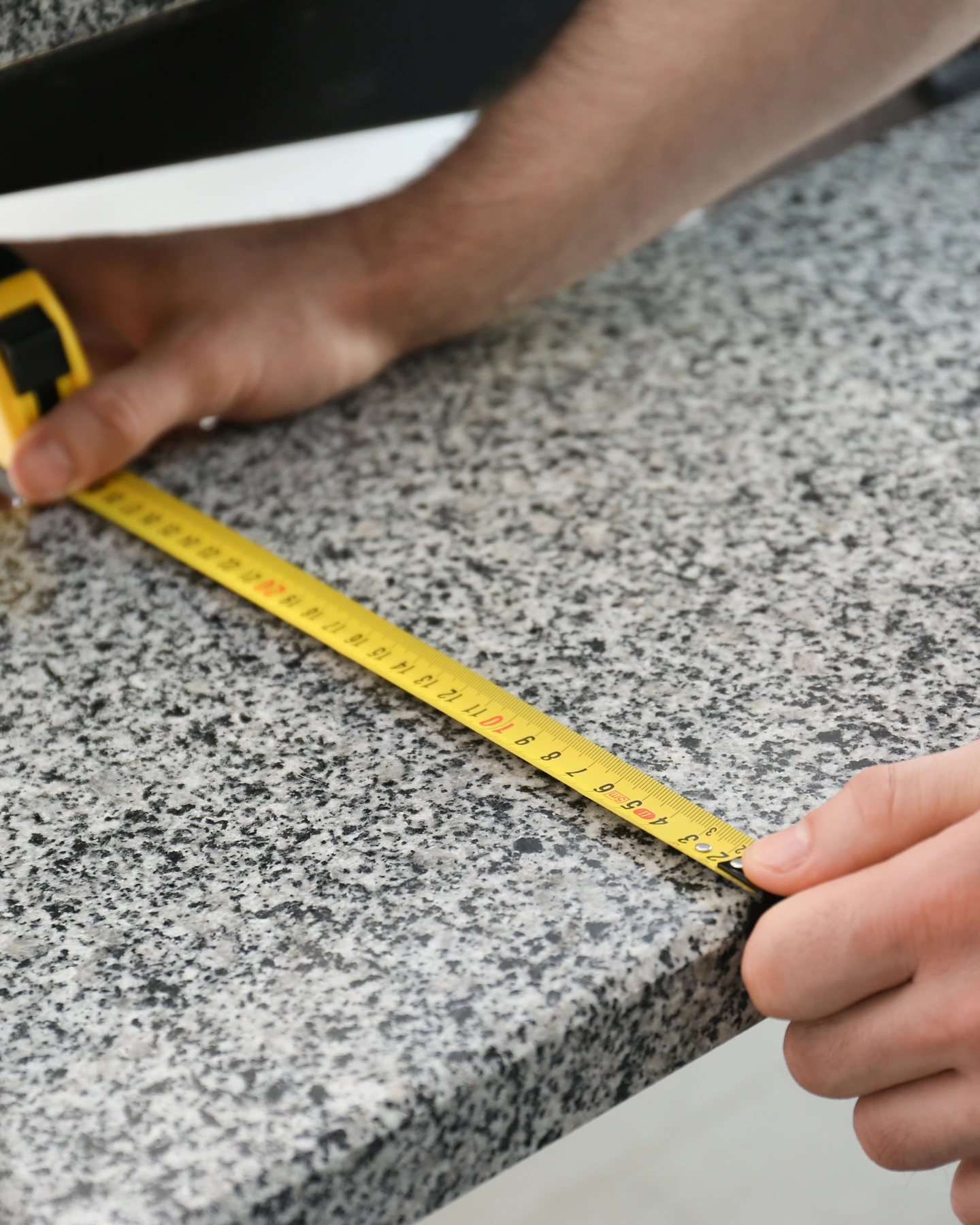
Standard stairlifts need a minimum clear width of 28 inches measured wall-to-banister. The rail occupies about 5–6 inches, and the folded seat adds another 5–6 inches — leaving roughly 16–17 inches of walking clearance on a 28-inch staircase. At 27 inches, you are below the threshold for most units. Slim-profile models — the Bruno Elite SRE-2010 and Handicare 1100 — have a folded width of 10.25 inches and can work down to 26 inches, but walking clearance is tight. Below 26 inches, a stairlift is not viable; a through-floor lift is the better path. The assessment includes a stair width measurement and a clearance confirmation before anything is quoted.
Yes. Any staircase with turns, landings, or intermediate platforms requires a custom curved rail. The installer laser-measures every angle, run length, and landing dimension at the assessment. Those measurements go to the factory, where the rail is bent to match your exact geometry — no two curved rails are identical. A 90-degree turn with one landing is the most common curved job. L-shaped and U-shaped staircases with two landings are more complex but fully doable. The rider does not feel the curve — the chair tracks smoothly through the bend at the same speed as the straight sections. Fabrication typically takes 1–3 weeks depending on the manufacturer.
The stairs. Every residential stairlift mounts the rail to the stair treads, not the wall. Stair treads are solid lumber or engineered wood supported by stringers — they are built to carry load. Drywall and wall studs are not designed for the lateral loads a moving stairlift generates. The only component that may contact the wall is the charging strip at the top or bottom parking position, and even that is optional on battery-powered models. If an installer tells you they can wall-mount a residential stairlift, get a second opinion.
Equipment
Standard residential stairlifts are rated for 300 to 350 pounds. Heavy-duty models handle 400 pounds. Bariatric units — specifically the Harmar Pinnacle SL600 and the Bruno bariatric line — go to 600 pounds. The weight rating covers the rider plus anything they are carrying. It is not a guideline. Exceeding the rated capacity stresses the motor, gear train, and rail brackets, and voids the warranty. If you are between categories — say 340 pounds and the standard is rated to 350 — most installers will recommend stepping up to the 400-pound unit for a margin of safety and reduced motor wear over the long term.
Yes. Every stairlift we install runs on DC battery power — two sealed 12-volt lead-acid batteries inside the carriage. The household outlet provides a continuous trickle charge, but the motor draws from the batteries, not the outlet. During a power outage, the batteries provide 8–20 full round trips depending on the model, rider weight, and rail length. Harmar's batteries are rated for up to 60 rides per charge — three to four times the reserve of most other brands. When power returns, the batteries recharge automatically over 4–8 hours. In hurricane-prone and storm-market regions, this is not a bonus feature — it is the engineering reason stairlifts use battery-driven DC motors in the first place.
Measured at the rider's ear at full speed on a standard 14-step straight rail: Handicare and Stannah run at approximately 50 dB — about the ambient level of a quiet room. Bruno runs at approximately 53 dB. Harmar runs at approximately 55 dB. Acorn runs at approximately 60 dB — a clearly audible difference. For context, 3 dB is roughly a 50% change in perceived loudness (decibels are logarithmic). If the stairlift is installed near a bedroom and either the rider or a household member is a light sleeper, specify Handicare or Stannah. Do not assume all brands sound the same — the 10 dB spread between Handicare and Acorn is substantial.
A standard grounded 120V outlet within 6 feet of the top or bottom of the staircase — whichever end is the primary parking position. If the nearest outlet is more than 6 feet away, you have two options. An electrician can install a new outlet closer to the staircase — a 1–2 hour job, typically $150–$350 depending on your area, and it may require a permit. Or the installer can run a low-profile cord channel along the baseboard from the existing outlet — workable but less clean and a potential trip risk if the channel crosses a walkway. Approximately 15% of homes we assess need an outlet added or upgraded from an ungrounded two-prong to a grounded three-prong. We identify this at the assessment and include it in the written quote.
Safety
Every residential stairlift from a name-brand manufacturer includes: an obstruction sensor at the base of the footrest (stops the carriage if something is on the stairs), seat belt, swivel seat that locks before allowing the rider to stand at the top or bottom landing, upper and lower limit switches that stop the carriage precisely at each end, key switch to prevent unauthorized use, and remote controls at both ends so someone can send the chair up or down without riding it. Mid-range and premium models add soft-start and soft-stop (gradual acceleration and deceleration to prevent jolting), pressure-sensitive armrest controls, and in some cases a powered fold footrest that closes automatically when the seat folds. None of these are optional extras — they are standard on every unit we install.
Open risers — where you can see through the back of each step — are usually fine. The rail bolts into the tread surface, not the riser. As long as the treads are solid and at least 1 inch thick, the lag bolts have adequate material to anchor into. Floating staircases — where treads are cantilevered from a single wall-mounted stringer or supported by cables — are a different situation. Those treads may not have the structural rigidity to support rail brackets and a loaded carriage. A structural assessment is required. Some floating designs can handle it with reinforcement brackets. Others cannot. The installer tests tread deflection during the assessment and gives you a definitive answer before quoting.
Yes. A stairlift serves the household, not one individual rider. Multiple riders at different weights are fine, provided all riders are within the unit's weight rating. There is no programming or setup required to switch between users — whoever needs the chair calls it with the remote and uses it. The one limitation is simultaneous use: a standard residential stairlift has one carriage and one rail. If two people need to use the stairs at the same time on a narrow staircase, the stairlift occupies the outer section and leaves 16–18 inches of walking clearance. That is walkable but narrow. On wider staircases (36 inches or more), some households install two rails — one on each side — but that is uncommon and adds significant cost.
After the sale
Very little. The recommended schedule: wipe the rail with a dry cloth monthly to remove dust. Lubricate the rack gear with silicone spray every 6 months — the installer shows you exactly where and how at the end of the installation day. Check the seat belt and swivel lock for smooth operation every 6 months. Have a professional service visit once per year: the technician checks batteries, tests all safety sensors, inspects motor brushes, and tightens any brackets that may have shifted. Annual service runs $100–$175. Batteries last 3–5 years and cost $80–$150 to replace, including labor. The rail itself is steel or aluminum and does not wear out under residential use. A Bruno or Stannah installed today, serviced annually, will be operational in 2040.
The unit can be removed by any qualified installer. Removal takes 1–2 hours. The lag bolt holes in the stair treads fill with color-matched wood filler and a spot coat of finish — on hardwood stairs, the repair is typically invisible from standing height. The unit itself can be donated to a nonprofit (Habitat for Humanity ReStores sometimes accept them, as do some aging-services organizations), sold through a dealer's refurbished program, or disposed of. Straight rail units have modest resale value ($300–$900 for the carriage). Curved rail units have effectively zero resale value — the rail is custom to the original staircase and does not transfer.
A straight stairlift carriage and motor can be removed and reinstalled on a new rail at the new home, if the new staircase geometry is compatible. The rail itself is cut to the original staircase length and typically cannot be reused if the new staircase is a different length. Realistically, you pay for removal ($200–$400), a new rail cut to the new staircase ($400–$700), and reinstallation labor ($300–$600). Total transfer cost: $900–$1,700 for a straight rail. That compares favorably to a new purchase if the carriage and motor are under 5 years old. Curved rails cannot transfer — they are custom-fabricated to an individual staircase and have no value on a different home.
Submit your own question
If your situation is not covered by the 20 questions above, submit it through the free assessment form. Describe your staircase — straight or curved, approximate number of steps, stair width, and the specific question. We route it to a certified installer in our network who has handled that scenario. You get a direct, specific answer within one business day — not a brochure, not a sales call, not a referral to a FAQ. A qualified tech answers your question in writing.
If the answer leads to a home assessment, the assessment is free, takes 45 minutes, and includes a written quote with a 30-day price hold. You are not required to sign same-day, and there is no obligation to move forward. The assessment exists so you can make a fully informed decision — not so we can close a sale on the first visit.
Common questions about Ask an Installer
Who answers the questions — a salesperson or an actual installer?
An actual installer. Every technician in our network holds manufacturer certification, an active state contractor license, and a minimum of 5 years of residential stairlift installation experience. We route your question to the tech best qualified for your specific situation — not whoever is available to take a sales call.
Does it cost anything to ask a question?
No. Technical questions through Ask an Installer are free with no obligation. If the answer leads to a home assessment, that is also free — a 45-minute in-person visit with a written quote and a 30-day price hold. No pressure to sign same-day.
Can I ask about a stairlift that a different company installed?
Yes. Our installers can answer general technical questions about any brand or unit, regardless of who originally sold or installed it. If the question requires hands-on diagnosis — a unit making an unusual noise, a safety sensor not triggering properly — we can schedule a service visit. There may be a diagnostic fee for units we did not originally install.
How quickly do I get an answer?
Most questions are answered within a few hours on business days. Complex situations — unusual staircase geometry, structural concerns, code compliance questions — may take up to one business day while the installer reviews any photos or measurements you provide. We will always acknowledge receipt of your question on the same day it is submitted.
Ready to Get Started?
Free in-home assessment within 24 hours. No pressure, no obligation.