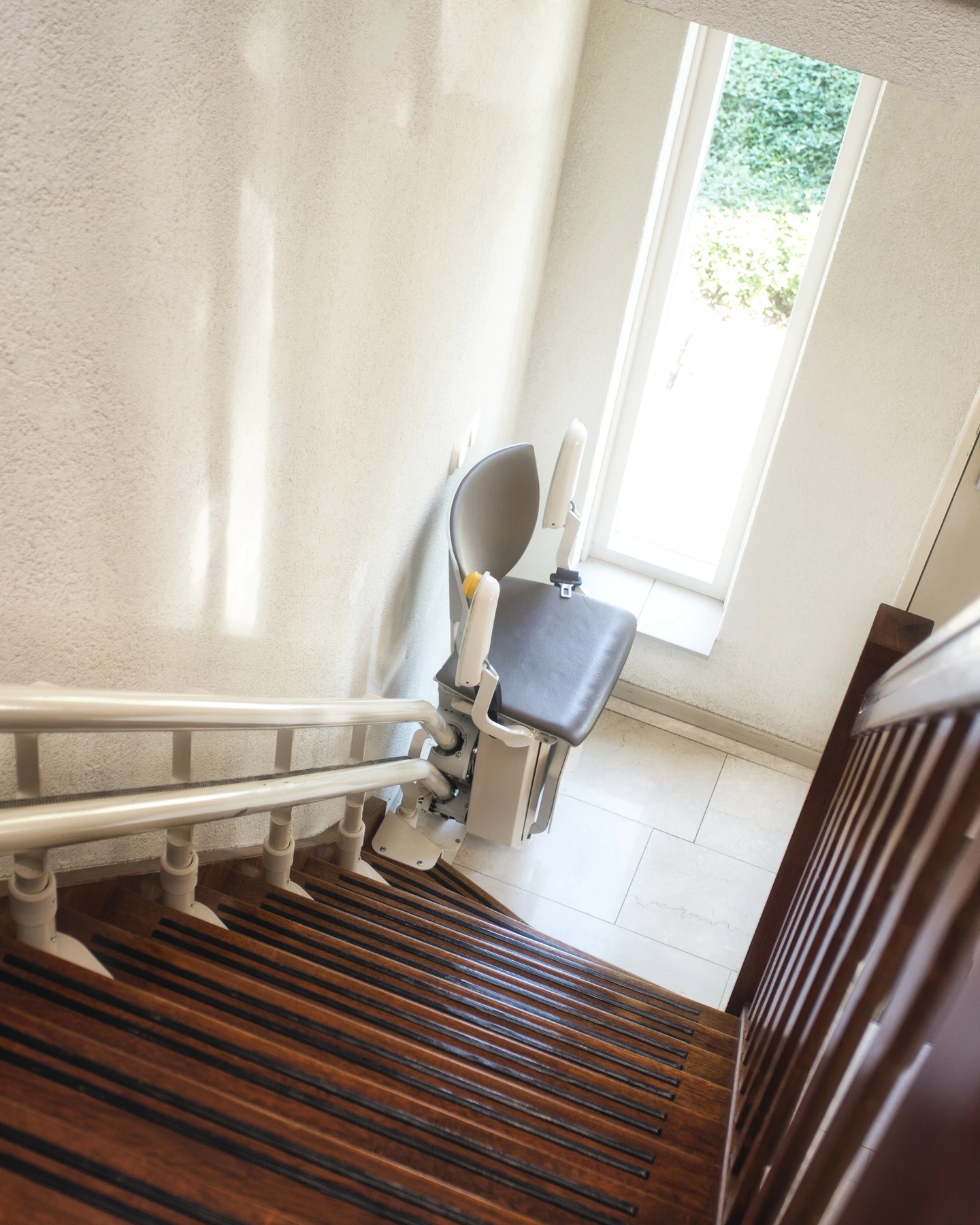
Stannah Stairlift Review: The 159-Year-Old Standard (2026)
Stannah is the oldest name in the stairlift industry and arguably the most over-engineered. Founded in London in 1867 as a crane and hoist manufacturer, Stannah started building stairlifts in 1975 and has been refining the same fundamental design for half a century. The result is a product that routinely runs 20 years on basic maintenance — longer than any competitor we install. The trade-off is price: Stannah units run 15–25% above Bruno for comparable specifications. This review covers the full current lineup, real 2026 pricing, and our honest assessment of whether the Stannah premium is worth it.
Company background: 1867 to today
Joseph Stannah founded the company in 1867, building cranes and hoists for the London docks. The business survived two world wars, pivoted through industrialization, and entered the residential accessibility market in 1975 with its first stairlift. That is not a marketing story — that is a fifth-generation family business with 159 years of continuous operation.
Today, Stannah employs over 2,000 people globally and generates more than £260 million in annual revenue. The stairlift division is headquartered in Andover, Hampshire, England, with manufacturing facilities in the UK. The US operation runs through Stannah Stairlifts Inc., based in Franklin, Massachusetts, which manages North American sales, installation, and service through a network of authorized dealers in all 50 states.
Stannah is not publicly traded. It is still family-owned, with fifth-generation Stannah family members in management roles. This matters because a family-owned manufacturer with a 159-year reputation has different incentives than a private-equity-backed holding company optimizing for quarterly returns. Stannah’s engineering choices consistently favor durability over cost reduction — heavier steel gauges, tighter machining tolerances, thicker upholstery padding — which is why their units last longer and cost more.
The 2026 model lineup
Stannah’s US residential lineup organizes around three model families, each available in straight and/or curved rail configurations with multiple seat style options:
- Siena — the flagship, available in curved (Siena 260) and straight (Siena 600) rail configurations
- Starla — the customizable mid-range, available in curved (Starla 260) and straight (Starla 600) versions
- Sadler — the entry-level straight-rail option
Within each model family, Stannah offers multiple seat styles — including the Sofia and Solus chairs — with different upholstery, armrest, and swivel options. The rail and drive system are the same within a model family; the seat is where customization happens. This means a Siena 260 with a Sofia chair and a Siena 260 with a Solus chair ride identically — they just look and feel different at the seating surface.
Siena: the curved flagship
The Siena 260 is Stannah’s flagship curved stairlift and the model that competes directly with the Bruno CRE-2110. It has been in production, in evolving forms, for over 25 years. The current 260 platform represents decades of iterative refinement on the same fundamental design — rack-and-pinion drive, dual-tube curved rail, DC battery power.
Key specifications: Siena 260 (curved)
- Weight capacity: 300 lb
- Speed: Approximately 18–20 feet per minute (varies by inclination)
- Drive: Twin rack-and-pinion with protective moulding over gear rack
- Power: 24V DC, dual 12V batteries, charge at parking positions
- Rail: Dual-tube custom-fabricated curved rail
- Seat options: Sofia (powered two-way swivel), Solus, and standard perch seats
- Swivel: Manual or powered, depending on seat choice. Sofia offers powered two-way swivel.
- Configurations: 90° turns, 180° turns, landings, spiral staircases
- Fabrication lead time: 14–21 business days from measurement to delivery
- On-site install time: 4–8 hours
Siena 600 (straight)
- Weight capacity: 300 lb (up to 352 lb on select configurations)
- Drive: Rack-and-pinion with protective moulding
- Rail: Straight rail, smooth quiet operation
- Speed: Approximately 20 feet per minute
The Siena’s build quality is noticeable from the first ride. The seat padding is thicker than Bruno or Handicare. The armrest mechanisms have less play. The swivel action — particularly on the Sofia powered swivel — is smoother and more controlled. These are not performance differences. They are fit-and-finish differences that reflect Stannah’s decision to use heavier materials and tighter tolerances throughout the seat assembly.
The curved rail fabrication on the Siena 260 uses a dual-tube design rather than Bruno’s single-tube approach. Both work. The dual-tube provides a slightly wider bearing surface for the carriage, which theoretically distributes load more evenly on steep or heavily curved sections. In practice, we have not seen a meaningful difference in ride quality or long-term durability between Bruno’s single-tube and Stannah’s dual-tube curved rails. Both track cleanly and last decades.
Installed price range (2026): Siena 260 curved: $11,500–$17,000. Siena 600 straight: $4,200–$6,200.
Starla: the customizable straight and curved option
The Starla is Stannah’s mid-range model family, positioned between the flagship Siena and the entry-level Sadler. The mechanical internals are shared with the Siena — same drive system, same motor, same rail platform. The differences are in the seat options, upholstery range, and cosmetic finishes.
Key specifications: Starla 260 (curved) / Starla 600 (straight)
- Weight capacity: 300 lb (curved), 350 lb (straight)
- Drive: Rack-and-pinion, same as Siena platform
- Seat options: Widest selection of customizable options in the Stannah lineup — multiple finishes, vinyl and woven upholstery fabrics, six rail colors
- Swivel: Manual or powered, depending on configuration
- Speed: Approximately 20 feet per minute
The Starla’s value proposition is customization without the Siena’s premium price tag. If you want a Stannah’s build quality and longevity but want to choose from a wider palette of upholstery, rail colors, and seat configurations, the Starla gives you more options at $500–$1,000 below the Siena’s price. The drive system is identical. The 20-year service life is identical. The difference is cosmetic.
Installed price range (2026): Starla 260 curved: $10,500–$16,000. Starla 600 straight: $3,800–$5,800.
Sadler: the entry-level straight
The Sadler is Stannah’s budget-conscious straight-rail model for the US market. It uses a simpler seat assembly with fewer customization options and a more standardized design. The drive system is still Stannah’s rack-and-pinion, and the build quality is still recognizably Stannah — heavier-gauge steel, tighter tolerances, better upholstery padding than comparably priced competitors.
Key specifications
- Weight capacity: 300 lb
- Drive: Rack-and-pinion
- Power: 24V DC, dual batteries
- Swivel: Manual swivel at top landing
- Seat: Standard upholstery, limited color options
The Sadler competes on price with the Bruno Elan and the Handicare 1000, and it is genuinely competitive in that bracket. You get Stannah’s engineering fundamentals — the rack-and-pinion drive, the British-built motor, the over-spec’d steel work — at a price point that overlaps with Bruno’s entry-level model. If you want a Stannah but the Siena and Starla are outside your budget, the Sadler is a rational compromise.
Installed price range (2026): $3,500–$5,200.
Real 2026 pricing
| Model | Installed price range | Most common price |
|---|---|---|
| Sadler (straight) | $3,500–$5,200 | $4,200 |
| Starla 600 (straight) | $3,800–$5,800 | $4,600 |
| Siena 600 (straight) | $4,200–$6,200 | $5,100 |
| Starla 260 (curved) | $10,500–$16,000 | $12,800 |
| Siena 260 (curved) | $11,500–$17,000 | $14,000 |
Stannah pricing sits 15–25% above Bruno across comparable configurations. A Siena 600 straight at $5,100 typical versus a Bruno Elite SRE-2010 at $4,900 typical is only $200 apart — a close race. But a Siena 260 curved at $14,000 typical versus a Bruno CRE-2110 at $12,500 is $1,500 — a gap that matters to most budgets.
The premium buys you two things: (1) measurably longer service life (20+ years typical versus 15–18 for Bruno), and (2) heavier build quality in the seat assembly, upholstery, and finish work. Whether that is worth $1,000–$2,000 depends on how long you plan to use the lift and whether the fit-and-finish differences matter to you. For a 10-year planning horizon, Bruno is the better value. For a 15–20 year horizon, Stannah’s total cost of ownership is competitive because you are less likely to need a replacement unit during that span.
Warranty breakdown
Stannah’s warranty structure for units purchased through authorized US dealers:
- Motor and gear: Limited lifetime warranty for the original purchaser when registered with Stannah at purchase.
- All other parts: 27 months from date of purchase. This is slightly longer than Bruno’s and Handicare’s 24-month parts warranty — a small but real distinction.
- Batteries: 1 year warranty. Batteries are still consumables that need replacement every 3–5 years, but Stannah’s 12-month coverage is better than Bruno and Handicare, which offer zero battery warranty.
- Labor: Installation cost is typically included in the Stannah quote when purchased directly through Stannah. Labor warranty terms vary by dealer for third-party dealer installs.
The 27-month parts warranty is worth noting. It is three months longer than the industry-standard 24 months. On a practical level, this means a control board that fails at month 25 is covered under Stannah but out of warranty under Bruno and Handicare. Small edge, but a real one.
The key drawback is parts delivery speed for warranty claims. Stannah’s US parts inventory is managed from the Franklin, Massachusetts office, but many components ship from the UK warehouse. Delivery times for non-stock parts run 10–14 business days — roughly double Bruno’s 3–5 day turnaround. If your lift goes down and needs a UK-sourced part, you are potentially looking at two weeks without a working stairlift. This is the single biggest practical disadvantage of owning a Stannah in the US market.
Twin rack-and-pinion: the Stannah drive system
Stannah uses a rack-and-pinion drive system across its lineup, with a protective moulding that covers the gear rack on the rail. This is the same fundamental drive technology used by Handicare and the Bruno Elan. The Bruno Elite uses a beltless direct-drive system, which is a different and arguably simpler approach.
The rack-and-pinion system works by meshing a small gear (pinion) on the drive motor with a toothed bar (rack) mounted along the rail. The motor turns the pinion, the pinion walks along the rack, and the chair moves. It is a proven, well-understood mechanism that has been used in stairlifts for decades.
Stannah’s implementation adds the protective moulding — a plastic or rubber cover over the gear rack that prevents dust, pet hair, and debris from accumulating in the gear teeth. This reduces noise and maintenance compared to exposed gear tracks. Stannah claims this contributes to the quiet, smooth ride quality that their units are known for, and our experience supports that claim. Stannah units are not quite as quiet as Handicare (Stannah measures 53–55 dB versus Handicare’s 49–52 dB), but they are smooth and well-damped with no vibration or harshness.
The trade-off versus Bruno’s beltless direct drive: the rack-and-pinion system has more moving parts (the pinion gear, the rack teeth, the gear mesh interface) than a direct motor-to-gearbox connection. In theory, more moving parts means more potential failure points. In practice, Stannah’s rack-and-pinion system is so over-engineered — heavier steel, tighter tooth profiles, better gear lubrication — that it achieves equal or better reliability than simpler systems over a 20-year span. The parts just do not wear out because they are built with so much margin.
The 20-year service life claim
In our install base, Stannah units that receive basic maintenance (battery replacement every 3–5 years, annual rail lubrication) average 18–22 years of service before needing a major component replacement. Bruno averages 15–18 years. Handicare averages 14–17 years. Acorn averages 8–12 years.
Stannah’s longevity advantage is real, measurable, and the primary reason some buyers pay the premium. It is not marketing. It comes from three engineering decisions:
- Heavier steel gauges. Stannah uses thicker-gauge steel in the rail, carriage, and drive housing than competitors. Heavier steel means more thermal mass (less temperature cycling stress), more corrosion margin, and more structural reserve under load. The downside is weight: a Stannah curved rail weighs noticeably more than a Bruno curved rail, which makes on-site handling harder for the install crew. Not your problem as the homeowner, but a real cost factor for the installer.
- Tighter machining tolerances. The gear mesh in Stannah’s rack-and-pinion system has less play than comparably priced systems. Less play means less vibration, less noise, and less gear tooth wear over time. The cost of tighter tolerances is higher manufacturing cost, which passes through to the buyer.
- Better upholstery and seat mechanisms. The seat padding on a Stannah is thicker and uses denser foam than Bruno or Handicare. The swivel mechanism uses heavier bearings. The armrest hinges are more robust. These details do not affect the ride — they affect how the chair feels and holds up after 50,000 cycles of sitting, standing, swiveling, and folding.
Is 20 years worth $1,000–$2,000 more than 15 years? That depends entirely on your planning horizon. If you are installing a stairlift in a home you plan to live in for 20+ years, or in a home you plan to leave to your children, Stannah’s durability advantage has real financial value. If your planning horizon is 5–10 years, Bruno delivers 90% of Stannah’s quality at a lower price point, and the longevity difference does not come into play.
Pros and cons
What we like
- Longest service life in the industry — 20+ years with basic maintenance, 3–5 years longer than Bruno
- Over-engineered build quality — heavier steel, tighter tolerances, better upholstery
- 27-month parts warranty — three months longer than the industry-standard 24 months
- 1-year battery warranty — Bruno and Handicare offer zero battery coverage
- 159-year company history — fifth-generation family ownership, not private-equity-managed
- Protected rack-and-pinion — moulding covers gear rack, reduces noise and dust buildup
- Multiple seat styles per model — Sofia, Solus, and perch options with powered swivel
- Authorized dealers in all 50 states
What we don’t
- 15–25% price premium over Bruno — real money, especially on curved installs ($1,500+ gap)
- Slowest parts delivery in the US market — 10–14 business days for UK-sourced parts vs. 3–5 for Bruno
- Lower weight capacity — max 352 lb on select straight configs; Bruno handles 400 lb, Harmar handles 600 lb
- Longer curved rail fabrication time — 14–21 business days vs. 10–14 for Bruno
- No bariatric option — nothing above 352 lb in the lineup
- Heavier rails — more difficult for install crews, can add to install time and cost
Who should buy a Stannah
Buy a Stannah if:
- Your planning horizon is 15–20+ years and you want the longest-lasting unit on the market
- You are willing to pay a 15–25% premium for over-engineered build quality and better fit-and-finish
- You want a brand with 159 years of continuous operation and fifth-generation family ownership
- Seat comfort and upholstery quality matter to you — Stannah’s padding and swivel mechanisms are the best in class
- You are leaving the home to children or a spouse who will need the lift for decades
Do not buy a Stannah if:
- Budget is the primary constraint — Bruno delivers 90% of the quality at 15–25% less
- You need fast parts replacement — Stannah’s 10–14 day parts pipeline is the slowest among name brands
- Your rider weighs over 325 lb — Stannah’s max capacity (352 lb) does not provide enough headroom; look at Bruno Elite (400 lb) or Harmar (600 lb)
- Your staircase is very narrow — Handicare 1100 has the slimmest rail profile
- Noise is your top priority — Handicare is 2–4 dB quieter than Stannah
- You need a heavy-duty or outdoor specialist unit — Harmar owns those categories
Request a free in-home assessment and we will help you decide whether Stannah’s premium is justified for your specific situation, or whether Bruno or Handicare is the smarter spend.
Common questions
Is Stannah a good stairlift brand?
How much does a Stannah stairlift cost in 2026?
How long does a Stannah stairlift last?
When was Stannah founded?
What warranty does Stannah offer?
Where are Stannah stairlifts made?
Does Stannah make a curved stairlift?
How does Stannah compare to Bruno?
What is the weight limit on a Stannah stairlift?
Can I get a Stannah stairlift installed in my state?
Your free home assessment is one phone call away
No deposit. No obligation. No high-pressure sales. A certified installer visits your home, measures once, and gives you a written quote that's honored for 30 days. It takes about 45 minutes. More than 15,000+ homeowners have said yes over the last 15 years.
- Licensed in all 50 states
- $2M liability insured
- BBB A+ since 2012
- 15+ years in business