Bruno vs Stannah: Premium Stairlift Showdown (2026)
Bruno and Stannah are the two brands families ask about when price isn't the primary concern and they want the stairlift that lasts the longest with the fewest problems. Both are premium. Both are excellent. The question is which kind of premium you want: American-made with a domestic parts pipeline, or British-made with a 50-year engineering pedigree. We install both. Here's what we tell families who've narrowed their shortlist to these two.
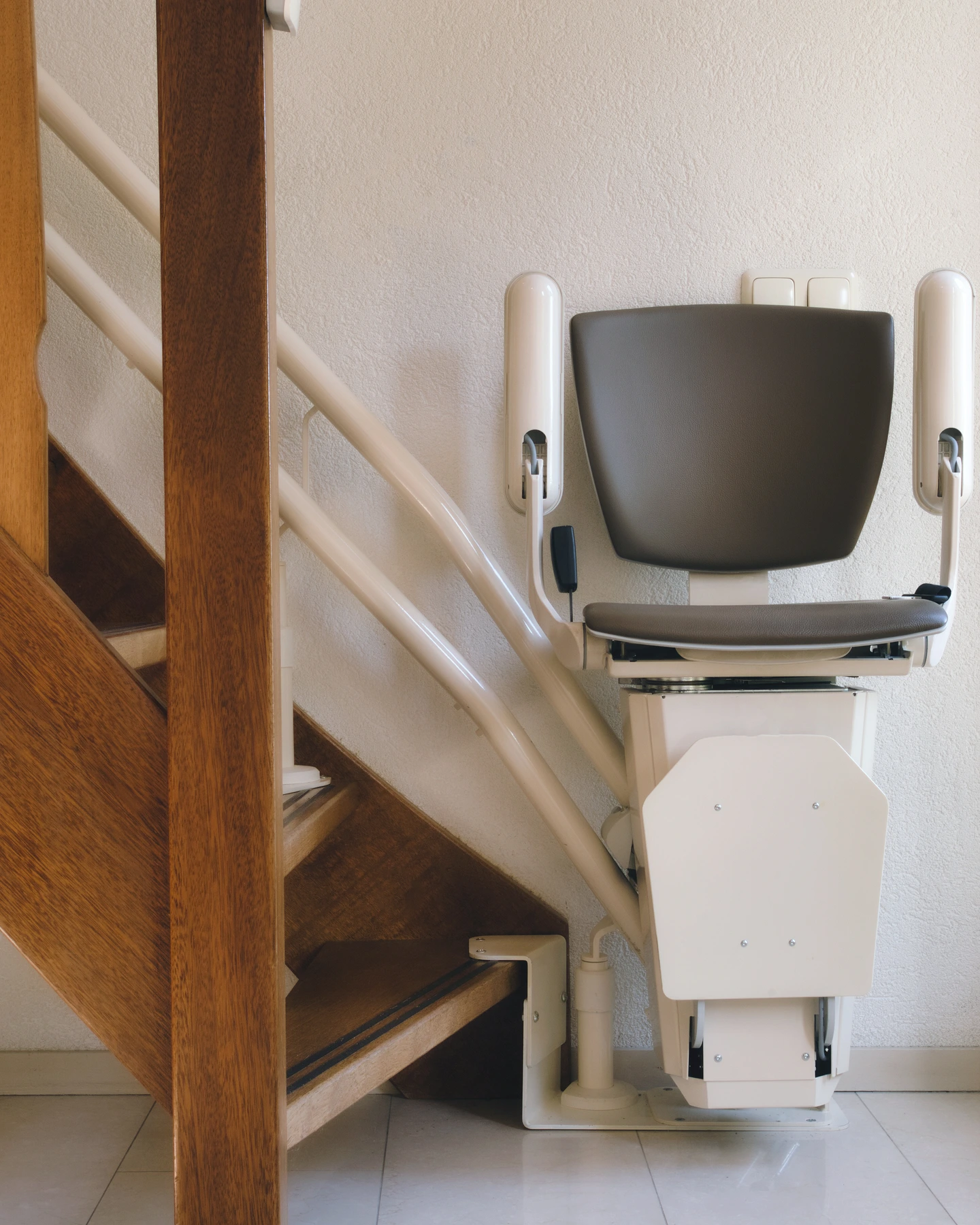
The quick verdict
Bruno is the better value for most US buyers. Comparable build quality, significantly faster parts supply, lower price point, and a domestic service network. Stannah is the better choice if longevity above all else is the goal — their units routinely run 20+ years, and the build quality on the Siena 260 curved is best-in-class. The 15–25% price premium and slower parts pipeline are the trade-offs.
Both brands build stairlifts that last 15–20 years. The difference is in the details: Bruno's domestic supply chain means faster repairs and lower service costs over the life of the unit. Stannah's engineering heritage means slightly better build quality on the seat mechanism, the swivel bearings, and the upholstery — details you notice on year 10 that you don't notice on year 1. If you're in the US and want the best overall package, buy the Bruno. If you're willing to pay more for the unit that your grandchildren will eventually have removed, buy the Stannah.
Company heritage and manufacturing
Bruno Independent Living Aids
Founded in 1984 in Oconomowoc, Wisconsin. Bruno is a veteran-founded, family-owned company that manufactures stairlifts, vertical platform lifts, and vehicle lifts. Their factory is still in Wisconsin. The company was founded by Michael Bruno, a WWII veteran, and remains privately held. They are the largest residential stairlift manufacturer in the United States by install volume.
Bruno builds the Elite, Elan, and curved CRE-2110 lines in Wisconsin. Their steel supply chain is domestic. Their engineering team is domestic. Their parts warehouse is domestic. When something breaks on a Bruno stairlift in Kansas City, the replacement part ships from Wisconsin.
Stannah Stairlifts
Founded in 1867 in Andover, Hampshire, England — originally as a crane and hoist manufacturer. Stannah entered the stairlift market in 1975 and has been building them continuously for 51 years. They are the oldest purpose-built stairlift manufacturer still in operation. The company is family-owned, now in its fifth generation of Stannah family management.
Stannah builds the Siena line (160 straight, 260 curved, 600 straight) in their UK factory. They operate US subsidiaries for sales and service, but manufacturing is entirely UK-based. Parts ship from the UK to US installers. This supply chain difference is the single most important practical distinction between the two brands for US buyers.
Side-by-side specification table
| Specification | Bruno Elite SRE-2010 | Bruno CRE-2110 (curved) | Stannah Siena 600 | Stannah Siena 260 (curved) |
|---|---|---|---|---|
| Country of manufacture | USA (Wisconsin) | USA (Wisconsin) | UK (Hampshire) | UK (Hampshire) |
| Type | Straight | Curved | Straight | Curved |
| Price installed | $4,200–$5,500 | $10,000–$15,000 | $4,800–$6,500 | $12,000–$17,000 |
| Weight capacity | 400 lb | 400 lb | 350 lb | 300 lb |
| Drive system | Direct-drive, beltless | Direct-drive, beltless | Rack-and-pinion | Rack-and-pinion (twin rail) |
| Motor | 24V DC enclosed gear | 24V DC enclosed gear | 24V DC, 0.27 kW | 24V DC, 0.27 kW |
| Speed | ~20 ft/min | ~18 ft/min | ~18 ft/min | ~18 ft/min |
| Battery backup | Dual 12V, 20+ trips | Dual 12V, 20+ trips | Dual 12V, 15–20 trips | Dual 12V, 15–20 trips |
| Swivel seat | Power, 90° | Power, 90° | Manual or power, 90° | Manual or power, 90° |
| Footrest | Manual linked or power | Power | Power retractable | Power retractable |
| Warranty — motor | Lifetime limited | Lifetime limited | 5 years | 5 years |
| Warranty — rail | Lifetime | Lifetime | 5 years | 5 years |
| Parts supply to US | 3–5 business days | 3–5 business days | 10–14 business days | 10–14 business days |
| Upholstery options | 3–4 neutrals | 3–4 neutrals | 6+ colors, premium fabrics | 6+ colors, premium fabrics |
| Expected lifespan | 15–20 years | 15–20 years | 20–25 years | 20–25 years |
Drive system: beltless vs rack-and-pinion
This is the core engineering difference between the two brands, and it shapes everything else about the ride experience.
Bruno: direct-drive beltless
Bruno's drive system connects the motor to the drive gear through a worm gear mechanism with no belt. The motor turns, the worm gear engages the drive pinion, and the carriage moves along the rail. The gear mechanism is fully enclosed in a sealed housing, which keeps dust, pet hair, and debris out of the drive train. This design has fewer moving parts than a belt-driven or rack-and-pinion system, which translates to fewer wear points and a longer service interval.
The practical result: Bruno units have an exceptionally consistent ride feel from year 1 to year 15. The motor doesn't get louder over time the way rack-and-pinion systems can. There's no belt to stretch, no exposed rack to clean, no pinion teeth to wear.
Stannah: rack-and-pinion (twin rail on curved)
Stannah uses a traditional rack-and-pinion drive with a 0.27 kW DC motor. On the Siena 260 curved model, this system runs on a twin-rail design — two parallel tracks that provide exceptional stability through turns and around corners. Stannah has been refining this system for five decades, and the precision of their rack-and-pinion geometry is as good as rack-and-pinion gets.
The twin-rail design on the Siena 260 is genuinely superior to single-rail curved systems (including Bruno's CRE-2110) for complex staircase geometries with tight turns, mid-landings, and 180-degree switchbacks. The carriage tracks more smoothly through these transitions because two rails provide a wider bearing surface than one.
The trade-off: rack-and-pinion is inherently more exposed to environmental debris than Bruno's enclosed system. Over 10–15 years, the rack needs periodic cleaning and lubrication. Stannah's rack is higher quality than most competitors', but it's still an exposed mechanical surface.
Pricing comparison
Stannah costs more than Bruno. The Stannah Siena 600 straight installed runs $4,800–$6,500 vs the Bruno Elite SRE-2010 at $4,200–$5,500. The Stannah Siena 260 curved installed runs $12,000–$17,000 vs the Bruno CRE-2110 at $10,000–$15,000.
The premium reflects three things: the import cost of UK-manufactured equipment, Stannah's higher materials spec on upholstery and seat components, and the brand's positioning as the luxury tier of the market. Whether the premium is worth it depends entirely on what you value. If you value the longest possible lifespan and the nicest seat feel, the Stannah premium pays for itself. If you value a domestic parts pipeline and a lower total price with similar core performance, the Bruno is the smarter buy.
For a detailed breakdown of what drives stairlift pricing, see our stairlift cost guide.
Warranty depth
Bruno's warranty is longer on paper. The motor, gearbox, and rail carry a lifetime limited warranty. All other components are covered for 2 years.
Stannah's warranty is 5 years on all major components — motor, gearbox, rail, and electronics. It's shorter than Bruno's lifetime claim on the motor, but it's broader in what it covers during those 5 years. Stannah's 5-year warranty includes the control board and safety sensors that Bruno only covers for 2 years.
In practice, the distinction matters less than it appears. Bruno motors almost never fail within the warranty period (or at all — their expected lifespan is 20+ years). The components that actually fail on both brands are the consumables: batteries (3–5 year replacement cycle, $75–$150), seat swivel bearings (15,000–25,000 cycles), and safety sensor microswitches (dust and age). These are post-warranty items on both brands.
The real warranty question is not duration but enforcement speed. When you file a Bruno warranty claim, the part ships from Wisconsin in 3–5 days. When you file a Stannah warranty claim, the part ships from Hampshire, England in 10–14 days. If your stairlift is non-functional and you're waiting on a warranty part, that time difference is the difference between a minor inconvenience and a significant mobility disruption.
Parts pipeline: 3–5 days vs 10–14 days
The supply chain question that matters most
Both brands build excellent equipment. The difference you feel as a homeowner isn't in the product — it's in what happens when the product needs service. Bruno's US manufacturing means US-speed repairs. Stannah's UK manufacturing means transatlantic shipping on every part.
Bruno parts ship from domestic inventory in Wisconsin. Standard delivery to any US installer: 3–5 business days. Expedited delivery for urgent repairs: 1–2 business days. We stock the most common Bruno wear items (batteries, swivel bearings, sensor microswitches) in our regional warehouses for same-day or next-day repairs.
Stannah parts ship from their UK factory or UK-based distribution. Standard delivery to a US installer: 10–14 business days. This includes manufacturing/pulling from UK inventory, export documentation, transatlantic shipping, and US customs clearance. Expedited international shipping is available but expensive — roughly $80–$200 per shipment depending on the part size and urgency.
A few US-based aftermarket suppliers carry some Stannah-compatible parts (batteries, generic sensors), which can cut the wait time on simple repairs. But for anything proprietary — a Siena 260 curved rail section, a Stannah control board, a Stannah-specific motor assembly — you're waiting on the UK pipeline. There is no domestic alternative.
Over a 15-year ownership period, a homeowner will need 3–5 repair parts on a well-maintained stairlift of either brand. That's 3–5 times the difference between a 3-day wait and a 14-day wait. For some families, that's acceptable. For a household where the stairlift is the only safe way to access the second floor, a 14-day wait on a critical part is a serious problem.
Curved rail comparison
If you're buying a curved stairlift, the Bruno vs Stannah comparison shifts. This is where Stannah's engineering pedigree is most visible.
Bruno CRE-2110
Bruno's curved rail is custom-fabricated from a photo survey or laser measurement of your staircase. The rail is a single-track steel rail with a drive rack. Fabrication takes 1–2 weeks at the Wisconsin factory. The CRE-2110 handles 400 lb capacity, which is 100 lb more than the Stannah curved. It handles most residential curved geometries well — single turns, L-shapes, and moderate switchbacks.
Where the Bruno curved shows its limits: very tight 180-degree turns (inside radius under 24 inches) and complex multi-turn geometries with three or more direction changes. The single-rail design has more play in tight curves than Stannah's twin-rail system.
Stannah Siena 260
The Siena 260 uses a twin-rail system — two parallel tracks instead of one. This provides a wider bearing surface for the carriage, which translates to a smoother, more stable ride through every turn geometry. The twin-rail design is Stannah's signature engineering advantage on curved installations.
The Siena 260 tracks with noticeably less vibration and less lateral play through tight turns than any single-rail curved system, including Bruno's. On a complex staircase with multiple turns and a mid-landing, the ride quality difference between the Stannah 260 and the Bruno CRE-2110 is perceptible. On a simple single-turn curve, the difference is minimal.
The trade-off: 300 lb capacity (vs Bruno's 400 lb) and a higher price ($12,000–$17,000 vs $10,000–$15,000). For riders under 275 lb on complex staircases, the Stannah 260 is the superior curved rail. For riders over 300 lb, it's not an option — you need the Bruno.
Build quality and upholstery
On day one, both brands feel like premium equipment. On day 3,000, Stannah feels slightly more premium. The difference is in the details that accumulate over a decade of daily use.
Stannah's seat upholstery is denser, more stain-resistant, and holds its shape longer than Bruno's. Stannah offers 6+ upholstery color and fabric options including leather-effect vinyl, which is a step up from Bruno's 3–4 neutral fabric options. The seat padding retains its firmness longer. The armrest hinge mechanism has tighter tolerances. The swivel bearing is smoother after 10 years of use.
Bruno's build quality is excellent by industry standards — it's just not quite at Stannah's level on the cosmetic and comfort components. Where Bruno matches or exceeds Stannah is on the structural components: the rail mounting system, the motor housing, the battery enclosure, and the safety sensor array. These are the parts that determine whether the unit is safe and functional. Bruno is equal or better on function; Stannah is better on feel.
If you're buying a stairlift for daily use over 15+ years and the rider cares about comfort and aesthetics, Stannah's fit and finish justifies the premium. If the rider cares primarily about reliability and the equipment being functional, Bruno's structural quality and domestic parts pipeline are the better investment.
Longevity and 15-year cost of ownership
Over 15 years of ownership, the total cost picture changes from the purchase price comparison. Let's run the numbers on a straight rail install.
Bruno Elite SRE-2010 — 15-year total cost estimate
- Purchase installed: $4,800 (mid-range)
- Battery replacements (3 sets at $125 each): $375
- Swivel bearing replacement (1x): $180 part + $150 labor = $330
- Sensor replacement (1x): $60 part + $100 labor = $160
- Rail lubrication supplies (15 years): $40
- Estimated 15-year total: $5,705
Stannah Siena 600 — 15-year total cost estimate
- Purchase installed: $5,600 (mid-range)
- Battery replacements (3 sets at $125 each): $375
- Swivel bearing replacement (1x): $200 part + $150 labor = $350
- Sensor replacement (1x): $80 part + $100 labor = $180
- Rail lubrication supplies (15 years): $40
- Estimated 15-year total: $6,545
The 15-year cost gap narrows to about $840. That's $56 per year more for the Stannah. Whether that's worth it depends on the comfort and aesthetic premium you felt at the showroom — because the functional performance over 15 years is comparable between the two brands.
At 20 years, the Stannah pulls ahead slightly: Stannah units routinely reach 20–25 years with minimal additional service, while Bruno units are more likely to need a motor rebuild or significant component replacement between year 18 and year 22. If you plan to keep the unit past 20 years, the Stannah's longer engineering runway starts to justify its price.
Our recommendation by scenario
Buy the Bruno if:
- You want the best value at the premium tier
- Fast repairs matter — the 3–5 day domestic parts pipeline is a significant advantage
- The rider weighs over 300 lb (Bruno offers 400 lb; Stannah straight maxes at 350 lb, curved at 300 lb)
- You're using funding programs that cap at a specific dollar amount — Bruno fits more budgets
- You prefer buying American-made equipment
Buy the Stannah if:
- You want the longest possible lifespan (20–25 years vs 15–20 years)
- Seat comfort and upholstery quality are important to the rider
- You're buying a curved rail for a complex staircase — the Siena 260 twin-rail is best in class
- You value 50 years of engineering heritage in the product
- You live in a metro area with a local Stannah-certified service center (reduces the parts pipeline issue)
What we install more often
Bruno, by a ratio of about 5:1 over Stannah. The reason is primarily the parts pipeline and the price. Most of our customers are practical buyers who want a premium product with fast service — and that's Bruno. The Stannah buyers we serve tend to be families who researched extensively, tried both seats in a showroom, and decided the Stannah's comfort and build quality justified the premium. Both groups are making rational choices.
Common questions
Is Stannah really worth 15–25% more than Bruno?
Can I get Stannah parts serviced locally in the US?
Which brand has a better curved stairlift?
Are Bruno and Stannah both authorized for VA HISA grant funding?
Which lasts longer — Bruno or Stannah?
Your free home assessment is one phone call away
No deposit. No obligation. No high-pressure sales. A certified installer visits your home, measures once, and gives you a written quote that's honored for 30 days. It takes about 45 minutes. More than 15,000+ homeowners have said yes over the last 15 years.
- Licensed in all 50 states
- $2M liability insured
- BBB A+ since 2012
- 15+ years in business