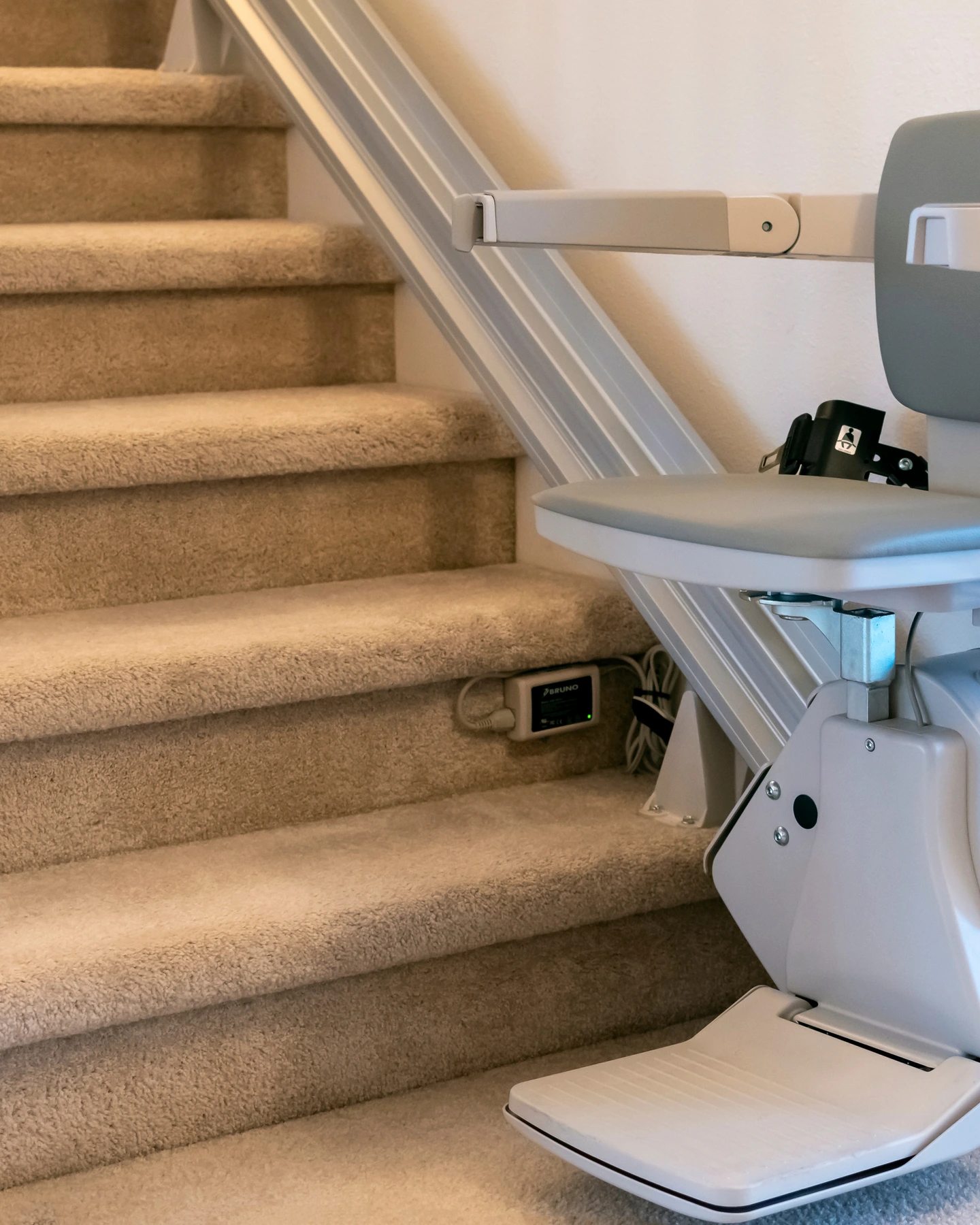
Bruno vs AmeriGlide: Stairlift Brand Breakdown
Bruno starts at $3,800 installed. AmeriGlide starts at $1,499 shipped to your door. That price gap — roughly $2,000 to $3,000 depending on the model — is real, and for some buyers it is the deciding factor. But the price difference exists for specific, traceable reasons, and understanding those reasons is the difference between a smart budget decision and a regret you live with for years. This is not a review that declares a winner. It is a breakdown that explains what you are buying — and what you are not buying — at each price point.
Two fundamentally different business models
Bruno and AmeriGlide do not compete in the same way that Ford and Chevrolet compete. They operate fundamentally different business models, and understanding that difference explains everything else — the price gap, the quality gap, the service gap, and the situations where each one makes sense.
Bruno Independent Living Aids
Founded in 1984. Headquartered in Oconomowoc, Wisconsin. Bruno designs, engineers, and manufactures stairlifts, vertical platform lifts, and vehicle lifts in their own facility. Every Bruno stairlift is built in Wisconsin. The company sells through a network of authorized dealers — local businesses that purchase Bruno equipment at wholesale and sell it to homeowners with professional installation included. Bruno does not sell direct to consumers. You cannot buy a Bruno stairlift online and install it yourself (without voiding the warranty).
AmeriGlide
Founded in 2005. Headquartered in Raleigh, North Carolina. AmeriGlide is primarily a distribution and sales company, not a manufacturer. AmeriGlide sources stairlifts from third-party manufacturers — some domestic, some overseas — and sells them under the AmeriGlide brand name. The company sells direct to consumers through its website and call center. AmeriGlide offers both professional installation (through a contractor network) and self-installation (DIY kits shipped to the customer). The DIY option is a core part of AmeriGlide's value proposition — it is how they reach the $1,499 starting price.
This is the foundational difference. Bruno builds. AmeriGlide distributes. Both are legitimate business models. But they produce different outcomes for the buyer in terms of quality control, parts availability, warranty enforcement, and long-term service.
Manufacturing: integrated vs distributed
Bruno's ISO 9001-certified manufacturing facility in Wisconsin controls the entire production process: motor assembly, rail extrusion, gear machining, seat fabrication, control board assembly, and final testing. Every unit is tested on a staircase before it ships. Quality control is in-house. When a quality issue is discovered, Bruno traces it to the specific production run and addresses it internally.
AmeriGlide's manufacturing model is different. The company sources components and finished units from multiple OEM (original equipment manufacturer) suppliers. The AmeriGlide Rave 2 — their most popular model — is not manufactured by AmeriGlide. It is manufactured by a third party and sold under the AmeriGlide name. This is called relabeling, white-labeling, or OEM distribution, and it is standard practice in many consumer product categories.
The practical implication for the buyer: when a Bruno motor fails in year 3, Bruno has the replacement motor in their warehouse in Wisconsin because they manufactured it. When an AmeriGlide motor fails in year 3, AmeriGlide must source the replacement from whoever manufactured the original — and that supply chain is only as reliable as the OEM supplier's willingness and ability to maintain inventory for older models.
We have seen this play out in practice. AmeriGlide has gone through corporate restructuring (including reincorporation as "AmeriGlide Distributing 2019, Inc."), and during transitional periods, parts availability for older models has been inconsistent. Warranty details matter — read them before you buy.
Product comparison: Bruno Elan SRE-3000 vs AmeriGlide Rave 2
| Feature | Bruno Elan SRE-3000 | AmeriGlide Rave 2 |
|---|---|---|
| Weight capacity | 300 lb | 300 lb |
| Rail type | Extruded aluminum, single-piece | Steel, modular sections |
| Rail width | 5.25 inches | 6.5 inches |
| Motor type | DC, enclosed gear system | DC, standard gear |
| Noise level | ~52 dB | ~60 dB |
| Seat swivel | Manual, 90° at top | Manual, 90° at top |
| Battery backup | Yes, 2x 12V SLA | Yes, 2x 12V SLA |
| Safety sensors | Footrest, carriage, obstruction | Footrest, carriage |
| Warranty (parts) | 5 years | 2 years |
| Warranty (labor) | 1 year (via dealer) | None (DIY) / varies (installed) |
| Made in | Wisconsin, USA | OEM sourced (varies) |
| Installation included | Yes (dealer installs) | Optional (extra cost) |
On paper, both units carry a rider up a straight staircase on battery-backed DC power. The differences are in the details that affect long-term reliability: rail profile width (Bruno is slimmer by 1.25 inches), noise (Bruno is 8 dB quieter — noticeable), warranty duration (Bruno is 5 years vs 2 years on parts), and the enclosed gear system (Bruno's gears are sealed from dust and debris; the Rave 2's are exposed).
The enclosed gear system is the single most important engineering difference. Dust, pet hair, and household debris accumulate on open gear tracks over years of use, causing the grinding and wearing that degrades performance. Bruno's sealed system avoids this. AmeriGlide's open system requires periodic cleaning that most homeowners do not perform.
Installation: professional vs DIY
Bruno requires professional installation through an authorized dealer. The dealer's installer is trained on Bruno products, carries the correct fasteners for different tread materials, programs the end-of-travel stops, calibrates the safety sensors, and validates the installation against Bruno's checklist. The installation cost is bundled into the dealer's price — typically $800 to $1,200 of the total installed cost.
AmeriGlide offers both professional installation and a DIY option. The DIY option ships the unit to your door with an instruction manual and mounting hardware. The homeowner installs it themselves. This is how AmeriGlide reaches the $1,499 starting price — by eliminating the labor component entirely.
The DIY risk
We have removed and reinstalled AmeriGlide units where the original DIY installation had problems:
- Wrong fasteners for the tread material. The included lag bolts assume solid wood treads of a specific thickness. Homes with plywood-over-plywood treads, engineered wood, or concrete subflooring require different fasteners.
- Incorrect side selection. Installing a right-hand unit on the left side of the staircase reverses the seat swivel direction at the top landing, leaving the rider facing down the stairs when they dismount — a serious fall risk.
- End-of-travel misalignment. The stops that prevent the unit from overrunning the top or bottom of the rail must be precisely positioned. A misaligned top stop can park the chair 6 inches short of the landing, requiring the rider to step off onto a stair tread instead of the flat landing surface.
- Missing electrical ground. The charging base must connect to a grounded 120V outlet. Older two-prong outlets lack a ground. A DIY installer may not check, resulting in an ungrounded unit with no fault protection.
Professional installation — whether through AmeriGlide's contractor network or an independent installer — eliminates all of these risks. If you buy an AmeriGlide unit, we strongly recommend paying for professional installation. The $800 to $1,000 labor cost is the best money you will spend on the project. Full DIY vs professional analysis.
Warranty and service: the real cost difference
Bruno's warranty: 5 years on parts, lifetime on the motor (limited), 1 year on labor through the installing dealer. Warranty claims go through the local dealer, who orders parts from Bruno's Wisconsin warehouse. Parts availability for current and discontinued models is excellent — Bruno has maintained parts supply for models going back 20+ years because they manufacture them.
AmeriGlide's warranty: 2 years on parts (standard), with extended warranty options available for purchase. No labor warranty on DIY installations. Labor warranty on professionally installed units varies by the installer, not AmeriGlide. Warranty claims go through AmeriGlide's customer service center in Raleigh, North Carolina.
The service gap
This is where the real cost difference lives. When a Bruno unit needs service, the homeowner calls the local dealer. The dealer sends a trained technician who carries Bruno parts on the truck. The repair happens, typically within 3 to 7 business days.
When an AmeriGlide DIY-installed unit needs service, the homeowner calls AmeriGlide's customer service line. AmeriGlide diagnoses the issue by phone. If parts are needed, they ship to the homeowner. If the homeowner cannot install the parts themselves, they must find a local service technician willing to work on AmeriGlide equipment — which is not guaranteed, because many independent technicians prefer to service brands they are authorized for.
The BBB record tells part of the story. AmeriGlide's Better Business Bureau profile shows recurring complaints about customer service response times, warranty claim delays, and difficulty scheduling service. Bruno's dealer network, by contrast, is locally accountable — you can walk into the dealer's office if a problem is not being resolved.
When AmeriGlide is the right choice
AmeriGlide is not a bad product in every situation. There are specific scenarios where it is a rational, defensible choice:
- Short-term need (3 to 12 months). Post-surgical recovery, temporary disability, or a trial period to determine if a stairlift will work before investing in a premium unit. The Rave 2 handles 300 lb on a straight rail for this duration without issues. At $1,799 shipped (or $2,600 installed), the cost-per-month is manageable.
- Tight budget with no funding available. If the buyer does not qualify for VA grants, Medicaid waivers, or other funding, and the total available budget is under $2,500, AmeriGlide with professional installation is better than no stairlift at all. The stairs are the risk — a $2,600 AmeriGlide with proper installation reduces that risk significantly.
- Rental property or staging. A landlord providing temporary accessibility for a tenant, or a real estate agent staging a multi-story home for sale to senior buyers. The unit does not need to last 15 years. It needs to function for a specific purpose and period.
In all three cases, buy the professional installation. Do not DIY.
When Bruno is the right choice
Bruno is the right choice in every other scenario, and specifically:
- Long-term installation (5+ years). The 5-year parts warranty, the sealed gear system, the slimmer rail, and the available parts supply for 20+ years make Bruno the economic winner over any ownership period beyond 5 years. The higher upfront cost is amortized over a longer useful life.
- Curved staircase. The Bruno Elite CRE-2110 is the industry benchmark for curved rail stairlifts. AmeriGlide does not manufacture a curved rail — they offer curved units through partnerships, but the product does not have the same track record or the same parts infrastructure. If your staircase curves, buy Bruno or Handicare. Curved rail guide.
- Heavy-duty need (350+ lb). Bruno's Elan HD handles 400 lb with the same sealed gear system and 5-year warranty. AmeriGlide's heavy-duty options are less established and have shorter warranty coverage. For a rider near or above the standard 300 lb capacity, buy the brand with the better engineering margin.
- VA or Medicaid funded. Both VA and Medicaid programs require installation by a licensed, authorized installer with documentation. Bruno's authorized dealer network produces the documentation these programs require. DIY AmeriGlide installations do not qualify.
- You value quiet operation. Bruno's enclosed gear system runs at approximately 52 dB. The AmeriGlide Rave 2 runs at approximately 60 dB. An 8 dB difference is significant — it is the difference between "I can hear a faint hum" and "I can hear it from two rooms away." If the stairlift is near bedrooms, this matters. Noise comparison.
Total cost of ownership: 10-year analysis
| Cost Component | Bruno Elan SRE-3000 | AmeriGlide Rave 2 (installed) |
|---|---|---|
| Purchase + installation | $3,800 | $2,600 |
| Battery replacements (3 sets over 10 years) | $375 | $375 |
| Professional service calls (5 visits over 10 years) | $1,000 | $1,250* |
| Parts outside warranty (years 6-10 for Bruno, years 3-10 for AmeriGlide) | $300 avg. | $600 avg. |
| Gear system cleaning (AmeriGlide only, open gear) | $0 | $400 |
| 10-year total | $5,475 | $5,225 |
*AmeriGlide service call costs are typically higher because finding a willing local technician for a non-standard brand often requires premium pricing.
The 10-year total cost of ownership is remarkably close: $5,475 for Bruno versus $5,225 for AmeriGlide with professional installation. The AmeriGlide saves $250 over a decade — roughly $25 per year. That saving disappears entirely if a single additional repair or parts-sourcing issue occurs in years 3 through 10.
At the 15-year mark — a realistic lifespan for a Bruno unit but not guaranteed for an AmeriGlide — the cost gap shifts decisively in Bruno's favor because the Bruno is still operational while the AmeriGlide may require replacement.
For the full picture of stairlift costs, see our cost guide. For the best stairlifts across all price points, see our 2026 rankings.
Common questions
Is Bruno or AmeriGlide better?
Is AmeriGlide a good brand?
How much does a Bruno stairlift cost vs AmeriGlide?
Does AmeriGlide make their own stairlifts?
Can I install an AmeriGlide stairlift myself?
Your free home assessment is one phone call away
No deposit. No obligation. No high-pressure sales. A certified installer visits your home, measures once, and gives you a written quote that's honored for 30 days. It takes about 45 minutes. More than 15,000+ homeowners have said yes over the last 15 years.
- Licensed in all 50 states
- $2M liability insured
- BBB A+ since 2012
- 15+ years in business