Stairlift Glossary: Every Term Explained (A-Z)
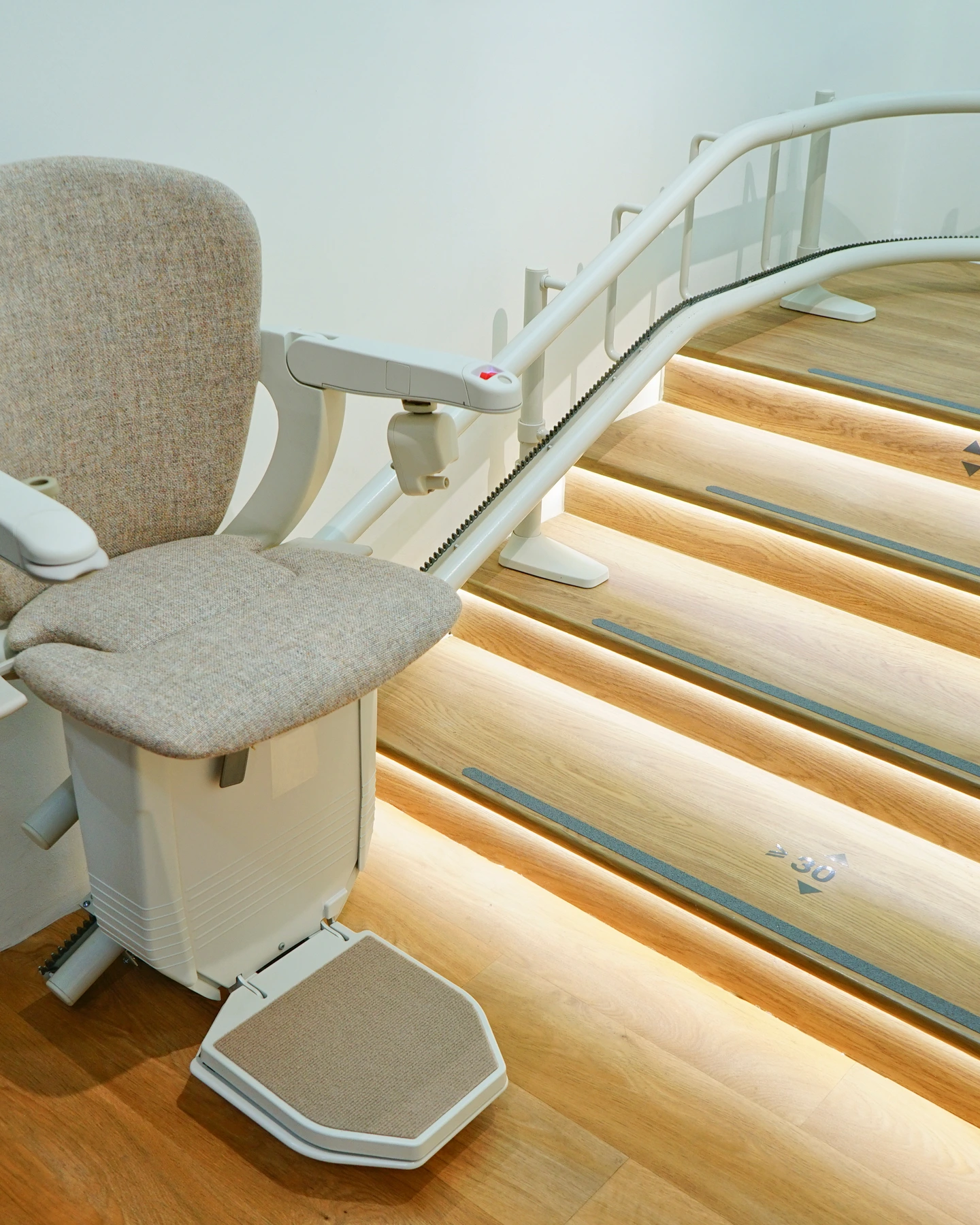
Forty-plus stairlift terms explained in plain English by the people who install them. Each entry includes what the term means, why it matters to your purchase, and the installer's take on whether it should affect your decision.
Mechanical & Drive System
A gear system where a small rotating gear (pinion) meshes with a toothed metal strip (rack) along the rail. Industry standard for residential units. Durable for 15-20 years.
Marketing terminology for standard rack-and-pinion. Do not pay a premium for this -- it is conventional engineering with a branding wrapper.
Direct-current motor powered by onboard batteries. Universal 2026 standard. Enables power-outage operation with 8-20 round-trip capacity. If anyone quotes an AC motor, they are selling obsolete tech.
Electronic acceleration/deceleration preventing jarring motion. Standard on mid-range and premium models. Verify inclusion on budget options -- it matters for rider comfort and safety.
Seat, Controls & Safety
Swivel: seat rotates 90 degrees at the landing for safe dismount. Manual levers work fine. Power swivel adds $200-$400 -- worth it for severe arthritis, otherwise optional.
Pressure-sensitive strip on carriage bottom and footrest that stops the lift on contact. The most critical active safety feature. Technicians test with a coin during installation.
Wall-mounted or wireless buttons at top and bottom of staircase. Essential for multi-user households -- prevents the chair from being stranded at the wrong end.
Physical keyed switch preventing unauthorized use. Relevant for commercial settings and homes with unsupervised children or dementia patients. Not needed in most residential situations.
Electrical & Battery
Standard battery chemistry for residential stairlifts. Maintenance-free, leak-proof. Consumable component -- replace every 3-5 years at $75-$150. Phillips screwdriver replacement simplicity.
Low-amperage charging that slowly tops off batteries without overcharging. Extends lifespan vs rapid charging. Draws ~15-30 watts standby -- negligible on the electric bill.
A rail section at the bottom that folds up against the wall. Adds $300-$600 but eliminates tripping hazards when the staircase opens into a hallway or doorway. Recommended in those situations.
Funding, Insurance & Regulatory Acronyms
VA grant covering up to $6,800 for service-connected disabilities. One-time, non-repayable. Requires VA provider prescription. Covers full stairlift installation in most cases.
Medicaid program funding home modifications in 47 states. Typical caps: $7,500-$10,000. Income-qualified, requires nursing-home level-of-care assessment. 30-90 day application. The largest untapped funding source.
IRS and CMS classification for medical equipment intended for repeated use. Stairlifts qualify -- full purchase cost deductible on Schedule A. Does not increase home value per IRS, so no value-offset calculation needed.
The safety standard governing platform lifts and stairway chairlifts. Specifies drive systems, safety devices, load ratings, installation practices. Adopted by most state building codes. Non-UL-listed imports skip this verification.
622 agencies across the US coordinating services for adults 60+. Your first call for funding information. Find yours via 211 or the Eldercare Locator at 1-800-677-1116.
IRS publication defining qualifying medical expenses for Schedule A deduction. Stairlifts explicitly listed as qualifying capital expenses. No value-offset calculation (unlike home elevators).
Frequently Asked Questions
Rack-and-pinion. All major manufacturers standardized on it. 15-20 year durability vs 8-12 for belt. Belt drives are legacy technology.
If stairs open into a hallway or high-traffic area, yes. Adds $300-$600 but eliminates tripping hazards. The rail folds up against the wall when the lift is parked at the top.
Independent Underwriters Laboratories testing confirming ASME A18.1 compliance. Non-UL imports skip safety verification. Insurance companies and VA/Medicaid programs mandate UL listing.
Ready to Get Started?
Free in-home assessment within 24 hours. No pressure, no obligation.