Aging in Place: 7 Signs Your Parents’ Stairs Are a Problem | All American Stairlifts
The 7 Warning Signs Your Parents’ Stairs Have Become Unsafe These signs tend to appear in order. Most families call us at stage 4 or 5 — after a fall or a diagnosis. The families who call at stage 1 or 2 are the ones who avoid the emergency entirely. 1 in 4 Americans over […]
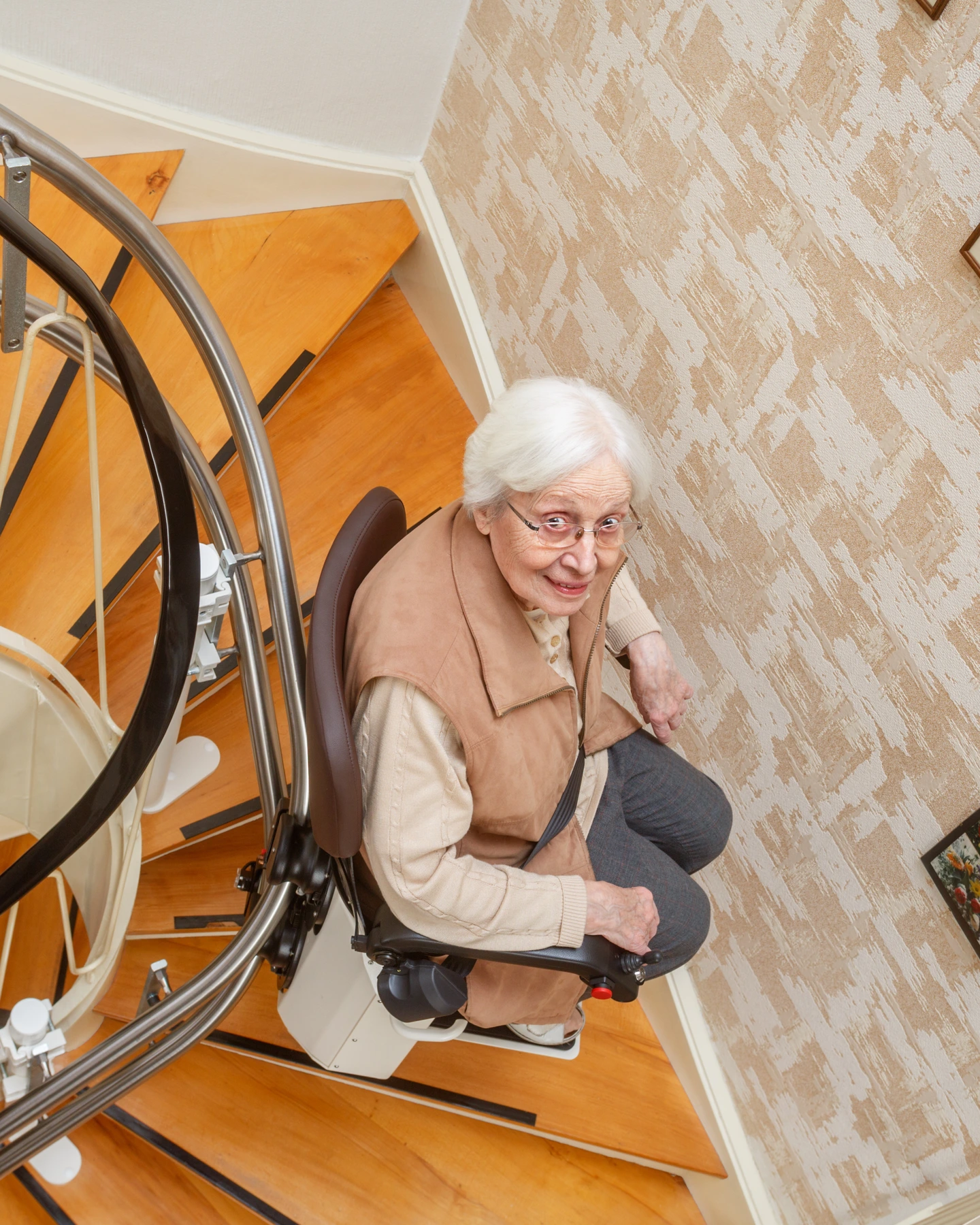
The 7 Warning Signs Your Parents’ Stairs Have Become Unsafe
These signs tend to appear in order. Most families call us at stage 4 or 5 — after a fall or a diagnosis. The families who call at stage 1 or 2 are the ones who avoid the emergency entirely.
A healthy adult uses one hand on the railing for balance, or no hands at all. When your parent starts using both hands — pulling their body weight up rather than stepping up — it means the leg muscles, knees, or hips are no longer doing the job alone. This is not dramatic. It does not look like a crisis. It looks like a person being careful. But it is the first measurable sign that the staircase has crossed from routine to effortful.
Watch how they come down. Descending stairs puts roughly 3.5 times body weight per step on a standard 7-inch rise. If your parent descends sideways, one step at a time, or leans heavily into the railing, the knees are already past the safe-load threshold for that staircase.
This one is easy to miss because they will never say it out loud. But if your mother stops going upstairs after dinner — sleeps in the recliner, keeps a blanket on the couch, uses the downstairs bathroom exclusively after 6 p.m. — she has already made a risk calculation. She does not trust the stairs in low light.
If you visit and notice a pillow and blanket on the living room couch, that is not a napping habit. That is a workaround.
When your parent converts the dining room into a bedroom, or starts sleeping in a first-floor den permanently, they have already given up a floor of the house. Many families tell themselves the problem is solved — the stairs are no longer in daily use, so the risk is managed. It is not managed. The laundry is still upstairs. The main bathroom with the tub is still upstairs. The winter clothes are in the upstairs closet. Your parent is now living in half a house, and the isolation from the second floor compounds over months.
Falls are the leading cause of injury death in adults over 65 — ahead of car accidents, ahead of drowning. A fall on a staircase is categorically more dangerous than a fall on a flat surface because the body travels further and impacts at a steeper angle. A hip fracture from a stair fall changes the trajectory of the next five years: 20% of hip fracture patients over 65 die within 12 months, and 50% of those who survive never return to their pre-fall level of independence.
The “caught themselves” version matters just as much. If your parent grabbed the railing and stopped a fall — or stumbled but did not go down — that near-miss is a leading indicator, not a false alarm. The next time, the grip may not hold.
Stroke. Parkinson’s disease. Hip replacement. Knee replacement. COPD or CHF that makes exertion dangerous. Multiple sclerosis. A new cancer treatment that causes peripheral neuropathy in the feet. Any diagnosis that changes balance, strength, sensation, or cardiovascular tolerance for exertion makes the staircase a different object than it was six months ago.
Orthopedic surgeons and physical therapists will often tell a patient after hip or knee replacement that they should avoid stairs for 6-12 weeks. What they do not always say is that the post-surgical period is the window where a stairlift should already be installed — not decided on, not researched, but installed and ready for the day the patient comes home from rehab.
This is the emotional stage, and it is where most adult children live for months before taking action. Your parent insists they are fine. They interpret the conversation as a threat to their independence — and they are not entirely wrong. But you are the one lying awake running scenarios. You are the one who checks your phone for missed calls.
The research is clear: caregiver stress in adult children peaks not during a crisis but during the ambiguity that precedes it. The period between “something is wrong” and “we did something about it” is the most psychologically damaging stretch for the family, not the patient.
This is the decision point. Everything else in the house works. They can manage the kitchen, the bathroom, the front door. They like their neighborhood, their doctor is nearby, their church is a five-minute drive. The only structural barrier between staying home and having to move is the staircase. If the stairs were flat, they would stay for another decade.
When the staircase is the single variable, the math is straightforward — and it overwhelmingly favors solving the staircase.
The Conversation No Family Wants to Have
There is no version of this conversation that feels good. Your parent is an adult. They have run their own life for 40 years longer than you have run yours. Telling them that their staircase is no longer safe sounds, to them, like the opening line of a conversation that ends with a nursing home brochure.
It is not. But they do not know that yet, and the framing of the first 60 seconds determines whether they hear “I want to help you stay” or “I think you should leave.”
What Works
“The staircase in this house is steep — steeper than most” lands differently than “You are having trouble with the stairs.” One is about the building. The other is about their body.
“I want you to be in this house for the next twenty years” opens a different conversation than “I am worried about you falling.” The first sentence is about staying. The second is about danger.
“I looked into a stairlift — it bolts onto the existing stairs, installs in one afternoon, and Medicaid may cover it” is actionable. “We should do something about the stairs” is not.
“Would you be open to having someone come out and measure — just to see what it would look like? No cost, no commitment.” This gives them control. A free assessment is not a sale. It is information.
What Does Not Work
- Bringing it up after a holiday meal with the whole family present. This feels like an intervention.
- Using the word “unsafe” more than once. The first time it is information. The second time it is a verdict.
- Comparing them to someone else’s parent.
- Waiting for the “right time.” There will not be a right time. The right time was the first time you noticed.
If They Say No
They might. Respect it, but do not drop it. Come back in 30 days. Bring a different angle: the cost comparison (stairlift vs. a move), the Medicaid coverage, the fact that the grandchildren cannot visit the upstairs playroom anymore. Resistance is usually not about the stairlift. It is about what the stairlift represents — an admission that something has changed. Give them time to sit with that, but do not pretend you did not see what you saw.
The 4 Paths Forward
When the stairs become a problem, families face four realistic options. Each has a place. None is universally correct.
| Option | Cost | Timeline | Best For |
|---|---|---|---|
| Stairlift | $3,500-$5,500 (straight) $9,500-$16,000 (curved) |
Same day (straight) 4-6 weeks (curved) |
Can sit, stand, transfer independently; staircase is the only barrier |
| Ramp / Platform Lift | $1,500-$15,000 | 1-4 weeks | Wheelchair users; 3-6 exterior entry steps; split-level entries |
| Remodel (1st Floor Suite) | $25,000-$75,000 | 2-4 months | Large first-floor footprint available; also want resale value |
| Move | $20,000-$60,000+ transaction $51,600-$135,600/yr facility |
3-6 months minimum | Multiple accessibility barriers beyond stairs; care needs exceed home mods |
What “Aging in Place” Actually Costs
This is the math that changes the conversation at the kitchen table.
A straight-rail stairlift costs $3,500-$5,500 installed. Call it $4,500 as the midpoint. That is a one-time cost with no monthly fee. Maintenance is a $150-$200 annual service visit. The stairlift lasts 10-15 years with normal use.
Over five years — a reasonable planning horizon for an 80-year-old — the stairlift costs $4,500 plus roughly $1,000 in maintenance, for a five-year total of $5,500. Assisted living over the same period: $258,000. Nursing home: $678,000.
Full Aging-in-Place Modification Package
- Stairlift (straight rail): $4,500
- Grab bars in two bathrooms: $800
- Walk-in shower conversion (one bathroom): $5,000-$8,000
- Better lighting on stairs and hallways: $500
- Lever door handles throughout: $400
Total: $11,200-$14,200. Still less than two months of assisted living. Still less than six weeks of a nursing home.
What Medicaid Covers
If the resident qualifies for Medicaid, 47 states cover the stairlift through HCBS waivers with no cost to the family. If the resident is a veteran enrolled in VA healthcare, the HISA grant covers up to $6,800. If neither applies, the IRS allows the stairlift as a medical expense deduction under Section 213(d). The effective out-of-pocket for a qualifying family is often zero.
The Free Assessment: What Actually Happens
The free in-home assessment is the step families put off the longest, and the step they are most relieved to have done.
When a Stairlift is NOT the Answer
A stairlift solves one specific problem: a person who can sit, stand, and transfer independently but cannot safely climb or descend a staircase. It does not solve every mobility problem, and we turn down installs when the stairlift is not the right tool.
A stairlift requires the rider to stand from the wheelchair, pivot, sit on the stairlift seat, ride up, stand again, pivot, and sit back in a wheelchair. If the person cannot perform that transfer sequence, the alternative is a vertical platform lift or a first-floor remodel.
The rider has to buckle in, hold the joystick, and release it at the top. A person with moderate-to-advanced dementia may not remember the sequence, may unbuckle mid-ride, or may attempt to stand while the lift is moving. We do not install unless a full-time caregiver will operate the lift for every ride.
If the treads are rotted, the stringers are split, or the subfloor beneath the stairs flexes underfoot, the staircase needs structural repair first. Uncommon in well-maintained homes but comes up in older properties with deferred maintenance.
Most stairlifts require a minimum clear width of 28 inches after the rail is mounted. We carry a narrow-stair mount kit that works down to 26 inches, but below that the staircase does not have room.
If your parent is falling on flat ground, losing balance while standing still, or unable to walk more than 20 feet without resting, the mobility issue is larger than the stairs. Start with a geriatrician or physical therapist for a full mobility assessment before making a home modification decision.
Frequently Asked Questions
The average age of our stairlift riders is 76, but the distribution is wide. The youngest install this year was for a 34-year-old with multiple sclerosis. The oldest was 98. The most common trigger is not a specific birthday — it is a specific event: a fall, a hip replacement, a stroke, or an adult child visiting and noticing something they had not noticed six months ago.
No. A stairlift bolts into the stair treads — the same treads that carpet tack strips are nailed into. When removed (we do this for free), the bolt holes are filled and refinished. No structural modification, no wall cutting. The NAR’s 2025 Aging-in-Place report found that home accessibility modifications are either neutral or mildly positive for resale.
10-15 years with normal residential use and an annual service visit. The motor is rated for 10,000+ trips. The battery pack wears first — expect to replace it once at the 5-7 year mark ($200-$400 service call). The rail itself is steel and effectively permanent.
Yes. The rail mounts to one side, and the seat, armrests, and footrest all fold up flat against the wall. A folded stairlift takes up about 12 inches of staircase width. On a standard 36-inch staircase, that leaves 24 inches of clear walkway.
Every modern stairlift runs on a battery that recharges continuously from a standard wall outlet. When the power goes out, the battery runs the lift for 10-15 additional trips. You will not be stranded mid-staircase.
Medicare does not cover stairlifts. Private health insurance generally does not either. However, 47 states cover stairlifts through Medicaid HCBS waivers for qualifying residents — the waiver pays the installer directly and the family writes no check. The VA HISA grant covers up to $6,800 for veterans with service-connected disabilities. Some Medicare Advantage plans include home safety modifications as a supplemental benefit. And the IRS allows stairlifts as a medical expense deduction under Section 213(d). The effective out-of-pocket for many families is zero or close to it.
Lead with the goal, not the problem. Say “I want you in this house for the next twenty years” rather than “I am worried about the stairs.” Frame the stairlift as a house improvement, not a personal concession. Bring a specific option and a specific next step: “Would you be open to having someone come measure — just to see? No cost, no commitment.” And do not bring it up in front of the whole family. One-on-one, over coffee, with no audience.
It feels solved, but it is not. The laundry is still upstairs. The main bathroom with the tub is still upstairs. The winter clothes are in the upstairs closet. Your parent is now living in half a house. Over months, the unused second floor becomes a storage attic they cannot access. A stairlift gives the whole house back.
Modern stairlifts operate at 55-60 decibels — roughly the volume of a normal conversation. You will hear a quiet hum for the 30-60 seconds it takes to travel the full flight. It will not wake anyone sleeping upstairs while someone rides down.
Ready to Get Started?
Free in-home assessment within 24 hours. No pressure, no obligation.