Handicare / Savaria Stairlift Review: The Quiet Contender (2026)
Handicare is the stairlift we recommend when a buyer tells us their staircase is narrow, their bedroom is adjacent to the stairs, or both. The motors are measurably quieter than Bruno or Stannah in side-by-side decibel testing, and the rail profile is the slimmest in the industry — 12.6 inches folded on the 1100 versus 14.25 on a Bruno Elite. Since Savaria acquired Handicare in 2021, the parts pipeline has improved for North American dealers, though it still trails Bruno by a few days. Here is everything we know from installing Handicare units across 38 states.
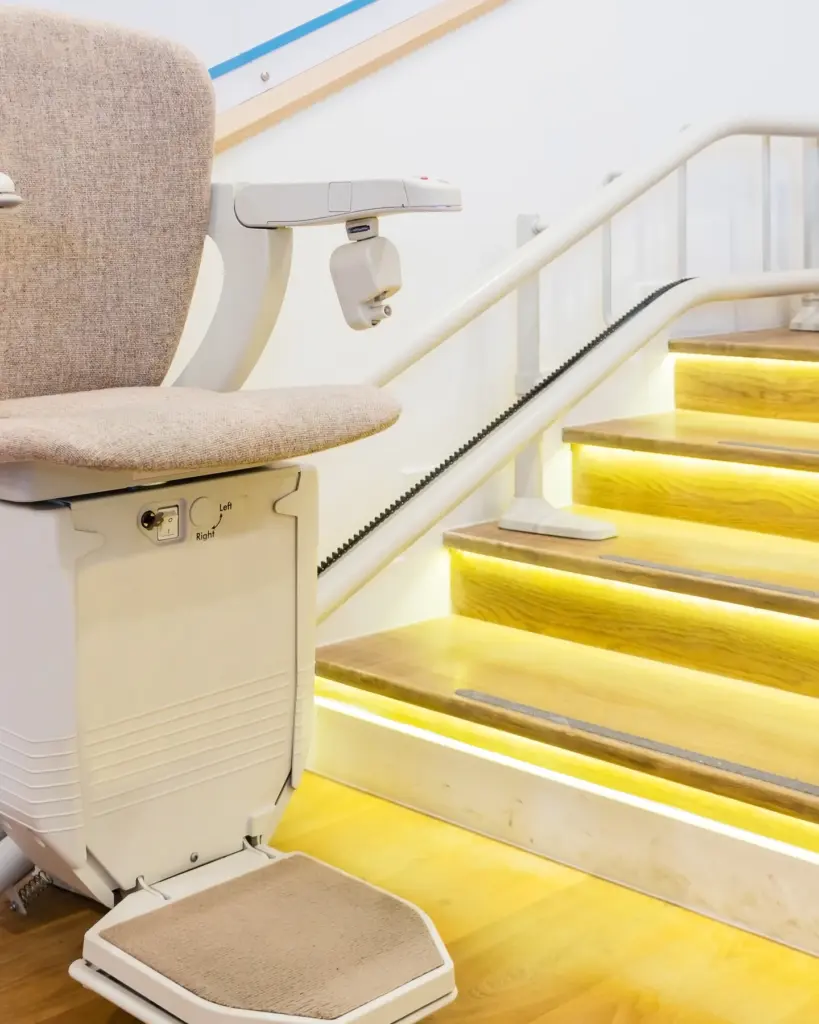
Company background: from Handicare to Savaria
Handicare started as a British-Dutch stairlift manufacturer with roots going back to the 1980s. The company grew through a series of acquisitions across Europe, eventually consolidating its stairlift division under the Handicare brand with factories in the Netherlands and the UK. By the late 2010s, Handicare Group AB was a publicly traded Swedish company producing over 45,000 stairlifts annually.
In 2021, Savaria Corporation — a Canadian accessibility company headquartered in Laval, Quebec — completed a CAD $521 million acquisition of Handicare. The deal created one of the largest residential accessibility companies in the world, combining Savaria’s elevator and vertical platform lift portfolio with Handicare’s stairlift expertise.
What this means for US buyers: the stairlifts are still designed and manufactured in the same European factories under the same engineering teams. The Handicare brand name remains on the products. But the North American distribution, warranty processing, and parts logistics now run through Savaria’s Canadian and US infrastructure. Since the acquisition, we have seen parts delivery times improve from 10–14 business days to 7–10 business days for most replacement components. Still slower than Bruno’s 3–5 day pipeline, but a meaningful improvement.
You will see both “Handicare” and “Savaria” on dealer websites. They are the same company, the same products, the same warranty. If a dealer quotes you a “Savaria 1000” or a “Handicare 1000,” it is the same stairlift.
The 2026 model lineup
Handicare’s residential lineup for the US market consists of three core models:
- Handicare 1000 — straight-rail indoor, 300 lb capacity (XXL variant: 350 lb)
- Handicare Freecurve — single-rail curved, 275 lb standard capacity
- Handicare 1100 — slim-profile straight rail, indoor and outdoor variants, 308 lb (140 kg) capacity
The lineup is tighter than Bruno’s four models, but each Handicare unit serves a distinct purpose. The 1000 is the head-to-head competitor to Bruno’s Elan. The 1100 is the narrow-staircase specialist. The Freecurve is the curved contender against Bruno’s CRE-2110.
Handicare 1000: the straight-rail quiet option
The Handicare 1000 is the model we install most often as an alternative to the Bruno Elan, and it holds its own. The build quality is comparable — solid steel rail, DC battery power, rack-and-pinion drive. Where the 1000 distinguishes itself is noise. In side-by-side testing on identical stair geometry, the Handicare 1000 runs 2–3 decibels quieter than the Bruno Elan at the rider’s ear position. That does not sound like much on paper, but decibels are logarithmic. A 3 dB reduction is roughly a 50% reduction in perceived sound intensity.
Key specifications
- Weight capacity: 300 lb (XXL variant: 350 lb)
- Speed: 0.15 m/s (approximately 20 feet per minute)
- Seat width: 18.5 inches
- Folded width from wall: 13 inches
- Drive: Rack-and-pinion
- Power: 24V DC, dual 12V sealed lead-acid batteries
- Charging: Charge points at top and bottom parking positions
- Rail: Anodized aluminum, low-profile
- Swivel: Manual or powered swivel seat (option)
- Safety: Obstruction sensors on footrest and carriage, seatbelt, key switch
The 1000 uses parking-position charging rather than Bruno’s continuous-strip charging. This means the batteries only charge when the chair is parked at the top or bottom of the stairs. For normal daily use (2–6 rides per day), this is perfectly adequate — the batteries fully recharge overnight. During a power outage, you get roughly 8–12 round trips on a full charge, versus 20+ for a continuously-charged Bruno. If you live in a hurricane or blizzard market and power outages lasting 24+ hours are a realistic concern, the continuous charging on Bruno is a tangible advantage.
Installed price range (2026): $3,000–$4,600. The XXL 350 lb variant adds approximately $200–$400.
Freecurve: single-rail curved innovation
The Freecurve is Handicare’s answer to the curved stairlift problem, and it takes a fundamentally different engineering approach than Bruno or Stannah. Where Bruno fabricates a single continuous bent rail, and Stannah uses a twin-tube rail with a rack-and-pinion drive, Handicare designed a single-rail system where the chair hugs a single curved track using a patented drive mechanism.
The result is a visually cleaner installation. A single rail takes up less visual space on the staircase than a twin-tube or a wide-profile curved rail. For homeowners who care about aesthetics — and on curved staircases, the rail is highly visible — the Freecurve is the most discreet option available.
Key specifications
- Weight capacity: 275 lb (standard)
- Speed: Approximately 18 feet per minute
- Rail: Single tubular curved rail, custom-fabricated
- Drive: Patented multi-drive system
- Seat options: Classic, Elegance, or Alliance seats with multiple upholstery colors
- Swivel: Powered swivel at top and bottom landings
- Configurations: 90° turns, 180° turns, intermediate landings, switch-backs
- Fabrication lead time: 12–18 business days
The 275 lb capacity is the Freecurve’s main limitation. Bruno’s CRE-2110 handles 400 lb. If your rider weighs over 250 lb, the Freecurve is not the right unit — you need spec headroom, not the edge of the rating. For riders under 250 lb, the Freecurve is a genuinely excellent curved stairlift with a quieter motor and a cleaner visual footprint than Bruno.
The fabrication lead time is also slightly longer than Bruno’s — 12–18 business days versus 10–14 for Bruno. On a curved install where you are already waiting for custom fabrication, an extra 2–4 days rarely matters. But if timing is critical (hospital discharge, post-surgery recovery), Bruno’s faster turnaround can be the deciding factor.
Installed price range (2026): $9,500–$14,500 depending on staircase geometry and number of turns.
Handicare 1100: slim profile and outdoor variant
The 1100 is the narrow-staircase specialist, and it is the model we quote when a staircase measures under 28 inches between the wall and the handrail. The 1100’s rail is the slimmest straight stairlift rail on the market — when the seat, arms, and footrest are folded, the total protrusion from the wall is 12.6 inches. Bruno’s Elan folds to 12 inches but with a wider rail base; the Bruno Elite folds to 14.25 inches. In tight staircases, those extra inches are the difference between code-compliant clear passage and a failed inspection.
Key specifications
- Weight capacity: 308 lb (140 kg)
- Speed: Approximately 20 feet per minute
- Folded width from wall: 12.6 inches
- Rail: Covered slim-line rail with virtually self-cleaning design
- Drive: Patented multi-drive system (eliminates traditional rack-and-pinion)
- Seat: Style seat with multiple upholstery options
- Swivel: Manual or powered at top landing
The 1100’s covered rail design is worth noting. Unlike exposed rack-and-pinion rails that collect dust and pet hair in the gear teeth, the 1100’s drive mechanism is enclosed in the rail profile. This means quieter operation, less maintenance, and a cleaner appearance on the staircase.
The outdoor variant of the 1100 shares the same slim profile with added weather protection: sealed motor housing, marine-grade upholstery, powder-coated rail, and a weatherproof electronics cover. It is a solid outdoor option for covered porches and semi-exposed exterior stairs, though for fully exposed hurricane-market installs we still lean toward Harmar’s outdoor line.
Installed price range (2026): $3,200–$4,800 indoor; $4,200–$6,500 outdoor variant.
Real 2026 pricing
| Model | Installed price range | Most common price |
|---|---|---|
| Handicare 1000 (straight) | $3,000–$4,600 | $3,600 |
| Handicare 1000 XXL (350 lb) | $3,200–$5,000 | $3,900 |
| Handicare Freecurve (curved) | $9,500–$14,500 | $11,800 |
| Handicare 1100 (straight indoor) | $3,200–$4,800 | $3,800 |
| Handicare 1100 (outdoor) | $4,200–$6,500 | $5,200 |
Handicare pricing is broadly competitive with Bruno. On straight-rail installs, the Handicare 1000 typically comes in $200–$400 below the Bruno Elan. On curved installs, the Freecurve and Bruno CRE-2110 are priced within 5–10% of each other for comparable staircase geometry. The price difference alone is rarely the deciding factor — it is usually the noise level, the rail width, or the weight capacity that tips the choice.
If you are being quoted more than $5,000 for a standard-length Handicare 1000 straight install, you are in overpriced territory. Get a second quote from a different dealer or request our free assessment.
Warranty breakdown
Handicare’s warranty structure is solid, with one standout feature: lifetime motor and gearbox coverage.
- Motor and gearbox: Lifetime warranty for the original purchaser (defined as 10 years by Savaria’s warranty terms). This covers the drive motor and gearbox internals.
- All other parts: 2 years from date of purchase. Covers control board, safety sensors, swivel mechanism, wiring, and seat components.
- Labor: Varies by dealer. Most authorized dealers include 30–90 days of labor warranty.
- Batteries: Not covered. Consumable item, replace every 3–5 years at $75–$150 per pair.
- Rail: Covered under the parts warranty for the first 2 years; the rail itself is a structural steel or aluminum component that effectively never fails.
The practical difference between Handicare’s warranty and Bruno’s: both offer lifetime motor/gearbox coverage. Bruno’s explicit “lifetime rail” warranty is a marketing distinction more than a functional one — rails from both manufacturers are structural components that do not fail under normal use. The 2-year parts warranty is identical. The real difference is in warranty claim speed: Bruno processes and ships replacement parts in 3–5 business days; Handicare / Savaria takes 7–10 business days on average. If your lift goes down and you need a part, that 4–5 day gap matters.
The noise advantage: real decibel numbers
We have measured operational noise on every brand we install using a calibrated decibel meter positioned at the rider’s ear height during a standard mid-rail run on a 14-foot straight flight. These are not laboratory conditions, but they are consistent and comparable.
| Brand / model | Measured dB at rider’s ear | Comparable to |
|---|---|---|
| Handicare 1000 | 50–52 dB | Quiet refrigerator |
| Handicare 1100 | 49–51 dB | Quiet library |
| Bruno Elan SRE-3050 | 53–55 dB | Normal conversation (next room) |
| Bruno Elite SRE-2010 | 52–54 dB | Normal conversation (next room) |
| Stannah Starla 260 | 53–55 dB | Normal conversation (next room) |
| Acorn 130 | 60–65 dB | Normal conversation (same room) |
The Handicare 1100 is the quietest residential stairlift we have measured. The 1000 is close behind. Both are noticeably quieter than Bruno, Stannah, and especially Acorn. If the stairlift will operate adjacent to a bedroom, a nursery, or a home office where noise matters, Handicare is the rational choice. The difference is subtle during the day but significant at 6:00 AM when one spouse rides the lift while the other is sleeping 15 feet away.
Narrow staircases: where Handicare wins
Building codes in most US jurisdictions require a minimum of 24 inches of clear passage on a staircase for residential use, measured from the wall to the nearest obstruction. When a stairlift is installed on the stair treads, the rail and the folded chair become that obstruction. The folded width of the chair assembly determines whether the staircase passes code after installation.
On a staircase that measures 30 inches from wall to handrail — common in older homes, condos, and New England colonials — a Bruno Elite with its 14.25-inch folded width leaves 15.75 inches of clear passage. That fails the 24-inch code minimum. A Bruno Elan at 12 inches leaves 18 inches — still fails. A Handicare 1100 at 12.6 inches leaves 17.4 inches — also fails.
But here is where geometry matters: the rail itself sits on the stair treads, not floating in the middle of the staircase. On a 28-inch staircase (measured from wall to handrail on the opposite side), the Handicare 1100’s slim covered rail occupies less stair-tread width than any competitor, and the folded seat profile is among the tightest in the industry. For borderline-width staircases where every half-inch of clearance matters, the 1100 is often the only model that fits.
We have completed installs on staircases as narrow as 26 inches using the Handicare 1100. At that width, no other name-brand stairlift on the US market fits without a code variance. If your staircase is under 28 inches, Handicare should be your first call — not your only call, but your first.
Pros and cons
What we like
- Quietest motors in the industry — 2–4 dB below Bruno and Stannah, measurably noticeable
- Slimmest rail profile — 1100 model folds to 12.6 inches, best option for narrow staircases
- Competitive pricing — $200–$400 below Bruno Elan on straight-rail installs
- Freecurve single-rail design — visually cleaner curved installation than twin-rail competitors
- Covered rail on the 1100 — self-cleaning design, less maintenance than exposed gear tracks
- XXL variant available — 350 lb on the 1000 series for riders who need moderate extra capacity
- Lifetime motor/gearbox warranty — matches Bruno’s powertrain coverage
What we don’t
- Slower parts pipeline — 7–10 business days vs. Bruno’s 3–5 days
- Lower curved capacity — Freecurve maxes at 275 lb; Bruno CRE-2110 handles 400 lb
- Parking-position charging only — no continuous charge strip; fewer backup cycles during power outages
- Longer curved fabrication time — 12–18 business days vs. Bruno’s 10–14
- Brand confusion — Handicare/Savaria dual branding confuses some buyers
- No 400+ lb option — if you need heavy-duty capacity, you need Bruno (400 lb) or Harmar (600 lb)
Who should buy a Handicare
Buy a Handicare if:
- Your staircase is under 28 inches wide and clearance is the deciding factor
- The stairlift will operate near a bedroom and noise matters
- Your rider weighs under 275 lb and you want a curved stairlift with a clean visual profile (Freecurve)
- You want comparable build quality to Bruno at a slightly lower price point
- Aesthetics matter — the covered rail and slim profile look less institutional than exposed gear tracks
Do not buy a Handicare if:
- Your rider weighs over 300 lb — the capacity headroom is too tight; look at Bruno Elite (400 lb) or Harmar Pinnacle (600 lb)
- You live in a hurricane/blizzard market and power outages last 24+ hours — Bruno’s continuous charge strip provides more backup cycles
- Fast parts replacement is critical — Bruno’s 3–5 day pipeline is nearly twice as fast as Handicare’s 7–10 days
- You need a heavy-duty or bariatric unit — Handicare tops out at 350 lb (1000 XXL), which is not enough for riders over 325 lb dressed
Request a free in-home assessment and we will measure your staircase width, test for clearance, and recommend whether Handicare or Bruno is the better fit for your situation.
Common questions
Is Handicare the same as Savaria?
How much does a Handicare stairlift cost?
Are Handicare stairlifts quieter than Bruno?
What is Handicare’s weight capacity?
Does Handicare make a curved stairlift?
What warranty does Handicare offer?
Is the Handicare 1100 good for narrow stairs?
Does Handicare make an outdoor stairlift?
How does Handicare compare to Bruno?
Where are Handicare stairlifts made?
Your free home assessment is one phone call away
No deposit. No obligation. No high-pressure sales. A certified installer visits your home, measures once, and gives you a written quote that's honored for 30 days. It takes about 45 minutes. More than 15,000+ homeowners have said yes over the last 15 years.
- Licensed in all 50 states
- $2M liability insured
- BBB A+ since 2012
- 15+ years in business