Used, Refurbished, or New? The Honest Math Behind Each Option
A new straight stairlift runs about $3,350 installed. A refurbished one runs $1,800 to $2,800. A rental runs $130 a month. And a used unit from Facebook Marketplace runs $400 to $900 — plus the $2,000 to $4,000 you will spend trying to get it installed and working. Each of these numbers is real. Each is the right answer for a specific situation. This guide runs the actual math, names the situations where each option wins, and flags the one scenario where almost everybody loses money.
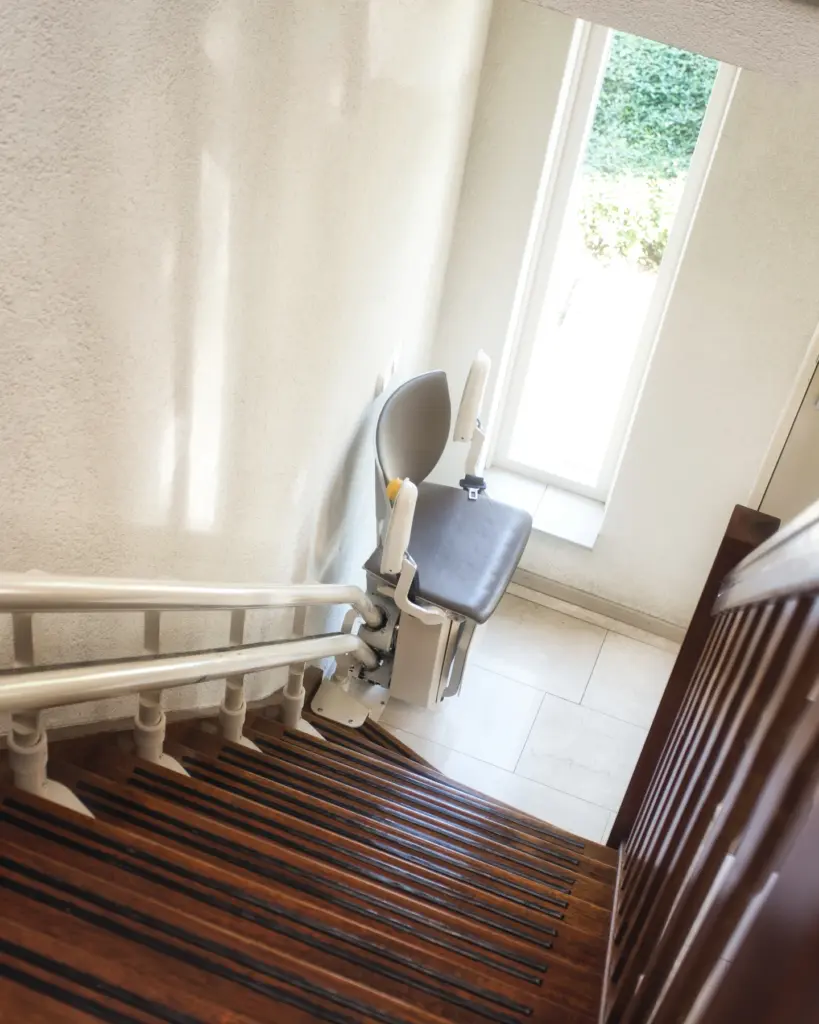
When buying new is the clear answer
If the rider expects to use the stairlift for 5 years or more, buying new is almost always the cheapest option per year of use. A $3,350 Bruno Elan with a 5-year warranty and 15-year expected lifespan costs $223 per year. A $2,200 refurb with a 1-year warranty and 10-year remaining lifespan costs $220 per year — roughly the same, but with less warranty coverage and a shorter runway.
About 70% of residential stairlift purchases are for long-term aging-in-place use. In those cases, buying new is not the cautious option or the expensive option — it is the mathematically sound option. Here is why.
Full manufacturer support for 2 to 5 years
A new Bruno Elan SRE-3000 ships with a 2-year comprehensive warranty covering parts, labor, and service calls. The Bruno Elite SRE-2010 ships with 5 years. Handicare covers 2 years on the 1000 series, 3 years on the 2000 curved. Stannah covers 2 years standard with a paid extension to 5. These are not cosmetic guarantees — they cover the motor, the gearbox, the logic board, the battery, the rail, and the labor to fix any of them.
Compare that to a refurbished unit's typical 12-month warranty, or a rental unit's zero warranty beyond the rental agreement, or a Craigslist unit's handshake promise that 'it worked fine when we took it out.'
Current safety standards
The ASME A18.1-2020 standard added requirements for obstruction sensors, overspeed governors, and battery backup behavior. A new unit meets the current code. A 2016 refurb may not — and that becomes your problem when you sell the house and the buyer's inspector checks.
Higher resale value
New stairlifts retain 25% to 40% of purchase price in dealer buybacks. A Bruno Elan bought new at $3,350 can fetch $850 to $1,300 after 5 to 7 years. A refurbished unit bought at $2,200 fetches $300 to $600 — steeper discount because the motor has more hours and the warranty history is shorter.
When new is specifically the wrong answer
Buying new does not make sense when the expected use window is under 3 years, when the budget makes the choice between a stairlift and no stairlift (not between new and refurb), or when the staircase is in a home the family plans to sell within 18 months. In those cases, refurbished or rental is the better call — and we will walk through the math on both below.
When refurbished makes financial sense
A professionally refurbished straight stairlift runs $1,800 to $2,800 installed — roughly 50% to 70% of new price. A refurbished curved unit runs $6,500 to $9,500, though availability is limited because curved rails are custom-cut to specific staircases.
Refurbished stairlifts are real products sold by real dealers with real warranties. They are not junk. A properly refurbished Bruno Elan with 2,000 motor hours on a 15,000-hour-rated motor has 87% of its mechanical life remaining. That is a lot of stairlift for 55% of new price.
The situations where refurbished is the financially correct answer:
2- to 4-year expected use
A parent recovering from a stroke who expects to regain full stair mobility in 2 to 3 years. A family member in a terminal care situation where the realistic window is 1 to 4 years. A homeowner who plans to sell the house in 2 to 3 years and wants the stairlift as a selling feature for senior buyers, not a permanent fixture.
In all three cases, the shorter warranty on a refurb (12 months vs 2 to 5 years) matters less because the expected use barely exceeds it. And the $1,000 to $1,500 saved on purchase goes directly to care costs that are probably more urgent.
Tight budget where the alternative is no stairlift
If the household budget is $2,500 and the choice is between a refurbished Bruno Elan at $2,200 installed or continuing to risk falls on the stairs, the refurb is not a compromise — it is the right clinical decision. Falls are the leading cause of injury death among adults over 65 in the United States (CDC, 2024). A working stairlift, even with a shorter warranty, eliminates that staircase as a fall vector. We would rather install a refurbished unit today than schedule a new unit that takes three more months to fund.
Rental property or multi-tenant use
If you manage a rental property that houses senior tenants, a refurbished unit at $1,800 to $2,200 makes more sense than a $3,350 new unit because tenant turnover means the lift may be removed and reinstalled at a different property within a few years. The lower capital cost improves the ROI on the modification, and the 12-month warranty covers the first lease cycle.
What refurbished does NOT save you
Installation labor is the same — 3 hours for a straight rail. Delivery is the same. The service protocol is the same. You are saving on equipment cost only, not on the installation itself. Some buyers expect refurbished to be half the price across the board; in practice, the savings are concentrated in the hardware, and the total installed price is 50% to 70% of new, not 50%.
Where refurbished stairlifts actually come from
Most buyers have never thought about how a used medical device gets from one home to another. There are four supply channels, ranked by quality.
1. Licensed installer buybacks (best source)
When a homeowner no longer needs a stairlift — the rider has passed, the family is selling the house, or the rider has moved to a care facility — the original installer removes the equipment, buys it back at 15% to 30% of the original price, and refurbishes it in-house. A proper dealer refurbishment includes: motor hour count pulled from the logic board, gear mesh and clutch inspection, both 12V batteries replaced (no exceptions — batteries are cheap and unpredictable), rail checked for corrosion and tooth wear, seat cleaned or re-upholstered, electronics tested, safety sensors calibrated, and rail cut to the new customer's stair length.
2. Estate sales
Stairlifts in estate-sale homes range from nearly new to heavily used. Reputable dealers only purchase estate units under 8 years old from known brands (Bruno, Handicare, Stannah, Acorn, Harmar) because off-brand parts are unreliable.
3. Rental returns
A unit rented for 6 months, returned, and professionally inspected is functionally identical to a buyback unit — sometimes with fewer motor hours. Expect more cosmetic wear than a buyback.
4. Medical equipment recyclers
A small number of units come through insurance claims or nonprofit redistribution programs. Quality varies widely, documentation is often incomplete. We buy from this channel selectively and only after a full bench inspection.
What to verify before buying a refurbished stairlift
The 5-point refurb checklist
Any reputable refurb dealer will answer these five questions in writing before you sign. If they can't or won't, find a different dealer.
- Motor hour count. Every modern stairlift (post-2008) stores cumulative hours on the logic board. New motors are rated for 10,000 to 15,000 hours; residential use logs 300 to 500 hours per year. A refurb with 2,000 hours has 87% of its life remaining. A refurb with 7,000 hours is past halfway and should be priced accordingly.
- Battery manufacture date. Date code is stamped on the case. Batteries degrade whether used or not. Any battery over 18 months old should be replaced before installation. If the dealer is selling a refurb with the original 4-year-old batteries, they are cutting corners on the cheapest component — which tells you about the rest of the refurbishment.
- Rail condition. Check for corrosion, rack tooth wear, and visible bends. On curved rails, inspect the welded junctions — highest-stress points and first to fail if improperly stored.
- Warranty terms in writing. Industry standard is 12 months parts and labor. Under 6 months is a red flag. Get coverage, duration, exclusions, and transferability in a signed document.
- Brand and model identification. If the dealer cannot tell you the brand and model, it is a mystery box. Brand determines parts availability for the next decade. Bruno and Handicare parts are stocked nationally. Off-brand parts are a 4- to 8-week international order.
One more: code compliance. Ask whether the unit meets the current ASME A18.1 standard. Pre-2015 models may lack required obstruction sensors, overspeed governors, or battery backup behavior. A reputable refurbisher upgrades these during refurbishment.
When rental makes sense (and the break-even math)
Stairlift rental exists for a specific reason: temporary mobility needs measured in months, not years. It is a legitimate product when used correctly. It is an expensive mistake when used as a long-term solution because someone did not want to commit to a purchase.
What rental actually costs in 2026
Rental pricing has three components, and most quotes only mention the first one:
- Monthly rate: $80 to $180 for a straight unit, $250 to $400 for a curved unit (when available — curved rentals are rare)
- One-time delivery, installation, and removal: $300 to $800, paid upfront, non-refundable
- Refundable security deposit: $500 to $1,000, returned after the unit is removed in acceptable condition
Some contracts include usage limits (20 to 40 trips per day) and damage clauses that void your deposit. Read the fine print on 'normal wear' vs 'damage.'
The break-even math, worked out
Here is the math that rental dealers hope you do not run yourself.
| Month | Rental cumulative cost | Purchase (new Elan) | Purchase (refurb Elan) |
|---|---|---|---|
| Month 1 | $930 ($130 rent + $500 install + $300 deposit*) | $3,350 | $2,200 |
| Month 6 | $1,580 | $3,350 | $2,200 |
| Month 12 | $2,360 | $3,350 | $2,200 |
| Month 17 | $2,710 (crosses refurb) | $3,350 | $2,200 |
| Month 18 | $2,840 | $3,350 | $2,200 |
| Month 23 | $3,490 (crosses new) | $3,350 | $2,200 |
| Month 24 | $3,620 | $3,350 | $2,200 |
| Month 36 | $5,180 | $3,350 | $2,200 |
*Deposit is refundable but ties up your cash. Cumulative cost shown excludes deposit refund. At midpoint rate of $130/month.
The crossover points are clear: rental exceeds the cost of a refurbished purchase at month 17 and exceeds the cost of a new purchase at month 23. After month 24, every dollar you spend on rent is money you will never recover — you are paying more than purchase price and you own nothing at the end.
When rental is genuinely the right call
- Post-surgery recovery (3 to 6 months): hip replacement, knee replacement, spinal fusion, ankle reconstruction. The surgeon expects full stair mobility to return. Total rental cost at 6 months: roughly $1,580. Significantly less than a $2,200 refurb purchase.
- Cardiac or pulmonary rehab (4 to 8 months): the cardiologist or pulmonologist expects improvement in exercise tolerance. Rental for 8 months costs about $1,840 — still under the refurb purchase price.
- Short-term stay in a relative's home: a parent staying with adult children for 4 to 6 months while their own home is being modified. The children's staircase gets a rental, the parent's home gets a permanent install.
- Hospice care with a known timeline: when the family and the care team agree the timeline is 3 to 9 months. Rental keeps the capital available for care costs that are almost certainly more pressing.
When rental is a bad deal masquerading as flexibility
If the answer to 'how long will you need it?' is 'we're not sure' or 'probably a while' or 'indefinitely,' rental is the wrong product. Uncertainty about timeline is not the same as a short timeline. An uncertain timeline that turns into 24 months costs you $3,620 in rent and zero equity. The same $3,350 spent on a new Bruno Elan gives you a 15-year asset with resale value. When in doubt, buy.
When buying used from Craigslist or Facebook Marketplace makes sense
The honest answer
Almost never. A stairlift is not a piece of furniture. It is a motorized medical device bolted into the structure of your home, carrying a person up and down stairs multiple times a day. The installation is the product as much as the hardware is.
Used stairlifts appear on Craigslist, Facebook Marketplace, and eBay at $200 to $1,200 for equipment alone. On paper, that looks extraordinary compared to $2,200 for a refurbished install. In practice, it almost never works out.
Problem 1: No installer will mount a rail they did not sell
This is the deal-breaker most marketplace buyers discover after the purchase. Licensed installers will not install a unit from a private party — liability, warranty, and code compliance make it uninsurable. You end up with equipment you cannot get professionally installed. A general handyman does not carry stairlift-specific insurance, does not know the ASME A18.1 code, and cannot calibrate the safety sensors on a device that carries a person up and down an incline.
Problem 2: Unknown history
A private seller cannot tell you the motor hour count, battery age, service history, or code compliance status. 'Works great' means it powered on — not that the overspeed governor functions, the obstruction sensors are calibrated, or the battery backup will engage during a power failure.
Problem 3: The rail probably does not fit
Rails can be cut shorter but cannot be extended. A rail from a 14-step staircase does not fit a 12-step staircase. If the rail is too short, it is scrap. Curved rails are custom-fabricated to one specific staircase — a used curved rail from Marketplace will not fit your stairs.
The one exception
Some licensed dealers list certified pre-owned units on Marketplace as a lead-generation channel — priced at $1,500 to $2,500 including professional installation and a 6- to 12-month warranty. If the listing includes a dealer name, license number, and 'installed and warranted,' it may be legitimate. If the listing is from 'Dave in Tampa' with three blurry photos, it is not.
Real 2026 price comparison: new vs refurbished vs rental
Every number in this table is an installed price — equipment, rail, delivery, labor, safety testing, and warranty included. Tax varies by state and is not included. Rental numbers assume the midpoint monthly rate plus a one-time $500 install/removal fee; the deposit is excluded because it is refundable.
| Configuration | New (installed) | Refurbished (installed) | Rental (12 months) | Rental (24 months) |
|---|---|---|---|---|
| Straight indoor, 14 ft | $3,350 | $1,800-$2,800 | $2,060 | $3,620 |
| Curved indoor, single turn | $9,800 | $6,500-$8,500 | $4,380* | $8,260* |
| Curved indoor, double turn | $11,400 | $7,500-$9,500 | Rarely available | Rarely available |
| Outdoor straight | $5,200 | $3,000-$4,200 | $2,560 | $4,620 |
| Heavy-duty 400 lb | $4,700 | $2,800-$3,800 | $2,360 | $4,220 |
*Curved rental at $320/month midpoint. Availability is limited — most rental programs stock straight units only.
What the table reveals
Three patterns emerge when you read the numbers side by side:
- Refurbished straight is the value sweet spot. At $1,800 to $2,800 installed, a refurbished straight rail costs less than 12 months of rental and comes with 12 months of warranty plus potential resale value. For any use window of 12 months or longer, refurbished beats rental.
- Curved refurbished is rare and limited. Because curved rails are custom-fabricated to specific staircases, the odds of a used curved rail fitting your staircase are near zero. Refurbished curved stairlifts do exist, but only when the dealer has a rail that happens to match your geometry — which requires a nearly identical staircase layout. Expect limited selection and longer wait times.
- Rental only wins under 12 months on straight, under 14 months on curved. For any timeline beyond those windows, purchase — new or refurbished — is cheaper. And at 24 months of rental, you have paid more than the new purchase price for a straight unit and own nothing.
Brand-specific refurb pricing
Not all refurbished stairlifts are priced equally. Brand matters because it affects both the refurb purchase price and the future parts availability.
| Brand / Model | New price (straight, installed) | Typical refurb price (installed) | Refurb as % of new | Parts availability |
|---|---|---|---|---|
| Bruno Elan SRE-3000 | $3,250-$3,650 | $1,900-$2,400 | 58-66% | Excellent (US factory) |
| Bruno Elite SRE-2010 | $4,500-$5,100 | $2,600-$3,200 | 58-63% | Excellent (US factory) |
| Handicare 1000 | $3,400-$3,800 | $2,000-$2,600 | 59-68% | Good (NL/UK supply chain) |
| Acorn 130 | $2,500-$2,900 | $1,500-$1,900 | 60-66% | Fair (UK factory, limited US depot) |
| Stannah 260 Siena | $5,000-$5,800 | $2,800-$3,500 | 56-60% | Good (UK factory, strong US network) |
| Harmar Pinnacle SL350 | $3,500-$4,200 | $2,100-$2,700 | 60-64% | Excellent (US factory, FL-based) |
Bruno and Harmar refurbs command the best resale values because their US-based supply chains mean parts are available same-week, nationally. A refurbished Bruno is easy for any licensed dealer to service. A refurbished Acorn is trickier — Acorn's business model historically relied on their own installation network, which limits which dealers can source parts. If you buy a refurbished Acorn, confirm that your local dealer can independently source Acorn parts.
Selling your old stairlift — what it is actually worth
If you already own a stairlift and no longer need it, you have three disposal options with very different financial outcomes.
Option 1: Dealer buyback (recommended)
Most licensed stairlift dealers offer buyback programs. The dealer sends a technician to inspect the unit in your home, quotes a buyback price, and — if you accept — removes the equipment, patches the mounting holes, and hands you a check. Typical turnaround is 1 to 2 weeks from inspection to removal.
| Unit age | Condition | Typical buyback value |
|---|---|---|
| Under 3 years | Good, maintained | $800-$1,300 |
| 3-5 years | Good, maintained | $500-$900 |
| 5-8 years | Functional, some wear | $300-$600 |
| Over 8 years | Any condition | $0-$200 (often free removal only) |
| Curved rail, any age | Any condition | $200-$800 (rail has no resale value — only the seat/motor unit) |
The buyback values above are for name-brand units (Bruno, Handicare, Stannah, Harmar, Acorn). Off-brand or unidentifiable units typically get free removal only — the dealer removes the equipment at no charge to you but does not pay for the unit.
Option 2: Private sale on Marketplace
Listing the equipment yourself at $400 to $1,200 may net more than a dealer buyback, but you handle removal, carry liability if the buyer is injured, and the sale may take months. We do not recommend this route for the same reasons outlined in the marketplace buying section above.
Option 3: Donation
Several nonprofits accept donated stairlifts and redistribute them to low-income seniors. You may claim a tax deduction for fair market value — consult your tax advisor for that determination. Donation typically includes free removal by the receiving organization.
What affects buyback value
Four factors, in order of impact:
- Age. Units under 3 years old get the best buyback offers because the dealer can resell them with a 12-month warranty and still have mechanical life to spare. Units over 8 years are worth more as parts donors than as resale units.
- Brand. Bruno, Handicare, and Stannah have the highest buyback demand because dealers can reliably source parts. Acorn buyback is more selective — some dealers buy Acorn, others do not.
- Service records. A unit with documented annual service visits (you should have receipts) is worth 10% to 20% more than an identical unit without records, because the dealer can verify the maintenance history and warrant the refurb with more confidence.
- Cosmetic condition. Stains, tears, scuffs, and sun fading reduce the buyback offer because the dealer has to re-upholster. A clean, well-maintained seat adds $50 to $150 to the buyback value.
The 4-question decision framework
If you have read this far and you are still not sure which option fits your situation, answer these four questions in order. They will route you to the right product.
- How long will the rider need the stairlift?
- Under 12 months with a defined end date (surgery recovery, rehab, known hospice timeline) → Rental
- 12 to 36 months → Refurbished
- 3+ years or indefinitely → New
- Not sure → treat it as 3+ years and buy new (uncertainty is not a short timeline)
- Is the staircase straight or curved?
- Straight → all four options are available (new, refurb, rental, and technically marketplace, though we advise against it)
- Curved → new or refurbished only, and refurbished curved availability is limited. Curved rental is rare and expensive. Curved marketplace is functionally impossible.
- What is the realistic budget?
- Under $2,000 → refurbished straight or rental. At this budget, a refurbed Acorn 130 at $1,500 to $1,900 installed is the best value product on the market.
- $2,000 to $3,500 → refurbished Bruno/Handicare or new Acorn. This is the range where refurb and entry-level new overlap.
- $3,500+ → new Bruno Elan, Elite, or equivalent. Full warranty, full lifespan, full resale value.
- Does the rider qualify for funding?
- VA HISA grant ($2,000 to $6,800), Medicaid HCBS waiver, state assistive technology program, or Area Agency on Aging grant → these programs often cover enough to make a new unit affordable. Check the funding landscape before settling for refurbished on budget grounds alone. Our funding guide maps every program by state.
And one more rule that does not fit neatly into four questions: do not buy from a marketplace seller. A $600 Marketplace stairlift plus $2,000 to $4,000 in failed installation attempts costs more than a $2,200 refurb from a licensed dealer that arrives installed, tested, and warranted on day one.
Request a free assessment — we will quote new, refurbished, and rental side by side so you can compare on paper.
Common questions
How much does a refurbished stairlift cost in 2026?
Is it safe to buy a used stairlift?
How long does a refurbished stairlift last?
When does renting a stairlift cost more than buying one?
Can I install a stairlift I bought on Facebook Marketplace myself?
What is my old stairlift worth?
Do dealers sell refurbished curved stairlifts?
Should I rent or buy if I am not sure how long I will need the stairlift?
What warranty comes with a refurbished stairlift?
Can I get funding for a refurbished stairlift?
Your free home assessment is one phone call away
No deposit. No obligation. No high-pressure sales. A certified installer visits your home, measures once, and gives you a written quote that's honored for 30 days. It takes about 45 minutes. More than 15,000+ homeowners have said yes over the last 15 years.
- Licensed in all 50 states
- $2M liability insured
- BBB A+ since 2012
- 15+ years in business