Curved Stairlifts: Everything You Need to Know Before the Custom Rail Ships
A curved stairlift is the single most expensive mobility product most families will ever buy for a home. The installed price runs $9,000 to $15,000 in 2026, and more than half of that cost sits in one component: a steel rail that is laser-measured, CNC-bent, welded, powder-coated, and shipped to your house as a one-of-one piece of infrastructure. Once that rail is fabricated, it fits your staircase and nobody else's. There are no returns. This guide walks through every stage of the process — from the day someone scans your stairs to the day an installer bolts the last bracket — so you know exactly what you're paying for, which brand models are worth considering, and when a curved rail is actually the wrong answer.
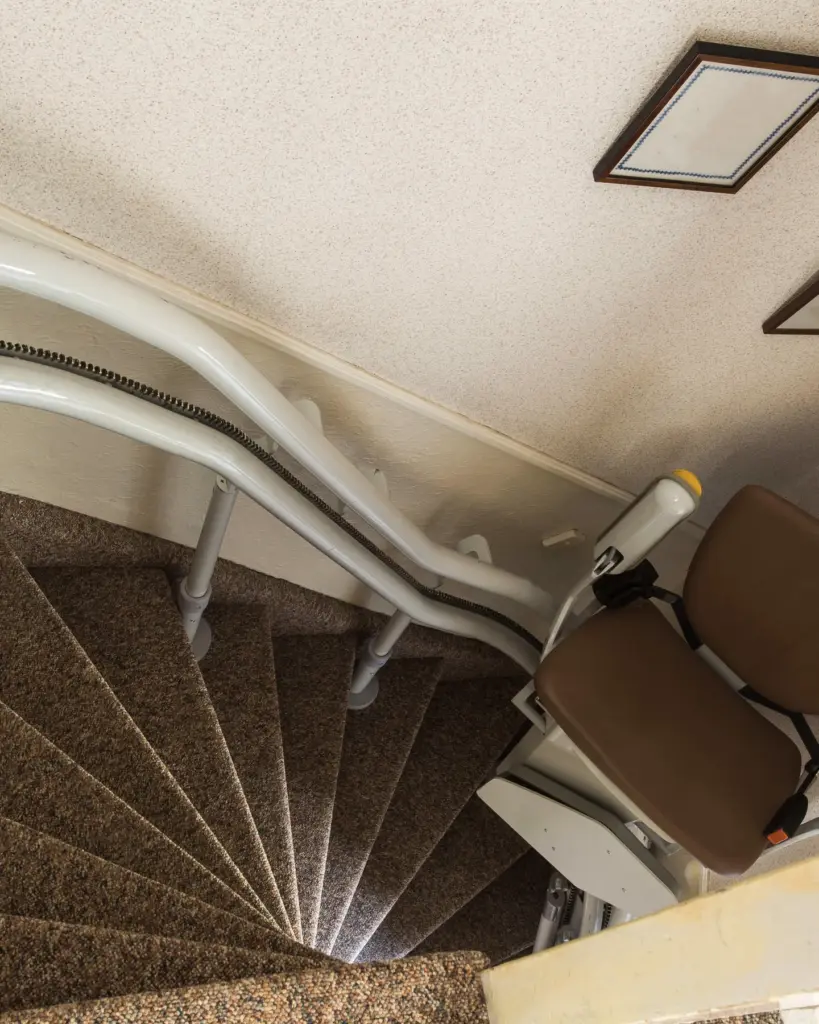
When you need a curved rail (not a straight)
A straight stairlift rides a single extruded aluminum or steel rail from the bottom step to the top, in a line. If your staircase does anything other than go in a straight line from floor to floor, you almost certainly need a curved rail. But 'almost' matters here, because the decision is not always obvious and the price difference between straight and curved is $6,000 or more.
You definitely need a curved rail if:
- Your staircase turns. Any bend — 90 degrees, 180 degrees, a gentle arc — requires a custom rail. There is no adapter that bolts onto a straight rail to negotiate a corner.
- Your staircase has a mid-landing. A flat platform between two straight flights is a turn in disguise. The rail has to go level across the landing, then angle down the second flight. That transition is fabricated, not bolted together.
- Your stairs are fanned or tapered. Winder treads — pie-shaped steps that replace a landing — are common in homes built before 1970 and in many split-level designs. Even two or three winder treads at the top or bottom push you into curved territory.
- You need the rail to wrap at the top or bottom. If the top landing is narrow and you need the seat to rotate past the top step for a safe dismount, the rail has to curve around the newel post. Same at the bottom if the rail needs to park out of the walkway.
- Your staircase is spiral or helical. Any staircase that rotates continuously around a central column is the most complex curved installation and requires the most expensive rail fabrication.
You might NOT need a curved rail if:
- You have two straight flights connected by a wide landing. In some homes, two independent straight stairlifts — one on each flight — cost less than a single curved unit. The user walks across the landing and transfers to the second chair. This works when the landing is at least four feet deep and the user can walk a few steps unaided. Two straight units might run $5,000 to $7,500 total versus $10,000 to $14,000 for one curved unit.
- Your 'curve' is actually just a bottom bullnose. Some staircases have a decorative rounded bottom step but are otherwise straight. A straight rail can be installed to start above the bullnose, or the bullnose can be modified for less than $200 in carpentry. Do not let a dealer sell you an $11,000 curved unit over a $60 bottom-step modification.
- You only need the rail to extend past the top step. Many straight rails can be cut and hinged to fold against the wall at the top landing, eliminating a trip hazard without requiring a curved section.
If your staircase changes direction at any point between bottom and top — by turn, landing, or winder tread — you need a curved rail. If your staircase is straight but has cosmetic features at the top or bottom, get a second opinion before accepting a curved quote. The price difference justifies a 30-minute assessment from a competing installer.
How the custom rail is made — from laser scan to your staircase
The reason curved stairlifts cost two to three times more than straight models is the rail. A straight rail is extruded in bulk at the factory and cut to length on-site. A curved rail is a bespoke fabrication — a single production run of one unit, built from a 3D digital model of your specific staircase. Here is what that process looks like, step by step.
Step 1: Digital measurement (your home, 60-90 minutes)
A trained technician visits your home with a photogrammetric survey kit — typically a set of calibrated paper targets and a camera system. Targets are placed on each step, on the landings, and on the walls where the rail will mount. The technician photographs these targets from multiple angles. The images are uploaded to proprietary software (Bruno uses their own system; Savaria/Handicare uses PS4D) that converts the photographs into a millimeter-accurate 3D point cloud of your staircase geometry.
Some companies use a laser measurement system instead of photogrammetry. The end result is the same: a digital model accurate to within 2-3mm across the full length of the staircase. This accuracy matters because the rail must match the stair pitch, width, and turning radius at every point. A measurement error of even 10mm at a turn will produce a rail that binds or leaves a gap at the bracket.
Step 2: CAD modeling and engineering review (factory, 2-5 days)
The measurement data is imported into CAD software, where an engineer designs the rail path — seat clearance from walls, knee clearance from the opposite banister, headroom under low ceilings, and swivel arcs at top and bottom. The output is a fabrication drawing: coordinates that tell the CNC bending machine exactly where and how far to bend. Complex multi-turn staircases may require several engineering iterations.
Step 3: CNC bending and welding (factory, 3-5 days)
The rail starts as straight steel or aluminum tubing (tube-rail systems like Bruno and Stannah) or flat steel bar stock (Handicare's flat-rail). A CNC tube bender applies calculated force at calculated positions to produce the specified curvature. Complex configurations are bent in sections and TIG-welded together. Weld joints are ground smooth so the drive mechanism can traverse without stuttering. Twin-rail systems require both rails to match within tight tolerances, doubling fabrication work.
Step 4: Surface finishing (factory, 1-2 days)
Degreasing, acid etching or sandblasting for adhesion, then electrostatic powder coating in white, ivory, or gray. Cured at 400°F for a chip- and corrosion-resistant finish. Custom color matching is available at extra cost.
Step 5: Quality assurance (factory, 1 day)
The rail is test-fitted to a jig replicating your staircase dimensions. A weighted carriage runs the full length to verify smooth travel, alignment, and gear engagement. If QA fails, the rail goes back to bending or welding — one reason lead times can stretch beyond the quoted window.
Step 6: Crating and shipping (3-7 days)
A finished rail weighs 80 to 150 pounds and ships via freight carrier in a custom crate. Multi-section rails are field-joined during installation with precision bolted couplers. Factory to dealer depot: 3 to 7 business days.
From the day your staircase is measured to the day the rail arrives at the installer's depot: 4 to 6 weeks is typical. Rush orders (2-3 weeks) are available from some manufacturers at a premium of $500 to $1,500. Lead times stretch toward 8 weeks during peak season (October through February, when fall-related injuries spike demand).
Real 2026 pricing — component breakdown for a $12,000 curved install
The average curved stairlift installation in 2026 costs about $12,000. That number comes from our internal data across roughly 400 curved installs in the past 12 months. Below is where every dollar goes on a representative single-turn (90-degree upper) curved install with a 16-foot rail, standard seat, and no unusual site conditions.
- Custom curved rail (16 ft, single 90° turn, powder-coated): $4,200 — measurement, CAD, CNC fabrication, welding, finishing, QA, crating
- Seat assembly (swivel, fold-up, upholstered): $520 — frame, foam, fabric, hinge hardware, swivel mechanism
- Motor + drive unit (rack-and-pinion or worm drive): $880 — DC gearmotor, clutch, speed governor, gear track engagement
- Battery backup + charger: $210 — two 12V sealed lead-acid batteries, trickle charger, charge stations at top and bottom
- Control electronics + remotes: $240 — logic board, armrest controls, two wireless paddle remotes, safety sensors
- Freight shipping (factory to depot): $350 — oversized crated freight, residential area surcharge
- Installation labor (5-7 hours, 2 technicians): $1,100 — wall prep, bracket drilling, rail assembly, seat mount, wiring, testing, training
- Dealer margin + overhead: $3,500 — measurement visit, engineering time, insurance, warranty reserve, office, vehicles
- Sales tax (varies by state): $1,000 — at 8.25% representative rate
Total: ~$12,000 installed
Where the money actually concentrates
Look at that breakdown and you see the story: the custom rail and the dealer margin account for roughly $7,700 — 64% of the total. The mechanical components (seat, motor, battery, electronics) add up to about $1,850, which is nearly identical to a straight-rail install. The labor is higher ($1,100 vs $500 for straight) because curved installs take twice as long and require two technicians instead of one for the heavier rail sections.
This cost structure explains why curved stairlift quotes vary so dramatically between dealers. The rail fabrication cost is relatively fixed — every dealer pays roughly the same to the manufacturer. But dealer margin swings from $2,500 to $4,500 depending on overhead, volume, and how much price competition exists in your metro area. A $10,000 quote and a $14,000 quote on the same staircase often reflect a $2,000 margin difference and a $2,000 difference in what 'installed' includes.
What makes a $15,000 install different from a $9,000 install
| Cost driver | Lower end ($9,000) | Upper end ($15,000) |
|---|---|---|
| Rail complexity | Single turn, standard pitch | Multiple turns, spiral, or extreme pitch changes |
| Rail length | 12-16 ft | 22-30+ ft |
| Brand tier | Handicare Freecurve (single rail) | Bruno Elite CRE-2110 (400 lb capacity) |
| Seat options | Standard manual swivel | Powered swivel, powered footrest, custom upholstery |
| Site conditions | Standard drywall, existing outlet | Plaster walls, no nearby outlet, historic home restrictions |
| Landing treatment | Simple top park | Wrap-around park at top and bottom, hinge sections |
If you want a transparent, itemized quote for your specific staircase, request a free in-home assessment. We break out every line so you can see exactly what you're buying.
Brand comparison — Bruno Elite vs Handicare Freecurve vs Stannah Siena 260
Three manufacturers account for the vast majority of curved stairlift installations in the U.S. market. Each takes a different engineering approach to the same problem, and those differences matter more than the brochure photos suggest.
| Specification | Bruno Elite CRE-2110 | Handicare Freecurve | Stannah Siena 260 |
|---|---|---|---|
| Rail type | Single tube rail | Single flat rail | Twin tube rail (rack & pinion) |
| Weight capacity | 400 lb | 275 lb | 300 lb |
| Drive system | Direct-drive gearbox | Worm drive | Rack and pinion |
| Speed | ~20 ft/min | ~16 ft/min | ~18 ft/min |
| Max incline | 45° | 52° | 45° |
| Swivel range | 135° total (manual + powered option) | 80° auto Turn & Go | 90° manual or powered |
| Powered footrest | Optional | Optional | Standard (powered folding) |
| Seat styles | 2 styles, multiple upholstery colors | 3 styles (Classic, Elegance, Alliance) | Multiple fabrics + wood trim options |
| Battery backup | Yes (2x 12V SLA) | Yes (24V system) | Yes (2x 12V DC) |
| Warranty — parts | 2 years | 2 years | 2 years |
| Warranty — motor/drivetrain | 5 years | Lifetime (10 years defined) | 5 years |
| Country of manufacture | USA (Stoughton, WI) | North America (Savaria factory) | UK (Andover) |
| Typical installed price (2026) | $11,500 - $15,000 | $9,000 - $12,500 | $11,000 - $14,000 |
Bruno Elite CRE-2110 — the heavy-duty option
Bruno is the only curved model with a 400-pound weight capacity. That is not marketing padding — the reinforced rail, heavier-gauge brackets, and upgraded motor are engineered for bariatric users. If the primary rider weighs over 250 pounds, the Bruno is the safest choice and often the only choice that an installer will warranty at that load. Bruno is also the only major curved brand manufactured entirely in the U.S. (Stoughton, Wisconsin), which matters for parts availability and turnaround on warranty claims. The trade-off is price: Bruno is consistently the most expensive curved install by $1,000 to $2,000.
Handicare Freecurve — the value entry point
The Freecurve replaced the discontinued Handicare 2000 (a twin-rail system) with a single-rail design that is slimmer on the staircase and less expensive to fabricate. At $9,000 to $12,500 installed, it is typically the least expensive name-brand curved stairlift available. The Freecurve's Turn & Go feature automatically swivels the seat during travel on narrow staircases, reducing the chance of knee contact with the opposite banister. The limitation is capacity: 275 pounds. For riders under 250 pounds on a moderately complex staircase, the Freecurve is a strong value play. For heavier riders or highly complex configurations, it is the wrong choice.
Stannah Siena 260 — the design-forward option
Stannah is the largest stairlift manufacturer in the world by unit volume, and the Siena 260 reflects 50 years of refinement. The twin-rail rack-and-pinion drive is the smoothest and quietest mechanism in this comparison. The powered folding footrest is standard, not optional — a $300 to $500 savings versus adding it to a Bruno or Handicare. Stannah also offers the most seat customization: multiple fabric choices, leather-look vinyl, and light or dark wood armrest trims. The Siena's seatbelt design is unique — a retractable belt mounted at the armrest tip, operable with one hand, rather than the hip-buckle style used by every other brand. Imported from the UK, so warranty parts occasionally take longer to arrive than domestic brands.
Which one should you buy?
If the rider weighs over 250 lb: Bruno CRE-2110. No other curved model is rated for that load. If budget is the primary constraint and the rider is under 250 lb: Handicare Freecurve. If ride quality, noise level, and seat design matter most: Stannah Siena 260. In all three cases, the installer matters as much as the brand. A well-installed Freecurve will outperform a poorly installed Bruno.
The 3 most common curved configurations
Every curved stairlift is custom, but the vast majority of residential installs fall into one of three staircase configurations. Understanding which one matches your home helps you estimate cost, lead time, and complexity before the measurement visit.
Configuration 1: 90-degree upper turn
This is the most common curved layout in American homes. A straight flight of stairs arrives at a 90-degree turn near the top, often with two or three winder treads or a small quarter-landing. The rail travels straight up the main flight, then curves 90 degrees to park on the upper hallway.
Typical rail length: 14-18 feet. Typical installed cost: $10,000-$13,000. Fabrication complexity: Moderate — a single bend with transition from incline to level. Lead time: 4-5 weeks.
This configuration represents roughly 45% of curved installs. The rail is relatively straightforward to engineer because it has one directional change. The main design decision is whether to wrap the rail around the top newel post (adds $800-$1,200) or park it just before the turn (saves money but may leave the parked seat partially obstructing the top step).
Configuration 2: Mid-landing (two flights, one landing)
Two straight flights separated by a flat landing. The rail descends the upper flight, transitions to level across the landing, then descends the lower flight. This is common in split-level homes, colonial-era homes with dog-leg stairs, and any home where the staircase reverses direction 180 degrees.
Typical rail length: 20-28 feet. Typical installed cost: $12,000-$15,000. Fabrication complexity: High — two pitch transitions plus the level run across the landing. Lead time: 5-6 weeks.
The cost jump here comes from rail length and the two transition zones. Each transition from angled to level (or level to angled) is a complex bend that the CNC machine must execute at precise coordinates. Two transitions means twice the engineering tolerance risk. Some installers will propose two separate straight stairlifts (one per flight) on this configuration — that can save $3,000 to $5,000, but it requires the user to stand, walk across the landing, and transfer to a second seat. If the user cannot do that safely, a continuous curved rail is the correct answer.
Configuration 3: Spiral or helical staircase
A staircase that rotates continuously around a central column or an open well, typically through 180 to 360 degrees. These are found in Victorian homes, some mid-century designs, lighthouse-style towers, and compact urban townhouses.
Typical rail length: 16-24 feet (but every foot is curved). Typical installed cost: $13,000-$18,000+. Fabrication complexity: Very high — continuous curvature with changing pitch. Lead time: 6-8 weeks.
Spiral staircases are the most expensive curved installs because the rail is curved along its entire length. There are no straight sections to simplify fabrication. The measurement must capture the radius, pitch, and tread depth at every point on the helix. Any error compounds as the rail spirals — a 3mm measurement deviation at the bottom can produce a 15mm misalignment at the top. Some spiral staircases are too tight for any stairlift; if the inner radius is under 24 inches or the tread depth at the inner edge is under 4 inches, most manufacturers will decline the job. In those cases, a through-floor lift is the appropriate alternative.
Take a photo from the bottom looking up and another from the top looking down. Send both to a dealer and they can tell you the configuration category and a rough price range before scheduling a measurement visit. Send us your staircase photos and we will respond within one business day.
What to expect on measurement day vs install day
Measurement day (60-90 minutes at your home)
The measurement visit is the most important appointment in the process. What happens here determines whether the $4,000+ rail fits your stairs or becomes scrap steel.
Before the technician arrives: Clear the staircase completely — remove rugs, runners, stair gates, and loose items. The technician needs unobstructed access to every step and both landings. Ensure decent lighting for the photogrammetric camera system.
What the technician does: Places calibrated paper targets on every tread, riser, landing, and adjacent wall. Photographs targets from 15 to 30 angles. Measures ceiling height at critical points (headroom at the top is the most common constraint). Notes electrical outlet locations — the stairlift needs a 120V outlet within 6 feet of a parking position. Records staircase width at every point, since curved rails occupy 10 to 13 inches. Documents obstructions: radiators, doorways, light fixtures, handrail positions.
What you should do: Have the primary rider present. Note whether they can bend their knees to 90 degrees, grip an armrest, and buckle a seatbelt — these affect seat and swivel selection. Ask which side of the staircase the rail will mount on. Wall-side is standard, but some configurations require banister-side mounting, which means modifying the handrail.
The wait (4-6 weeks)
After measurement day, the data goes to the factory. You will typically receive an engineering confirmation drawing within 5 to 10 business days. Review this drawing. It shows the rail path, the seat parking positions, and any modifications required (outlet relocation, handrail trimming). Approve it in writing. Rail fabrication begins after your approval and takes 2 to 4 weeks.
Install day (5-8 hours at your home)
Two technicians arrive with the crated rail sections, seat assembly, and all hardware. Clear the path from your front door to the staircase — rail sections weigh 80 to 150 pounds total.
Installation sequence:
- Rail mounting (2-3 hours): Brackets are drilled into stair treads (not walls), one every 2 to 3 treads. Rail sections are lifted into position, aligned, and bolted. Multi-section rails are joined with precision couplers.
- Mechanical assembly (1-2 hours): Motor, drive unit, seat with swivel plate, battery pack, and charge stations at both parking positions.
- Electronics and testing (1-2 hours): Control board, safety sensors, and remotes are wired. The empty carriage runs the full rail multiple times, then loaded runs confirm smooth operation.
- User training and sign-off (30 minutes): The primary rider operates the lift under supervision. The installer demonstrates all controls, the seatbelt, the key switch, and the manual release for power failures.
After the install: Expect a break-in period of about a week as motor and gears seat. Minor whine or vibration in the first few days is normal. Adjustments during the first 30 days are typically covered at no charge.
Common misconceptions about curved stairlifts
Misconception 1: "There's a flexible or modular rail that avoids custom fabrication"
Some dealers describe a 'flex rail' or 'modular curved rail' that snaps together from standard segments on-site, eliminating the 4-6 week wait. Modular rail systems do exist, but they are assembled from many short aluminum segments bolted together. Every joint is a vibration point, the ride is noticeably rougher, weight capacity is typically limited to 265 pounds, and the installed price is not dramatically lower because on-site labor to align 20+ segments is substantial.
Modular rail works in short-term or rental situations. For a permanent installation, factory-fabricated custom rail is the better investment — smoother ride, higher capacity, 15-20 year lifespan, and $1,500-$3,000 resale value versus essentially zero for a modular rail.
Misconception 2: "Any staircase can take a straight rail with modifications"
Online forums suggest that with enough creativity — intermediate platforms, transfer seats, two units — you can avoid paying for a curved rail. In limited cases that is true (see the two-straight-lifts option in the decision section above). In most cases, the workaround either creates a safety risk, violates building code, or costs nearly as much as a curved rail once you add the second unit and extra electrical work. Start with a curved rail quote and work backward.
Misconception 3: "Curved stairlifts damage your walls"
Curved stairlift rails mount to the stair treads, not to the walls. The brackets drill into the wood of the step, typically using 3/8-inch lag bolts. The walls are not touched. If the stairlift is ever removed, the bracket holes in the treads can be filled with wood filler and sanded, or covered by carpet if the stairs are carpeted. The only wall modification that occasionally happens is a small section of baseboard trim may need to be notched if the rail is mounted very close to the wall on a tight staircase. This is a $30 repair if you ever remove the unit.
Misconception 4: "You can buy a used curved rail for half the price"
Used straight rails are widely available and represent excellent value. Used curved rails are nearly worthless — because a curved rail is fabricated to the exact geometry of one specific staircase. The odds that a used curved rail from one house will fit another house are essentially zero. Even two staircases that appear identical will differ by enough millimeters to make a used rail unusable.
Some dealers sell 'refurbished' curved stairlifts, which means they refurbish the seat, motor, and electronics and fabricate a new custom rail. The seat/motor bundle is discounted, but you still pay full price for the rail. Expect $7,500 to $10,500 for a refurbished curved install — a savings of $1,500 to $3,000 versus new, with a shorter warranty (typically 12 months vs 2-5 years).
Misconception 5: "The stairlift will block the stairs for everyone else"
Every modern curved stairlift has a fold-up seat, fold-up footrest, and fold-up armrests. When folded, the unit protrudes 10 to 13 inches from the wall. On a standard 36-inch-wide staircase, that leaves 23 to 26 inches of usable width — enough for most people to walk past comfortably. On narrower staircases (30-32 inches), it is tighter. A Handicare Freecurve single-rail system has the slimmest folded profile of the three major brands.
When a curved stairlift is the wrong answer
A curved stairlift is the right solution for most multi-level homes with non-straight staircases. But there are situations where spending $10,000 to $15,000 on a curved rail is the wrong call, and a different mobility solution is objectively better.
When a through-floor lift is better
A through-floor lift moves a person between floors through a ceiling/floor opening, bypassing the staircase entirely. Consider one when: the user is in a wheelchair full-time and cannot transfer to a stairlift seat safely; the staircase is under 28 inches wide or steeper than 45 degrees; or the spiral has an inner radius under 24 inches (too tight for any stairlift). Cost: $15,000 to $35,000 installed including structural work. More expensive, but the right tool when stairs are not viable.
When a platform lift is better
A vertical platform lift (VPL) travels straight up, usually outdoors. It is the right choice when the user needs to access a raised porch or deck (a VPL at $4,500-$12,000 is often simpler than an outdoor-rated curved rail that adds $2,000-$4,000 to the price), or when the elevation change is short — under 6 feet — making a full curved stairlift overkill.
When a home remodel is better
If the user's bedroom, bathroom, and kitchen can all move to one floor, a first-floor conversion ($8,000-$25,000) may be a better investment. It is permanent, adds home value, and eliminates any mechanical lift. A curved stairlift adds essentially zero resale value. If the user plans to stay in the home indefinitely, the remodel deserves serious consideration. If the timeline is under three years, the stairlift is usually the more practical choice.
When a rental makes more sense
Curved stairlift rentals are rare because the rail cannot be reused, but some dealers offer lease-to-own programs ($350-$500/month) with partial credit if returned within 12-24 months. If the need is temporary — surgery recovery, a visiting parent — explore this before committing to a $12,000 purchase.
Frequently asked questions about curved stairlifts
Your free home assessment is one phone call away
No deposit. No obligation. No high-pressure sales. A certified installer visits your home, measures once, and gives you a written quote that's honored for 30 days. It takes about 45 minutes. More than 15,000+ homeowners have said yes over the last 15 years.
- Licensed in all 50 states
- $2M liability insured
- BBB A+ since 2012
- 15+ years in business