The Complete Stairlift Buyer's Guide (2026)
Last year we installed 1,400 stairlifts across 38 states. About a third of those buyers had already gotten a bad quote from somewhere else — priced $2,000 too high, sold the wrong model, or pitched a $600/year service plan they didn't need. This guide is the conversation we have on every free assessment, written down, so you can shop smart before anyone steps in your house.
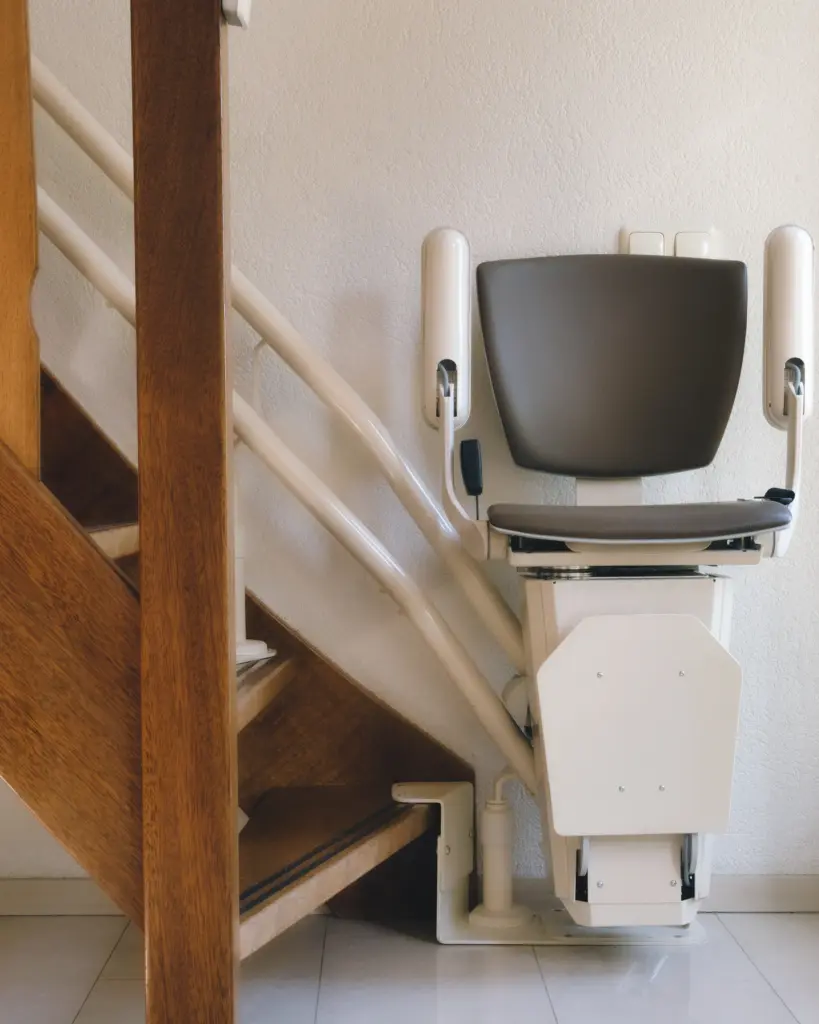
What a stairlift actually is (and what it isn't)
A stairlift is equipment, not construction. The rail bolts into your existing stair treads — it does not touch your wall, banister, or floor joists. Removal leaves a handful of small holes in the treads.
A stairlift is equipment, not construction. The rail bolts into your existing stair treads — it does not touch your wall, banister, or floor joists. Removal leaves a handful of small holes in the treads.
A stairlift is equipment, not construction. The rail bolts into your existing stair treads — it does not touch your wall, banister, or floor joists. Removal leaves a handful of small holes in the treads.
A stairlift is a motorized chair that rides a rail bolted to your stair treads. That's it. The rail fastens into the wood or metal stringer of the staircase, not the wall and not the banister. If an installer tells you they need to drill your drywall or cut your handrail, they're doing it wrong — or they're working on a house that needs a structural evaluation first, which is a separate conversation.
A stairlift is not a medical device in the FDA sense. The FDA doesn't clear or approve residential stairlifts the way it does wheelchairs, hospital beds, or oxygen concentrators. What a stairlift is classified as, for some insurance and tax purposes, is durable medical equipment (DME). That DME classification matters because it's what makes the equipment deductible under IRS Publication 502 and reimbursable under certain VA and Medicaid programs. We'll get to the funding piece below.
Don't confuse a stairlift with its neighbors. A chairlift is another word for stairlift — same thing, used interchangeably in the industry. A home elevator is a fully enclosed shaft with a cab and a pit, and it's roughly 5 to 20 times the cost ($30,000–$60,000 installed, often more). A through-floor lift is a simplified elevator that cuts a hole between two floors without a masonry shaft, running $18,000–$28,000. A dumbwaiter is for laundry and groceries, not people. If someone quotes you a dumbwaiter for mobility, walk away.
The three types that cover 95% of homes
Forget the marketing taxonomy. Ninety-five percent of residential installs are one of three configurations: straight rail indoor, curved rail indoor, or an outdoor variant of either. The type you need is determined by the physical shape of your staircase, not by what looks nicest in the brochure.
Straight rail
A straight rail is the workhorse of the industry. If your staircase is one continuous flight from the bottom to the top with no landings and no turns, you're buying a straight rail. Period. Nothing fancier is necessary, and nothing fancier is worth the money.
- Best for: a single flight, no turns, anywhere from 8 to 16 steps
- Typical cost installed: $2,500–$5,500
- Install time: 2–4 hours, same day
- Models we recommend: Bruno Elan SRE-3000 (our budget-to-mid pick), Bruno Elite Indoor SRE-2010 (our premium pick, and our most-installed model overall), Handicare 1000 (quietest motor in the category), Acorn 130 (honest budget option)
A straight rail is cut to length on site. The rail itself is a stock steel extrusion that any competent installer has on the truck. There is no fabrication lead time. If an installer is telling you a straight rail takes 2 weeks to order, they're either drop-shipping from a warehouse or padding the timeline.
Curved rail (custom)
A curved rail is required any time your staircase has a turn, a mid-landing, a 90° corner at the top or bottom, or a spiral. Every curved rail is custom-fabricated to your specific staircase using a photo survey or a laser measurement — there is no stock curved rail. This is where the cost lives.
- Best for: any staircase with a turn, a landing, or a non-straight geometry
- Typical cost installed: $9,000–$15,000, with rail fabrication driving about 60% of the total
- Install time: 1–2 weeks rail fabrication in the factory, then 1 day on-site install
- Models we recommend: Bruno Elite CRE-2110 (industry benchmark for curved), Handicare 2000 (slightly quieter, slightly more flexible on tight geometry), Stannah Siena 260 (premium, British-built, 25-year product lineage)
A warning on this category: if you see a product marketed as a "flexirail," "universal curved rail," or "fits-any-stair modular curved system," do not buy it. These are jointed rails assembled from straight sections on site with flexible couplings. They do not track cleanly through real-world curves, they squeak within a year, and none of the name-brand manufacturers sell them. The only reason they exist is to avoid the custom fabrication cost — and what you save on the rail, you pay back in service calls.
Outdoor rail
Outdoor units are a completely different engineering problem from indoor units. The motor is sealed against moisture, the rail carries a marine-grade coating (usually a powder-coat over galvanized steel) that withstands salt air and UV, the seat has a weatherproof vinyl cover, the electronics live under a weather hood, and the battery is rated for a wider temperature range. You cannot use an indoor lift outdoors, even on a covered porch — the first hard rain will kill the control board.
- Best for: front porch steps, raised entries, deck access, split-level exterior stairs, pool deck entries
- Typical cost: $3,500–$7,500 for a straight outdoor unit, $10,000+ for curved outdoor
- Models we recommend: Bruno Elite Outdoor SRE-2010E (our coastal workhorse), Handicare 1100 Outdoor, Harmar Pinnacle SL350 Outdoor (good for heavy-duty outdoor use)
In hurricane markets — Florida, the Gulf coast, the Carolinas — we specifically push customers toward Harmar's outdoor line. Harmar is made in Florida, their outdoor units are tested against real coastal conditions, and their parts supply is same-week even after a storm event. Get a free outdoor assessment in your city.
The four things that actually matter (and the six that don't)
Things that actually matter
- Weight capacity — 300 lb standard; 400 lb if either rider weighs 275+ dressed
- Battery backup — non-negotiable for power cuts, hurricanes, grid shutoffs
- Rail length + geometry — measured individually for every install
- Installer licensing + bonding — verify with your state contractor board
Upsells that don't matter
- Seat color upgrade — all brands offer neutrals free
- Powered footrest — manual works fine, saves $200–$400
- Key-lock anti-tamper — skip
- Dual-remote pairing — one remote is enough
- "Digital diagnostics" subscription — no annual fee is acceptable
- Cloud / smart-home integration — avoid on safety equipment
Things that actually matter
- Weight capacity — 300 lb standard; 400 lb if either rider weighs 275+ dressed
- Battery backup — non-negotiable for power cuts, hurricanes, grid shutoffs
- Rail length + geometry — measured individually for every install
- Installer licensing + bonding — verify with your state contractor board
Upsells that don't matter
- Seat color upgrade — all brands offer neutrals free
- Powered footrest — manual works fine, saves $200–$400
- Key-lock anti-tamper — skip
- Dual-remote pairing — one remote is enough
- "Digital diagnostics" subscription — no annual fee is acceptable
- Cloud / smart-home integration — avoid on safety equipment
Things that actually matter
- Weight capacity — 300 lb standard; 400 lb if either rider weighs 275+ dressed
- Battery backup — non-negotiable for power cuts, hurricanes, grid shutoffs
- Rail length + geometry — measured individually for every install
- Installer licensing + bonding — verify with your state contractor board
Upsells that don't matter
- Seat color upgrade — all brands offer neutrals free
- Powered footrest — manual works fine, saves $200–$400
- Key-lock anti-tamper — skip
- Dual-remote pairing — one remote is enough
- "Digital diagnostics" subscription — no annual fee is acceptable
- Cloud / smart-home integration — avoid on safety equipment
Things that actually matter
- Weight capacity. Standard residential stairlifts carry 300 lb. That covers about 90% of buyers. If either person who will use the lift weighs 275 lb or more fully dressed (shoes, coat, handbag), step up to a 400 lb heavy-duty model — you want headroom, not the edge of the spec. A 400 lb upgrade is usually $300–$600. True bariatric 500–600 lb units exist (Harmar Pinnacle SL600 handles 600 lb) but they're a specialty order and cost roughly 40% more than a standard 300 lb install.
- Battery backup with DC drive. This is non-negotiable in 2026. Every stairlift we sell runs off two 12-volt sealed lead-acid batteries, which are trickle-charged from a normal household outlet and drive the unit on DC power. That means the lift still works during a power outage — through a hurricane, a blizzard, a rolling blackout, a transformer blown by a pickup truck, whatever. If anyone is still trying to sell you an AC-drive residential stairlift, they are selling you 2005 technology at 2026 prices. Walk away.
- Rail length and geometry. A 14-foot rail handles most 13-step straight flights. A 16-foot rail covers taller ceilings. Curved rails are measured individually from a photo survey or laser scan — your quote should include the measured rail length in feet, not just "fits your stair."
- Installer licensing, bonding, and insurance. This is the piece most buyers skip entirely, and it's the piece that protects you if something goes wrong. See the 10-question checklist below for the specific things to verify before you sign.
Things marketers push that don't matter much
- Seat color. Every major brand offers three or four neutral upholstery options. They all look fine. Picking "premium stone" over "standard tan" is a $150–$300 upsell for a chair your rider is going to sit in, not admire.
- Power-folding footrest. The marketing angle is "you don't have to bend over to fold it." Manual folding footrests work via a linkage off the seat — when you fold the seat up, the footrest folds with it. You don't bend over for that either. Save $200–$400 and skip the motorized footrest.
- Key-lock anti-tamper. Some models offer a physical key lock so "nobody can use the lift without permission." Your stairlift is not a threat vector. The risk of a grandchild riding it for fun is much smaller than the risk of losing the key when you need to ride it at 3am. Skip.
- Dual-color remote controls. You get one remote at the top and one at the bottom of the stairs, or you get a remote and a built-in armrest control. Two remotes in beige and two in brown is not a feature.
- "Digital diagnostics" or premium service subscriptions. Any annual service plan billed at $200–$600 per year on a residential stairlift is not a safety product — it's a revenue product for the installer. We do not sell them. If your install comes with a mandatory first-year "premium care" plan, that's the price padding showing.
- Cloud-connected / smart / app-enabled anything. We categorically recommend avoiding all cloud integration on safety equipment. Your stairlift does not need to talk to your phone. Your stairlift needs to work for 15 years on a trickle-charged battery and a dead-simple DC motor. The more firmware it has, the more ways it can fail during an ice storm with no internet.
What a fair price actually looks like
fall in the $3,200–$4,500 range. Anything under $2,500 or over $5,500 deserves a second quote.
Watch for these price games
"$1,999!" headline rates that assume a perfect stair + existing outlet + no install. Financing tied to purchase ("$89/month!") without disclosing the 9% APR. Rental models that cost more than buying over 18 months.
fall in the $3,200–$4,500 range. Anything under $2,500 or over $5,500 deserves a second quote.
Watch for these price games
"$1,999!" headline rates that assume a perfect stair + existing outlet + no install. Financing tied to purchase ("$89/month!") without disclosing the 9% APR. Rental models that cost more than buying over 18 months.
fall in the $3,200–$4,500 range. Anything under $2,500 or over $5,500 deserves a second quote.
Watch for these price games
"$1,999!" headline rates that assume a perfect stair + existing outlet + no install. Financing tied to purchase ("$89/month!") without disclosing the 9% APR. Rental models that cost more than buying over 18 months.
Stairlift pricing is less mysterious than the industry makes it sound. The cost of a unit breaks down roughly 40% equipment, 30% rail (higher for curved), 20% labor and installer overhead, 10% margin. When you know the ranges, you can tell instantly whether a quote is fair.
Straight rail installed: $2,500–$5,500
About 70% of the straight-rail installs we do fall in the $3,200–$4,500 band. That's the sweet spot: a name-brand unit (Bruno Elite, Handicare 1000), a 13–15 ft rail, a 300 lb capacity, battery backup, a 5-year warranty, a same-day professional install, no surprise fees.
- Budget range ($2,500–$3,200): Acorn 130, refurbished Bruno Elan, or an entry model with a shorter warranty. Perfectly functional if the budget is tight.
- Mid range ($3,200–$4,500): Bruno Elan SRE-3000 new, Handicare 1000 new. This is where most buyers should land.
- Premium ($4,500–$5,500): Bruno Elite Indoor SRE-2010 with soft-start, Handicare 1000 with the quiet-drive upgrade, Stannah Siena 160. Slightly nicer ride, slightly better warranty, noticeable only on daily use.
Curved rail installed: $9,000–$15,000
- $9,000–$11,000 for a single 90° turn at the top or bottom of an otherwise-straight flight.
- $12,000–$15,000 for a double turn, a mid-flight landing, or a U-shape.
- $15,000+ for a true spiral staircase. These are rare, require a specialty rail, and most installers will subcontract the fabrication.
If you are being quoted $18,000–$22,000 for a single-turn curved rail in a typical two-story home, you are being overcharged. We see it constantly — especially from the national chains that advertise on daytime TV. Get a written second quote before you sign anything.
Outdoor units
Add 10–25% on top of the equivalent indoor price. An indoor straight rail that would run $3,800 installed becomes $4,200–$4,750 as an outdoor unit. The premium is real — it pays for the weather sealing, the marine-grade rail coating, and the outdoor-rated battery — but anything more than 25% over the indoor equivalent is padding.
What should never be in a "base price"
- Travel fees for anywhere inside a standard metro area. We don't charge them. Nobody should.
- Site visit or assessment fees. The assessment is free. If an installer is charging $150–$300 to come measure, they're filtering out price shoppers — which means their retail price is already high.
- Hourly labor add-ons. A residential stairlift install is a fixed-price job. You get a number, you sign it, the number doesn't change on install day unless you ask for something different.
- "Training fees" for how to use the chair. The 15-minute hands-on walkthrough at handoff is part of the install. That's the job.
Price games to watch for
- "$1,999 installed!" headline rates. These assume a perfect straight stair with an existing grounded outlet at the bottom, a budget import unit, and no curve. Real invoices come in $1,500–$2,500 higher.
- Financing tied to the quote. "$89 a month!" looks great until you see it's a 60-month term on a $5,200 price at 9.5% APR, which is $5,340 in payments. Ask for the cash price and the APR separately.
- Rental programs. Some installers push monthly rentals at $150–$300/month. Over an 18-month rental, you've often paid more than the outright purchase of the same unit, with none of the resale value on the back end.
Funding: 6 paths worth exploring
Most families we work with pay out of pocket, but a meaningful minority qualify for partial or full coverage through one of these six programs. Worth 20 minutes of research before you write the check.
1. Medicare Part B — no, it does not cover stairlifts
Let's kill this myth first. Traditional Medicare Part B does not cover residential stairlifts. It has never covered them. CMS explicitly excludes home modifications and durable medical equipment intended for a home environment, even when a physician prescribes it. If a salesperson tells you "Medicare might cover this," they are either mistaken or lying. Ask them to put it in writing on their letterhead. They won't.
2. Medicare Advantage — sometimes
Medicare Advantage plans (Part C) are run by private insurers and have leeway to offer supplemental benefits. Some plans — particularly Special Needs Plans (SNP) and some regional Advantage plans — cover partial stairlift costs as a home-modification benefit. Coverage is plan-specific and changes every year. Call your plan's member services directly. Do not let the dealer make the call on your behalf.
3. Medicaid HCBS waivers — state-specific, real money
Home and Community-Based Services waivers are the biggest untapped funding source for stairlifts in the US. Forty-seven states operate at least one waiver program that covers stairlifts as "environmental modifications" or "home accessibility modifications." Typical caps run $7,500–$10,000 per lifetime modification. Eligibility is income-qualified and usually requires a nursing-home level-of-care assessment — meaning you qualify if you would otherwise need nursing-home care. The application process takes 30–90 days and involves your state's Medicaid waiver agency, not the federal Medicaid office.
4. VA HISA grant — up to $8,150
The VA Home Improvements and Structural Alterations (HISA) grant covers up to $8,150 for veterans with service-connected disabilities and up to $2,000 for non-service-connected disabilities. It's a one-time grant, not a loan, and it pays for stairlifts, ramps, bathroom modifications, and related accessibility work. Requires a VA provider's prescription and processing through the VA Healthcare Administration. Most VA medical centers have a HISA coordinator on staff.
5. IRS Schedule A medical deduction — Publication 502
If you itemize (not the standard deduction), the full cost of a stairlift install is a qualified medical expense under IRS Publication 502. This includes the equipment, the rail, the labor, the electrical work, and any ancillary modification costs. For most buyers the tax benefit is worth $600–$2,400 back depending on marginal rate and AGI — not a free lift, but a meaningful offset. Keep the invoice, keep the prescription (if you got one), keep the Form 1099 from the installer.
6. State property tax exemptions
Not a stairlift grant, but a cash-flow helper. Most states offer a Senior Homestead Exemption and/or a Disabled Homeowner Exemption that reduces your annual property tax bill by $500–$2,500. If you're buying a stairlift this year, applying for the property tax exemption the same month often frees up cash in the budget to cover the out-of-pocket portion. Your county assessor's website has the form.
We file the paperwork for you at no charge. VA HISA, HCBS waiver applications, IRS documentation packets — all of it is part of our free in-home assessment. Request yours here.
The 10-question consultation checklist
Print this page. Read these ten questions out loud to whoever is quoting you. If they can't answer one of them without hesitating or deflecting, walk away. You're not being difficult — you're doing the basic due diligence the industry hopes you skip.
- What is your state contractor license number? Most states require a general contractor, specialty contractor, or home improvement contractor license for stairlift installation. You can verify the number in 30 seconds on the state licensing board's website.
- What is your bond amount, and who holds the bond? A bonded contractor has posted collateral with a surety company that pays out if they don't complete the work or damage your property. Typical residential bonds run $10,000–$25,000.
- Do you carry $2 million general liability insurance? Two million is the floor for any contractor working inside a home. Ask for a Certificate of Insurance (COI) naming you as a certificate holder for the job. You should have it before install day.
- What is the battery backup spec on the model you're quoting? The answer should be "two 12V sealed lead-acid batteries, trickle-charged, DC drive, rated for X number of up-and-down cycles on a full charge." A blank stare means they don't know the product they're selling.
- Is the rail manufacturer-warrantied for life? Bruno, Handicare, Stannah, and Harmar all offer lifetime rail warranties on their name-brand models. If your quote doesn't include a lifetime rail warranty, you're buying something other than what you think you're buying.
- Is your install labor warrantied, and for how long? Separate from the manufacturer warranty on the equipment. Industry standard for install labor is 1–3 years. Anything less than 1 year is a red flag.
- Are you charging a separate "travel fee," "site assessment," or "first-year service plan"? The answer should be no on all three. Any yes is a line-item you can negotiate out.
- What is your written 30-day price hold policy? You should be able to take a quote home, compare it, sit on it, and sign it inside 30 days without the price changing. If the quote expires in 48 hours, that's pressure selling.
- Can you pull any electrical permit my home needs without subcontracting it? Some jurisdictions require a permit for the 120V outlet install near the top or bottom of the staircase. A licensed stairlift installer should handle this directly or have a licensed electrician on staff.
- Who answers the phone if this lift breaks at 2am on a Sunday? The answer should be a real person, a real 24/7 dispatch line, and a real response-time commitment (typical: same-day or next-morning for a non-emergency, within 4 hours for a stuck rider).
Install day: what actually happens
Install day is undramatic, which is how it should be. A straight rail is a 2–4 hour job on site. A curved rail is a full day on site after 1–2 weeks of factory fabrication. Here's what we do, in order, every time.
The truck arrives on the scheduled window — usually a 2-hour arrival window, not a 4-hour one. The technician greets the homeowner, confirms the install location, and takes off his shoes at the door. Yes, really. We have a rule. Lead technician then lays drop cloths on the stair treads and on the floor at the bottom. Tool bags come out of the truck, the rail sections come out in labeled bundles, and the laser measure comes out for a final verification of the dimensions we captured at the free assessment visit.
The rail is bolted into the stair treads using stainless lag bolts, typically two bolts per foot of rail. Important: the rail attaches to the stair treads, not to the wall and not to the banister. Your walls and your handrail are not structural hold points for a stairlift. Anyone telling you otherwise is working on a house that needs a carpenter before it needs an installer.
Once the rail is down and level-checked, the drive motor and battery pack are mounted to the carriage, the seat assembly is bolted on, the armrests and footrest are snapped in, and the electrical cord gets routed to the nearest grounded outlet (we add the outlet if there isn't one within 6 feet). The technician then runs the safety tests in order: seat-present sensor, footrest obstacle sensor (a dime on the floor should stop the unit cold), soft-start engagement, soft-stop at each end, emergency-stop button on the seat, remote-call function from both the top and bottom remotes.
Then comes the walkthrough: 10 to 15 minutes of hands-on training with the rider. How to sit, how to swivel the seat at the top landing, how to buckle the optional seatbelt, how to operate the armrest joystick, what the warning beep means, where the battery charge indicator is, what to do if the lift stalls. We don't leave until the rider has ridden the unit up and down three times unassisted and can operate it confidently.
Straight rail total time on site: 2–4 hours. Curved rail total time on site: 1 full day, after 1–2 weeks of off-site fabrication. Outdoor units add about 30 minutes for the weather-hood install and additional sealant work around the mounting points. You can ride the lift the same afternoon we install it — there is no cure time, no settling period, no "wait 24 hours before use."
Maintenance: what most families get wrong
A residential stairlift is a low-maintenance machine. It has one motor, two batteries, a drive rack, a handful of safety sensors, and a seat mechanism. Treat it right and it runs 15 to 20 years with minor service. Here's what we recommend and what we warn against.
Annual service is optional, not required. Most quality manufacturers build in a two-year service interval, not one. If your family uses the lift heavily — say, 8+ rides per day — an annual check is reasonable. If it's used 2–4 times a day, every 18–24 months is fine. Any installer pushing a mandatory annual $200–$500 service contract is selling a revenue stream, not a safety requirement.
Do not buy the "premium service plan" sold at install. Repeat after us: no annual fee is acceptable for a residential stairlift. If the install crew hands you a clipboard at handoff asking you to sign up for a $39/month extended service plan, politely decline. Real warranty claims are honored by the manufacturer regardless.
Replace the backup battery every 3–5 years. The two 12-volt sealed lead-acid batteries in the unit are consumables. They cost $75–$150 total and you can replace them yourself on most Bruno, Handicare, and Acorn models using a Phillips screwdriver. If your installer is quoting a $350 "battery service call" for a simple battery swap, you're paying for 20 minutes of labor at $900/hour.
Lubricate the rail track once a year with the manufacturer-specified dry silicone spray. A 10-ounce can costs $8 at any hardware store and lasts three years. Spray a light coat on the drive rack, let it dry, wipe excess. That's the maintenance.
Do not use WD-40 on the rail. WD-40 is not a lubricant, it's a penetrating oil. On a stairlift rail it attracts dust, gums up the drive pinion, and voids most manufacturer warranties. We have pulled seized drive mechanisms off brand-new lifts because the owner sprayed WD-40 on the rail "to make it run smoother." It makes it run worse.
What actually fails, in order
- Backup batteries — age-driven, not use-driven. Replace every 3–5 years. Easy DIY on most models.
- Seat swivel bearings — use-driven, fails around 15,000–25,000 cycles. Symptom is a stiff or squeaky swivel. Manufacturer replacement part, 30 minutes of labor.
- Safety sensor microswitches — dust and age. Cheap to replace ($15–$40 part), 15 minutes of labor.
- Drive motor — almost never fails within the warranty period. Modern DC stairlift motors have a 20+ year expected lifespan under residential duty cycles.
When to call the installer vs. when to DIY
Call the installer when: the unit throws an error code, the seat won't swivel, the lift slows or stalls partway up the rail, the emergency stop engages during normal ride, or the battery indicator shows low charge after a full overnight charge cycle. DIY when: you're swapping the backup batteries, wiping the rail clean, replacing a burnt-out armrest LED, or tightening an upholstery screw.
Brands worth your attention (and one to avoid)
Bruno
Wisconsin, USAIndustry leader for curved rails and our most-installed straight. Solid build, quiet motor, widely supported parts pipeline across the US.
- Flagship model Elite Series
- Weight capacity 300-400 lb
- Warranty 5 yrs + lifetime rail
Handicare / Savaria
UK / CanadaQuieter than Bruno in side-by-side comparisons. Model 1000 (straight) and Model 2000 (curved) are our most-specified Handicare units.
- Weight capacity 300-350 lb
- Warranty 5 yrs
- Strength Soft-start motor
Stannah
UKThe oldest modern stairlift manufacturer. Siena 260 is the curved flagship. Slightly more expensive but known for 15+ year service life.
- Flagship Siena 260 curved
- Weight capacity 300-352 lb
- Strength Longevity
Acorn
UKBudget option that doesn't embarrass you. The 130 straight rail is the entry-level pick for tight budgets — honest recommendation.
- Model 130 straight
- Price range $2,500-$3,200
- Warranty 2 yrs (thinner)
Harmar
Florida, USAHeavy-duty and outdoor specialist. Pinnacle SL600 handles 600 lb capacity. Outdoor models hold up well in coastal and hurricane markets.
- Heavy-duty Pinnacle SL600
- Weight capacity up to 600 lb
- Strength Hurricane markets
Generic Chinese imports
Unbranded marketplace"FLEXIRAIL" and similar marketplace listings under $2,000 with same-day shipping. No US parts supply, no installer network, no warranty enforcement. We've seen three fail within 14 months.
- Price range <$2,000
- Parts support None
- Warranty Unenforceable
Our full brand notes below — use the grid above for a quick overview.
Bruno
Wisconsin, USAIndustry leader for curved rails and our most-installed straight. Solid build, quiet motor, widely supported parts pipeline across the US.
- Flagship model Elite Series
- Weight capacity 300-400 lb
- Warranty 5 yrs + lifetime rail
Handicare / Savaria
UK / CanadaQuieter than Bruno in side-by-side comparisons. Model 1000 (straight) and Model 2000 (curved) are our most-specified Handicare units.
- Weight capacity 300-350 lb
- Warranty 5 yrs
- Strength Soft-start motor
Stannah
UKThe oldest modern stairlift manufacturer. Siena 260 is the curved flagship. Slightly more expensive but known for 15+ year service life.
- Flagship Siena 260 curved
- Weight capacity 300-352 lb
- Strength Longevity
Acorn
UKBudget option that doesn't embarrass you. The 130 straight rail is the entry-level pick for tight budgets — honest recommendation.
- Model 130 straight
- Price range $2,500-$3,200
- Warranty 2 yrs (thinner)
Harmar
Florida, USAHeavy-duty and outdoor specialist. Pinnacle SL600 handles 600 lb capacity. Outdoor models hold up well in coastal and hurricane markets.
- Heavy-duty Pinnacle SL600
- Weight capacity up to 600 lb
- Strength Hurricane markets
Generic Chinese imports
Unbranded marketplace"FLEXIRAIL" and similar marketplace listings under $2,000 with same-day shipping. No US parts supply, no installer network, no warranty enforcement. We've seen three fail within 14 months.
- Price range <$2,000
- Parts support None
- Warranty Unenforceable
Our full brand notes below — use the grid above for a quick overview.
Bruno
Wisconsin, USAIndustry leader for curved rails and our most-installed straight. Solid build, quiet motor, widely supported parts pipeline across the US.
- Flagship model Elite Series
- Weight capacity 300-400 lb
- Warranty 5 yrs + lifetime rail
Handicare / Savaria
UK / CanadaQuieter than Bruno in side-by-side comparisons. Model 1000 (straight) and Model 2000 (curved) are our most-specified Handicare units.
- Weight capacity 300-350 lb
- Warranty 5 yrs
- Strength Soft-start motor
Stannah
UKThe oldest modern stairlift manufacturer. Siena 260 is the curved flagship. Slightly more expensive but known for 15+ year service life.
- Flagship Siena 260 curved
- Weight capacity 300-352 lb
- Strength Longevity
Acorn
UKBudget option that doesn't embarrass you. The 130 straight rail is the entry-level pick for tight budgets — honest recommendation.
- Model 130 straight
- Price range $2,500-$3,200
- Warranty 2 yrs (thinner)
Harmar
Florida, USAHeavy-duty and outdoor specialist. Pinnacle SL600 handles 600 lb capacity. Outdoor models hold up well in coastal and hurricane markets.
- Heavy-duty Pinnacle SL600
- Weight capacity up to 600 lb
- Strength Hurricane markets
Generic Chinese imports
Unbranded marketplace"FLEXIRAIL" and similar marketplace listings under $2,000 with same-day shipping. No US parts supply, no installer network, no warranty enforcement. We've seen three fail within 14 months.
- Price range <$2,000
- Parts support None
- Warranty Unenforceable
Our full brand notes below — use the grid above for a quick overview.
There are maybe a dozen stairlift manufacturers operating in the US residential market. These are the ones we actually install, in the order we recommend them. Your results may differ — ours are based on 1,400 installs in the last 12 months and the warranty-claim data that came out of those jobs.
Bruno Independent Living Aids
Made in Oconomowoc, Wisconsin. Bruno is the industry leader for curved rails and one of the top two for straight rails. Their Elite Indoor SRE-2010 is our single most-installed model — it's the one we quote when a buyer says "I want the one you'd put in your own mother's house." The Elan SRE-3000 is the mid-tier straight rail and is priced $600–$1,000 under the Elite. Curved lineup is the CRE-2110. Warranty: 5 years on the drive mechanism, lifetime on the rail. Parts supply is same-week anywhere in the lower 48. If we had to pick one brand to install forever, it would be Bruno.
Handicare / Savaria
Handicare was a British-Dutch manufacturer now owned by Savaria (Canadian). The 1000 straight and the 2000 curved are the two models you'll see quoted. Build quality is comparable to Bruno, and side-by-side the Handicare motors run slightly quieter — about 2–3 decibels, noticeable if you're a light sleeper and the lift is near a bedroom. Warranty is 5 years equipment, lifetime rail. Parts supply is good but slightly slower than Bruno (7–10 business days on replacement parts vs. 3–5 for Bruno).
Stannah
Stannah is a British brand that's been making stairlifts since 1975 — they practically invented the modern residential market. The Siena 260 is the flagship curved model, and the Siena 160 is their straight. Build quality is excellent, the upholstery is a noticeable step up from Bruno and Handicare, and Stannah units routinely run 20+ years with basic maintenance. The catch is price: Stannahs run 15–25% more than Bruno for comparable specs. If longevity is worth an extra $800–$1,500 to you, Stannah is a rational choice. If not, Bruno is still a better value.
Acorn
Acorn is the honest budget option. The Acorn 130 straight sits in the $2,500–$3,200 installed range and will do exactly what a stairlift is supposed to do for exactly the number of years the warranty covers. The trade-offs are real: warranty is 2 years (not 5), motor is louder, ride is less smooth, upholstery is thinner. If the alternative is "can't afford a lift at all," an Acorn 130 is a perfectly legitimate answer — we install them every month and they work. Just go in with clear eyes about what you're paying for.
Harmar
Made in Sarasota, Florida. Harmar's niche is heavy-duty and outdoor. The Pinnacle SL600 is one of the few true 600 lb bariatric units on the US market. Their outdoor lineup holds up better in hurricane and coastal markets than anyone else's — the metallurgy and sealant choices are specific to the Gulf coast climate. If you're in Florida, Texas, Louisiana, the Carolinas, or the Southeast generally, Harmar is worth a side-by-side quote.
AmeriGlide
AmeriGlide is a reseller / relabeler, not a manufacturer. Their "Rubex HD" and other model names are rebadged units from other factories — sometimes Bruno, sometimes Handicare, sometimes a Chinese OEM. This isn't inherently bad. The unit under the sticker may be perfectly good. But you need to ask the dealer point-blank: "what factory built this, and whose warranty am I actually holding?" If they can't answer, don't buy it.
The one to avoid — generic Chinese imports
In the last two years a class of "FLEXIRAIL" and "universal fit" Chinese-import stairlifts have shown up on Amazon, Temu, Alibaba Express, and a handful of pop-up e-commerce sites. The pitch is: "$1,800 installed, fits any staircase, same-day shipping, 1-year warranty, DIY install." We have personally pulled three of these out of homes in the last 12 months — all three failed within 14 months of install, all three had no US parts supply, all three had no installer network willing to service them, and none of the warranties were enforceable because the original seller had already vanished from the marketplace. You will save $1,500 up front and then write a $4,000 check 18 months later to have a real lift installed. Do not buy one. If you're stuck with one, we can quote a replacement.
When a stairlift is the wrong answer
We're in the stairlift business and we'll tell you plainly: a stairlift is the wrong answer for about 1 in 10 of the homes we visit. Here are the four situations where we recommend something else.
1. Single-story remodel
If the upstairs isn't essential — no primary bedroom, no main bathroom, just a guest room and attic storage — the cheaper and smarter move is often to convert a first-floor den or dining room into a bedroom and add a first-floor full bath. A first-floor bath conversion in an existing closet or pantry typically runs $8,000–$15,000 and permanently eliminates the need to ever climb the stairs again. That's less than a curved stairlift and it adds resale value to the house instead of subtracting from it.
2. Through-floor lift or home elevator
If both floors need to be fully independent — the rider uses a wheelchair and needs to transport it between levels, or there are three floors to serve — a through-floor lift ($18,000–$28,000) or a traditional residential elevator ($30,000–$60,000) is the more versatile answer. A stairlift moves a seated person. A through-floor lift moves a person in a wheelchair plus groceries plus a walker plus the oxygen tank. The math changes when the rider's mobility needs extend beyond just getting upstairs.
3. Multi-floor homes with complex geometry
If your house is three stories with multiple turns on each flight, a curved-rail stairlift on two separate flights can run $25,000–$35,000 installed. At that price point, two years of rent on a single-story rental or condo in the same town is often cheaper, and you avoid the curveball of a $35,000 depreciating asset in a house you may sell in five years anyway. We've had several families run the numbers and move instead. Nothing wrong with that.
4. Wheelchair users
A stairlift is for an ambulatory person who can transfer to a seat. It is not for someone who cannot leave a wheelchair. Wheelchair users need a platform lift (vertical platform lift, or "VPL") which runs $6,000–$15,000 for a short-rise residential platform, or an inclined platform lift which runs $12,000–$25,000. Different product, different installer specialty, different price bracket. Any installer trying to sell a seated stairlift to a wheelchair user is either confused or unethical.
The one thing we wish every family knew before calling
Eighty percent of stairlift regret doesn't come from buying a stairlift. It comes from buying the wrong stairlift. Wrong model for the stair geometry, wrong weight capacity for the rider, wrong warranty terms, wrong installer. The second biggest source of regret is signing same-day at the first quote — because the first quote is almost always from the installer with the biggest advertising budget, not the best price-to-quality ratio.
Our standing advice, which we give to every family that calls us: get two written quotes from licensed installers, lay them side-by-side on your kitchen table, compare line-by-line (equipment make and model, rail length, warranty terms, install timeline, total installed price, financing terms), and then decide. A good installer will welcome the comparison. A bad one will pressure you to sign before you get the second number. That pressure alone is information.
If you'd like us to be one of those two quotes, request a free assessment in your city. We'll come out, measure the stair, check the outlets, answer your questions, and leave you a written quote that's good for 30 days with no pressure to sign. If we're not the right fit, we'll tell you who is.
Common questions
Does Medicare pay for a stairlift?
How much does a stairlift cost?
How long does a stairlift last?
Can I install a stairlift myself?
Do stairlifts damage the wall or banister?
How long does installation take?
Can I use a stairlift during a power outage?
What weight can a stairlift hold?
Are stairlifts noisy?
How do you remove a stairlift later?
Do stairlifts need a building permit?
Can two people ride a stairlift at once?
Your free home assessment is one phone call away
No deposit. No obligation. No high-pressure sales. A certified installer visits your home, measures once, and gives you a written quote that's honored for 30 days. It takes about 45 minutes. More than 15,000+ homeowners have said yes over the last 15 years.
- Licensed in all 50 states
- $2M liability insured
- BBB A+ since 2012
- 15+ years in business