Stairlift Glossary: Every Term Explained
Stairlift shopping comes with its own vocabulary -- drive racks, charging strips, HCBS waivers, swivel seats, obstruction sensors. Dealers throw these words around expecting you to nod. This glossary exists so you don't have to. Every term is defined in plain English, and each one includes a short note on why it actually matters when you're choosing, buying, or maintaining a stairlift.
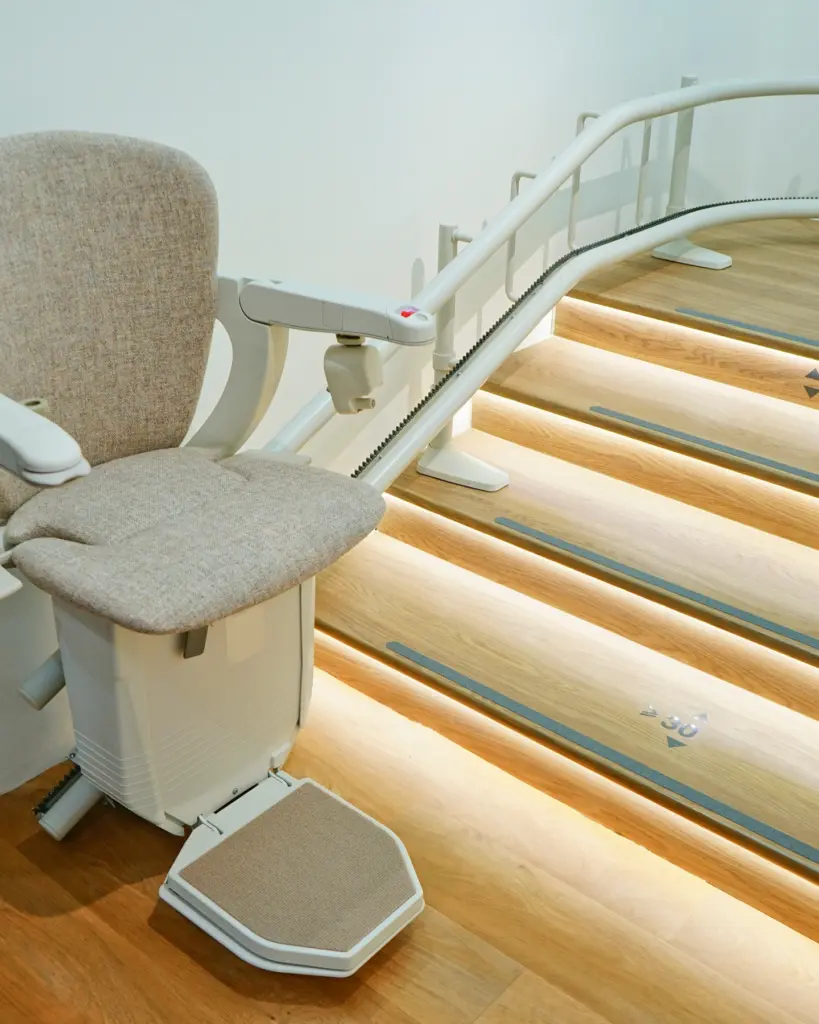
Mechanical & drive system terms
- Rack-and-pinion drive
- What it is: A gear system where a small rotating gear (the pinion) meshes with a toothed metal strip (the rack) mounted along the rail. The motor spins the pinion, which pulls the carriage up or down the rack.
Why it matters: Rack-and-pinion is the industry standard for residential stairlifts. It's mechanically simple, reliable for 15-20 years, and easy to service. If someone quotes you a unit with an unspecified drive type, ask -- it should be rack-and-pinion. - Drive rack
- What it is: The toothed metal strip that runs the length of the rail. The pinion gear rides along this rack to move the carriage.
Why it matters: The rack needs periodic cleaning. Dirt and pet hair accumulate in the teeth and can cause the pinion to slip or the motor to work harder than it should. A dry silicone spray once a year keeps it clean. - Belt drive
- What it is: An older drive mechanism that uses a reinforced rubber or polyurethane belt instead of a rack-and-pinion gear. The belt loops along the rail and the motor pulls it like a conveyor.
Why it matters: Belt drives are quieter than rack-and-pinion but wear out faster -- belts stretch, crack, and slip after 8-12 years of daily use. Most modern manufacturers have moved away from belt drives. If a dealer offers one, ask why. - Beltless drive
- What it is: A marketing term some manufacturers use to describe rack-and-pinion systems. It means exactly what it says -- no belt, the motor drives a gear directly.
Why it matters: Don't pay extra for "beltless technology." It's just the standard rack-and-pinion system with a fancier name. - Helical drive
- What it is: A variation of rack-and-pinion where the gear teeth are cut at an angle rather than straight across. Harmar uses this in their Pinnacle series.
Why it matters: Helical gears engage more gradually than straight-cut gears, producing less vibration and slightly less noise. The trade-off is marginally higher manufacturing cost. Not a reason to choose one brand over another, but a nice feature if the lift runs near a bedroom. - DC motor
- What it is: A direct-current electric motor powered by onboard batteries (typically two 12-volt sealed lead-acid units). The batteries trickle-charge from a household outlet when the lift is parked.
Why it matters: DC motors are the universal standard in 2026 residential stairlifts. They run during power outages because the batteries are always charged. If anyone offers you an AC motor stairlift, they're selling technology from the early 2000s. Walk away. See also: buyer's guide. - AC motor (obsolete)
- What it is: An alternating-current motor that runs directly off household wiring. No onboard batteries.
Why it matters: AC stairlifts stop working during a power outage -- exactly when an elderly or disabled rider may need them most. They're also louder than DC units (70+ dB vs. 45-55 dB). No major manufacturer sells a new AC residential stairlift in the US market today. If you encounter one, it's either very old or very cheap. - Soft-start / soft-stop
- What it is: Electronic motor control that gradually accelerates at departure and gradually decelerates before the end of the rail, instead of jolting to full speed or stopping abruptly.
Why it matters: Soft-start prevents the jarring sensation that startles riders and stresses joints. Every mid-range and premium model includes it. Budget models sometimes don't -- ask specifically before buying. - Overload sensor
- What it is: A strain gauge or current sensor that stops the motor if the load exceeds the rated weight capacity.
Why it matters: This is a safety feature, not an upsell. It protects the motor from burnout and the rider from a unit that's working beyond its structural limit. Every UL-listed stairlift has one.
Seat, controls & safety terms
- Swivel seat
- What it is: A seat mechanism that rotates 90 degrees at the top or bottom landing so the rider faces away from the staircase for safe dismount. Available in manual (lever-operated) or powered (button-operated) versions.
Why it matters: The swivel at the top landing is where most stairlift-related stumbles happen. A seat that locks into the swiveled position prevents the rider from stepping off while still facing the stairs. Manual swivels work fine -- powered swivels add $200-$400 and are only necessary if the rider has limited hand strength. - Power swivel
- What it is: A motorized version of the swivel seat. Press a button and the seat rotates automatically, then locks.
Why it matters: Useful for riders with severe arthritis in the hands or wrists who can't operate a manual lever. Otherwise, it's an optional convenience, not a necessity. See also: cost guide for typical upgrade pricing. - Footrest (manual vs. powered)
- What it is: The platform the rider's feet rest on during travel. Manual footrests fold up via a linkage when the seat is folded. Powered footrests fold via a small motor.
Why it matters: On most models, the footrest folds automatically when the seat folds -- no bending required. A powered footrest is one of the most common unnecessary upsells in the industry. Save $200-$400. - Armrest / armrest control
- What it is: Padded side arms on the seat, typically with a built-in toggle or joystick that controls movement up/down the rail.
Why it matters: Armrest-mounted controls are the primary way most riders operate the lift. Make sure the toggle or joystick is on the side the rider can reach most easily -- some models let you specify left or right. - Call-send controls (remote)
- What it is: Wall-mounted or wireless remote buttons installed at the top and bottom of the staircase. "Call" brings the empty chair to your floor. "Send" sends it to the other floor after you dismount.
Why it matters: Essential for two-person households where both people use the lift. Without call-send, the chair sits wherever the last rider left it. Every model includes at least two call-send stations. - Seatbelt / lap restraint
- What it is: A retractable or clip-on belt across the rider's lap during travel.
Why it matters: Not legally required in most states, but strongly recommended for riders with balance issues, Parkinson's, or post-stroke weakness. Some models include it standard; others charge $50-$100. Worth every penny. - Seat-present sensor
- What it is: A pressure or position sensor that detects whether someone is seated. The lift won't move unless the sensor confirms a rider is properly seated.
Why it matters: Prevents the lift from running empty (which wastes battery) and from operating while someone is halfway on the seat. A basic safety component on every UL-listed unit. - Obstruction sensor (safety edge)
- What it is: A pressure-sensitive strip on the bottom edge of the carriage and/or footrest that stops the lift immediately if it contacts an object on the stairs -- a shoe, a pet, a toy, a vacuum cord.
Why it matters: The most important active safety feature on a stairlift. During installation, the technician tests this by placing a coin on a stair tread -- the lift should stop cold. If it doesn't, the sensor needs adjustment before handoff. - Emergency stop
- What it is: A large, clearly marked button on the seat unit (usually red) that immediately cuts motor power when pressed.
Why it matters: Separate from the obstruction sensor. The emergency stop is rider-initiated -- press it and the lift halts instantly. Every model has one. Make sure the rider knows where it is and can reach it without looking down. - Key lock
- What it is: A physical keyed switch that prevents the lift from operating without the key inserted.
Why it matters: Mostly unnecessary for residential use. The risk of needing the lift and not finding the key outweighs the risk of unauthorized use. Skip this feature unless you have a specific reason (commercial building, group home). - Diagnostic display / error codes
- What it is: An LED or LCD panel on the armrest or carriage that shows error codes when the lift detects a fault.
Why it matters: Useful for the service technician, not for the rider. If the display shows a code, write it down and call your installer. Do not try to clear the code yourself -- some codes indicate a real safety fault that needs hands-on inspection.
Electrical & battery terms
- Battery backup (DC drive)
- What it is: The standard power architecture for modern stairlifts. Two 12-volt sealed lead-acid (SLA) batteries are trickle-charged from a household outlet and power the lift at all times -- including during outages.
Why it matters: This is not an optional feature. It's the way every quality stairlift works in 2026. A fully charged battery set provides 8-20 round trips during a power cut, depending on rail length and rider weight. Replace batteries every 3-5 years at $75-$150 for the set. - Charging strip / charge points
- What it is: Metal contact strips at the top and/or bottom of the rail where the carriage's charging contacts meet the house wiring. When the lift is parked at either end, the batteries charge.
Why it matters: If the charging strip corrodes or the contacts get dirty, the batteries won't charge and the lift will eventually stop mid-rail. A quick wipe with a dry cloth every few months prevents this. If the battery indicator stays low after an overnight park, check the charge points first. - Charge points (parking positions)
- What it is: The designated positions at the top and bottom of the rail where the lift parks and charges. Most rails have charge contacts at both ends; some budget models only charge at one end.
Why it matters: Always park the lift at one of the two charge points -- never mid-rail. Parking mid-rail means the batteries aren't charging, and you lose backup capacity. If your model only charges at one end, park it at that end overnight. - SLA battery (sealed lead-acid)
- What it is: The standard battery chemistry for residential stairlifts. SLAs are maintenance-free, leak-proof, and rated for trickle-charge duty cycles.
Why it matters: SLA batteries are cheap ($35-$75 each), widely available, and easy to swap on most models with a Phillips screwdriver. They're a consumable -- plan on replacing the pair every 3-5 years. If an installer quotes $350+ for a "battery service call," you're paying $250 for 20 minutes of labor. - Trickle charge
- What it is: A low-amperage charging method that slowly tops off the battery without overcharging. The lift charges whenever it's parked at a charge point.
Why it matters: Trickle charging extends SLA battery life compared to fast charging. It also means the lift draws very little standby power -- roughly 15-30 watts, comparable to a phone charger. Your electricity bill won't notice.
Installation & rail terms
- Rail (track)
- What it is: The steel or aluminum extrusion bolted to the stair treads that the carriage rides along. Straight rails are stock lengths cut on site. Curved rails are custom-fabricated to match your staircase geometry.
Why it matters: The rail is the single biggest cost driver in a curved installation -- fabrication accounts for roughly 60% of the total price. On a straight install, the rail is a commodity. See also: installation guide. - Folding rail (hinged rail)
- What it is: A rail section at the bottom of the staircase that folds up against the wall when the lift is not in use. This keeps the rail from protruding into a hallway or doorway at the base of the stairs.
Why it matters: Required when the bottom of the staircase opens directly into a hallway, a door swing, or a high-traffic area. A folding rail adds $300-$600 to the install but prevents a tripping hazard for everyone else in the house. Worth it in most cases. - Carriage
- What it is: The chassis that rides along the rail and carries the seat, motor, batteries, and control electronics. Think of it as the "car" -- the rail is the "road."
Why it matters: The carriage is the core mechanical assembly. When a tech says they're "inspecting the carriage," they're checking the drive gear, rollers, battery connections, and safety sensors all at once. - Stringer (stair stringer)
- What it is: The structural board running diagonally under a staircase that supports the treads and risers. The stairlift rail bolts into the treads, which are supported by the stringer.
Why it matters: The stringer must be structurally sound to support the combined weight of the rail, carriage, and rider (typically 350-500 lb total). An installer checks the stringer condition during the free assessment. If it's rotted, split, or underbuilt, the stringer needs repair before the lift goes in. - Tread
- What it is: The horizontal surface of a stair step -- the part you walk on. Stairlift rails bolt directly into the treads, not the wall or banister.
Why it matters: When a stairlift is removed, the only evidence is small bolt holes in the edge of each tread. These fill cleanly with wood putty and stain. Your wall and handrail are never touched during a proper install. See: removal guide. - Riser
- What it is: The vertical face between two treads -- the "front" of each step.
Why it matters: Risers don't bear any stairlift hardware, but their height determines total rail length. Taller risers mean fewer steps for the same ceiling height, which can sometimes bring a curved install into straight-rail territory. Your installer measures both tread depth and riser height during the assessment.
Funding, insurance & regulatory acronyms
- DME (Durable Medical Equipment)
- What it is: An IRS and CMS classification for medical equipment intended for repeated use. Stairlifts qualify as DME for tax deduction purposes under IRS Publication 502, even though Medicare Part B does not cover them.
Why it matters: The DME classification is what makes the full cost of a stairlift deductible as a medical expense on Schedule A. The IRS has ruled that stairlifts generally do not increase home value, so the full purchase price qualifies -- unlike a home elevator, where you must subtract the value increase. See: tax deduction guide. - CMS (Centers for Medicare & Medicaid Services)
- What it is: The federal agency that administers Medicare, Medicaid, and the Children's Health Insurance Program (CHIP).
Why it matters: CMS sets the rules on what Medicare covers. Traditional Medicare Part B explicitly excludes residential stairlifts. Medicare Advantage plans (Part C) are run by private insurers and sometimes cover them as supplemental benefits -- but that's plan-specific, not a CMS guarantee. See: Medicare stairlift guide. - HCBS (Home and Community-Based Services) waiver
- What it is: A Medicaid waiver program that funds home modifications -- including stairlifts -- to keep individuals out of nursing homes. Forty-seven states run at least one HCBS waiver that covers stairlifts under "environmental modifications."
Why it matters: HCBS waivers are the largest untapped funding source for stairlifts in the US. Typical lifetime caps run $7,500-$10,000. Eligibility is income-based and requires a nursing-home level-of-care assessment. Application takes 30-90 days. See: Medicaid waiver guide. - HISA (Home Improvements and Structural Alterations) grant
- What it is: A VA grant that covers up to $8,150 for home accessibility modifications (including stairlifts) for veterans with service-connected disabilities, and up to $2,000 for non-service-connected disabilities.
Why it matters: It's a one-time grant, not a loan. Requires a VA provider's prescription and processing through the VA Healthcare Administration. Most VA medical centers have a dedicated HISA coordinator. See: veterans guide. - SAH (Specially Adapted Housing) grant
- What it is: A VA grant of up to $109,986 (2026 limit) for major home modifications for veterans with qualifying service-connected disabilities. Covers more extensive work than HISA -- full bathroom conversions, widened doorways, ramps, and stairlifts.
Why it matters: SAH is for veterans with severe disabilities (loss of limbs, blindness, severe burns). It covers far more than just a stairlift, but a stairlift can be part of the package. Separate application from HISA. - SHA (Special Housing Adaptation) grant
- What it is: A smaller VA grant (up to $44,299 in 2026) for veterans with specific service-connected disabilities including blindness or loss of use of both hands.
Why it matters: A mid-tier VA option between HISA and SAH. Covers stairlifts as part of broader home modifications. - AAA (Area Agency on Aging)
- What it is: A local government or nonprofit agency designated under the Older Americans Act to coordinate services for adults 60+. There are 622 AAAs across the US.
Why it matters: Your local AAA is often the first call for finding stairlift funding. They know which HCBS waivers are active in your state, which nonprofits offer accessibility grants, and which local programs have open enrollment. Call 211 or visit the Eldercare Locator to find yours. - OT assessment (Occupational Therapy assessment)
- What it is: A home evaluation by a licensed occupational therapist who assesses the resident's mobility needs, the home's physical layout, and recommends specific equipment or modifications.
Why it matters: An OT assessment is required by most HCBS waiver programs and some VA programs before they'll approve stairlift funding. It's also useful as documentation for an IRS medical deduction. The OT's letter carries more weight than a primary-care doctor's note for most funding applications. - Publication 502 (IRS)
- What it is: The IRS publication that defines qualifying medical and dental expenses for the Schedule A itemized deduction. Stairlifts are explicitly listed as qualifying capital expenses.
Why it matters: Under Pub 502, the full cost of a stairlift install -- equipment, rail, labor, electrical work -- is deductible as a medical expense. The IRS considers that a stairlift does not increase home value, so there's no value-offset calculation (unlike a home elevator). You need receipts and ideally a letter of medical necessity. See: tax deduction guide. - UL listed
- What it is: Certification by Underwriters Laboratories that a product meets published safety standards. For stairlifts, the relevant standard is ASME A18.1 (Safety Standard for Platform Lifts and Stairway Chairlifts).
Why it matters: Only buy a UL-listed stairlift. UL listing means the unit has been tested for electrical safety, mechanical safety, and structural integrity by an independent lab. Non-UL-listed imports from online marketplaces skip this testing entirely. Most insurance companies and all VA/Medicaid programs require UL listing. - ASME A18.1
- What it is: The American Society of Mechanical Engineers safety standard that covers platform lifts and stairway chairlifts. It specifies requirements for drive systems, safety devices, structural load ratings, and installation practices.
Why it matters: ASME A18.1 compliance is what separates a real residential stairlift from a piece of furniture with a motor on it. When your installer says a unit is "code compliant," this is the code. Most states adopt ASME A18.1 by reference into their building codes.
Still have questions about a term your dealer used? Call us and ask. We explain everything in plain language before you sign anything. Request a free consultation.
Common questions
What is the difference between a rack-and-pinion drive and a belt drive?
What does 'DC motor' mean on a stairlift, and why does it matter?
What is a folding rail and do I need one?
What is an HCBS waiver and can it pay for my stairlift?
What does UL listed mean for stairlifts?
Your free home assessment is one phone call away
No deposit. No obligation. No high-pressure sales. A certified installer visits your home, measures once, and gives you a written quote that's honored for 30 days. It takes about 45 minutes. More than 15,000+ homeowners have said yes over the last 15 years.
- Licensed in all 50 states
- $2M liability insured
- BBB A+ since 2012
- 15+ years in business