Stairlift Noise Levels: How Loud Is a Modern Stairlift?
The most common concern we hear from families considering a stairlift -- after cost -- is noise. Will the lift wake up the household at 6am? Will the neighbor hear it through the wall? Will it sound like a dentist's drill grinding up the staircase? The short answer: a modern DC stairlift is quieter than a normal conversation. Here's the longer answer with actual decibel numbers and brand-by-brand data.
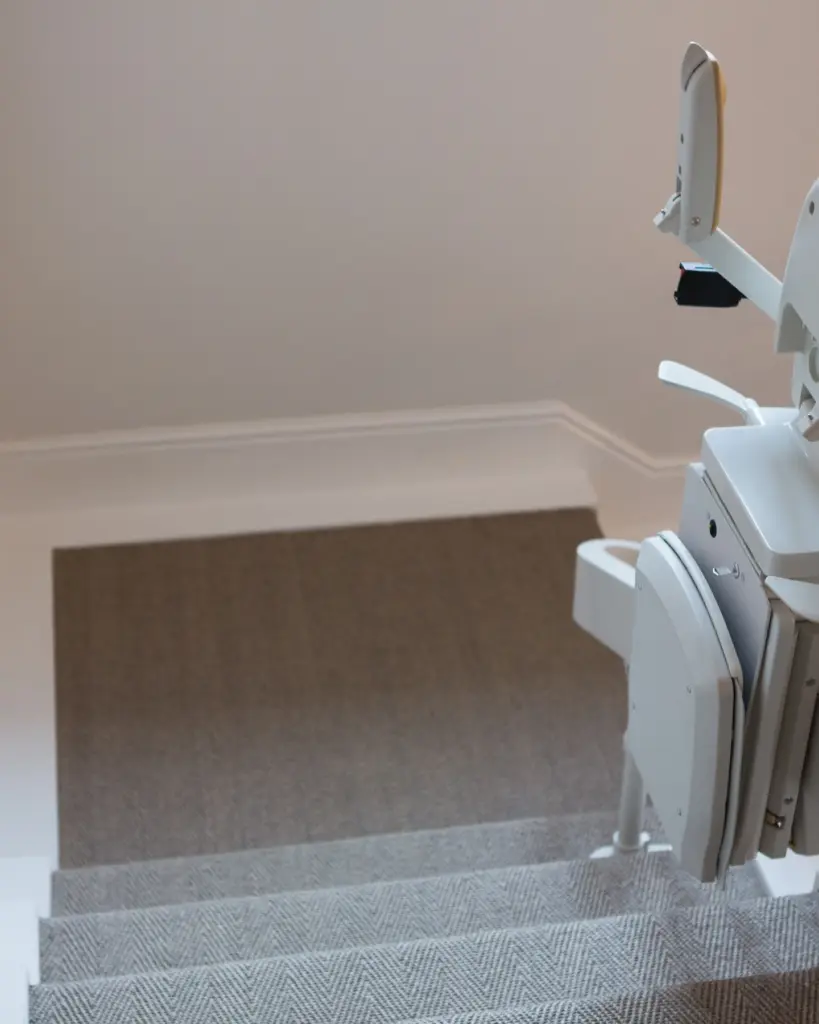
How loud is a stairlift, in real numbers?
A modern DC-drive residential stairlift produces between 45 and 55 decibels measured at the rider's ear during normal upward travel. Downward travel is typically 2-3 dB quieter because the motor is partially assisted by gravity.
To put that in context:
- 30 dB: a quiet bedroom at night
- 40 dB: a library
- 45-55 dB: a modern stairlift (comparable to a running refrigerator or a microwave)
- 60 dB: a normal conversation at arm's length
- 65 dB: a budget stairlift or an older model
- 70 dB: a vacuum cleaner, a legacy AC stairlift
- 80 dB: a blender, a food processor
The decibel scale is logarithmic, not linear. A 10 dB increase sounds roughly twice as loud to the human ear. So a 55 dB stairlift is perceived as roughly half as loud as a 65 dB one, even though the difference is "only" 10 decibels. This is why the 2-3 dB advantage of a Handicare or Bruno over an Acorn is noticeable in a quiet house at night, even though 3 dB sounds trivial on paper.
Brand-by-brand noise comparison
| Brand / Model | Type | Approx. noise level | Notes |
|---|---|---|---|
| Bruno Elan SRE-3000 | Straight | ~48-52 dB | Enclosed gear track reduces noise; consistently the quietest straight-rail unit we install |
| Bruno Elite SRE-2010 | Straight | ~48-53 dB | Slightly more motor hum under heavy loads; soft-start/stop dampens startup noise |
| Handicare 1000 | Straight | ~48-53 dB | Very competitive with Bruno on noise; soft-start motor is noticeably gentle |
| Handicare 2000 | Curved | ~50-55 dB | Slightly louder than straight due to curved-rail geometry creating more track friction |
| Stannah Siena 160 | Straight | ~50-54 dB | Solid mid-range noise performance; premium build quality dampens vibration |
| Stannah Siena 260 | Curved | ~52-56 dB | Well-engineered curved rail keeps noise reasonable for the category |
| Harmar Pinnacle SL300 | Straight | ~50-55 dB | Helical drive is smooth; slightly more audible than Bruno at higher rider weights |
| Harmar Pinnacle SL600 | Heavy-duty | ~53-58 dB | 600 lb capacity motor is larger and inherently produces more sound |
| Acorn 130 | Straight | ~55-62 dB | Budget motor is noticeably louder; audible from the next room |
These are field measurements, not lab specs. Manufacturers don't publish official decibel ratings in their product literature -- noise is measured by installers and reviewers using handheld sound meters during real-world installs. Actual noise varies with rider weight (heavier loads = motor works harder = more noise), rail length, lubrication condition, and ambient temperature (cold lubricant is stiffer and produces more friction noise).
The takeaway: if noise is a primary concern, Bruno and Handicare are the quietest options. Stannah and Harmar are solidly in the middle. Acorn is audibly louder but still well below the level of a normal conversation. None of them are loud enough to be a legitimate complaint -- you will hear the lift, but it won't disturb the household.
What actually makes the noise
A stairlift doesn't produce one sound. It produces a combination of four distinct noise sources, each contributing to the total level the rider and household hear.
1. Motor hum (25-35% of total noise)
The DC motor produces a low-frequency electrical hum when it's engaged. This is the sound most people associate with a stairlift -- a steady, monotone drone that starts when the joystick is engaged and stops when it's released. Higher-quality motors use tighter tolerances and better bearings, which reduces the hum. Budget motors have wider tolerances and produce more vibration.
2. Drive gear engagement (30-40% of total noise)
The rack-and-pinion system -- a rotating gear meshing with a toothed strip -- produces a rhythmic clicking or whirring as the teeth engage. This is the characteristic "tick-tick-tick" sound of a stairlift in motion. Enclosed gear tracks (like Bruno's design) contain this noise within the rail housing. Exposed gear tracks (common on budget units) let the sound radiate into the room.
Helical gears (used in Harmar's Pinnacle series) engage at an angle rather than straight-on, which spreads the engagement force over a larger tooth surface and produces less impulse noise. The difference is subtle -- about 1-2 dB -- but perceptible in a quiet room.
3. Rail friction (15-20% of total noise)
The carriage's guide rollers riding along the rail produce a low-level rubbing or whooshing sound. This is louder on curved rails because the rollers are under more lateral load through the turns. Proper rail lubrication (dry silicone spray, once a year) keeps friction noise to a minimum. A neglected rail -- dry, dusty, or lubricated with the wrong product -- can increase overall noise by 5-8 dB. See our maintenance guide for the correct lubrication procedure.
4. Seat and carriage vibration (10-15% of total noise)
The seat, armrests, and footrest can rattle or buzz if any fastener loosens over time. This is not a motor issue -- it's a furniture issue. A quick check with a wrench every 6-12 months keeps everything tight and eliminates rattle noise. If a stairlift that was quiet for years suddenly develops a new noise, check the seat fasteners before calling the technician.
Why older AC stairlifts were louder
If you've heard a stairlift from the 1990s or early 2000s, you heard an AC-drive unit. Those lifts ran on alternating-current motors powered directly from house wiring, without onboard batteries. AC motors of that era were louder for three specific reasons:
- No soft-start control. AC motors engaged at full torque from a dead stop, producing a loud "clunk" at departure and a jarring stop at the end of travel. Modern DC drives use electronic soft-start and soft-stop, ramping up gradually over 1-2 seconds.
- 60 Hz electrical hum. AC motors running at US line frequency (60 Hz) produce a distinctive, audible hum at that frequency and its harmonics. DC motors produce a wider-spectrum, lower-amplitude hum that the ear perceives as quieter even at the same decibel level.
- Heavier, less refined gear trains. AC stairlifts from that era used worm-gear or spur-gear drives with wider manufacturing tolerances. The gears were noisier, wore faster, and produced more vibration. Modern rack-and-pinion systems are machined to tighter tolerances and produce significantly less noise.
No major manufacturer sells a new AC residential stairlift in the US market today. If you encounter one, it's either a very old unit or a cheap import that's using obsolete technology. AC units were typically 65-75+ dB -- loud enough to wake a light sleeper in the next room with the door closed. The shift to DC drive is the single biggest reason modern stairlifts are quiet.
Night-use considerations
This is the real question behind the noise question. It's not "how loud is the stairlift?" -- it's "will my spouse hear it when I go downstairs at 3am for a glass of water?"
What the rider hears
The rider, sitting directly on the unit, hears the full 45-55 dB from the motor, gears, and rail. It's comparable to sitting next to a running dishwasher. Not silent, but not uncomfortable. Most riders stop noticing the sound after the first week.
What someone in the next room hears
Sound attenuates with distance and through walls. A stairlift running at 50 dB at the rider's position drops to roughly 35-40 dB at 15 feet through open air, and further to 25-35 dB through a closed interior door. For reference, 30 dB is the noise floor of a quiet bedroom. So yes, someone in a bedroom adjacent to the staircase may hear a faint hum through a closed door. It's comparable to hearing a refrigerator cycle on in the kitchen.
What the neighbors hear
Nothing. An exterior wall with standard insulation attenuates a 50 dB interior sound to well below ambient outdoor noise levels. Even in a duplex or townhome with a shared wall, a stairlift running at 50 dB on one side of an insulated common wall is inaudible on the other side. We have installed in hundreds of duplexes and townhomes and have never received a noise complaint from a neighbor.
Tips for quieter night operation
- Lubricate the rail. A properly lubricated rail is 3-5 dB quieter than a dry one. Takes 10 minutes once a year.
- Park at the top overnight. If the bedroom is upstairs, park the lift at the top. The descent (gravity-assisted) is 2-3 dB quieter than the ascent.
- Choose Bruno or Handicare if noise is a top-3 concern. They're the quietest units we install.
- Check seat fasteners. A loose armrest or footrest can introduce a rattle that's more annoying than the motor sound itself. Hand-tighten everything every 6 months.
Want to hear one before you buy? We bring a working demo unit to every in-home assessment so you can hear the actual noise level in your house, on your staircase. Schedule a free assessment.
Does a stairlift get louder over time?
Yes, but slowly, and most of the increase is maintenance-reversible.
Year 1-5: no change
A properly installed, properly lubricated stairlift operates at essentially the same noise level for the first 3-5 years. The motor, gear, and rail are all in their initial condition. The only noise variable is lubrication -- if you skip the annual rail lube, you'll notice a 3-5 dB increase by year 3.
Year 5-10: gradual increase (2-5 dB)
Drive gear teeth develop microscopic wear. Roller bearings loosen slightly. The rail surface develops a patina of fine scratches from years of roller contact. Total noise increase is typically 2-5 dB over this period -- noticeable side-by-side with a new unit, but not noticeable as a gradual daily change. A service visit with fresh lubrication and roller adjustment brings it back to near-new levels.
Year 10-15: wear-related noise
At this age, the most common noise culprit is the seat swivel bearing, which develops a squeak or grinding feel around 15,000-25,000 cycles. Replacement is a $40-$80 part and 30 minutes of labor. The drive motor itself is rated for 20+ years and rarely becomes the noise source within the first 15 years.
When noise means trouble
A sudden change in noise -- not a gradual increase, but a new sound that wasn't there yesterday -- is a diagnostic signal. A grinding noise means metal-on-metal contact, likely a worn drive gear or a foreign object in the rack. A clicking that wasn't there before means a loose fastener or a cracked roller. A high-pitched whine means a motor bearing is failing. None of these are emergencies, but all warrant a service call within the week. Don't ignore new noises -- they're the stairlift telling you something specific.
Common questions
How many decibels is a modern stairlift?
Which stairlift brand is the quietest?
Will a stairlift wake up my spouse at night?
Can neighbors hear a stairlift through the wall?
Do stairlifts get louder as they age?
Your free home assessment is one phone call away
No deposit. No obligation. No high-pressure sales. A certified installer visits your home, measures once, and gives you a written quote that's honored for 30 days. It takes about 45 minutes. More than 15,000+ homeowners have said yes over the last 15 years.
- Licensed in all 50 states
- $2M liability insured
- BBB A+ since 2012
- 15+ years in business