Stairlift After Hip Replacement: The #1 Medical Reason Families Call Us
Over 450,000 hip replacements are performed in the US every year, making it the second most common major joint replacement after knees. Hospital stays have shortened dramatically — most patients go home within 1-2 days of surgery. That means a patient goes from operating room to their own staircase in about 48 hours. The staircase didn't change. The patient's ability to climb it did. This is the most common medical reason families call us, and the timeline is always tight.
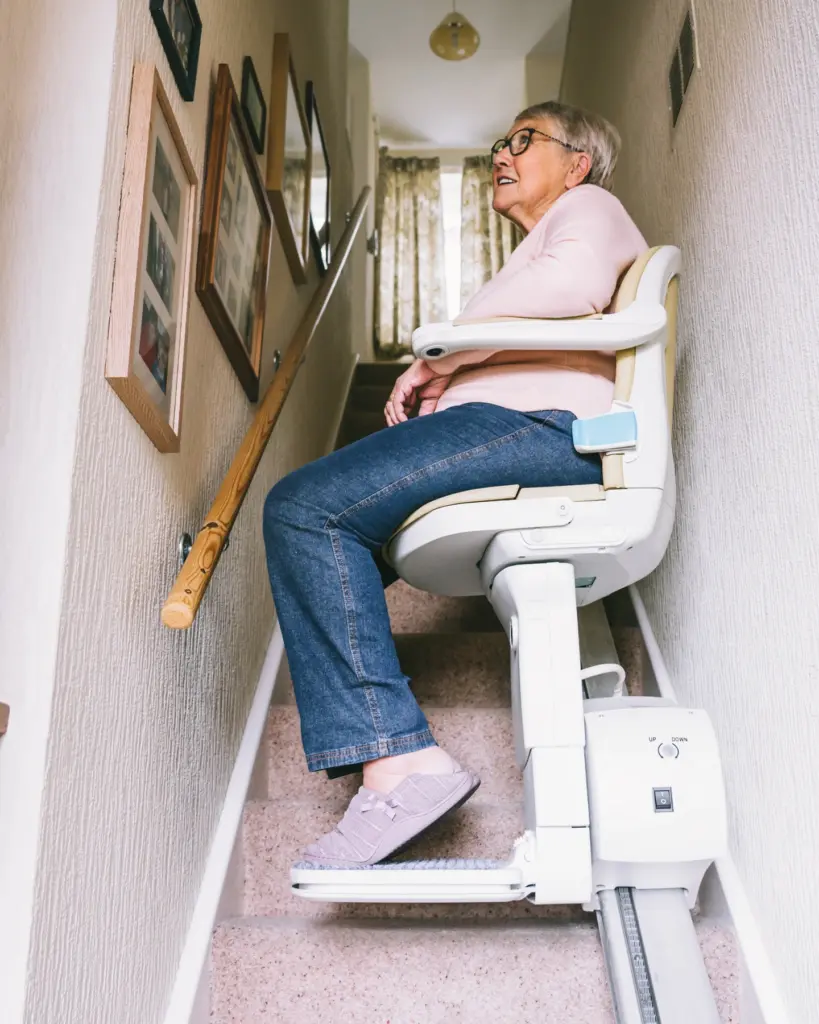
The hip replacement recovery timeline
Hip replacement recovery follows a predictable arc, though individual variation is real. Here's the general timeline based on current orthopedic protocols:
- Day 0-1: Surgery. Most patients are up and walking (with a walker) within hours of a total hip replacement, thanks to rapid-recovery protocols and spinal anesthesia that wears off quickly.
- Day 1-2: Hospital discharge. The physical therapist clears you for home if you can walk 150 feet with a walker, get in and out of bed independently, and demonstrate safe bathroom transfers. Notice what's not on that list: stair climbing.
- Week 1-2: Home recovery. Walker-dependent. Stairs are technically possible with the "good leg up, bad leg down" technique, but painful, slow, and risky. Most patients avoid stairs entirely or limit to once daily.
- Week 3-6: Transition from walker to cane. Stairs become slightly easier but still require significant effort and concentration. Most patients are doing physical therapy 2-3 times per week.
- Week 6-12: Cane to independent walking on flat surfaces. Stairs are manageable with a handrail but still noticeably harder than before surgery. PT continues.
- Month 3-6: Full recovery for most patients. Stair climbing returns to something close to pre-surgery ability, assuming no complications.
The critical window for stairlift need is Week 1 through Week 12 — roughly 3 months. Some patients need support for the full 6 months. A small percentage (those with complications, bilateral replacements, or pre-existing conditions) need a stairlift permanently.
Why stairs are the problem after hip surgery
Stair climbing after hip replacement is difficult for specific biomechanical reasons, not just general weakness:
- Hip flexion beyond 90 degrees. Anterior-approach hip replacements (the most common modern technique) have fewer flexion restrictions than the older posterior approach, but most surgeons still advise caution about deep flexion in the first 6-12 weeks. Stair climbing requires approximately 65-70 degrees of hip flexion on the ascending leg. That's within the safe range for most protocols, but it's close enough to the limit that patients are cautious — and cautious people on stairs move slowly, grip hard, and tire quickly.
- Single-leg loading. Each stair step requires the ascending leg to bear the full body weight while the hip is in flexion. The surgical hip's surrounding muscles (gluteus medius, iliopsoas, hip flexors) are weakened from the surgical approach and take 6-12 weeks to regain functional strength. The weak hip under full body load is the moment where falls happen.
- Balance disruption. Anesthesia, pain medications (especially opioids in the first 1-2 weeks), and the altered gait pattern with a walker all affect balance. Stairs require more balance than flat walking because the center of gravity shifts forward and upward with each step.
- Fear. Patients who've experienced the pain of a degenerating hip joint develop stair-avoidance behavior before surgery. After surgery, the physical pain may be gone, but the learned fear response persists. Some patients can climb stairs but won't because the memory of pain is still fresh. A stairlift removes the fear variable entirely.
Temporary vs permanent: reading the signals
About 70-80% of hip replacement stairlift needs are temporary — the patient recovers enough stair-climbing ability within 3-6 months to stop using the lift. The remaining 20-30% become permanent users, typically due to pre-existing conditions (arthritis in both hips, cardiac limitations, general deconditioning) that the hip replacement didn't address.
How to tell which category you're in:
Signals that the need is temporary (3-6 months)
- This is a first-time, unilateral (one-hip) replacement
- The patient was climbing stairs (with difficulty) before surgery
- No other significant mobility limitations beyond the hip
- The patient is engaged in physical therapy and progressing normally
- Age under 75 with no major comorbidities
Signals that the need may be permanent
- Bilateral (both hips) replacement, either simultaneous or staged
- The patient was already avoiding stairs before surgery due to other conditions (knee arthritis, COPD, heart failure, neuropathy)
- The hip replacement addresses one problem but others remain
- Age over 80 with multiple comorbidities
- The patient lives alone and has no one to spot them on stairs during recovery
We don't push buyers toward permanent purchases when a rental makes more sense. The economics are different, and getting it right saves families money. Here's the math.
Rental math: when renting beats buying
If you need a stairlift for less than 5 months, renting is cheaper. If you need it for more than 5 months, buying is cheaper. That's the breakeven on a straight rail.
Stairlift rental programs exist specifically for situations like hip replacement recovery. Here's how the numbers work:
Rental costs (straight rail only — curved rails are almost never rented)
- Installation fee: $500-$1,000 (one-time, covers install and removal)
- Monthly rental: $150-$250/month
- 3-month rental total: $950-$1,750
- 6-month rental total: $1,400-$2,500
Purchase costs (straight rail)
- New Bruno Elan or Handicare 1000 installed: $2,500-$4,500
- Resale value after 6 months of use: $800-$1,500 (if you sell through the installer)
- Net cost after resale: $1,000-$3,000
The decision framework
- Need is 3 months or less: Rent. Total cost $950-$1,750, and you're done when the rental ends. No equipment to store, no resale hassle.
- Need is 3-5 months: Close call. Renting is slightly cheaper but buying with resale is comparable. If there's any chance the need extends beyond 5 months, buy.
- Need is 5+ months or permanent: Buy. The monthly rental cost exceeds the purchase-minus-resale cost around the 5-month mark.
- Bilateral replacement (second hip scheduled 3-6 months after the first): Buy. You'll use it for the first recovery, keep it between surgeries, and use it again for the second recovery. Total use: 6-12 months.
We offer both rental and purchase options and will tell you honestly which one makes sense for your timeline. Request a free assessment — mention your surgery date.
Seated angle and hip precautions
Hip replacement patients receive "hip precautions" from their surgeon — a set of movement restrictions designed to prevent dislocation of the new joint while the surrounding tissues heal. The specific precautions depend on the surgical approach:
Posterior approach precautions (older, but still common)
- No hip flexion beyond 90 degrees (don't bend forward more than a right angle)
- No internal rotation of the leg
- No crossing the legs
- Duration: typically 6-12 weeks
Anterior approach precautions (newer, increasingly standard)
- Generally fewer restrictions — many surgeons allow flexion beyond 90 degrees from day one
- No hyperextension of the hip
- Duration: typically 2-6 weeks
How this affects stairlift use
A standard stairlift seat positions the rider at approximately 90-95 degrees of hip flexion — similar to sitting in a standard dining chair. This is within the safe range for anterior-approach patients from day one and within the safe range for posterior-approach patients as long as they don't lean forward while seated.
Key adjustments for hip replacement riders:
- Seat height. A higher seat reduces hip flexion angle. Some models (Bruno Elite, Stannah Siena) offer adjustable seat height. Raising the seat 1-2 inches from the standard position reduces hip flexion to approximately 80-85 degrees — well within precautions for both approaches.
- Swivel at the top. Swiveling off the chair at the top landing requires the rider to rotate their body. With posterior-approach precautions, this rotation must come from the whole body turning (shuffling the feet), not from rotating the operated hip internally. A powered swivel seat that rotates the entire chair eliminates the need for the rider to twist. This is the single most valuable upgrade for hip replacement patients.
- Footrest position. The footrest should be positioned so the knee is at or slightly below hip level — never above hip level, which would push hip flexion past 90 degrees.
The occupational therapist recommendation
The occupational therapist (OT) is the most important ally in the stairlift decision after a hip replacement. Here's why and how to work with them.
What the OT evaluates
Before hospital discharge, the OT conducts a functional assessment that includes stair climbing (if stairs exist at the patient's home). The OT observes the patient's ability to ascend and descend stairs using a handrail and the appropriate technique (good leg up, bad leg down). Based on this assessment, the OT makes one of three recommendations:
- Patient can manage stairs with handrail and appropriate technique. No stairlift needed. This is the minority of Day 1-2 post-op patients.
- Patient can manage stairs but with significant difficulty or safety risk. Stairlift recommended for the recovery period. This is the majority.
- Patient cannot safely attempt stairs. Stairlift required before discharge, or patient must stay on one level of the home, or patient cannot be discharged to a multi-story home.
Why the OT letter matters
An OT's written recommendation for a stairlift serves multiple purposes:
- It satisfies the documentation requirement for Medicaid HCBS waiver applications
- It supports the IRS medical deduction (proof that the expense is medically necessary, not elective)
- It provides the basis for a VA HISA grant application
- It satisfies the physician's-letter requirement for condo and HOA board approval
- Some Medicare Advantage plans require an OT or PT recommendation specifically (not just a physician's letter) before considering supplemental coverage
Ask your OT for a written letter before discharge. One paragraph, on letterhead, stating that a stairlift is medically recommended due to the hip replacement recovery. It takes 5 minutes and it opens every funding and approval door. If the OT doesn't offer it, ask. They write these letters regularly.
Discharge planning: the 48-hour window
Start before surgery, not after
The best time to arrange a stairlift for hip replacement recovery is before the surgery date. A straight rail can be installed the day before surgery or the day of discharge. If you wait until discharge day to start the process, you may face a 3-7 day gap between arriving home and having a working stairlift.
Here's the ideal timeline for coordinating a stairlift with a scheduled hip replacement:
2-4 weeks before surgery
- Call us for a free assessment. Mention the surgery date and the surgeon's name.
- We measure the staircase, confirm the model, and give you a quote.
- If renting, we reserve the rental unit for your surgery date.
- If buying, we order the equipment for delivery before surgery.
1-3 days before surgery
- We install the stairlift. The patient can test-ride it while they're still mobile and comfortable.
- Pre-surgery test rides are valuable — the patient learns the controls, practices the swivel, and builds confidence while they're at full strength. Post-surgery is not the time to learn new equipment.
Surgery day through discharge (Day 0-2)
- The stairlift is already installed and waiting at home.
- The patient arrives home from the hospital, walks to the staircase with their walker, sits on the stairlift, rides to the bedroom, and rests. No stair climbing on Day 1.
If surgery is already scheduled and you haven't called yet
Call today. A straight rail can be installed within 3-5 business days of the assessment in most markets. If your surgery is within the week, we can often do a same-day assessment and install within 48 hours. Request an urgent assessment — mention your surgery date.
Will insurance pay for a post-surgery stairlift?
The short answer: traditional Medicare and most private insurance plans do not cover residential stairlifts, even after surgery. But other funding paths exist.
What does NOT cover stairlifts
- Medicare Part B: Does not cover residential stairlifts. Never has. CMS classifies stairlifts as home modifications, not covered durable medical equipment.
- Private health insurance: Nearly all private plans exclude home modifications. Don't count on it.
- Workers' compensation: Does not typically cover home modifications unless the injury is work-related and the stairlift is prescribed as part of a workers' comp rehabilitation plan. Rare.
What MAY cover stairlifts
- Medicare Advantage (Part C): Some MA plans include supplemental home-modification benefits. Coverage varies by plan and by year. Call your plan's member services and ask specifically about stairlift coverage as a post-surgical home modification.
- Medicaid HCBS waivers: If the patient is Medicaid-eligible, HCBS waivers in 47 states cover stairlifts as "environmental modifications." Application takes 30-90 days, so start before surgery if possible.
- VA HISA grant: Up to $8,150 for veterans with service-connected disabilities. Covers stairlifts, ramps, and related home modifications.
What always applies
- IRS medical deduction: The full cost of the stairlift (purchase or rental, plus installation) is a qualified medical expense under IRS Publication 502. If you itemize deductions, this is worth $600-$2,400 back depending on your marginal tax rate and AGI.
We handle the paperwork for all of these programs at no additional cost. Full funding guide here.
What to do right now if surgery is scheduled
If you're reading this because a hip replacement is coming up — yours, your parent's, your spouse's — here's the action list:
- Check your staircase. Is it straight or curved? How many steps? Is there a grounded outlet within 6 feet of the top or bottom? Take a phone photo from the bottom looking up and from the top looking down.
- Talk to the OT. If the surgeon's office has a pre-surgical OT consultation, ask about stair recommendations. Get the written recommendation letter before surgery if possible.
- Call us. Mention the surgery date. We'll do a free assessment within days and have equipment reserved or installed before surgery.
- Decide rent vs buy. Use the math above. If this is a first-time unilateral replacement in a patient under 75, start with a 3-month rental. You can convert to a purchase later if needed.
- Check funding. If the patient is a veteran, start the VA HISA application now. If Medicaid-eligible, start the HCBS waiver application now. Both take weeks to process.
The single biggest mistake families make is waiting until after the surgery to think about the staircase. By then, the patient is home, the stairs are a crisis, and the timeline is compressed. Two phone calls before surgery — one to us, one to the OT — solves the problem before it starts.
Common questions
Do I need a stairlift after hip replacement?
Should I rent or buy a stairlift after hip surgery?
Can I use a stairlift with hip precautions?
How soon can a stairlift be installed before hip surgery?
Does Medicare pay for a stairlift after hip replacement?
Your free home assessment is one phone call away
No deposit. No obligation. No high-pressure sales. A certified installer visits your home, measures once, and gives you a written quote that's honored for 30 days. It takes about 45 minutes. More than 15,000+ homeowners have said yes over the last 15 years.
- Licensed in all 50 states
- $2M liability insured
- BBB A+ since 2012
- 15+ years in business