Stairlift Safety Features Explained
A residential stairlift is one of the simplest powered machines in your house. One motor, two batteries, a rail, and a seat. But between you and the motor are roughly a dozen safety systems, each designed to prevent a specific failure scenario. This guide explains every safety feature on a modern stairlift — what it does, why it exists, and which ones are non-negotiable versus marketing extras.
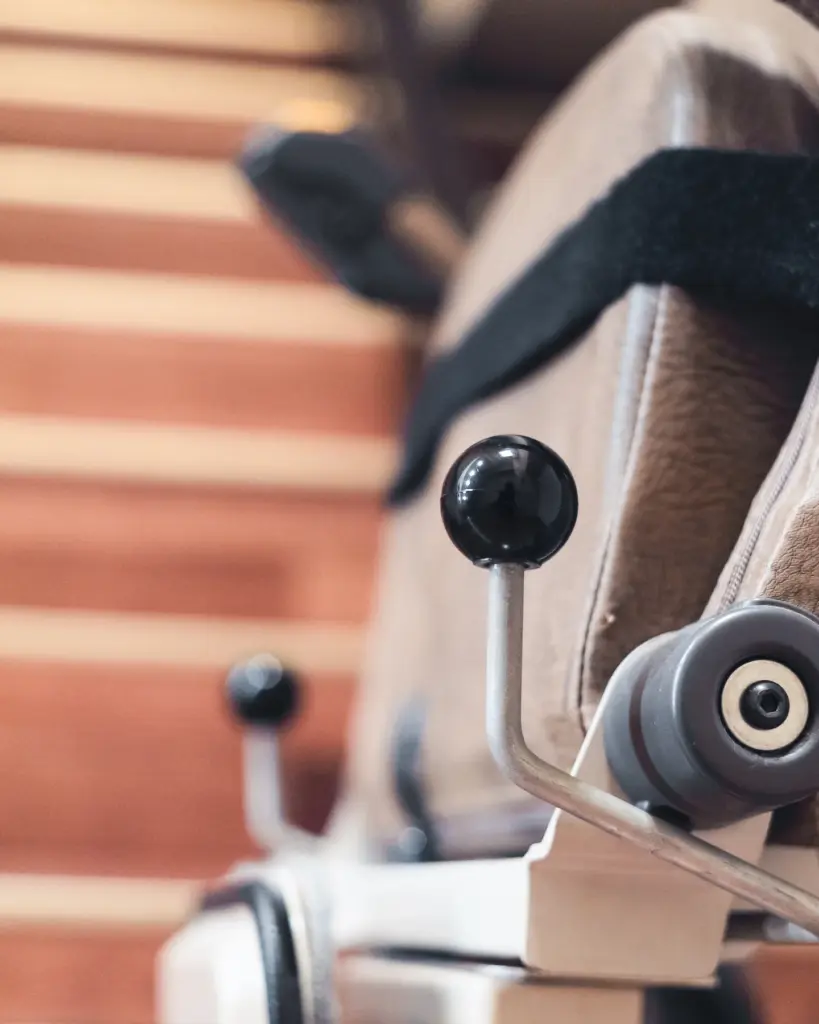
How stairlift safety works: layers, not luck
Stairlift safety is not a single feature — it is a stack of independent systems, each capable of stopping the lift on its own. Engineers call this "defense in depth." If the obstruction sensor misses a shoe on the step, the overspeed governor catches the resulting acceleration. If the overspeed governor somehow fails (it essentially never does), the emergency stop button is under the rider's thumb. Each layer operates independently of the others.
Every stairlift sold by a reputable manufacturer in the US in 2026 includes all of the features described below as standard equipment. These are not upgrades. They are not optional. If an installer presents any of them as an add-on, you are dealing with either a bottom-tier product or a salesperson inflating the feature list to justify a higher price.
The features below are listed in the order the rider encounters them during a typical ride, from boarding to exiting.
Obstruction sensors (footrest and carriage)
Detects objects in the stairlift's path and stops the unit immediately. Located on the leading edges of the footrest and the underside of the carriage.
Obstruction sensors are the first line of defense against collision. They come in two locations on every modern stairlift:
Footrest safety edges
Pressure-sensitive strips run along the front and both sides of the footrest. If the footrest contacts anything during travel — a shoe left on a step, a pet, a vacuum cleaner cord, a child's toy — the sensor triggers and the motor stops immediately. On Bruno and Handicare models, the sensitivity is calibrated so that a coin standing on edge on a step will trigger the stop. That level of sensitivity is intentional: the footrest is the lowest and most forward-facing part of the stairlift, and it arrives at each obstacle before anything else does.
Carriage underpan sensor
A second set of sensors sits under the carriage body (the mechanical housing that rides the rail). These catch anything that gets between the carriage and the rail — a towel draped over the railing, a dangling cord, a piece of clothing caught on the rail. The carriage sensors are particularly important on the downward trip, where gravity is working with the motor and stopping distance matters more.
Both sensor systems are normally-closed circuits, meaning the default state is "safe." A broken wire or a disconnected sensor does not disable the safety — it triggers it. The lift will not move until the circuit is restored. This is a deliberate design choice: fail-safe, not fail-dangerous.
Seat-present sensor
The seat-present sensor is a switch — usually a microswitch or a pressure pad — built into the seat pan. The stairlift will not operate unless someone is sitting in the seat. If the rider stands up mid-ride, the motor stops. If the seat is folded up (the stairlift's parked position), the motor will not engage from the armrest control.
This sensor prevents two scenarios. First, it stops a bystander from accidentally sending an empty chair up or down the stairs and having it arrive at the other end at speed with no one controlling it. Second, it prevents the lift from continuing if the rider shifts their weight forward and partially stands — a common instinct when the chair approaches the top landing, and exactly the moment when balance is most precarious.
On some models (Bruno Elite, Stannah Siena), the seat-present sensor works in conjunction with the seatbelt sensor. The lift will not move until the rider is both seated and belted. On other models (Acorn 130, Handicare 1000), the seatbelt sensor is advisory — it beeps but does not lock out the motor. We recommend the lockout version for riders with cognitive impairment or balance disorders.
Seatbelt
Every residential stairlift includes a retractable lap seatbelt, similar in mechanism to an automotive seatbelt but shorter and simpler. The belt clips across the rider's lap and prevents them from sliding forward off the seat during travel, particularly on the downward trip where gravity and momentum work together.
The seatbelt is the simplest safety feature on the unit and one of the most important. Falls from stairlifts are rare — the industry estimates fewer than 1 incident per 10,000 installed units per year — and most of the reported incidents involve riders who were not wearing the belt. The physics are straightforward: a stairlift descends at about 0.2 mph (roughly walking pace) on a 35-40 degree incline. That is enough momentum, if the chair stops suddenly (obstruction sensor trigger, end-of-rail stop), to pitch an unbelted rider forward out of the seat.
Some riders resist the seatbelt because it feels like a hassle for a 30-second ride. We understand the resistance and we recommend the belt anyway. The downside of wearing it is 3 seconds of your time. The downside of not wearing it is a fall on the stairs, which is exactly the event the stairlift was purchased to prevent.
Overspeed governor
Mechanically brakes the stairlift if it exceeds a preset speed threshold, typically 125-150% of normal travel speed. Operates independently of the motor and electronics.
The overspeed governor (OSG) is the safety feature you hope never activates, because its job is to catch a scenario where everything else has already gone wrong. If the drive motor fails in a way that causes it to accelerate rather than stop — an extremely rare event, but one the engineers must design for — the OSG mechanically clamps the carriage to the rail and brings the unit to a controlled stop.
The OSG is a centrifugal mechanism, similar in principle to the governors used in elevators. A set of spring-loaded flyweights spin with the drive shaft. At normal speed, the springs hold the weights inward. If the shaft spins faster than the calibrated threshold (typically 125-150% of normal travel speed), centrifugal force pushes the weights outward, which trips a mechanical brake that clamps the carriage to the rail.
Key point: the OSG is mechanical, not electronic. It does not depend on the control board, the battery, the wiring, or any software. It is a purely physical device that activates based on rotational speed. This independence is the entire point — it works even if the electrical system has completely failed.
Every stairlift from Bruno, Handicare, Stannah, Harmar, and Acorn includes an OSG as standard equipment. It is not an upgrade and it is not optional. If a product listing does not mention an overspeed governor, you are looking at an uncertified product.
Soft-start and soft-stop
Soft-start and soft-stop are motor control features that ramp the speed up gradually at the beginning of the ride and ramp it down gradually at the end. Instead of going from zero to full speed instantly (a hard start) or from full speed to zero instantly (a hard stop), the motor transitions over about 1-2 seconds.
This matters more than most buyers realize. A hard start lurches the rider backward into the seat. A hard stop pitches the rider forward against the seatbelt. For a healthy 40-year-old, the forces involved are trivial. For an 80-year-old with osteoporosis, a herniated disc, or a recent hip replacement, even a gentle lurch can cause real pain and, over hundreds of rides, real damage.
Soft-start and soft-stop also reduce mechanical wear on the drive motor and the rail. A motor that ramps smoothly generates less peak torque and less thermal stress than one that slams to full speed on every ride. Over a 15-year service life, the cumulative difference in wear is significant.
Bruno Elite and Stannah Siena models have the smoothest start/stop profiles in our experience — the transition is nearly imperceptible. Handicare 1000 is close behind. Acorn 130 has a noticeably firmer start, though it has improved over previous model years. If the rider has back or joint sensitivity, soft-start quality should be a deciding factor in model selection.
Emergency stop button
The emergency stop is a large, clearly marked button — usually red, always within thumb reach on the armrest — that cuts power to the motor instantly. Pressing it stops the lift wherever it is on the rail. It does not return the lift to the bottom or the top. It just stops.
To restart after an emergency stop, the rider (or a caregiver) presses the reset button or toggles the stop switch back to the run position. The exact mechanism varies by model. On Bruno units, the emergency stop is a push-pull button: push to stop, pull to reset. On Handicare and Stannah, it is a rocker switch. Either design works; the critical requirement is that the stop function is instantaneous and requires zero dexterity or strength to activate.
The emergency stop is there for the rider's peace of mind as much as for physical safety. Knowing you can halt the chair at any point during the ride — because you heard a noise, because you felt unsteady, because a pet ran onto the stairs — reduces the anxiety that many first-time riders feel. We always demonstrate the emergency stop during the handoff walkthrough and encourage the rider to use it during their first few practice rides to build confidence.
Swivel seat lock
The swivel seat lock is a mechanical latch that holds the seat in either the forward-facing (riding) position or the swiveled (exit) position. It prevents the seat from rotating while the lift is in motion, and it prevents the lift from moving while the seat is swiveled.
Here is how it works in practice. The rider sits in the chair at the bottom of the stairs, facing forward. The swivel lock holds the seat facing forward for the entire ride. At the top, the rider unlocks the swivel (a lever under the seat or an armrest button on power-swivel models), rotates 90 degrees to face the landing, and the swivel lock re-engages in the exit position. The rider now stands up facing the hallway, not the open staircase behind them.
The safety interlock between the swivel and the motor is critical. If the seat is rotated to the exit position and someone presses the armrest joystick, the motor does not engage. This prevents the lift from moving while the rider is sideways on the seat — a position with zero stability if the chair suddenly accelerated.
Manual swivel seats require the rider to pull a lever and rotate themselves. Power swivel seats rotate at the push of a button and are recommended for riders with weak grip strength, limited hip rotation, or arthritis in the hands. The power swivel adds $200-$500 to the install cost, depending on model. The safety interlock is identical on both types.
Battery backup (DC drive)
Battery backup is a safety feature, not a convenience feature. A stairlift that only works when the power is on leaves the rider stranded on the wrong floor during an outage — which is precisely when they may need to evacuate. During Hurricane Ian in 2022, stairlift users in Florida without battery backup were trapped upstairs in homes with rising water on the first floor. Every quality stairlift sold in 2026 runs on DC battery power, charged via a trickle charger plugged into a standard 120V outlet.
The two 12V sealed lead-acid batteries deliver 8 to 20 full up-and-down cycles on a full charge, depending on the model, the rider's weight, and the rail length. For a typical home with a 13-step straight staircase and a 200-pound rider, that is roughly 12-15 round trips — enough for a full day of normal use during an extended outage.
The batteries are consumables. They last 3-5 years under normal use and cost $75-$150 to replace. On most Bruno, Handicare, and Acorn models, the replacement is a 15-minute job with a Phillips screwdriver. We covered this in detail in our buyer's guide.
If someone tries to sell you an AC-drive residential stairlift in 2026 — one that runs directly off wall power without battery backup — walk away. That is obsolete technology. Every major manufacturer discontinued AC-drive residential models over a decade ago.
Key lock switch
Some stairlift models include a physical key lock that prevents the lift from operating without the key inserted and turned. The idea is to stop unauthorized use — typically framed as preventing grandchildren from riding the lift unsupervised.
Our honest assessment: the key lock is the least important safety feature on the list. In 15 years of installs, we have never encountered a safety incident caused by a child riding a stairlift for fun. We have, however, encountered multiple incidents where the key was lost, the rider was stuck on the wrong floor, and the family had to call us for a service visit to bypass the lock. If the key lock comes standard on your model, leave the key in the switch permanently. If it is an add-on, skip it.
The exception: memory care situations. If the rider has dementia and might attempt to use the lift unsafely (standing on the footrest, riding while not seated, attempting to board from the wrong side), a key lock controlled by the caregiver is a legitimate safety measure. In that specific scenario, the key lock is the right tool.
Overtravel limit switches
Overtravel limit switches are mechanical or magnetic switches mounted at both ends of the rail. They define the upper and lower boundaries of the stairlift's travel. When the carriage reaches the end of the rail, the limit switch triggers and the motor stops. If the primary limit switch fails, a secondary limit switch sits a few inches further down the rail as a backup.
This is a belt-and-suspenders system. The primary switch is supposed to catch the carriage. If it does not, the secondary switch catches it before the carriage runs off the end of the rail. Both switches are normally closed (fail-safe), meaning a broken wire or a disconnected switch stops the motor rather than allowing overtravel.
You will never interact with overtravel limit switches directly. They are set during installation, verified during the safety test, and left alone for the life of the unit. But they are worth understanding because they represent the same design philosophy that runs through every safety feature on the list: if one thing fails, another thing catches it.
Which features matter most — our ranking
Every feature on this page is standard on every name-brand stairlift. But if we had to rank them by how much real-world safety value they deliver, based on our install and service experience, here is the order:
- Battery backup (DC drive) — The only feature that prevents the rider from being stranded during a power outage. Non-negotiable.
- Obstruction sensors — The feature most likely to activate in daily use. Pets, shoes, vacuum cords, and grandchildren's toys are real and recurring hazards.
- Seatbelt — The simplest feature and the one most often skipped by riders. It is the difference between a minor stop and a fall.
- Overspeed governor — Catches the catastrophic failure scenario. Extremely unlikely to ever activate, but its presence is why stairlift fatalities are nearly unheard of.
- Soft-start / soft-stop — Prevents cumulative discomfort and injury, especially for riders with back, joint, or balance issues.
- Swivel seat lock — Prevents the most common exit-point hazard: the rider stepping off while facing the staircase instead of the landing.
- Emergency stop — Psychological safety as much as physical. Gives the rider a sense of control.
- Seat-present sensor — Prevents empty-chair runaway and mid-ride stand-up.
- Overtravel limit switches — Silent background safety. You never think about them, and that is the point.
- Key lock — Skip it unless you are managing a memory care situation.
If you are comparing quotes, do not let an installer present any of the top nine features as an upgrade or an add-on. They are all standard on every Bruno, Handicare, Stannah, Harmar, and Acorn model sold in the US in 2026. If a quote lists "safety package" as an extra line item, the price is bundled into the safety package — not the safety itself.
Request a free assessment and we will walk you through every safety feature on the specific model we recommend for your staircase.
Common questions
Are stairlifts safe for elderly users with balance problems?
Can a stairlift stop mid-ride if the power goes out?
How often should stairlift safety features be tested?
Do stairlifts have weight sensors?
What happens if I forget to buckle the seatbelt?
Your free home assessment is one phone call away
No deposit. No obligation. No high-pressure sales. A certified installer visits your home, measures once, and gives you a written quote that's honored for 30 days. It takes about 45 minutes. More than 15,000+ homeowners have said yes over the last 15 years.
- Licensed in all 50 states
- $2M liability insured
- BBB A+ since 2012
- 15+ years in business